
Dotonbori Night and Shinsekai at Night: Photographing Osaka's Neon
Dotonbori night and Shinsekai at night: the canal, the neon street, Tsutenkaku at blue hour, camera settings and which to choose.
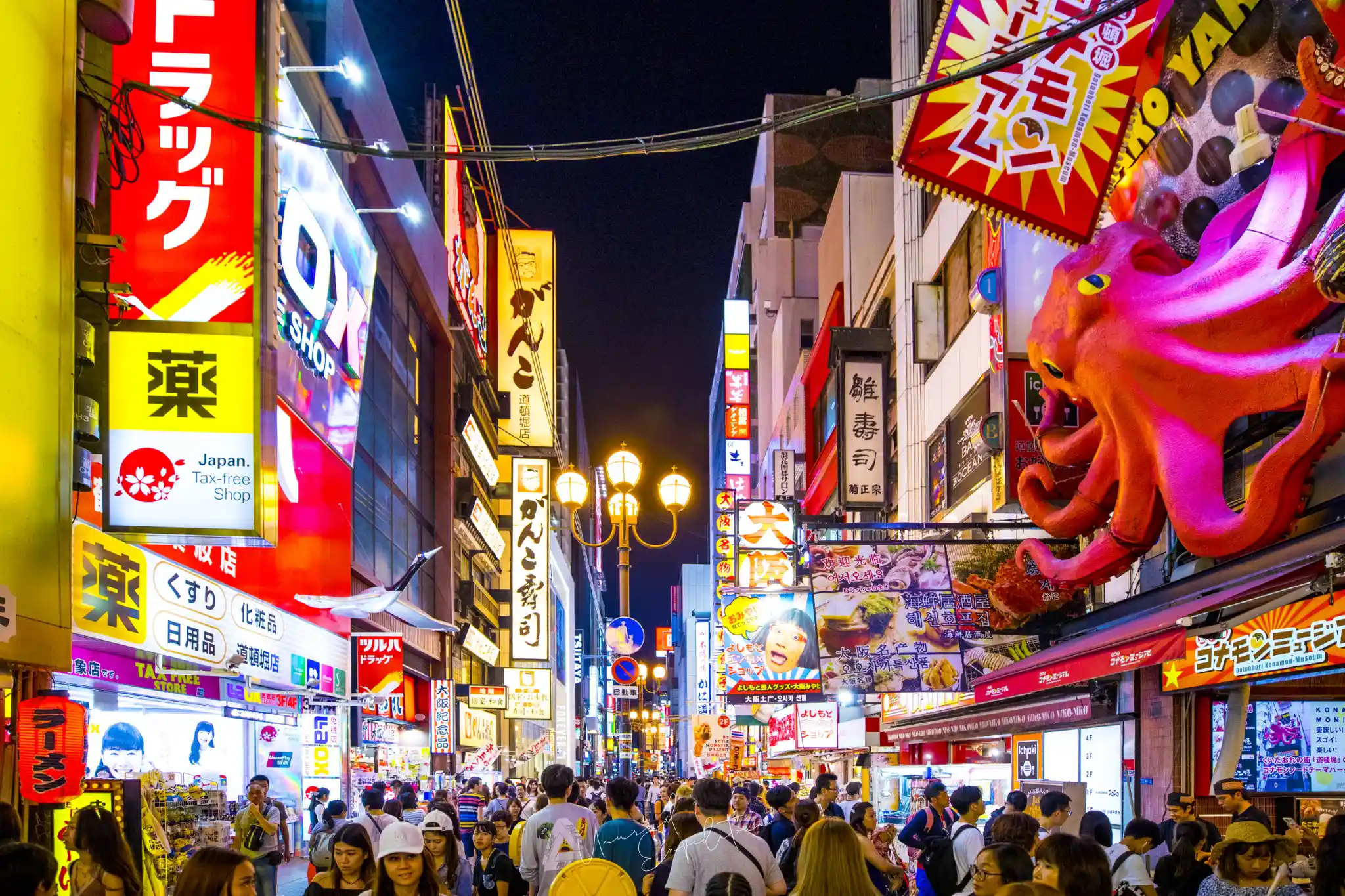
A Dotonbori night shoot starts at the blue hour, when the sky over Osaka is still deep blue and the giant signs along the canal are already lit; that short window gives colour in the sky and in the neon at once. Shinsekai at night is the second half of the evening: older streets of lanterns and hand-painted signs under the lit Tsutenkaku tower. Both are busy and easy to reach, and both reward a fast lens and patience more than a tripod.
Night in Osaka is the counterweight to Kyoto's dawns in our Kyoto and Osaka photography tour guide. We photographed both districts over several evenings, in dry weather and in rain.
Dotonbori night: the canal and the bridges
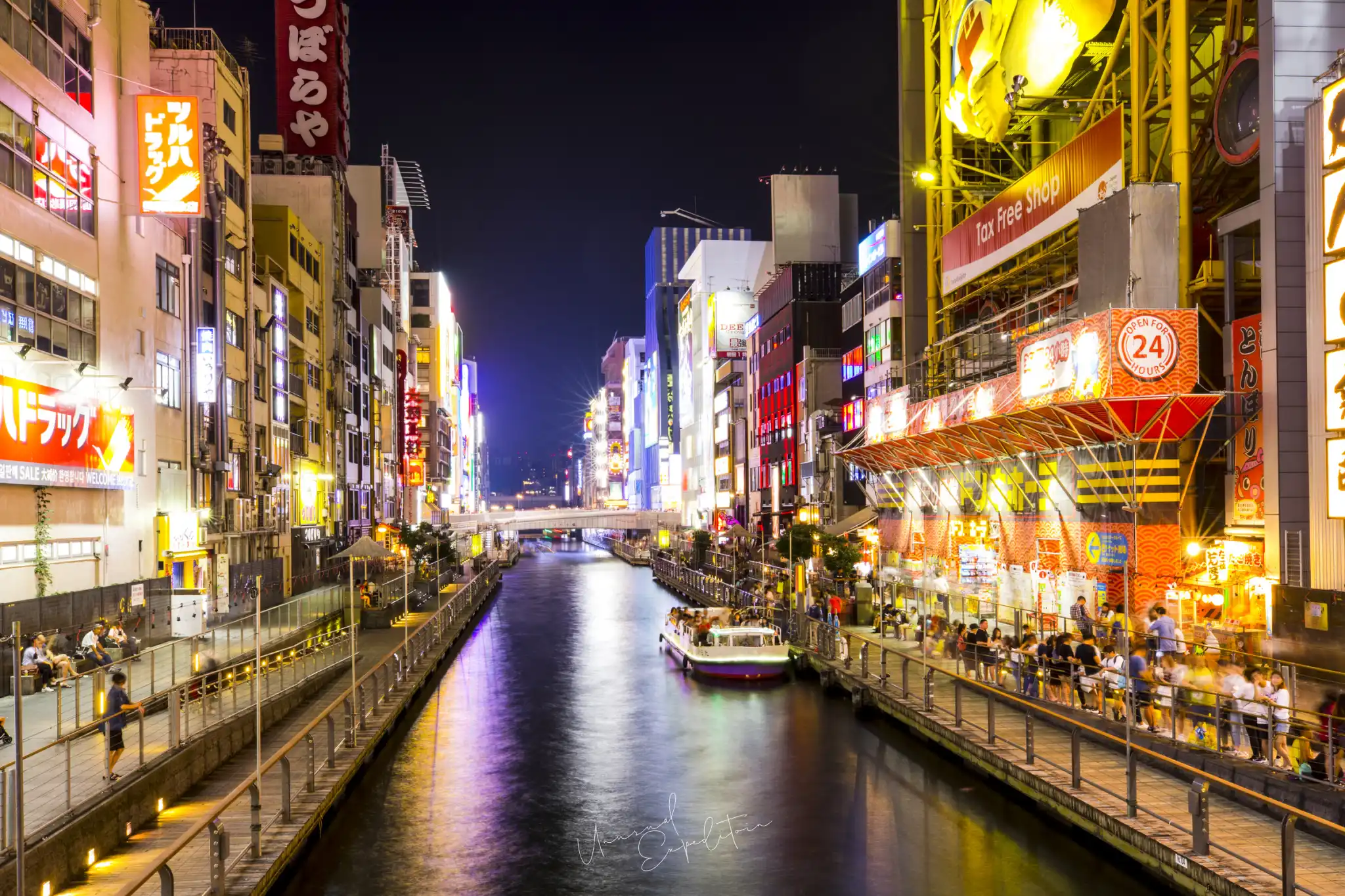
The Dotonbori canal at night is Osaka's signature view. From Ebisu Bridge or the bridges either side, the canal runs away between walls of light, and the water carries every sign as a long coloured reflection. A wide lens from the bridge rail gives the classic symmetrical frame; a longer lens compresses the signs into a dense wall. A small tripod or a rail rest allows exposures of a second or more, which smooth the water and turn the cruise boats into streaks of light, but the bridges are crowded, so set up at the edge and never block the way. On a still evening the reflections are sharpest; a little rain on the walkways adds a second layer of colour.
Dotonbori neon: the street behind the canal
Dotonbori's main street, one block back from the water, is a different picture. Here the signs are three-dimensional: a giant octopus, a crab with moving legs, lanterns and drugstore boards stacked up the buildings, and below them a river of people. A 16-35mm from the middle of the street captures the scale; step back to a corner and use the crowd as texture, with a slower shutter speed to blur the walkers against the sharp signs. Shoot at the blue hour first, then keep going after dark, when the signs carry the whole frame. Exposure is tricky because the signs are much brighter than the street: expose for the signs and let the shadows go.
Shinsekai at night
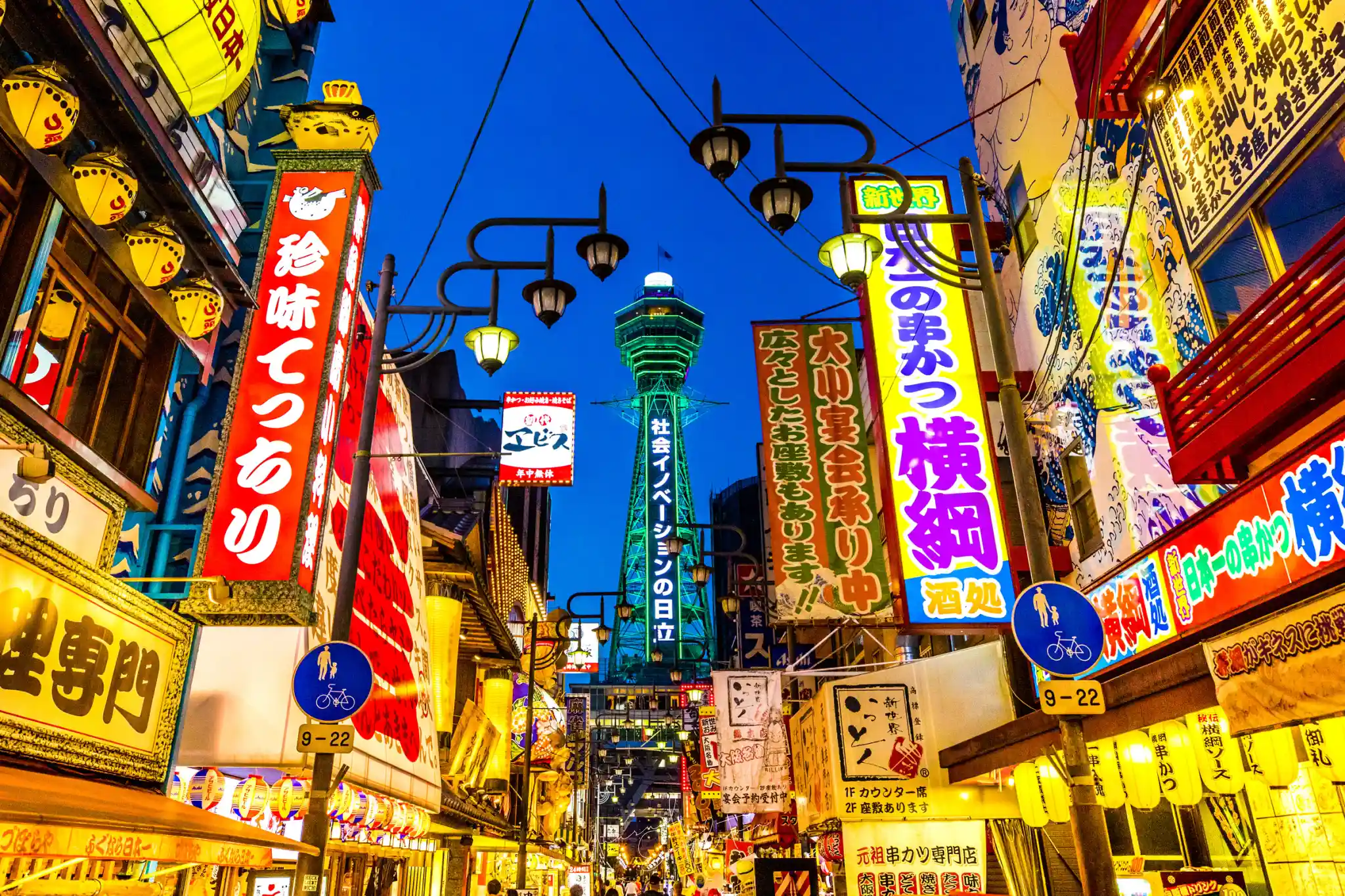
Shinsekai at night has none of Dotonbori's polish, which is its charm. The main street is hung with lanterns and huge painted signs for skewer restaurants, a giant puffer-fish lantern hangs over one corner, and at the end of it all rises Tsutenkaku, the tower rebuilt in the 1950s and lit in changing colours. The classic frame looks up the street from low down with a wide lens, lanterns on both sides and the tower centred above. The blue hour matters even more here than in Dotonbori, because the sky behind the tower is the background of the picture. Once it is fully dark, turn to details: lanterns, signs and the glow of restaurant fronts.
Dotonbori vs Shinsekai: which is better at night?
| Dotonbori | Shinsekai | |
|---|---|---|
| Character | Bright, modern, crowded | Retro, local, compact |
| Signature frame | Canal reflections, Glico sign | Lantern street under Tsutenkaku |
| Best moment | Blue hour into full night | Blue hour |
| Crowds | Very heavy | Moderate |
| Lens | 16-35mm, 24-70mm | 16-35mm |
If you only have one evening, give the blue hour to Shinsekai and the full dark to Dotonbori, which stays bright late into the night.
"The blue hour in Osaka is short, so we choose one street for it and stay there. Running between Dotonbori and Shinsekai to catch both, you usually catch neither."
Joseph Mak, tour leader, Unusual Expedition
Rainy nights in Dotonbori
Do not cancel a night shoot for rain. A wet evening in Dotonbori turns every pavement into a mirror, so the signs appear twice, once above and once at your feet, and umbrellas add shapes and colour to the crowd. Shoot from under an awning or the edge of a covered arcade, look for puddles at the kerbs and crossings, and get the camera low so the reflection fills the bottom of the frame. A lens hood and a cloth are essential, since drops on the front element smear the lights into halos. The crowds also thin a little in the rain, which makes room on the bridges. If the rain is heavy, the covered shopping arcades nearby give dry, brightly lit street scenes to fill the wait.
Camera settings for Osaka at night
Most night pictures in Osaka are hand-held, because tripods are impractical in crowded streets. A fast prime or a stabilised 24-70mm at ISO 1600 to 6400 handles the signs comfortably; the signs are bright enough that the real challenge is holding highlights, not finding light. Underexpose slightly, check the histogram for blown reds, and shoot raw so the neon colours can be recovered. For the canal reflections, rest the camera on the bridge rail for exposures around half a second to a second. A lens hood keeps stray light from the signs off the front element.
Things to do in Osaka at night for photographers
Beyond the two districts, Osaka at night offers the wet crossings of Umeda after rain, the lit keep of Osaka Castle above its moat, and the river through the city centre with its bridges and office lights. The castle is lit after dark and makes a calmer picture than the neon, best from across the moat. For the daytime spots, see Osaka photo spots; for the case for the city as a whole, is Osaka worth visiting.
Is Shinsekai worth visiting?
For a photographer, yes. Shinsekai is small, so a single evening covers it, and it shows an older, more local Osaka than the polished streets of the centre. Combine it with Dotonbori on the same night, or give it its own blue hour if you want the tower against a coloured sky. Arrive in daylight to scout the angles and the arcade, then wait for the sky to deepen.
Photograph Osaka's nights with us
We run Osaka with Kyoto and Nara as a private trip on request, with the evenings planned around the blue hour. See private tours and our Japan photography tours page.
Join the Kyoto and Osaka photography tour
Kyushu, Shikoku And Setouchi Photography Journey departs 25 Sep 2027 To 05 Oct 2027, led by Joseph Mak. Small group, photography first. All Kyoto and Osaka photography tours.
Explore Kyoto and Osaka in depth
- Kyoto and Osaka Photography Tour Guide: Temples, Torii, Deer and NeonJapan
- Osaka Photo Spots: Dotonbori, Shinsekai, Osaka Castle and UmedaJapan
- Nara Deer Park: Photographing the Deer of NaraJapan
- Nara Day Trip from Kyoto and Osaka: Todai-ji, the Deer and Kasuga TaishaJapan
- Is Osaka Worth Visiting? A Photographer's Case for the CityJapan
- Fushimi Inari Photography: The Torii Gates at Dawn, Dusk and After DarkJapan
- Best Time to Visit Kyoto and Osaka for Photography: Blossom, Maples and RainJapan
Upcoming Photo Tours
- Egypt Photo Tour – EgyptEgypt 12 Dec 2026 To 20 Dec 2026
- Inner Mongolia Winter Owl Photo Tour – ChinaChina 01 Jan 2027 To 04 Jan 2027
- Inner Mongolia Winter Photo Tour – ChinaChina 05 Jan 2027 To 11 Jan 2027
- Mekong And Central Highland Vietnam Photo Tour - VietnamVietnam 16 Jan 2027 To 24 Jan 2027