
Photographing the Northern Lights in Greenland
Northern Lights photography in Greenland: why 70N needs no storm, settings from a moving ship, moon phase, forecasts, Greenland vs Iceland.
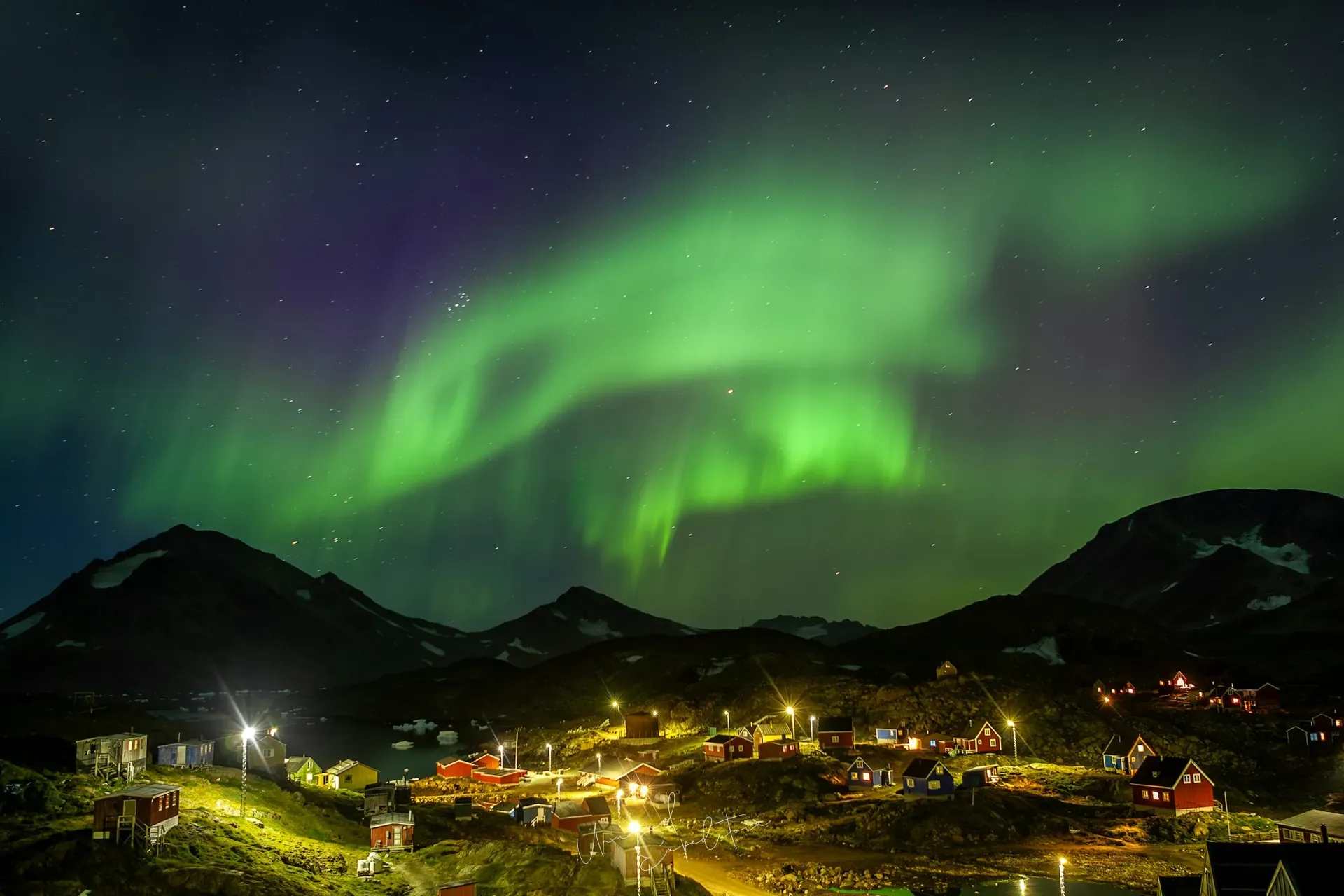
Photographing the Northern Lights in Greenland is easier than most people expect and harder than the brochures suggest. East Greenland sits directly under the auroral oval, so a clear dark night is enough to see the aurora without a solar storm; the difficulty is that you are usually shooting from a ship. This guide covers timing, settings from a moving deck, forecasting, and how Greenland compares with Iceland.
Why Greenland sits in the right place
The aurora forms in a ring around the magnetic pole called the auroral oval, and Scoresby Sund in East Greenland, at about 70 degrees north, lies beneath it on an ordinary night. In Iceland or Norway's south you often need elevated solar activity for the lights to reach overhead; in East Greenland a quiet night with clear skies will usually show at least a green arc, and moderate activity puts curtains directly above the ship. What Greenland lacks is darkness in summer. The midnight sun fades through August, and from the second half of August the sky is dark enough after about 22:00 for the aurora to be visible. By early September, the window used by Unusual Expedition's East Greenland photography cruise, nights are fully dark for several hours. The wider trip, including the icebergs and Ittoqqortoormiit, is laid out in the complete Greenland photography tour guide.
Moon phase on the September 2027 departure
Moonlight is the second thing that decides whether Northern Lights photographs in Greenland work. A full moon lights the icebergs beautifully but flattens the aurora; a new moon gives the deepest sky but black foregrounds. The 5 to 15 September 2027 departure sails four days after new moon, which falls around 1 September. For the first week in Scoresby Sund, East Greenland, the moon is a thin crescent setting early, so the aurora has a dark sky behind it. Towards the end of the voyage the moon waxes to full around 15 September, which helps foreground icebergs and the Westfjords coast if the lights appear on the return crossing. Planning the whole year around darkness, ice and colour is covered in Greenland photography season, month by month.
Shooting from a moving ship
Northern Lights photography in Greenland from the deck of M/V Sea Spirit breaks the rules learned on land. A tripod is nearly useless on a ship under way because the deck vibrates and the horizon moves, so long exposures of ten or twenty seconds smear the stars into lines and the aurora into fog. Work handheld or braced against a rail, with a fast wide lens at f/1.8 to f/2.8, ISO 3200 to 12800, and exposures of 1 to 4 seconds. Keep lens stabilisation on when handheld; switch it off only if you do get a tripod on a stationary deck at anchor. Shoot from the bow or the top deck, as far from the ship's working lights as the crew allows, and shield the lens from them with your body. Nights at anchor in a sheltered fjord are the best chance of a steady platform. Focus manually on a bright star and tape the ring. More on bodies, lenses and batteries in the cold is in camera gear for Greenland photography.

Forecasting: clouds matter more than Kp
The Kp index that aurora apps report measures geomagnetic activity worldwide, and at 70 degrees north in East Greenland it is less useful than people assume: a Kp of 1 or 2 is enough for visible aurora overhead when the sky is clear. The variable that actually decides the night is cloud. Fog forms over the cold water at the mouth of Scoresby Sund and katabatic wind can clear or bring cloud within an hour. The Icelandic Met Office publishes cloud cover and aurora forecasts that are reliable near Iceland and useful on the Denmark Strait crossings; inside the fjords, the ship's bridge and Poseidon Expeditions' team are the better source. The practical approach is simple: check the sky every hour after 22:00, dress before you look, and agree with your cabin mate who wakes whom.
"I have never promised anyone the lights and I never will. What I can promise is that if they come, you will be dressed, on deck, focused and set up in under a minute, because we practised it on the first night."
Joseph Mak, tour leader, Unusual Expedition
Realistic odds
No Northern Lights photography trip to Greenland can guarantee the aurora. Over an eleven-day voyage with about eight dark nights at sea or at anchor, the realistic expectation is some aurora on several nights and a strong display on perhaps one or two, weather permitting, and some voyages see less. Cloud is the usual reason for a blank night, not a quiet sun. Treat the aurora as the bonus on a trip whose daytime subjects, icebergs, fjord walls and the settlement of Ittoqqortoormiit, already justify the journey. Photographers who come only for the lights are the ones who go home disappointed; those who come for Scoresby Sund and keep a camera by the bunk are the ones who get both.
Greenland or Iceland for the Northern Lights?
Both are good. They are good in different ways, and the honest comparison is below.
| Factor | East Greenland (ship, Scoresby Sund) | Iceland (land-based) |
|---|---|---|
| Latitude | About 70 degrees north, under the auroral oval | About 64 to 66 degrees north, on its southern edge |
| Light pollution | None beyond the ship's own lights | Low outside Reykjavik, but towns and roads are never far |
| Cloud and weather | Fog at the fjord mouth, clearer inland, fast changes | Atlantic fronts, frequent cloud, you can drive to a gap |
| Season | Late August to early October, limited by sea ice | Late August to mid April |
| Getting there | Fly to Reykjavik, then expedition ship | Fly to Reykjavik, hire a car |
| What else you photograph | Icebergs, 2,000 metre fjord walls, Ittoqqortoormiit, Arctic wildlife | Waterfalls, black beaches, glaciers, geothermal landscapes |
| Cost and effort | Higher: cruise fares from US$8,850 per person | Lower: a car, guesthouses, your own schedule |
In words: Iceland is easier, cheaper and has a season six months long, with the freedom to drive out from under cloud. East Greenland is further north, so the aurora appears on quieter nights; it is darker, with no towns for hundreds of kilometres; and the foreground is icebergs and fjord walls rather than roads. The trade is a ship instead of a car and a season of about six weeks. For a first aurora trip, Iceland. For aurora over ice, with nobody else there, Greenland.
Come and photograph it with us
If you want to try the Northern Lights from a ship in Scoresby Sund, with the moon on your side and someone beside you who has done it before, join the Greenland Arctic Sights and Northern Lights photography tour, 5 to 15 September 2027, led by Joseph Mak and sailing round trip from Reykjavik aboard M/V Sea Spirit. Fares start at US$8,850 per person, with a single suite at US$13,550 and no single supplement.
Join the Greenland photography tour
Greenland Arctic Sights and Northern Lights 5 Sep 2027 departs 05 Sep 2027 To 15 Sep 2027, led by Joseph Mak. Small group, photography first.
Explore Greenland in depth
- The Ultimate Guide to a Greenland Photography TourGreenland
- Greenland Tour from Singapore: How to Get There and What to ExpectGreenland
- Greenland Photography Trip FAQGreenland
- The Best Time to Visit Greenland for PhotographyGreenland
- Greenland Photography Season, Month by MonthGreenland
- Greenland Arctic Wildlife Photography: What You Will Really SeeGreenland
- Camera Gear for Greenland PhotographyGreenland
- East Greenland vs West Greenland for PhotographyGreenland
- Photographing Ittoqqortoormiit, East Greenland's Loneliest TownGreenland
- Photographing Scoresby Sund, East GreenlandGreenland
Upcoming Photo Tours
- Egypt Photo Tour – EgyptEgypt 12 Dec 2026 To 20 Dec 2026
- Inner Mongolia Winter Owl Photo Tour – ChinaChina 01 Jan 2027 To 04 Jan 2027
- Inner Mongolia Winter Photo Tour – ChinaChina 05 Jan 2027 To 11 Jan 2027
- Mekong And Central Highland Vietnam Photo Tour - VietnamVietnam 16 Jan 2027 To 24 Jan 2027