
Photographing Scoresby Sund, East Greenland
How to photograph Scoresby Sund, the largest fjord system on earth: light at 70N, ship vs Zodiac vs shore, scale, weather, four days inside.
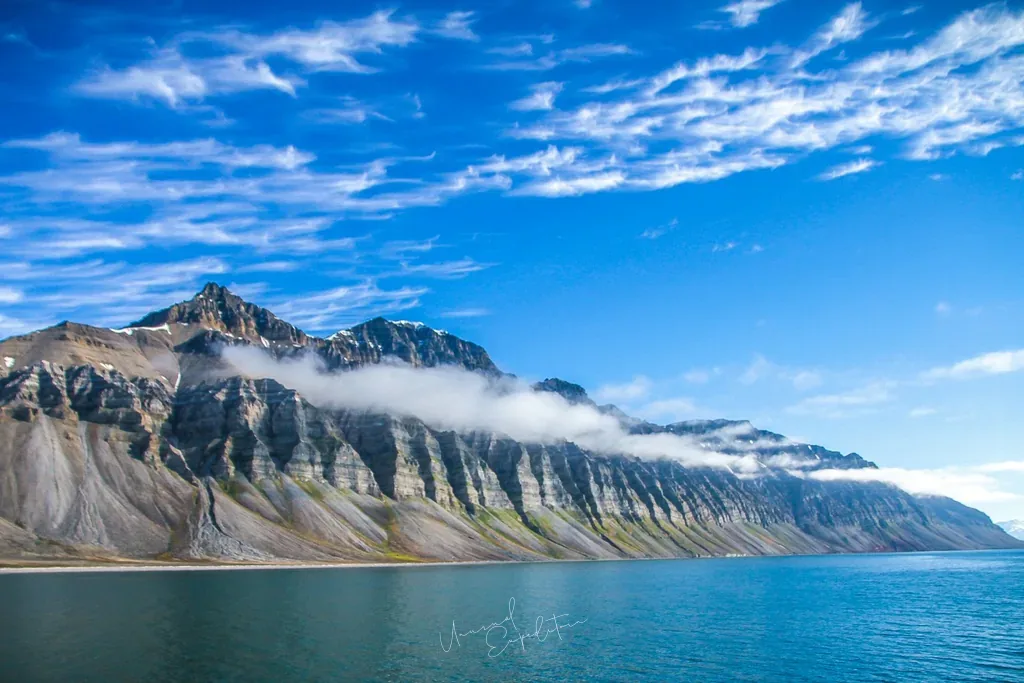
Photographing Scoresby Sund, East Greenland means working inside the largest fjord system on earth: icebergs grounded in shallow bays, red sandstone walls, mountains rising two thousand metres straight from the water, and light that stays low for hours. This guide covers the geography a photographer needs, how shooting from the ship, the Zodiac and the shore differ, and how four days inside Scoresby Sund are typically spent.
Where Scoresby Sund is and why it matters
Scoresby Sund, called Kangertittivaq in Greenlandic, opens onto the Greenland Sea at about 70 degrees north and runs roughly 350 kilometres inland, branching into a maze of side fjords. It is the largest fjord system in the world and the destination of Unusual Expedition's East Greenland photography cruise, which reaches it by ship from Reykjavik. The main basin, Hall Bredning, is wide enough that the far shore can disappear in haze. The side arms are narrower and more dramatic: Rode Fjord is walled in rust-red sandstone, and elsewhere basalt and granite rise to around 2,000 metres with glaciers hanging in the gaps. Icebergs calved from glaciers deep in the system drift out and ground on shallow banks, where they can sit for a season. For the wider context of the trip, including the Northern Lights and Ittoqqortoormiit, read the complete Greenland photography tour guide.
Light at 70 degrees north in early September
In the first half of September, Scoresby Sund, East Greenland gets roughly fourteen hours of daylight, and the sun never climbs high. Sunrise is around 06:00 and sunset around 20:00 local time, and the golden light that lasts twenty minutes in Singapore lasts well over an hour at each end of the day here. The middle of the day is still usable because the sun stays low enough to model the ice. Overcast days are not wasted: flat light brings out the blue inside icebergs, which direct sun tends to wash to white. The darkness after 22:00 is what makes aurora possible, and we cover that separately in photographing the Northern Lights in Greenland. Plan to be on deck before 06:00 and again from 18:00; the ship's expedition team will usually time Zodiac cruises to those windows when the weather allows.
Ship, Zodiac or shore: three different pictures
From the deck of M/V Sea Spirit you photograph scale: whole icebergs against whole mountains, the ship's wake as a leading line, and the long views down Hall Bredning. A 24 to 70 millimetre zoom does most of this work, with a longer lens for picking out details on distant walls. From a Zodiac you are at water level, where a single iceberg fills the frame, the blue reads properly, and reflections come into play; keep the camera on a short strap, shutter speeds above 1/500 second, and a lens cloth in reach because spray is constant. On shore landings you have a tripod, time, and foregrounds of autumn tundra, which in September turns the dwarf birch and bilberry red and orange. Shore is where panoramas and deliberate compositions happen. Practical gear notes, including dry bags and battery management, are in camera gear for Greenland photography.

Composition in a place with no sense of scale
The recurring problem in Scoresby Sund, East Greenland is that nothing in the frame tells the viewer how big anything is. An iceberg the size of a city block photographs like an ice cube unless something human or known sits beside it. The fixes are simple: wait for a Zodiac, a kayak or the ship to pass in front of the ice; include the shoreline where tundra meets water; or use a long lens to compress a line of bergs against a mountain wall so the layering does the work. On the water, use the wind-ruffled and calm patches as tonal bands and let a floe or a wake lead the eye in. For panoramas, shoot overlapping vertical frames handheld from the deck when the ship is stopped, or from a tripod on shore. Underexpose slightly to protect the highlights in the ice; the shadows recover, the whites do not.
"In Scoresby Sund I tell people to stop shooting the biggest iceberg and look for the one with a boat near it. Scale is the picture. The ice will still be there in ten minutes; the Zodiac will not."
Joseph Mak, tour leader, Unusual Expedition
Weather: wind, fog and fast changes
Scoresby Sund, East Greenland sits between the Greenland Ice Sheet and the open sea, and the weather reflects that. Katabatic winds pour down off the ice without much warning and can turn a calm Zodiac cruise into a wet one within minutes. Fog banks form over the colder water near the fjord mouth and burn off inland, so a grey morning at anchor can become a clear afternoon thirty kilometres further in. Daytime temperatures in early September sit around 0 to 5 degrees Celsius, with wind chill well below that on deck. Poseidon Expeditions' team reads the ice and wind each morning and changes the plan to suit, which is why no two voyages see the same side fjords. For photographers the lesson is to keep the camera ready at all times and to treat fog as a subject: icebergs emerging from grey are among the strongest images the place offers.
How four days in Scoresby Sund are spent
On Unusual Expedition's itinerary, M/V Sea Spirit enters Scoresby Sund, East Greenland on Day 4 after crossing the Denmark Strait and stays until Day 8. A typical pattern is a morning Zodiac cruise among grounded icebergs, an afternoon shore landing with a tundra walk, and evenings on deck as the ship repositions. One of those days, conditions permitting, is the landing at Ittoqqortoormiit, the only settlement in the system, covered in photographing Ittoqqortoormiit. Other days go to the inner arms such as Rode Fjord and to the iceberg graveyards where bergs ground in the shallows. The expedition team carries rifles on every landing because polar bears are possible, and the group stays within a perimeter they set. Which fjords are visited depends on ice and wind; the four days are a framework, not a fixed list.
Come and photograph it with us
Scoresby Sund rewards photographers who can wait for light and move fast when it comes, and it is far easier with a working photographer beside you and a ship that positions for the picture. Join Joseph Mak on the Greenland Arctic Sights and Northern Lights photography tour, 5 to 15 September 2027, sailing round trip from Reykjavik with four full days inside the fjord system. Fares start at US$8,850 per person. For when to go across the whole season, see the best time to visit Greenland for photography.
Join the Greenland photography tour
Greenland Arctic Sights and Northern Lights 5 Sep 2027 departs 05 Sep 2027 To 15 Sep 2027, led by Joseph Mak. Small group, photography first.
Explore Greenland in depth
- The Ultimate Guide to a Greenland Photography TourGreenland
- Greenland Tour from Singapore: How to Get There and What to ExpectGreenland
- Greenland Photography Trip FAQGreenland
- The Best Time to Visit Greenland for PhotographyGreenland
- Greenland Photography Season, Month by MonthGreenland
- Greenland Arctic Wildlife Photography: What You Will Really SeeGreenland
- Camera Gear for Greenland PhotographyGreenland
- East Greenland vs West Greenland for PhotographyGreenland
- Photographing Ittoqqortoormiit, East Greenland's Loneliest TownGreenland
- Photographing the Northern Lights in GreenlandGreenland
Upcoming Photo Tours
- Egypt Photo Tour – EgyptEgypt 12 Dec 2026 To 20 Dec 2026
- Inner Mongolia Winter Owl Photo Tour – ChinaChina 01 Jan 2027 To 04 Jan 2027
- Inner Mongolia Winter Photo Tour – ChinaChina 05 Jan 2027 To 11 Jan 2027
- Mekong And Central Highland Vietnam Photo Tour - VietnamVietnam 16 Jan 2027 To 24 Jan 2027