
Guanajuato Photo Spots: the Ravine City from Above and Below
Guanajuato photo spots: the Pípila view, painted hillsides, the Callejón del Beso, the yellow Basilica and papel picado streets.
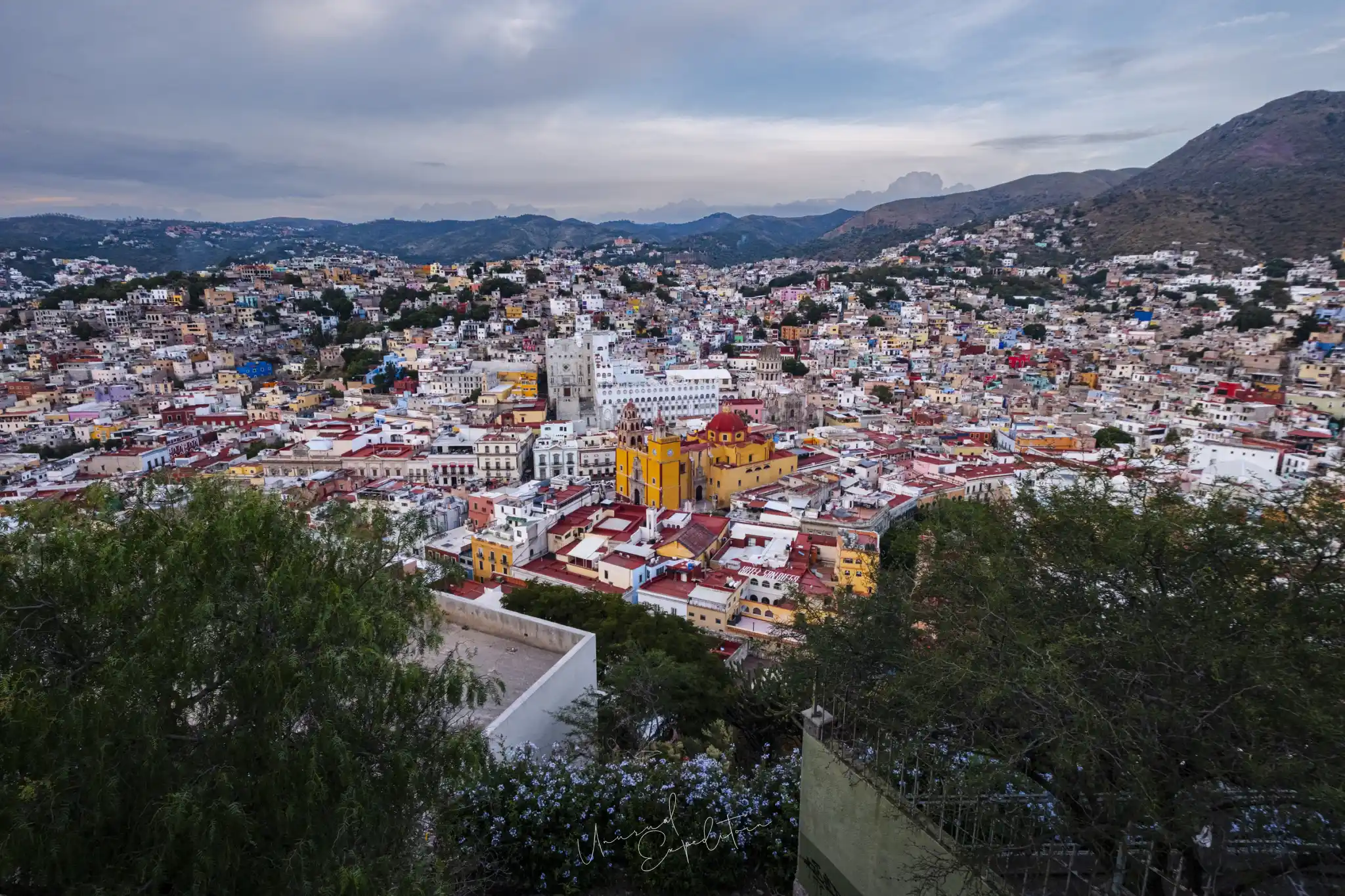
The best Guanajuato photo spots are the view across the ravine from the slopes above the centre, the Pípila monument at blue hour, the yellow Basílica Colegiata over the Plaza de la Paz, the Callejón del Beso and its neighbouring alleys, and the streets strung with papel picado around the markets. If you want photos of Guanajuato Mexico that show why the city is different, stand high and look down first, then go into the lanes and look up.
This is the city chapter of our Guanajuato photography tour guide, which also covers San Miguel de Allende and Dolores Hidalgo. Guanajuato city is a UNESCO World Heritage Site, inscribed in 1988 as the Historic Town of Guanajuato and Adjacent Mines, and it rewards a photographer who walks: almost everything below is on foot from the Jardín de la Unión.
Where is the view of the whole city?
Guanajuato fills a gorge, so the classic picture is from the side of it. The best known position is the Pípila monument on the southern slope, reached by the funicular that starts just behind the Teatro Juárez or by steep lanes on foot. From the terrace the whole ravine opens out: the houses stacked on the far slope, the Basílica Colegiata yellow in the middle, the university and the churches among the roofs. Several lanes higher up on the same slope give the same view with fewer people and a wall or a tree to frame it. In the late afternoon the far slope takes the sun while the bottom of the ravine is already in shade, and the colours are at their richest just before the light goes.
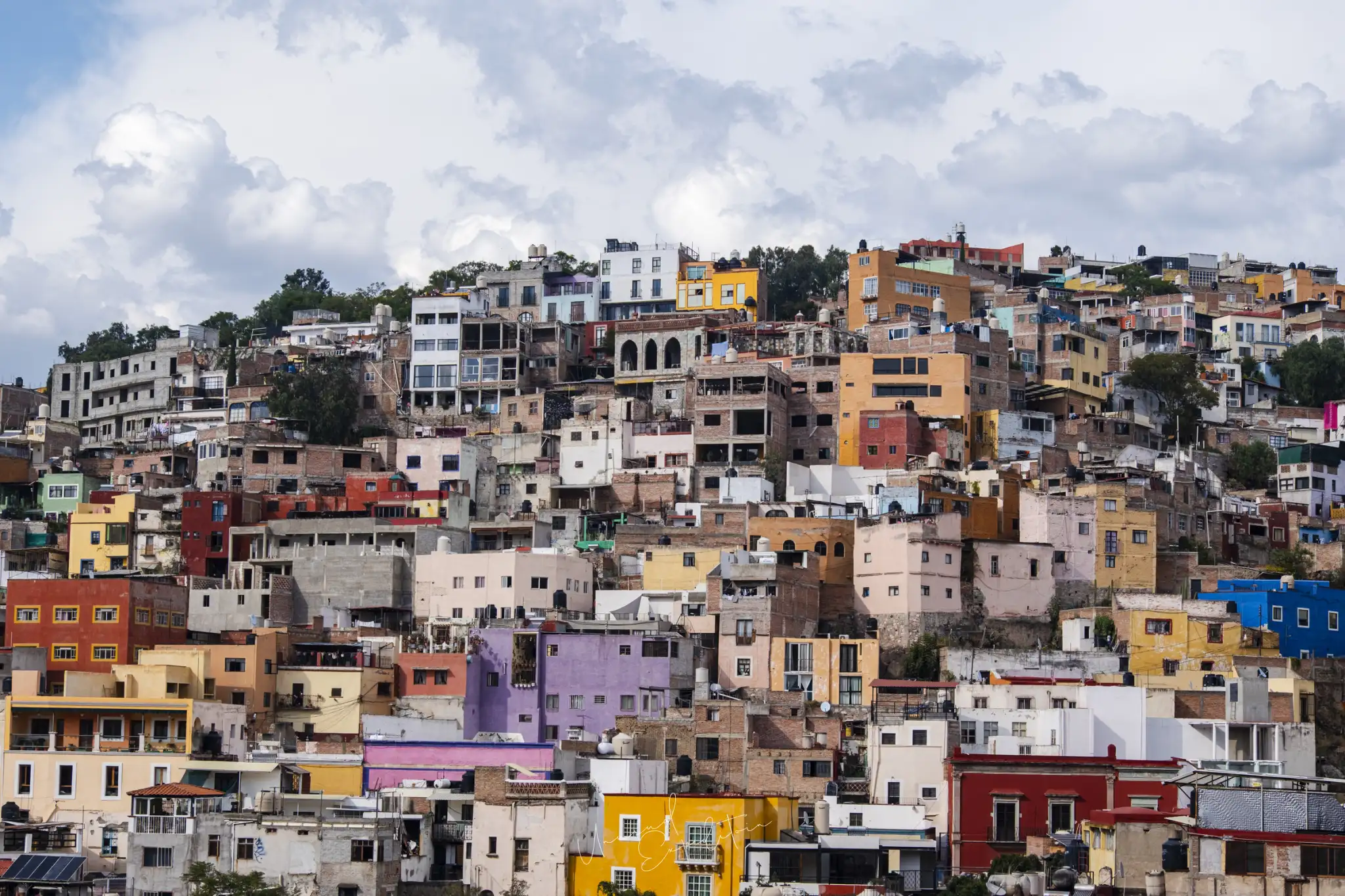
The painted hillsides with a long lens
From the Pípila or any terrace on the south side, a 70-200mm turns the opposite hillside into a wall of colour: pink, lilac, yellow, blue and terracotta houses, one above the other, with no sky and no street. It is the frame that sells the city on postcards and it is easy to make well. Keep the camera level, fill the frame edge to edge, and choose a section with one strong colour block, a yellow house or a blue one, to hold the eye. Soft light under thin cloud is better than hard sun here, because the colours stay even. The same hillside reads differently at blue hour, when the windows light one by one.
Callejón del Beso guanajuato: the alley of the kiss
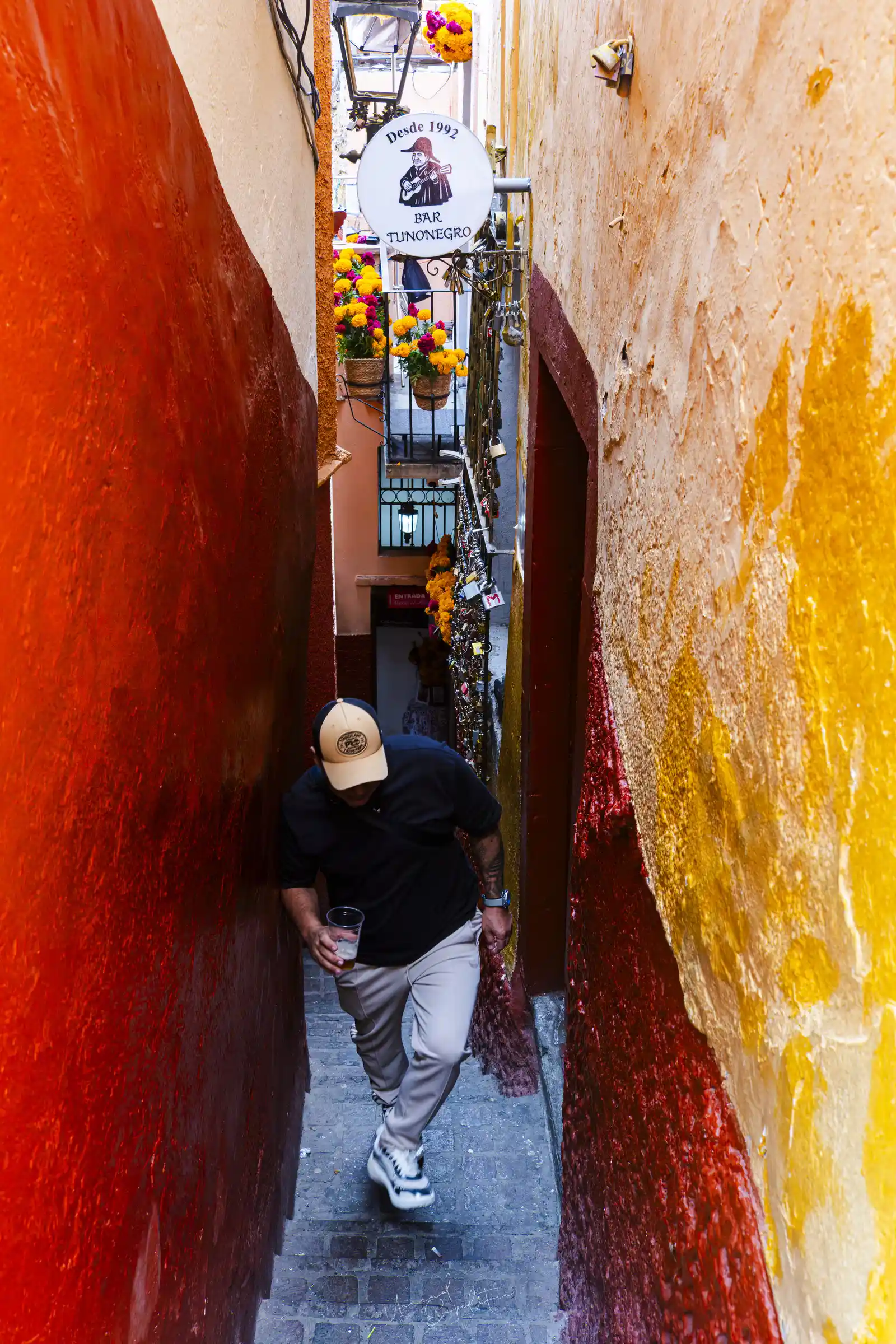
The Callejón del Beso is the city's most visited alley. The story is a Romeo and Juliet legend: two lovers from feuding families whose balconies faced each other across the lane, close enough to kiss. Guidebooks put the gap between the balconies at well under a metre. The alley is short, stepped and usually busy, so photograph it early or accept people in the frame and use them for scale. The neighbouring callejones are often better pictures: walls painted red and ochre, a strip of sky, a lamp, someone climbing the steps. Shoot from below with the wide end of a 16-35mm or 24-70mm, keep the verticals straight, and expose for the bright wall.
The Basílica Colegiata and the Plaza de la Paz
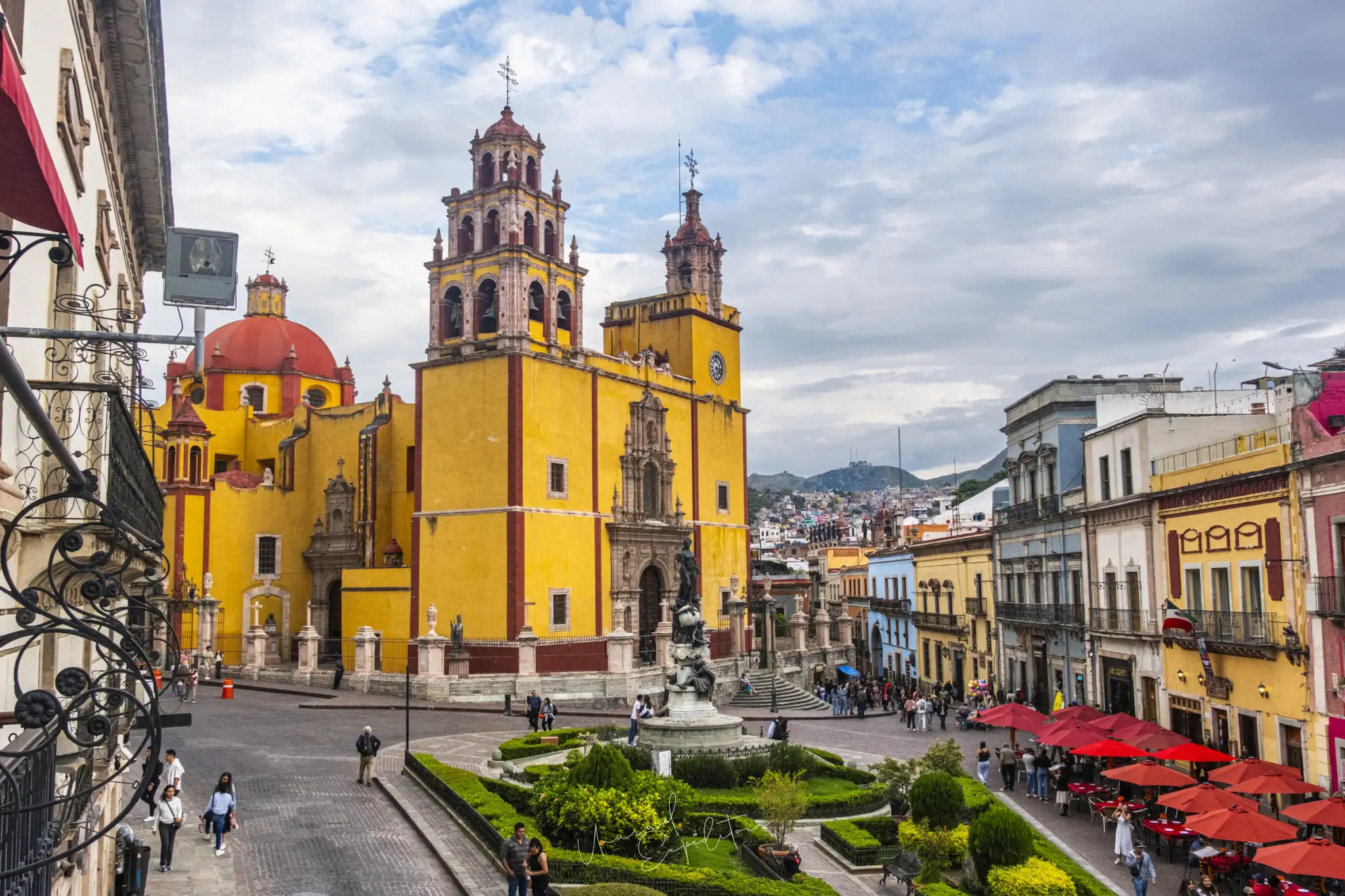
The yellow Basílica Colegiata de Nuestra Señora de Guanajuato is the landmark at the centre of the city, with a red dome beside its towers and the small Plaza de la Paz in front. From street level it is a tall subject with traffic and umbrellas around it. From a raised viewpoint on the slope behind the plaza, the picture changes: the church, the garden of the plaza, the red café umbrellas and the hills behind fit together in one frame. The basilica takes afternoon sun on its front, so this is a late afternoon position. At Day of the Dead the street in front is lined with ofrendas, which our Guanajuato and San Miguel de Allende at Day of the Dead article covers.
Streets with papel picado
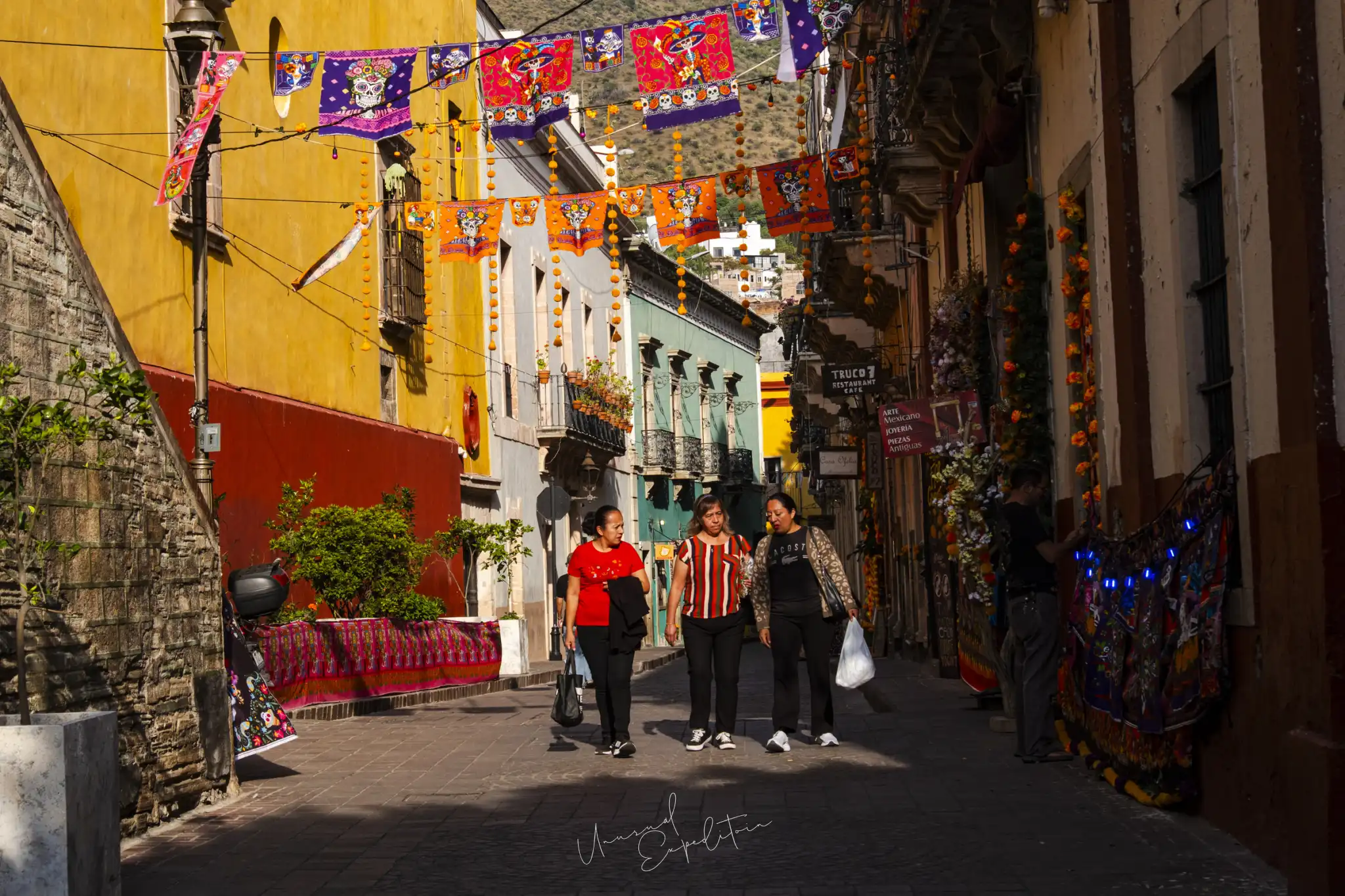
Guanajuato strings papel picado, the cut-paper banners of Mexican festivals, across many of its streets, and in late October they turn purple, orange and black for the Day of the Dead. The streets that work best are the narrow ones with a slope, where the banners overlap from front to back and the eye runs uphill under them. Stand at the bottom, use 35mm to 50mm to stack the banners, and wait for walkers to come into the patch of light. A wall in a strong colour on one side, red or yellow, makes the frame. These streets are near the markets and the Jardín de la Unión, and the morning gives the cleanest light before the shade fills them.
"Guanajuato is the only city on our route where I tell people to climb before they shoot. Ten minutes on the slope and you understand the place; after that, every alley you walk down makes sense."
Joseph Mak, tour leader, Unusual Expedition
Guanajuato things to do between the photo spots
Guanajuato is a university town with a theatre on its main square, and a photographer will find subjects between the set pieces. Estudiantinas, the student minstrel groups in Renaissance costume, lead callejoneadas through the lanes in the evenings. Marching bands and processions pass through the centre for saints' days and civic events. The markets, the Mercado Hidalgo above all, give colour and portraits if you ask first. The city also has the Museo de las Momias, which many visitors find unsettling and which does not allow every kind of photography; check the rules at the door. Diego Rivera was born in Guanajuato, and his childhood home is a museum in the centre.
Is Guanajuato safe to photograph at night?
The historic centre is busy into the evening, especially around the Jardín de la Unión and the theatres, and walking between the main squares after dark is normal for visitors. Use the same judgement as in any city: keep the camera on a strap, carry one lens rather than the whole bag, and avoid the quiet upper lanes late at night. Check your own government's current advice for Guanajuato state before you go; the UK Foreign Office and the US State Department both publish state-by-state guidance for Mexico, and the advice can differ between the city centre and other parts of the state.
Guanajuato photo spots at a glance
| Spot | Best light | Lens | Notes |
|---|---|---|---|
| Pípila monument | Late afternoon, blue hour | 24-70mm, 70-200mm | Funicular from behind the Teatro Juárez |
| Upper lanes on the south slope | Late afternoon | 24-70mm | Same view, fewer people |
| Painted hillside | Soft light | 70-200mm | Fill the frame with colour |
| Callejón del Beso and nearby alleys | Early morning | 16-35mm | Shoot upward, straight verticals |
| Basílica Colegiata from above | Late afternoon | 24-70mm | Front lit in the afternoon |
| Papel picado streets | Morning | 35mm to 50mm | Strongest in late October |
Two passes cover the city well: the alleys and streets in the morning, the slope and the panorama from the late afternoon into blue hour.
More of Guanajuato state
Guanajuato city pairs naturally with its neighbours. San Miguel de Allende is the street town of the state, covered spot by spot in San Miguel de Allende photo spots, and the parish town where independence began is in Dolores Hidalgo photos. The wider Mexico route is in the Mexico photography tour guide.
Walk Guanajuato with us
We photograph Guanajuato as part of our Day of the Dead trip through central Mexico, with photographers joining from many countries. See the Mexico photography tours page for the next departure.
Guanajuato photography tours
The next Guanajuato departure is announced on the Guanajuato photography tours page, with previous expeditions and all the planning guides.
Explore Guanajuato in depth
- Guanajuato Photography Tour: Guanajuato City, San Miguel de Allende and Dolores HidalgoMexico
- Dolores Hidalgo Photos: the Parish, the Catrina and the MarketMexico
- San Miguel de Allende Photo Spots: Where to Stand and WhenMexico
- Guanajuato and San Miguel de Allende at Day of the DeadMexico
Upcoming Photo Tours
- Egypt Photo Tour – EgyptEgypt 12 Dec 2026 To 20 Dec 2026
- Inner Mongolia Winter Owl Photo Tour – ChinaChina 01 Jan 2027 To 04 Jan 2027
- Inner Mongolia Winter Photo Tour – ChinaChina 05 Jan 2027 To 11 Jan 2027
- Mekong And Central Highland Vietnam Photo Tour - VietnamVietnam 16 Jan 2027 To 24 Jan 2027