
San Miguel de Allende Photo Spots: Where to Stand and When
Best photo spots in San Miguel de Allende: Calle Aldama at blue hour, streets at sunrise, the Jardín, the arches, the Mirador, La Aurora.
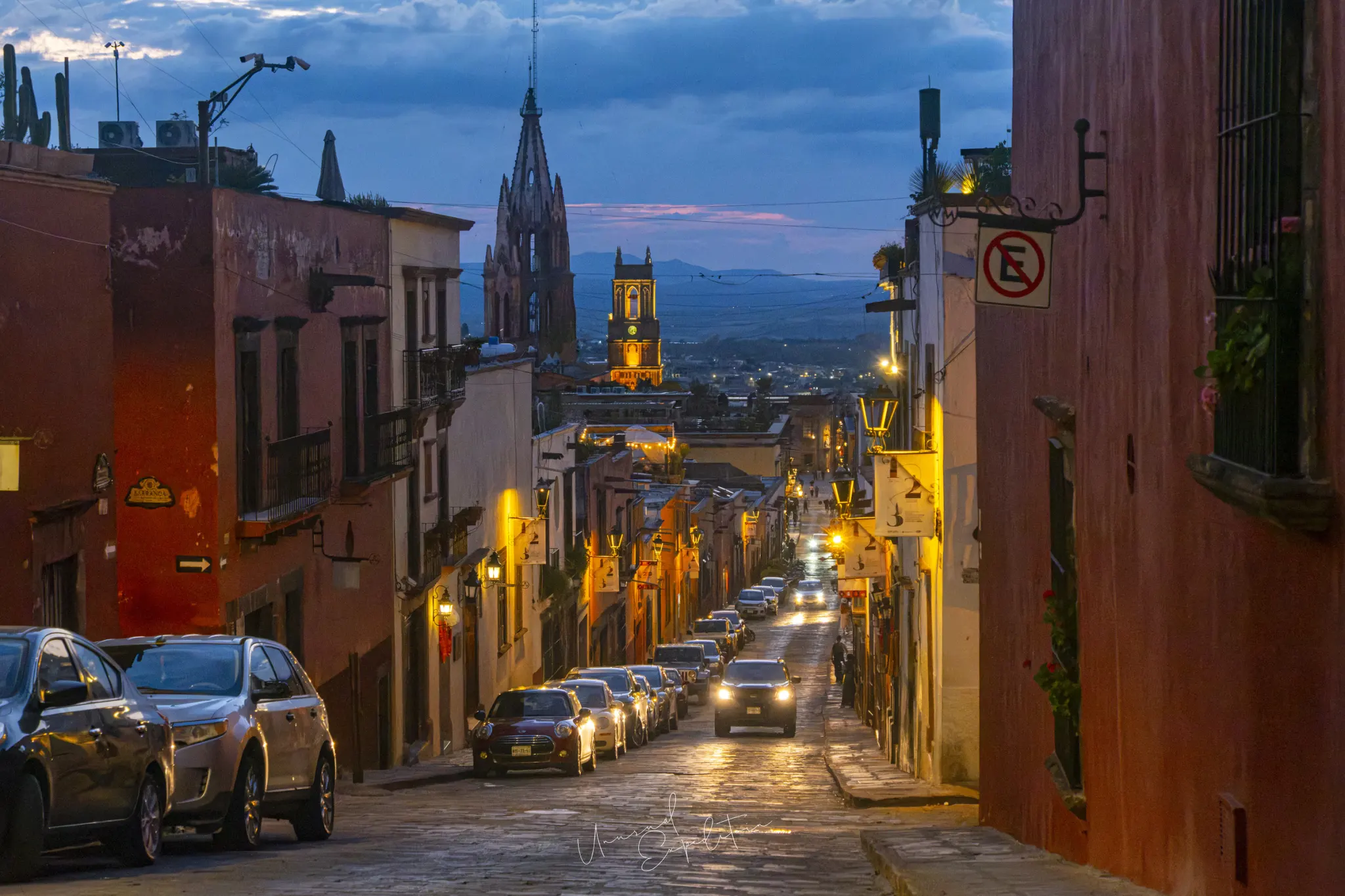
The best photo spots in San Miguel de Allende are Calle Aldama at blue hour with the Parroquia lit at the end of it, the same streets at sunrise, the Jardín Principal under the pink spires, the arches and doorways around it, the Mirador on the Querétaro road for the whole town, and the Fábrica La Aurora for interiors. All of them fit in one day on foot, and the town is on every departure of our Mexico festival of the dead photography tour. This is where to stand and when.
Is San Miguel de Allende worth visiting for photography?
Yes, and for a particular reason: the town is built on a slope of ochre, red and pink walls with cobbled streets running downhill towards one neo-Gothic church, so almost every street gives a composition with a vanishing point and a landmark in it. It is a UNESCO World Heritage town, it has been a retirement and art colony since the middle of the last century, and it is polished in a way the rest of the route is not. The photographs are architectural and about light, not about people, which makes it the calm day between the festival crowds of Guanajuato and Dolores Hidalgo and the parade in Mexico City.
Calle Aldama at blue hour
Calle Aldama runs downhill from the Parque Juárez to the Jardín Principal and aims straight at the spires of the Parroquia de San Miguel Arcángel. It is the most photographed street in Mexico. The picture is made in the twenty-five minutes after sunset, when the street lamps and the church floodlights come on under a sky that is still blue, and the red wall on the right leads the eye down to the lit spires. Stand on the right-hand pavement about two-thirds of the way down, a tripod against the wall, 24mm to 35mm, f/8, and let the exposure run from a fraction of a second to several seconds as the light goes. Cars park along the street and you will not get rid of them; include them as a line of reflections.
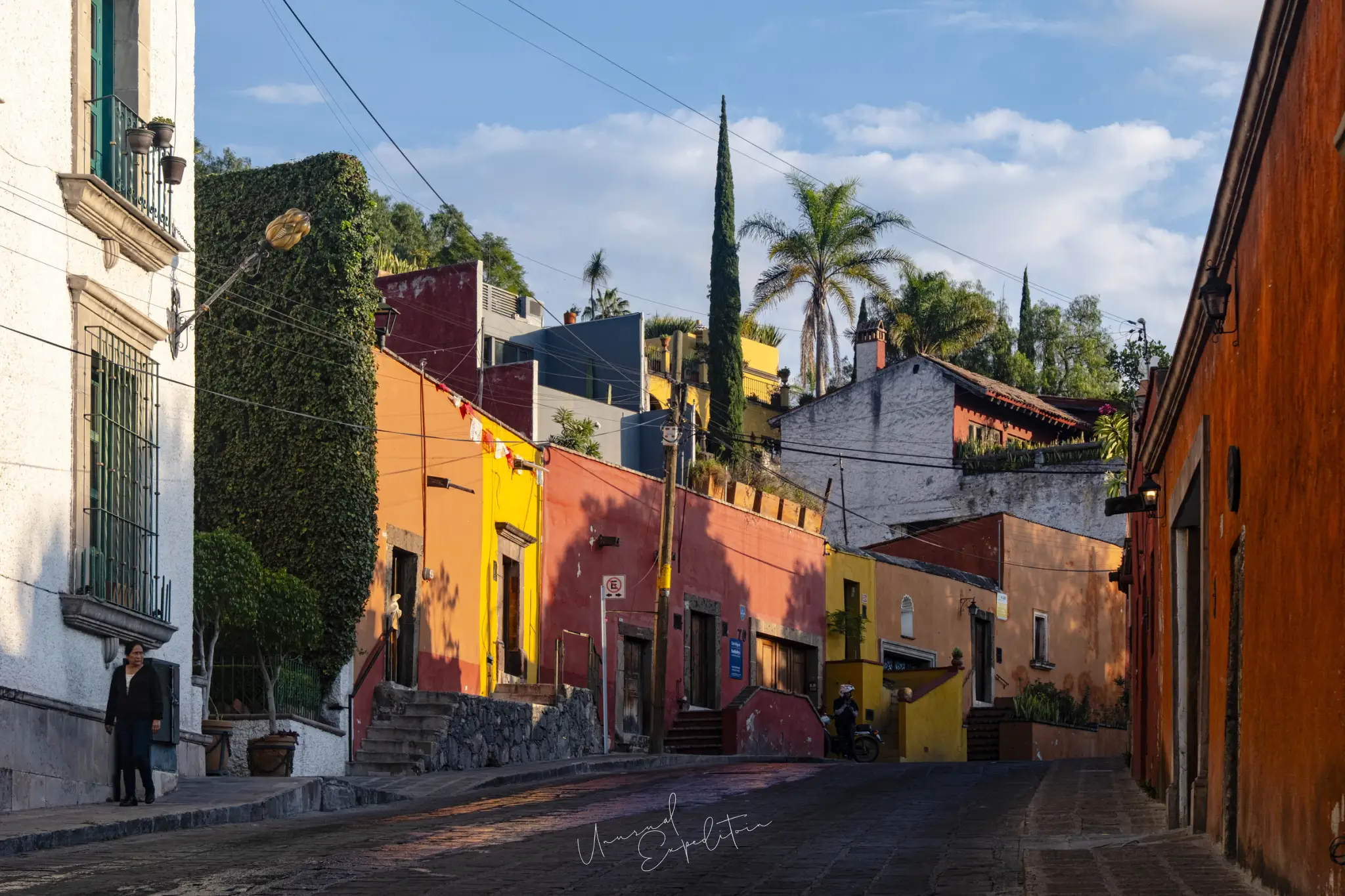
San Miguel at sunrise: the same streets, empty
At first light the streets are empty, the walls are lit from the side and the colours are at their deepest. Calle Aldama is worth a second visit then, but the better sunrise pictures are the side streets off it, Cuadrante, Hospicio and Recreo, where the sun comes down the hill and lights one wall while the other stays in shadow. Work fast: the light is good for about forty minutes, and the delivery vans arrive soon after. A 24-70mm hand-held covers it. The rooftop bars and hotel terraces that look over the Parroquia open later, so the high sunrise view is only for guests of the hotels that have one.
The Jardín Principal and the Parroquia
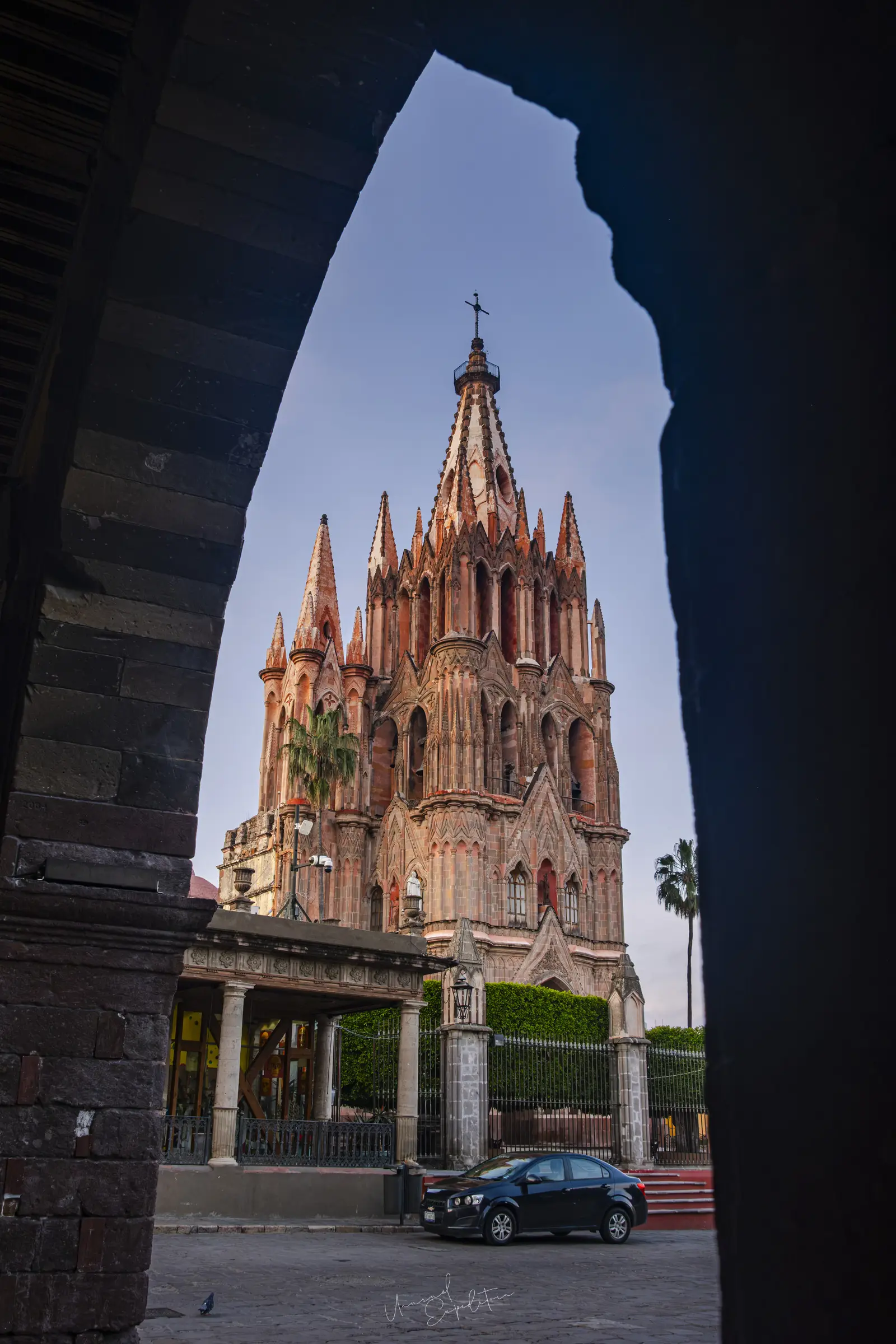
The main square sits directly under the Parroquia, whose pink stone facade was added in the 1880s by a local builder working, the story goes, from postcards of European cathedrals. From the square the spires fill a vertical frame; from the arcades on the north side they are framed by arches; from the benches under the clipped laurels the picture is the square itself, with shoe-shiners, mariachis in the evening and families on Sundays. The facade faces west, so it goes pink and then orange in the last hour of light and is floodlit after dark. Mid-morning it is in its own shadow and flat.
Arches, doorways and the streets around the centre
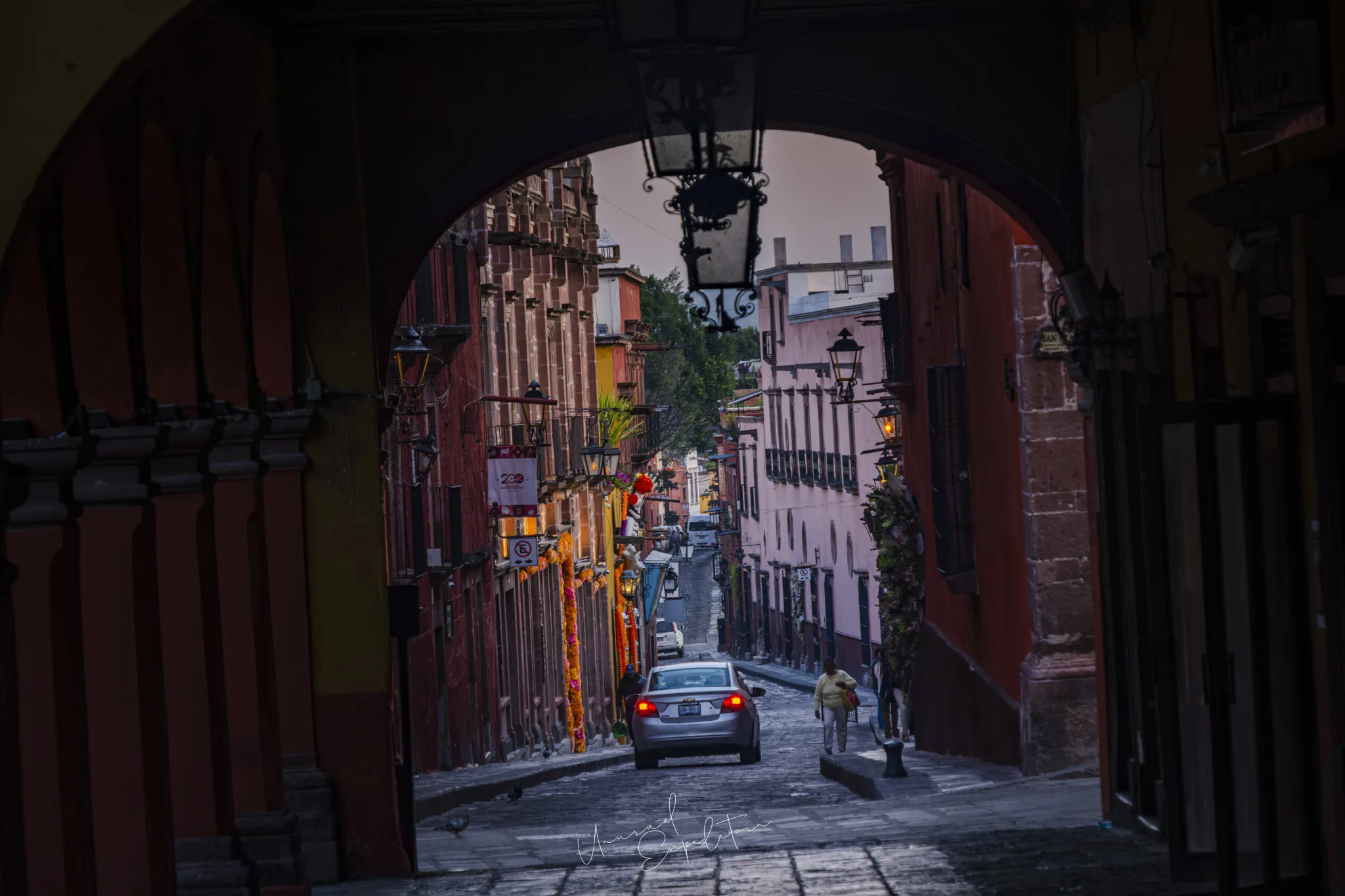
San Miguel's second subject is the detail: carved wooden doors, iron balconies, bougainvillea over a red wall, a cobbled lane through an arch with the town falling away behind it. The streets east of the Jardín towards the Templo de San Francisco and the Oratorio, and the lanes down to the Lavaderos del Chorro, the old public washing troughs below the Parque Juárez, give an hour of this. A 35mm or 50mm and no tripod. Shoot the arches with something passing through them, a person, a car, a dog, or they are empty postcards.
The Mirador: the whole town in one frame
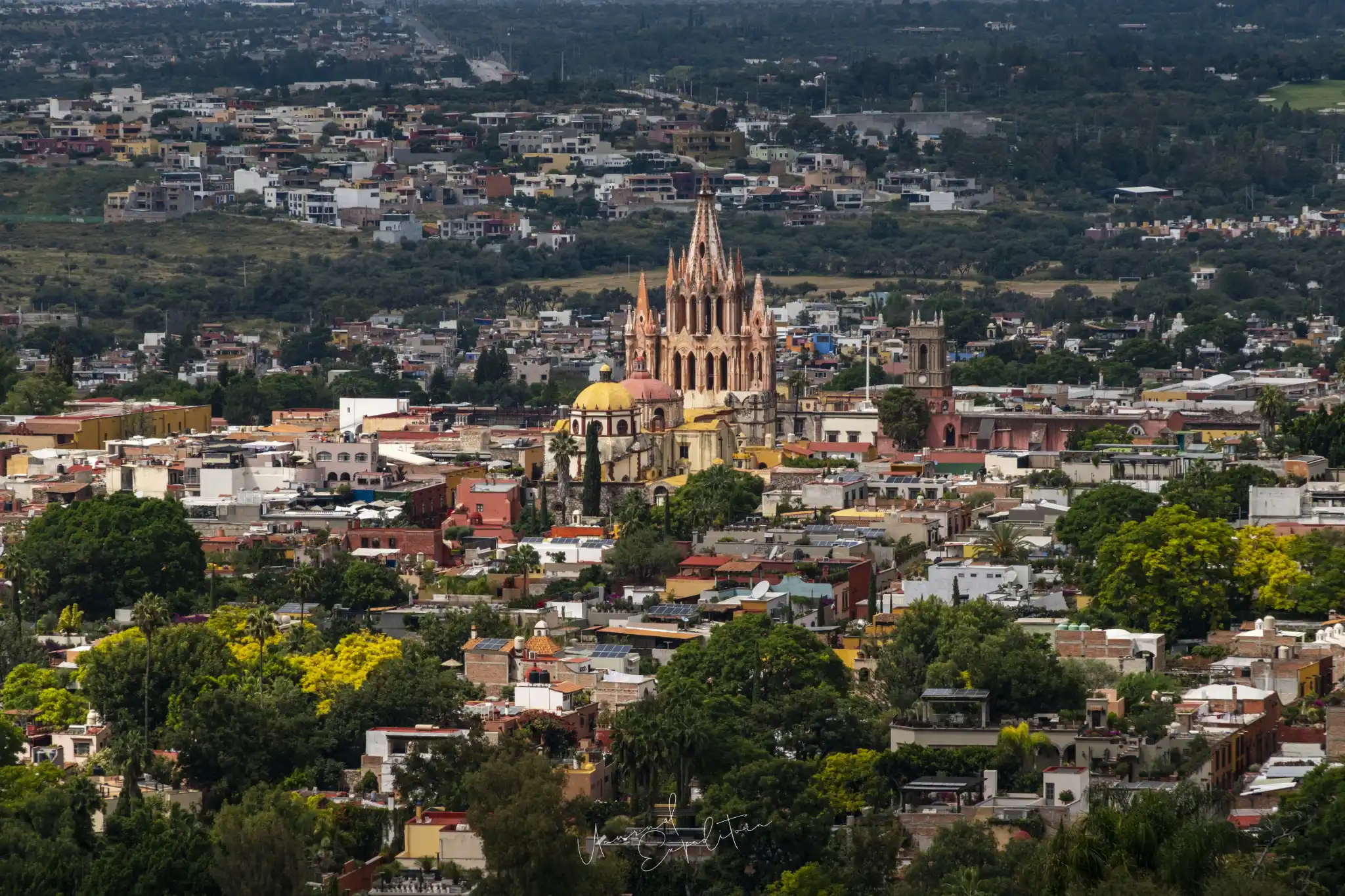
On the road climbing out of town towards Querétaro, the Salida a Querétaro, a viewpoint looks back over the roofs to the Parroquia and the reservoir beyond. It is the one place to photograph San Miguel as a town rather than a street. The view faces west, so late afternoon puts the sun in your face and the town in haze; the better light is early morning with the sun behind you, or the half hour after sunset when the town lights come on and the sky holds colour. A 70-200mm compresses the roofs against the spires; a 24-70mm takes in the hills. The viewpoint is a short taxi ride or a steep walk up from the centre.
Fábrica La Aurora and the interiors
A former textile mill on the north edge of town is now a complex of galleries, studios and furniture showrooms, and it is where San Miguel's craft and design side can be photographed indoors when the midday light outside is too hard. Iron columns, skylights, courtyards and workshops; ask before photographing inside the galleries, as most allow it and a few do not. The other interiors worth the time are the Templo de San Francisco and the Oratorio de San Felipe Neri, both baroque, both dim, both ISO 3200 and a steady hand.
"San Miguel is the one town on the route where I tell people to put the long lens away and walk. Every street points at the church. The job is to be on the right one when the lamps come on."
Joseph Mak, tour leader, Unusual Expedition
San Miguel de Allende photo spots by light
| Spot | Best light | Where to stand | Lens |
|---|---|---|---|
| Calle Aldama | Twenty-five minutes after sunset | Right pavement, two-thirds of the way down | 24-70mm, tripod |
| Side streets off Aldama | First forty minutes after sunrise | Where the sun lights one wall | 24-70mm |
| Jardín Principal and Parroquia | Last hour of light, then floodlit | Under the arcades or on the benches | 24-70mm, 16-35mm |
| Arches and doorways | Open shade, any time | East of the Jardín, down to El Chorro | 35mm, 50mm |
| The Mirador | Early morning, or dusk for the lights | Salida a Querétaro viewpoint | 70-200mm, 24-70mm |
| Fábrica La Aurora | Midday, indoors | Courtyards and workshops | 24-70mm |
One blue hour and one sunrise cover the two pictures the town is known for; the rest fills the middle of the day.
What does the Day of the Dead add in San Miguel?
In the festival week the Jardín carries an ofrenda, the shops dress their doorways with marigolds and papel picado, and Catrinas process through the centre on the festival evenings. It is gentler than Guanajuato or Mexico City and better for detail than for crowds: a marigold arch over a blue door, a sugar skull in a shop window, a child in face paint on a bench. The giant Catrina and the market tables of Dolores Hidalgo are a short drive away on the same days.
Walk it with us
San Miguel de Allende is the colonial-town day of the Mexico Festival of the Dead photography tour, with a blue hour on Calle Aldama and a sunrise in the streets, and Joseph Mak on the pavement with you. What to carry for the cobbles and the tripod sessions is in camera gear for Day of the Dead photography in Mexico.
Mexico photography tours
The next Mexico departure is announced on the Mexico photography tours page, with previous expeditions and all the planning guides.
Explore Mexico in depth
- Mexico Festival of the Dead Photography Tour: The Complete GuideMexico
- Janitzio Photos: The Island, the Cemetery and the Boat from PátzcuaroMexico
- Mexico City Photo Spots: The Best Places to Take PicturesMexico
- Day of the Dead Photos from Mexico: What the Real Celebration Looks LikeMexico
- Mexico Tour from Singapore: Flights, Visa and What to ExpectMexico
- Puebla, Cholula and Taxco for PhotographersMexico
- Guanajuato and San Miguel de Allende at Day of the DeadMexico
- Camera Gear for Day of the Dead Photography in MexicoMexico
- Mexico Day of the Dead Photo Tour: Your Questions AnsweredMexico
- Photographing the Day of the Dead Parade in Mexico CityMexico
- Mexico's Pyramids: Tula, Teotihuacán, Chichén Itzá, Ek Balam and TulumMexico
- Mixquic: Photographing the Day of the Dead Cemetery at NightMexico
Upcoming Photo Tours
- Egypt Photo Tour – EgyptEgypt 12 Dec 2026 To 20 Dec 2026
- Inner Mongolia Winter Owl Photo Tour – ChinaChina 01 Jan 2027 To 04 Jan 2027
- Inner Mongolia Winter Photo Tour – ChinaChina 05 Jan 2027 To 11 Jan 2027
- Mekong And Central Highland Vietnam Photo Tour - VietnamVietnam 16 Jan 2027 To 24 Jan 2027