
Guanajuato and San Miguel de Allende at Day of the Dead
Guanajuato day of the dead and San Miguel de Allende for photographers: Calle Aldama at blue hour and sunrise, Dolores Hidalgo, Basilica.
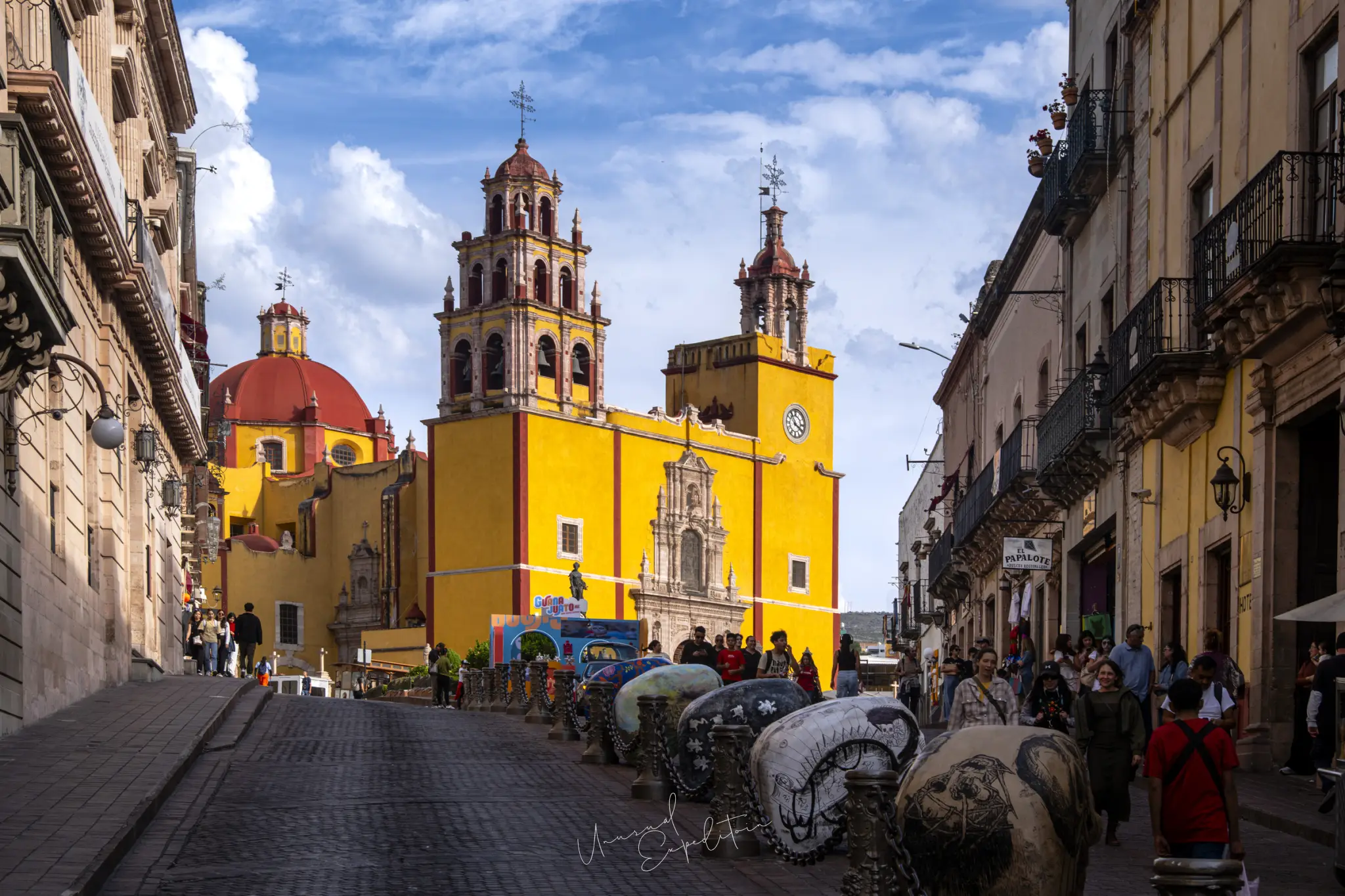
Guanajuato at Day of the Dead and San Miguel de Allende the day before it are the opening of the Mexico festival of the dead photography tour, and for many participants the pictures they come home with most: Calle Aldama at blue hour with the pink Parroquia lit at the end of it, the same street empty at sunrise, Dolores Hidalgo's yellow church with a giant Catrina in front, and Guanajuato's ravine of coloured houses with the Basilica at the bottom. We photographed all four in 24 hours on the 2026 departure, and this is how.
San Miguel de Allende: Calle Aldama at blue hour
Calle Aldama runs downhill from the Parque Juárez to the Jardín Principal, cobbled, lined with ochre and red walls, and aimed straight at the neo-Gothic spires of the Parroquia de San Miguel Arcángel. It is the most photographed street in Mexico, and it earns it in the twenty-five minutes after sunset at the end of October, when the street lamps and the church floodlights come on under a sky that is still blue. We arrived in San Miguel from Tula just before sunset and shot through the blue hour: a tripod, 24mm to 35mm, f/8, ISO 400, exposures from 1/80 of a second at the start to 6.5 seconds at the end as the light went. Stand on the right-hand pavement about two-thirds of the way down so the red wall leads in and the spires sit above the street's vanishing point.

San Miguel at sunrise: the same street, empty
Back on Calle Aldama before dawn the next morning, the cars are still parked but the people are gone, the sky behind the Parroquia goes pink twenty minutes before sunrise and the first sun reaches the top of the spires soon after. Frames from that three-quarters of an hour: 1/25 of a second hand-held at the start, 1/160 by the end, ISO 1800 falling to 800. Then up the lanes behind the Parque Juárez, where the elevated streets look across the whole town to the church and the plain beyond, and through the arches of the Jardín itself, which frame the Parroquia before the shoe-shiners arrive. Breakfast, and the day's drive starts after it.
Dolores Hidalgo: the yellow church and the sugar skulls
Forty minutes north of San Miguel, Dolores Hidalgo is where Mexican independence was proclaimed in 1810 and where, in the last week of October, a giant Catrina playing a violin stood in front of the yellow and pink parish church. We photographed it in the late morning: the church square with the Catrina from below on a 24mm, the bell towers against the blue sky, the market across the square where sugar skulls are made and sold by the tray, and the ice-cream vendors the town is known for. The market stalls are the place for the still lifes of the festival, sugar skulls, pan de muerto and papel picado, with the stallholders' permission and a small purchase.
Guanajuato day of the dead: the city in the ravine
Guanajuato is a silver-mining city built in and up the sides of a gorge, with traffic running through tunnels beneath it and houses in every colour stacked on the slopes. At Día de Muertos the streets around the Basílica Colegiata de Nuestra Señora de Guanajuato, the yellow church in the centre, are strung with papel picado and lined with ofrendas, and the university's Festival Cervantino has usually just ended, so the city is full but not overfull. We walked it in the late afternoon: the Basilica from the street below it with the afternoon sun on the yellow, the view across the ravine from a lane above the centre, the Callejón del Beso and the lanes around it, and the market near the Jardín de la Unión. The classic panorama is from the Pípila monument above the city at blue hour, reached by funicular, and it is the one we photographed on the 2025 reconnaissance.
What is the light like in these towns?
Hard and blue through the middle of the day, which is fine for painted facades against the sky and hard on faces. The two soft windows are the first ninety minutes after sunrise and the last hour before dark, and the tour is scheduled around them: San Miguel gets both, Guanajuato gets the late afternoon, Dolores Hidalgo gets the morning. Blue hour at this latitude and date lasts about 25 minutes, so the tripod is already up when the sun goes.
"Calle Aldama is a cliché because it works. Shoot it at blue hour like everyone else, then come back before sunrise when the only other person on the street is sweeping it, and you have the picture nobody else has."
Joseph Mak, tour leader, Unusual Expedition
Which lens for the colonial towns?
A 24-70mm or an 18-135mm does almost all of it: our frames are between 18mm and 70mm except for details on the church facades at 100mm to 135mm. A 10-24mm for the interior of the Parroquia and the Basilica. A tripod for the two blue hours. Nothing longer is needed.
Where did we stay and why it matters
In San Miguel, a hotel beside the Jardín Principal, so the blue hour and the sunrise were a five-minute walk with no transport. In Guanajuato, in the historic centre within steps of the Callejón del Beso, for the same reason. The hotel choice is the difference between photographing blue hour and watching it from a bus.
Two days, four towns
| When | Where | Pictures | Lens and settings |
|---|---|---|---|
| Arrival evening, blue hour | Calle Aldama, San Miguel | Blue hour, lit Parroquia | 24-35mm on a tripod, up to 6.5 s |
| Next morning, dawn | Calle Aldama and the lanes above | Empty street, pink sky, arches | 18-70mm hand-held, ISO 800 to 1800 |
| Late morning | Dolores Hidalgo | Giant Catrina, yellow church, sugar skulls | 24-70mm |
| Late afternoon | Guanajuato centre | Basilica, ravine view, lanes | 18-135mm |
The sequence runs from the most photographed street in Mexico to the least expected town, and the festival builds in each one.
Come and photograph it with us
Both towns open every departure of the Mexico Festival of the Dead tour. From Guanajuato the route continues to Lake Pátzcuaro, in Janitzio and the butterfly fishermen, and the timing of the whole week is in The best time for Day of the Dead photography.
Mexico photography tours
The next Mexico departure is announced on the Mexico photography tours page, with previous expeditions and all the planning guides.
Explore Mexico in depth
- Mexico Festival of the Dead Photography Tour: The Complete GuideMexico
- Mexico Tour from Singapore: Flights, Visa and What to ExpectMexico
- Puebla, Cholula and Taxco for PhotographersMexico
- Camera Gear for Day of the Dead Photography in MexicoMexico
- Mexico Day of the Dead Photo Tour: Your Questions AnsweredMexico
- Photographing the Day of the Dead Parade in Mexico CityMexico
- Mexico's Pyramids: Tula, Teotihuacán, Chichén Itzá, Ek Balam and TulumMexico
- Mixquic: Photographing the Day of the Dead Cemetery at NightMexico
- Janitzio and the Butterfly Fishermen of Lake PátzcuaroMexico
- The Best Time for Day of the Dead Photography in MexicoMexico
Upcoming Photo Tours
- Egypt Photo Tour – EgyptEgypt 12 Dec 2026 To 20 Dec 2026
- Inner Mongolia Winter Owl Photo Tour – ChinaChina 01 Jan 2027 To 04 Jan 2027
- Inner Mongolia Winter Photo Tour – ChinaChina 05 Jan 2027 To 11 Jan 2027
- Mekong And Central Highland Vietnam Photo Tour - VietnamVietnam 16 Jan 2027 To 24 Jan 2027