
Ha Giang Photo Spots on a Ha Giang Road Trip: Where to Stand
Ha Giang road trip photo spots: valley villages, Quan Ba, terraces, Ma Pi Leng, weekly markets, Mu Cang Chai and Long Coc, with light.
On a Ha Giang road trip the photo spots that matter are the Quan Ba pass and its valley, the karst villages along the road to Yen Minh and Dong Van, the Ma Pi Leng pass above the Nho Que river, the Sunday markets of Dong Van and Meo Vac, the terraced fields of the lower valleys and, further south and west, the terraces of Mu Cang Chai and the tea hills of Long Coc. The mountains give their best light early and late, and the weather decides the rest.
This list belongs with our Ha Giang and Mu Cang Chai photography tour guide. Joseph photographed Ha Giang in March, when peach blossom was out and the fields were being prepared, and Mu Cang Chai in early October at the harvest. Those frames lead the sections they belong to; the passes and viewpoints we have not photographed for the site are described from public information.
Things to do in Ha Giang with a camera
Ha Giang's high north is the Dong Van Karst Plateau, a UNESCO Global Geopark since 2010 covering Quan Ba, Yen Minh, Dong Van and Meo Vac, where UNESCO says 17 ethnic groups live. Since mid 2025 Ha Giang has been part of an enlarged Tuyen Quang province, and Mu Cang Chai, formerly in Yen Bai, is now in Lao Cai. The road is the experience: hairpins, passes, stone-walled villages and markets. Rules on border-area permits for foreign visitors have been reported differently by different sources, so check the current requirement before you go.
Valley villages under the karst
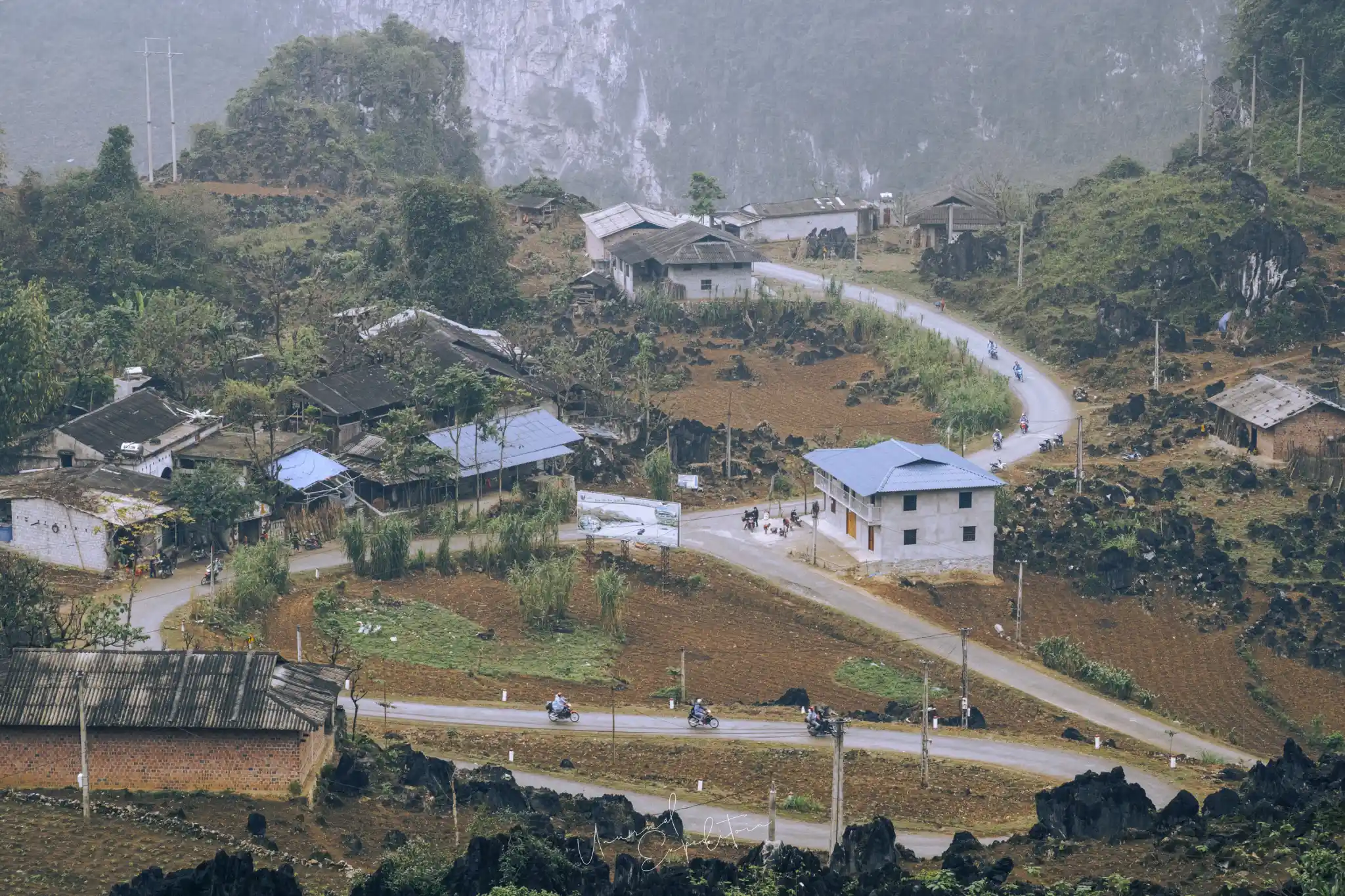
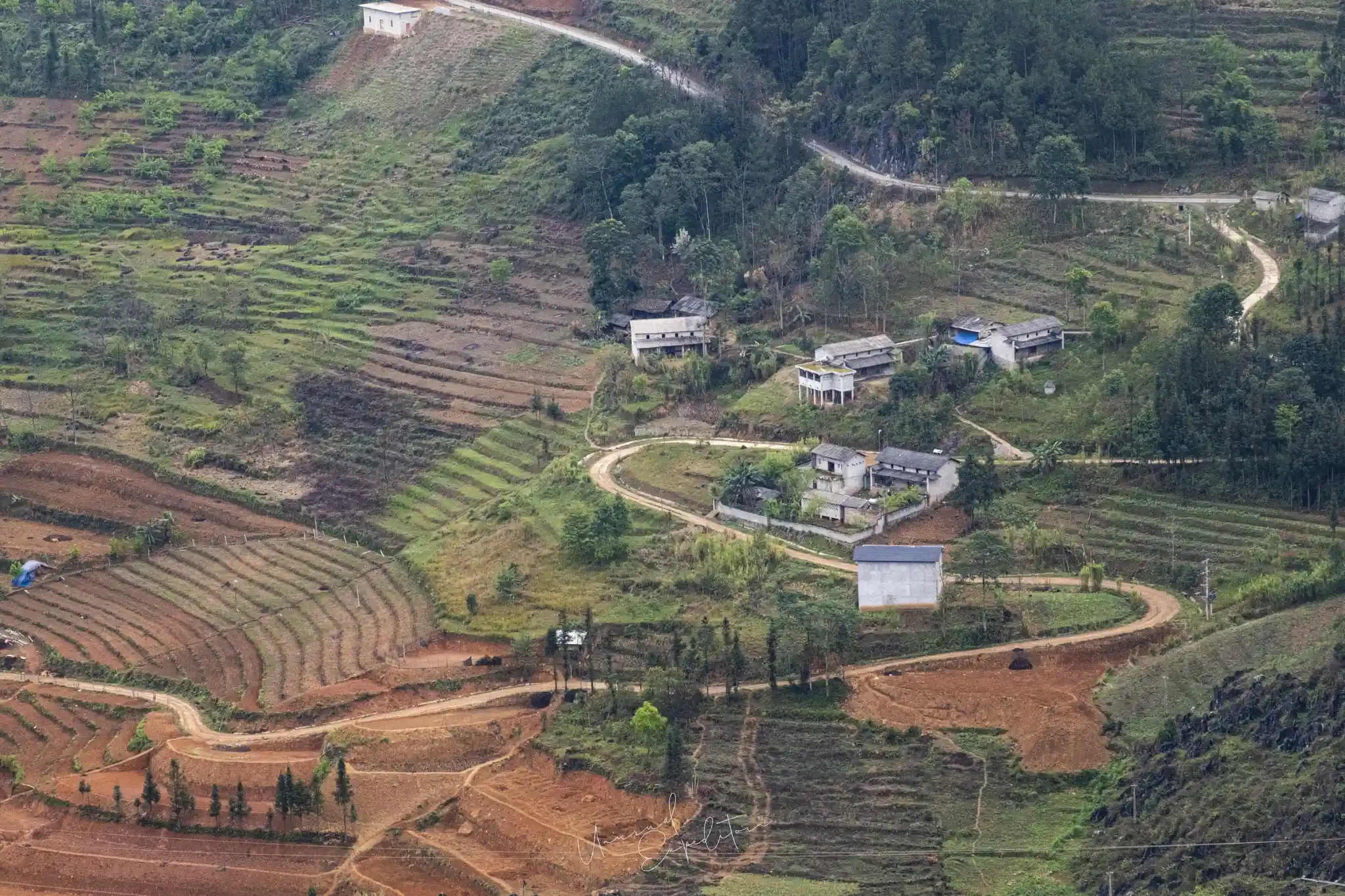
Between the passes the road drops into valleys where villages of mud-walled and stone houses sit in terraces of maize and rice under limestone peaks. On misty mornings the cloud sits on the peaks and the valley reads in layers. Our feature frame, a village and its road winding through a valley below the karst, is that kind of morning. Stop at a safe pull-off above the village, use a 70-200mm to compress the houses against the slope, and wait for a motorbike on the road to give scale. Stop only where there is space off the road; the bends are blind.
Quan Ba and the twin mountains
Quan Ba, often called Heaven's Gate, is the first big pass on the loop from Ha Giang city. From the viewpoint at the top the road falls away into a wide valley with two rounded hills, the so-called twin mountains, rising from the fields. Morning light from the east lights the valley floor. Expect tour groups and motorbike convoys; arriving early helps.
Terraced fields in the lower valleys
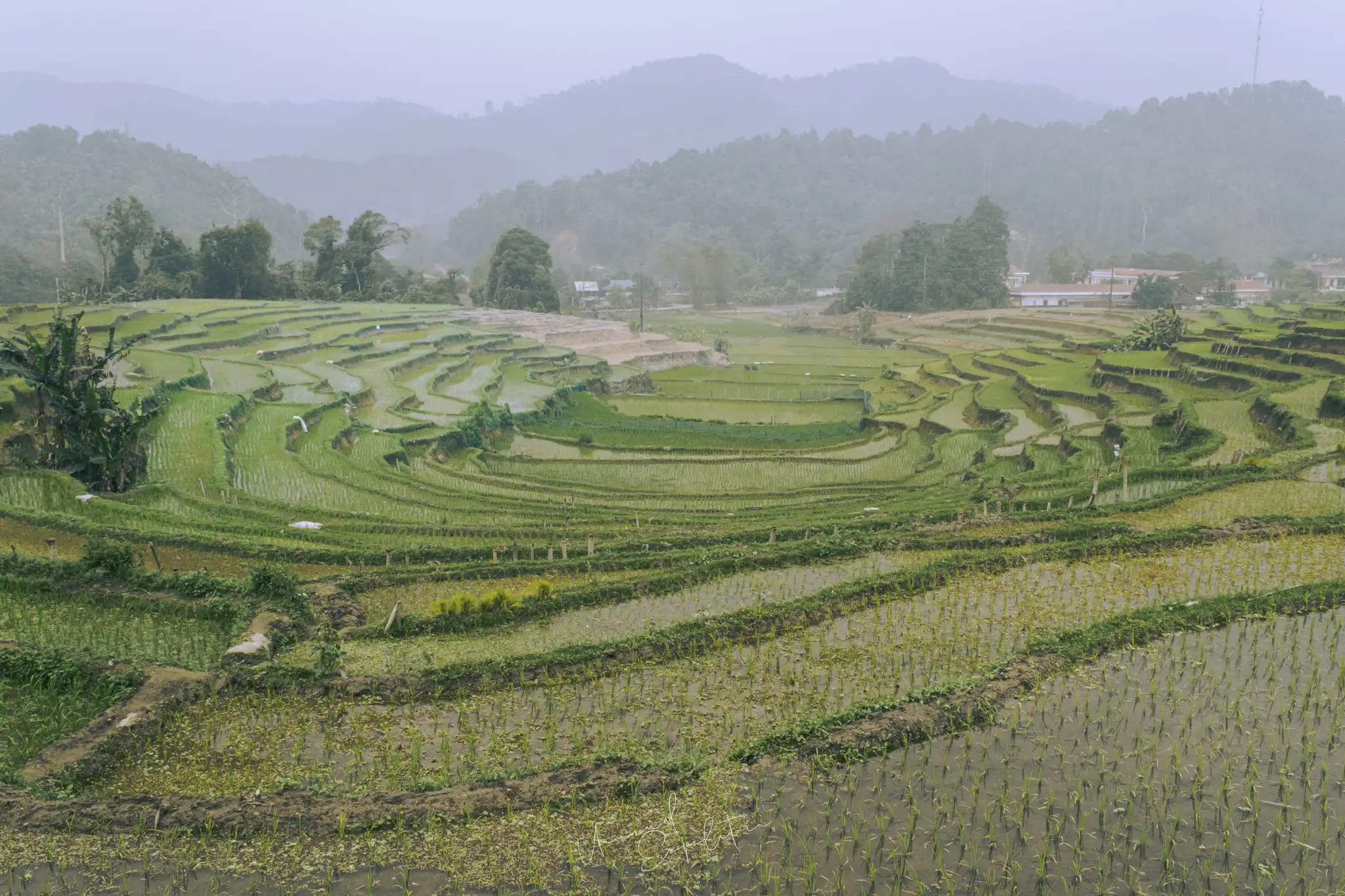
Ha Giang's lower valleys hold terraced fields stepped into the hillsides, which in March are wet and being prepared, so the terraces show as lines of water and earth. The light on the terraces is best soon after sunrise and late in the afternoon, when it rakes along the steps. A 24-70mm for the hillside, a 70-200mm for a farmer on a terrace edge. Ask before you walk along a dyke and keep to the paths.
Ma Pi Leng pass and the Nho Que river
Ma Pi Leng, on the road between Dong Van and Meo Vac, is the pass most people come to Ha Giang to see: a road cut into the cliff high above the green Nho Que river, which runs through a deep gorge. The light in the gorge is best in the morning and late afternoon; at midday the river goes flat. Use the pull-offs and viewpoints, not the road edge. A 16-35mm for the scale of the gorge and a 70-200mm for the river bends. Lung Cu flag tower, the northernmost point of Vietnam, is a short detour from Dong Van.
The weekly markets
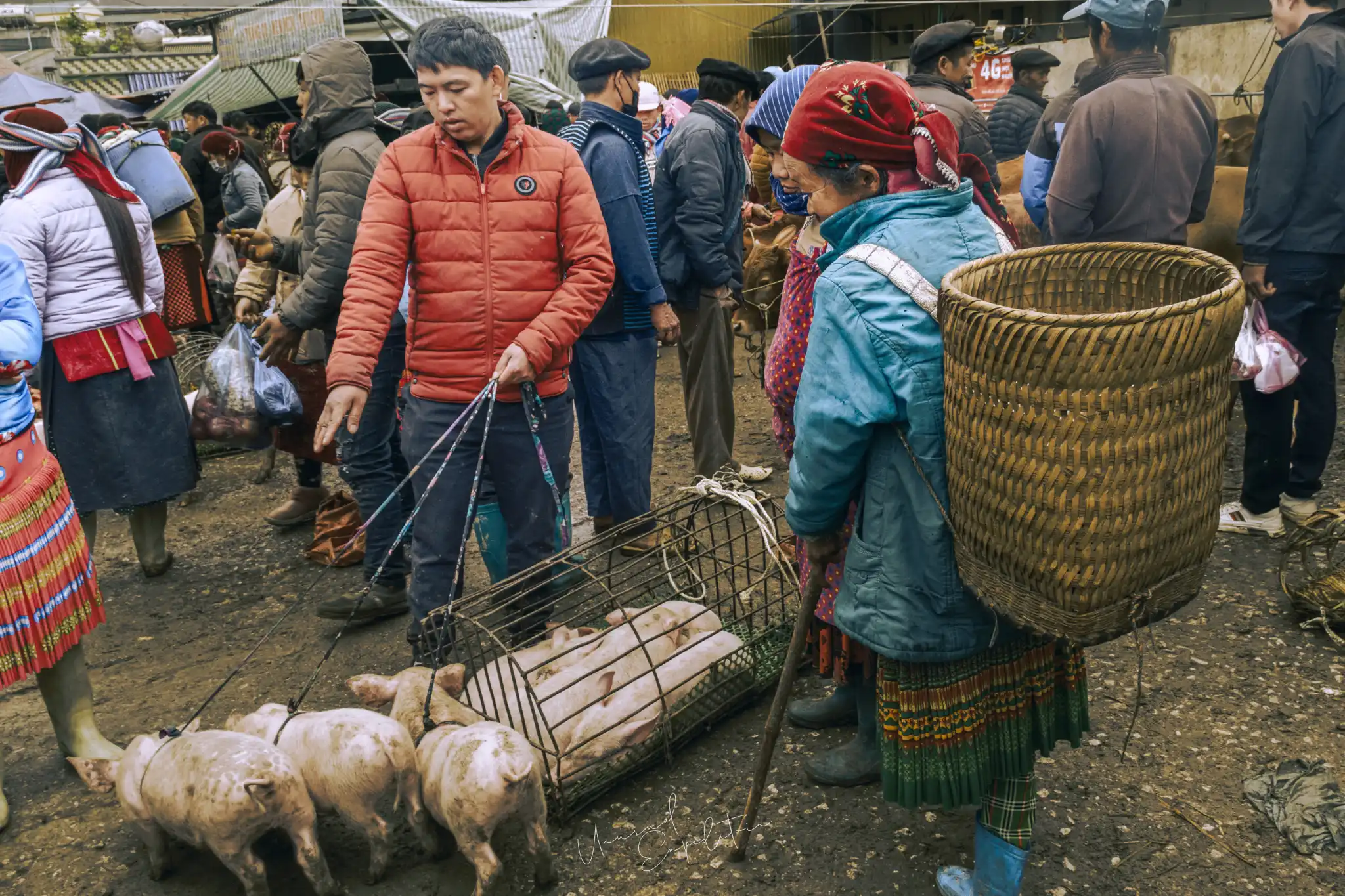
Markets are the heart of a Ha Giang trip. Dong Van and Meo Vac are well known for their Sunday markets, and smaller towns trade on other days of the week. Hmong and other communities come in from the villages to buy and sell livestock, cloth, tools and food, and the morning is busiest. Our March frames come from two weekly markets whose towns we have not named. A 24-70mm, a slow walk and a friendly manner do the work; ask before close portraits and never photograph children without a parent's agreement. More is in Ha Giang market photos.
Mu Cang Chai terraces
Mu Cang Chai, far to the southwest of Ha Giang, has some of Vietnam's most photographed rice terraces, on La Pan Tan, Che Cu Nha and De Xu Phinh, with Mam Xoi hill and the Khau Pha pass as favourite viewpoints. The terraces turn gold from mid September to early October and fill with water in May and June. Morning mist often lies in the valleys; late afternoon light gives the most relief on the steps. Our harvest frames are in Mu Cang Chai rice terraces photography.
Long Coc tea hills
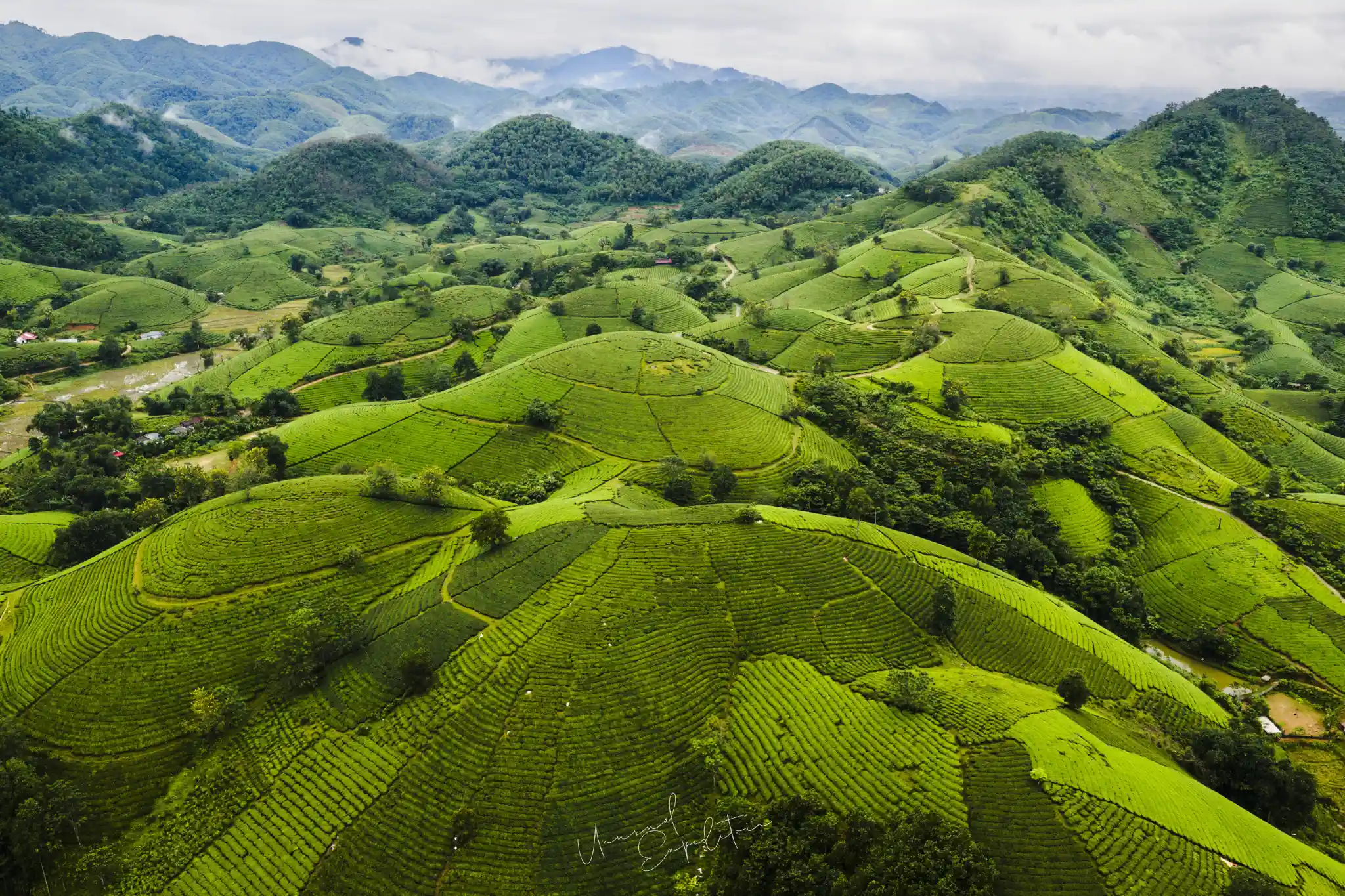
On the road from Hanoi toward Mu Cang Chai, the tea hills of Long Coc in Phu Tho rise from the mist like islands, which is why VietNamNet calls them the Ha Long Bay of the midlands. The mist is thickest early in the morning. From a hilltop or from the air the rows of tea wrap around each rounded hill. A 70-200mm isolates single hills; the drone pictures need a permit. Our page is Long Coc tea hill.
Ha Giang photo spots by season
| Spot | Best season | Best light |
|---|---|---|
| Valley villages | Year round, misty mornings | Early morning |
| Quan Ba | Year round | Morning |
| Lower valley terraces | Spring water, autumn gold | Sunrise, late afternoon |
| Ma Pi Leng | Clear days | Morning, late afternoon |
| Weekly markets | Year round | Morning |
| Mu Cang Chai | Mid September to early October, May to June | Late afternoon |
| Long Coc tea hills | August to December | Early morning mist |
Peach and plum blossom colour the villages from late February to early April, and buckwheat flowers in late autumn, so the north has more than one good season.
In Ha Giang the road is the subject. You stop because the light has hit a village or a market truck has pulled in, and the best frames of the trip are rarely at the famous viewpoint.
Joseph Mak, tour leader, Unusual Expedition
Photograph the north with us
We run Ha Giang, Mu Cang Chai and the north as private trips and announce any scheduled departure on the Vietnam photography tours page. Is the loop worth the miles? Our view is in is the Ha Giang loop worth it.
Join the Ha Giang and Mu Cang Chai photography tour
Mekong And Central Highland Vietnam Photo Tour - Vietnam departs 16 Jan 2027 To 24 Jan 2027, led by Joseph Mak. Small group, photography first. All Ha Giang and Mu Cang Chai photography tours.
Explore Ha Giang and Mu Cang Chai in depth
- Ha Giang and Mu Cang Chai Photography Tour Guide: Vietnam's Northern MountainsVietnam
- Long Coc Tea Hill: The Tea Country on the Road to Mu Cang ChaiVietnam
- Is the Ha Giang Loop Worth It? And How to Get to Ha Giang from HanoiVietnam
- Ha Giang Market Photos: Photographing a Hmong Market with RespectVietnam
- Ha Giang Loop Photos: Passes, Villages and Fields Along the RoadVietnam
- Best Time to Visit Ha Giang: Blossom, Mist and BuckwheatVietnam
- Sapa, Mu Cang Chai or Ha Giang: Which Northern Mountains to PhotographVietnam
- Mu Cang Chai Rice Terraces: Photography, Best Time and How to Get ThereVietnam
Upcoming Photo Tours
- Egypt Photo Tour – EgyptEgypt 12 Dec 2026 To 20 Dec 2026
- Inner Mongolia Winter Owl Photo Tour – ChinaChina 01 Jan 2027 To 04 Jan 2027
- Inner Mongolia Winter Photo Tour – ChinaChina 05 Jan 2027 To 11 Jan 2027
- Mekong And Central Highland Vietnam Photo Tour - VietnamVietnam 16 Jan 2027 To 24 Jan 2027