
Hadza People Culture at the Fire: Photographing Evenings near Lake Eyasi
Hadza people culture at the camp fire near Lake Eyasi: dusk light, firelight settings, no flash, and photographing with respect.
Hadza people culture is easiest to feel, and to photograph, at the fire. In the camps near Lake Eyasi the fire is where meat is cooked and shared, arrows are straightened, pipes are passed round and the day is talked over, and at dusk it is also the best light in the bush. A few quiet hours from the blue hour into darkness give you warm faces against a cold sky, sparks and smoke, and some of the most personal pictures of a Tanzania trip.
For the area as a whole, and how a visit is arranged, start with our Lake Eyasi photography tour guide.
Hadza people culture around the fire
Hadza people culture puts a great deal of weight on sharing, and the fire is where you see it. Frank Marlowe, who spent many years with Hadza camps and wrote the standard modern account, The Hadza, describes how meat from a hunt is spread widely through a camp and how no one is expected to eat alone while others go without. Hadza men still make fire with a hand drill, spinning a thin stick against a softer piece of wood until the wood dust smoulders, a skill Marlowe describes as part of everyday camp life. Around the fire, men repair arrows and heat shafts to straighten them, smoke, tell stories and tease each other in Hadzane, their language of click sounds. Visitors sit at the edge. Our page on the Hadzabe tribe in Tanzania explains more about who the Hadza are today.
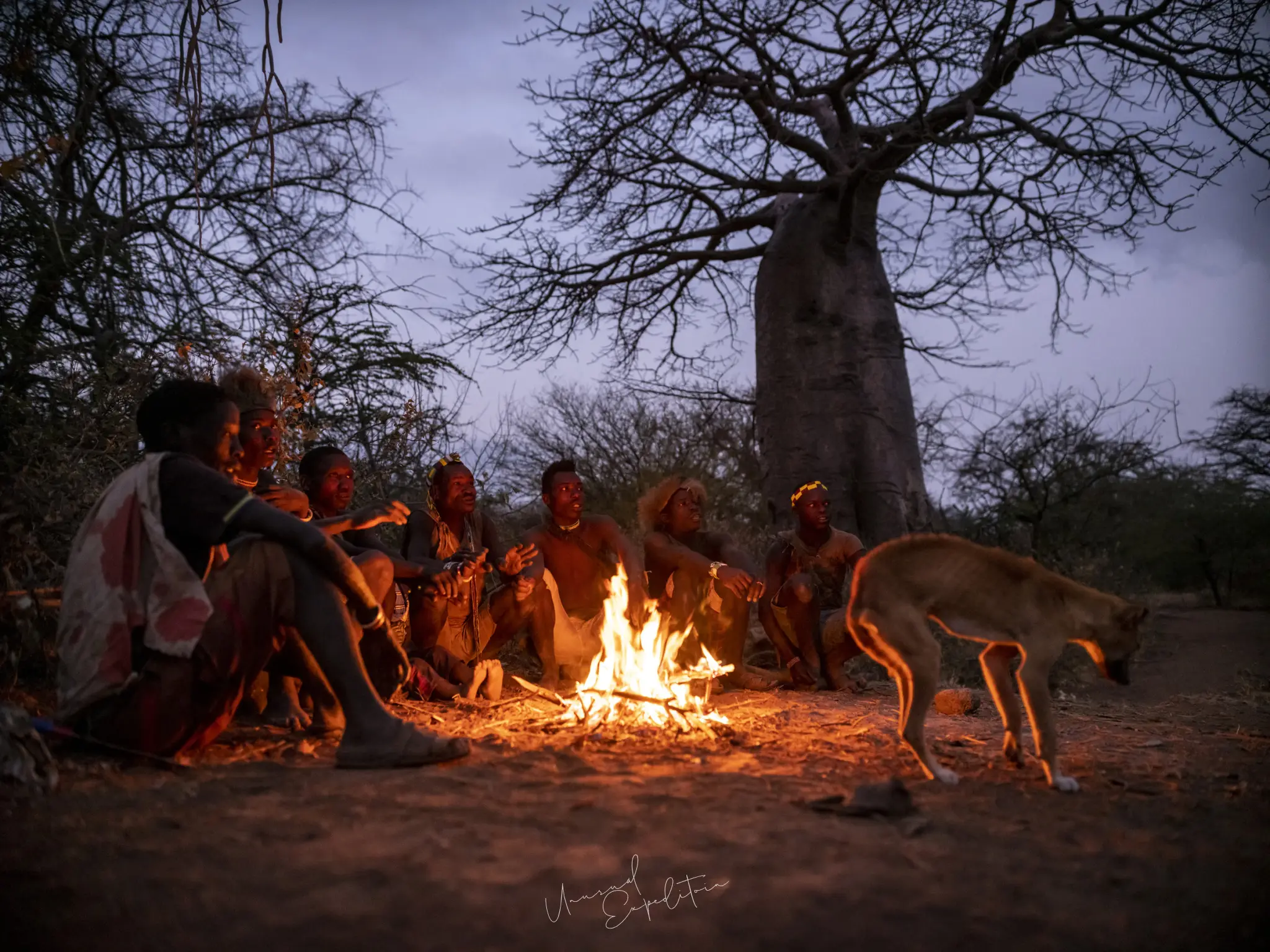
Dusk light near Lake Eyasi
Dusk near Lake Eyasi gives you a short window when the sky and the fire are in balance. Just after sunset, the sky behind the trees turns blue and violet, and a fire lights the faces around it in warm orange. That contrast lasts only a little while: soon the sky goes black and the only light left is the flame. Arrive at the fire while there is still colour in the sky, frame the baobab or the bush behind the group, and expose for the sky so the trees hold their shape. Then, as darkness comes, move closer and let the fire be the only light. In the dry season the dust and smoke in the air soften everything, which helps. The baobabs that stand over many camps have their own page: baobab trees around Lake Eyasi.
Camera settings for firelight
Firelight is dim, flickering and very warm, so plan for high ISO and a steady hand. A tripod is awkward around people sitting close together; a fast lens is more useful.
| Scene | Light | Lens | Settings to start from |
|---|---|---|---|
| Group at the fire, sky still blue | Blue hour plus flame | 16-35mm or 24-70mm | 1/60 s, wide aperture, ISO 1600 to 3200, expose for the sky |
| Faces lit by flame after dark | Firelight only | 24-70mm at f/2.8 | 1/125 s, ISO 3200 to 6400, expose for the skin |
| Smoke and sparks | Backlit by the fire | 24-70mm | Shoot into the flame from low down, underexpose a little |
| Hands and embers | Daylight or embers | 24-70mm | Overhead angle, include the ash ring |
Set the white balance by hand to around 3200 to 4000 kelvin, or the faces turn orange and the sky loses its blue.
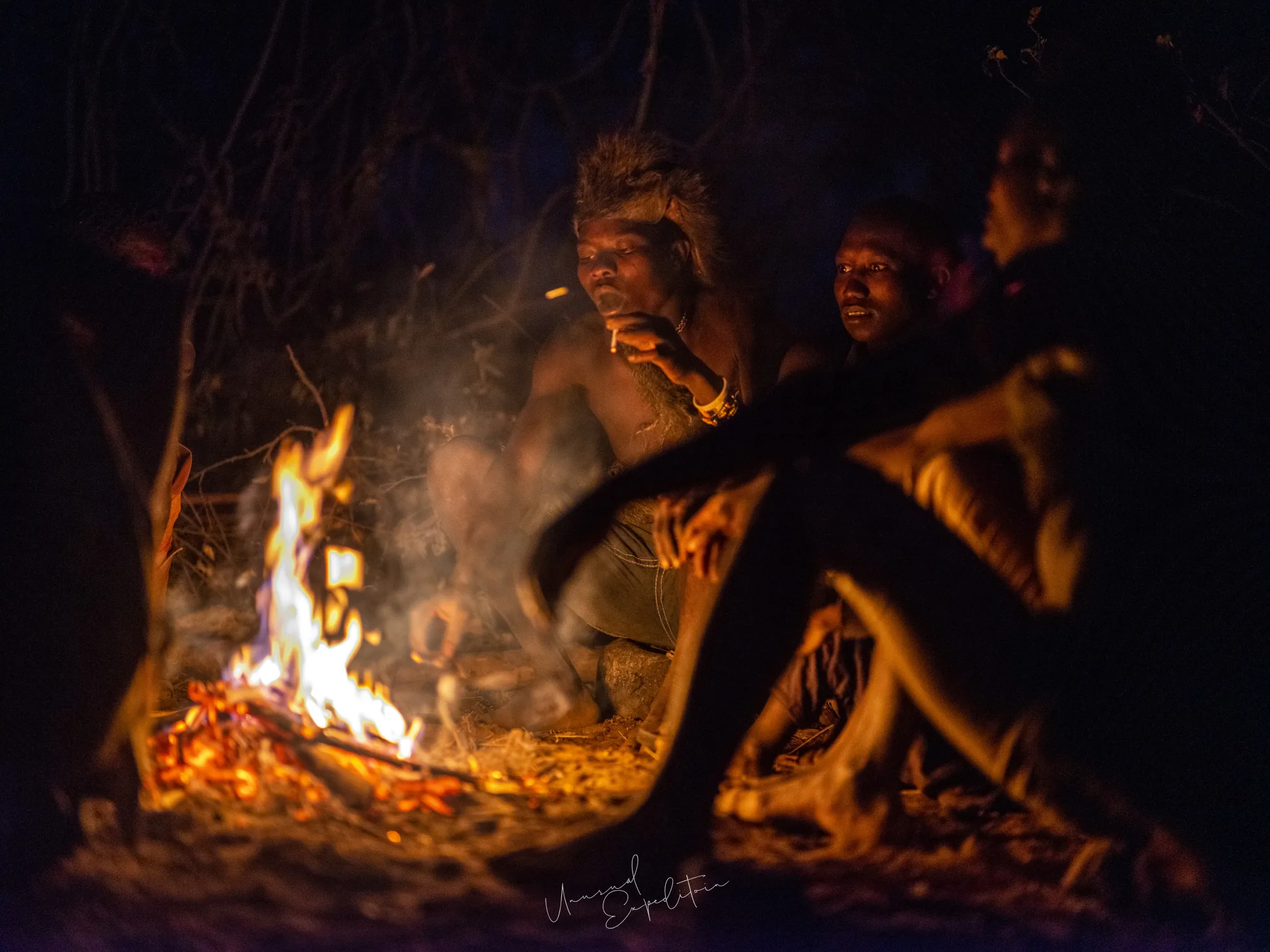
No flash at the fire
No flash is our rule at a Hadza fire, and it is a rule about people before it is about pictures. A flash in the dark is startling, it kills the mood around the fire, and it flattens the very light you came for. Use the fire. Keep the camera quiet, switch off focus-assist lamps and screen review in the dark, and do not shine a head torch into people's faces. Ask the group through your local guide whether they are happy to be photographed after dark, and stop when someone turns away. If children come to the fire, put the camera down. The evening is when people relax after a day of hunting and visitors; a few frames, then sitting with them, makes for a better evening for everyone. For the hunt that comes before, read our page on Hadzabe tribe hunting.
At the Eyasi fires I set the ISO high, sit on the ground and wait. Someone throws on dry branches, the flames jump, and for a few seconds every face in the circle lights up.
Joseph Mak, tour leader, Unusual Expedition
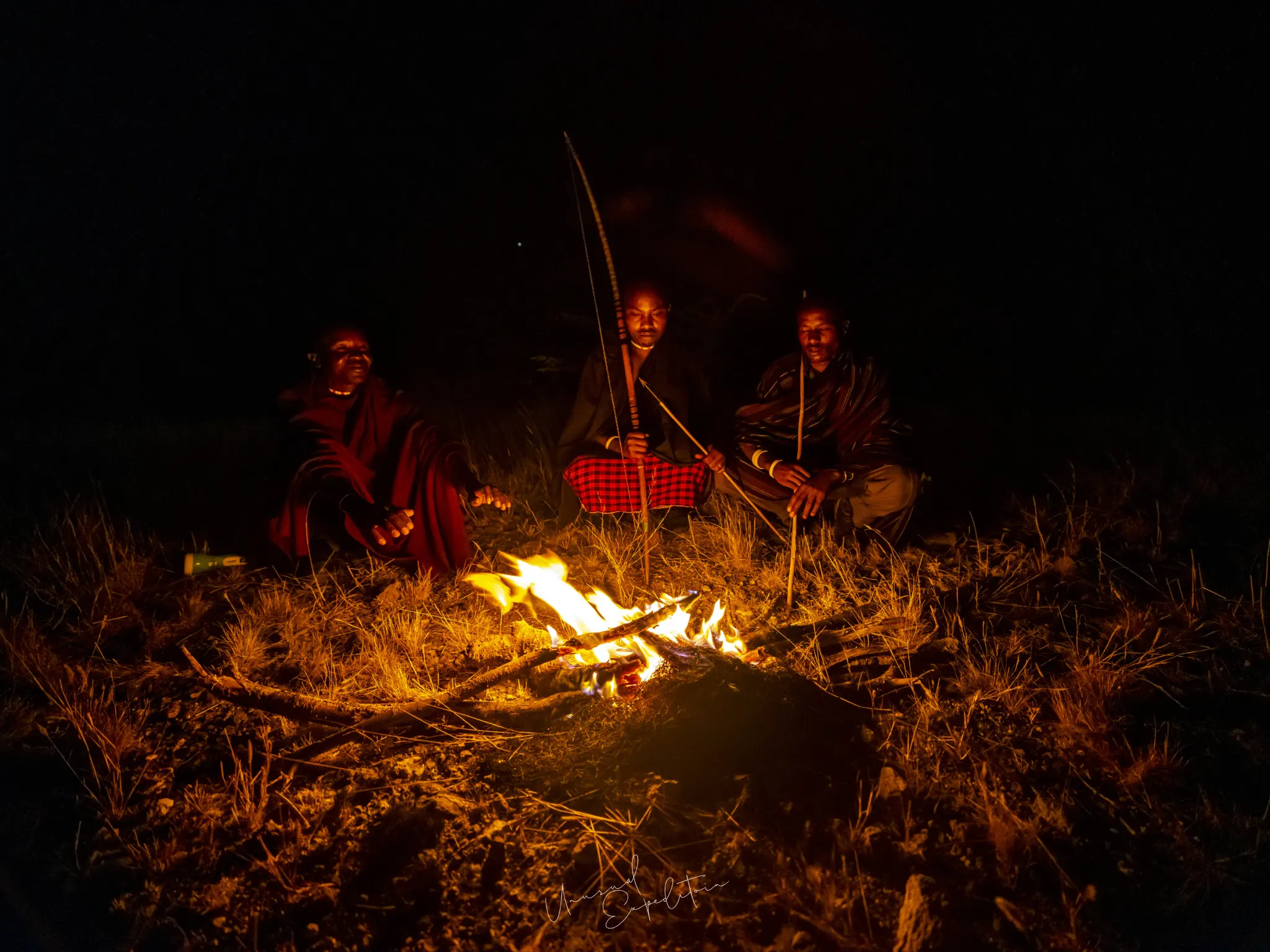
A night fire with bows
After full dark the fire becomes the whole picture. Men sit close with bows and arrows propped beside them, cloth blankets round their shoulders against the night chill, and the flame lights only the nearest faces and the bows above. Shoot from low down, at the height of the people sitting, so the fire sits in the lower part of the frame and the bows rise into the black. A 16-35mm or the wide end of a 24-70mm lets you include the whole small circle. Expose for the faces, not the flame: the fire will burn out to white at its core, and that is fine. Dry grass and twigs on the ground pick up the light and add texture. Do not move around the circle during the evening; choose your seat and work from it.
Smoke and sparks
Smoke and sparks are what make a fire picture feel alive, and both are easy to miss. Smoke only shows when light comes through it, so move until the fire is between you and the people you are photographing, or until the last of the sky is behind the smoke. Sparks fly when someone adds dry branches or stirs the embers; watch for the moment and shoot a short burst at a shutter speed slow enough, around 1/30 s, to draw each spark into a short line. Keep a cloth over the front of the lens between shots, because ash settles on everything. In the early evening, the smoke drifting through low sun also gives soft rays among the trees, which is worth a frame before the fire takes over.
Stay for an evening fire with us
Our scheduled Serengeti Photo Tour 2027 includes a Lake Eyasi visit; current dates are on the Tanzania photography tours page. Staying into the evening at a Hadza camp is easier on a private trip, which we arrange at your pace. Practical questions are answered in the Lake Eyasi photography FAQ.
Ask us about an evening at Lake Eyasi
Join the Lake Eyasi photography tour
Serengeti Photo Tour – Tanzania 2027 departs 21 Aug 2027 To 01 Sep 2027. Small group, photography first. All Lake Eyasi photography tours.
Explore Lake Eyasi in depth
- Lake Eyasi Photography Tour Guide: Hadzabe, Datoga and BaobabsTanzania
- Lake Eyasi Photography FAQ: Where the Hadzabe Live, Language, Heat and GearTanzania
- Hadzabe Tribe Tour: How to Get to Lake Eyasi and Whether It Is Worth ItTanzania
- Hadzabe Tribe in Tanzania: Who the Hadza Are and How to Photograph ThemTanzania
- Hadzabe Tribe Hunting: Bows, Honey and Photographing the HuntTanzania
- Datoga Tribe in Tanzania: Herders and Smiths of Lake EyasiTanzania
- The Baobab Tree in Tanzania: Photographing Baobabs around Lake EyasiTanzania
Upcoming Photo Tours
- Egypt Photo Tour – EgyptEgypt 12 Dec 2026 To 20 Dec 2026
- Inner Mongolia Winter Owl Photo Tour – ChinaChina 01 Jan 2027 To 04 Jan 2027
- Inner Mongolia Winter Photo Tour – ChinaChina 05 Jan 2027 To 11 Jan 2027
- Mekong And Central Highland Vietnam Photo Tour - VietnamVietnam 16 Jan 2027 To 24 Jan 2027