
Hadzabe Tribe Hunting: Bows, Honey and Photographing the Hunt
Hadzabe tribe hunting near Lake Eyasi: bows and arrows, the honeyguide bird, Hadza food, and how to photograph a hunt.
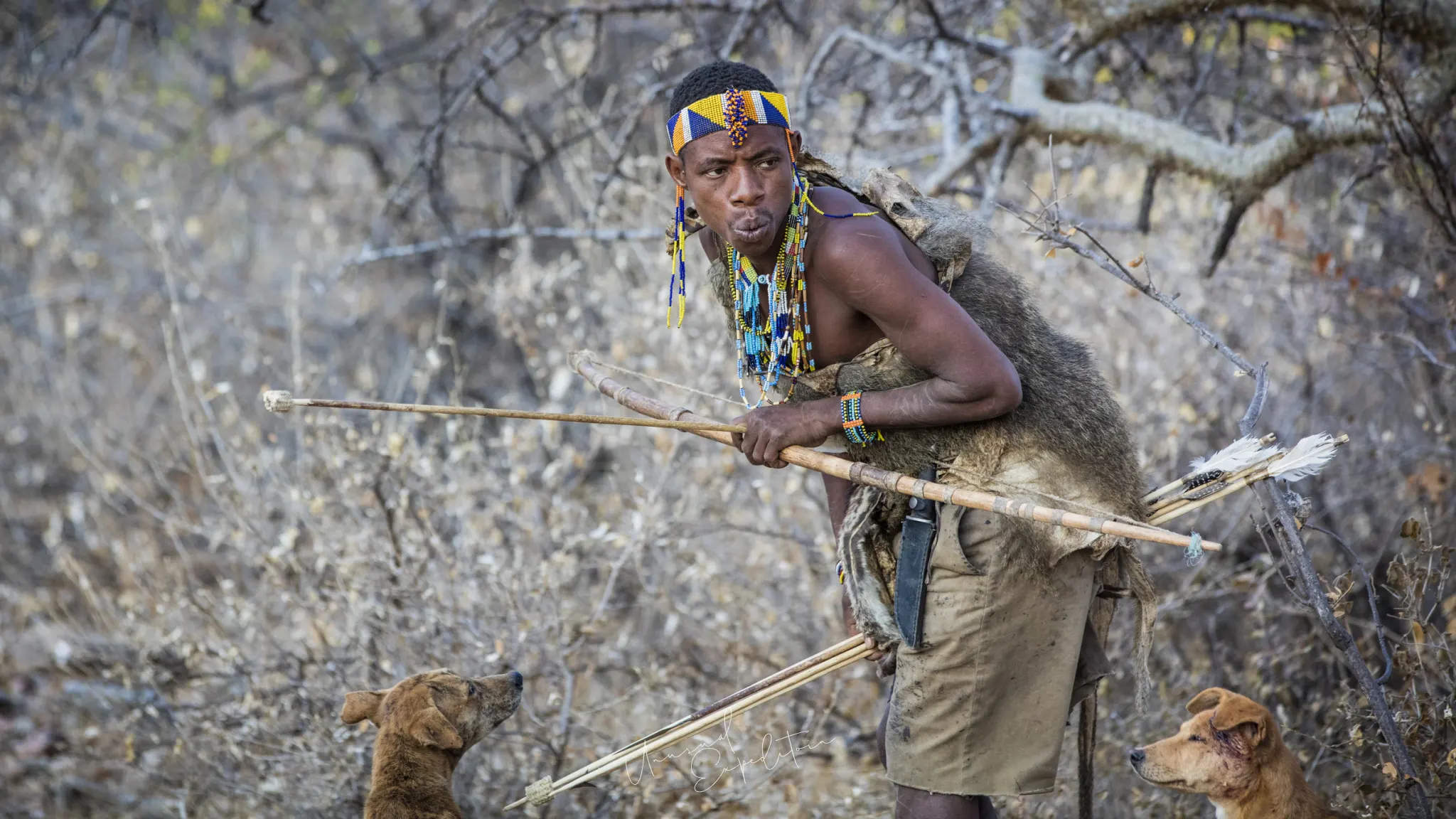
Hadzabe tribe hunting is done on foot with bows and arrows, usually by small groups of men who leave camp early with their dogs and track birds, small antelope and anything else the bush offers, while honey is found with the help of a wild bird. For photographers, joining a hunt near Lake Eyasi means fast walking through thorn scrub, a light camera and no guarantee of a kill. What you get in return are pictures of skill and concentration that no posed portrait can match.
This page sits within our Lake Eyasi photography tour guide, which explains how a visit to the lake is arranged and how it fits into a Tanzania trip.
How the Hadzabe hunt
The Hadzabe hunt with long wooden bows strung with animal tendon and with several kinds of arrow: blunt or wooden-tipped arrows for birds, and metal-tipped arrows for larger game. Frank Marlowe, the anthropologist who lived and worked with Hadza camps for many years, describes in his book The Hadza how the larger arrows are coated with plant poison, most often made from the sap of the desert rose. The Hadza do not smelt iron; the Horniman Museum in London holds Hadza arrowheads from Lake Eyasi that were cold beaten with a hammer from traded metal, and much of that metal work comes from their Datoga neighbours. Hunters move quietly, read tracks, broken grass and bird calls, and shoot from surprisingly close. Dogs flush and follow game. Many hunts end with a bird or two, or nothing, and that is normal.
Hadza honey and the honeyguide bird
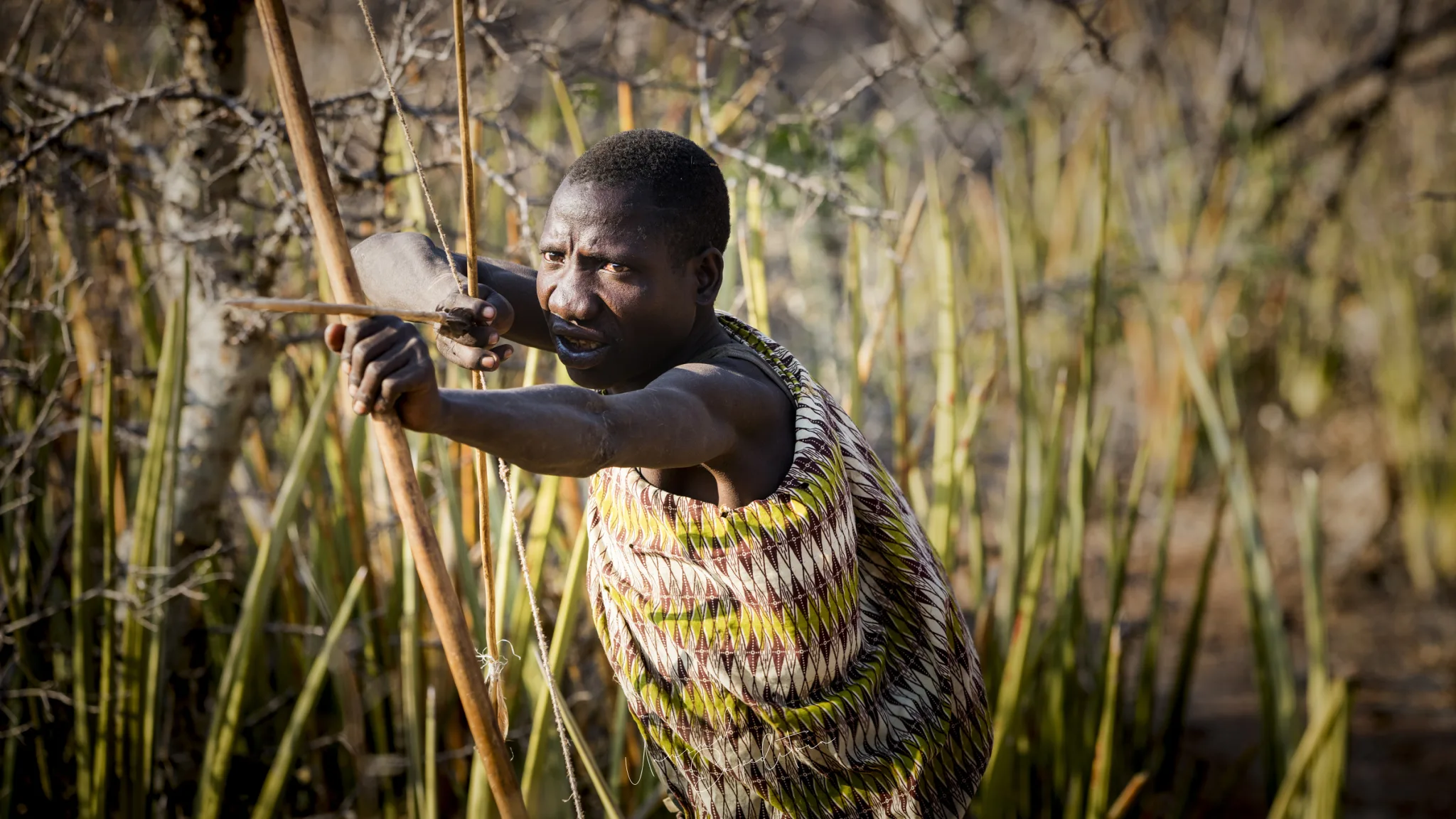
Hadza honey hunting is one of the most remarkable partnerships between people and a wild animal anywhere. The greater honeyguide, a small bird, leads honey-hunters to bees' nests and feeds on the wax they leave behind. In a study published in Science, the biologists Claire Spottiswoode and Brian Wood played recordings near Hadza land and found that honeyguides there responded far more readily to the melodic whistle of Hadza honey-hunters than to the call used by Yao honey-hunters in Mozambique, and that the opposite was true in Mozambique. The birds have learned the local human signal. On a walk you may hear the whistle and see a hunter climb a tree with a smoking bundle of grass to calm the bees, then chop into the trunk. Keep your distance: the bees are not calm.
Hadzabe tribe food
Hadzabe tribe food comes from the bush as far as the season allows. Marlowe lists five main foods: meat, honey, baobab fruit, berries and tubers, with women doing most of the digging for tubers and gathering of berries, and men most of the hunting and honey collecting. What a camp eats changes with the year: honey and berries are plentiful at some times, tubers are the steady standby. Today maize flour bought with cash or traded also feeds many camps, as the researcher Yatsuka noted around Mang'ola. When a hunt succeeds, the meat is cut up at once and cooked on the spot or carried back, and it is shared out widely. Photographing that moment is a question of judgement: it can be graphic, it belongs to the people who hunted, and you should ask before you raise the camera.
Walking with Hadza hunters: what to expect
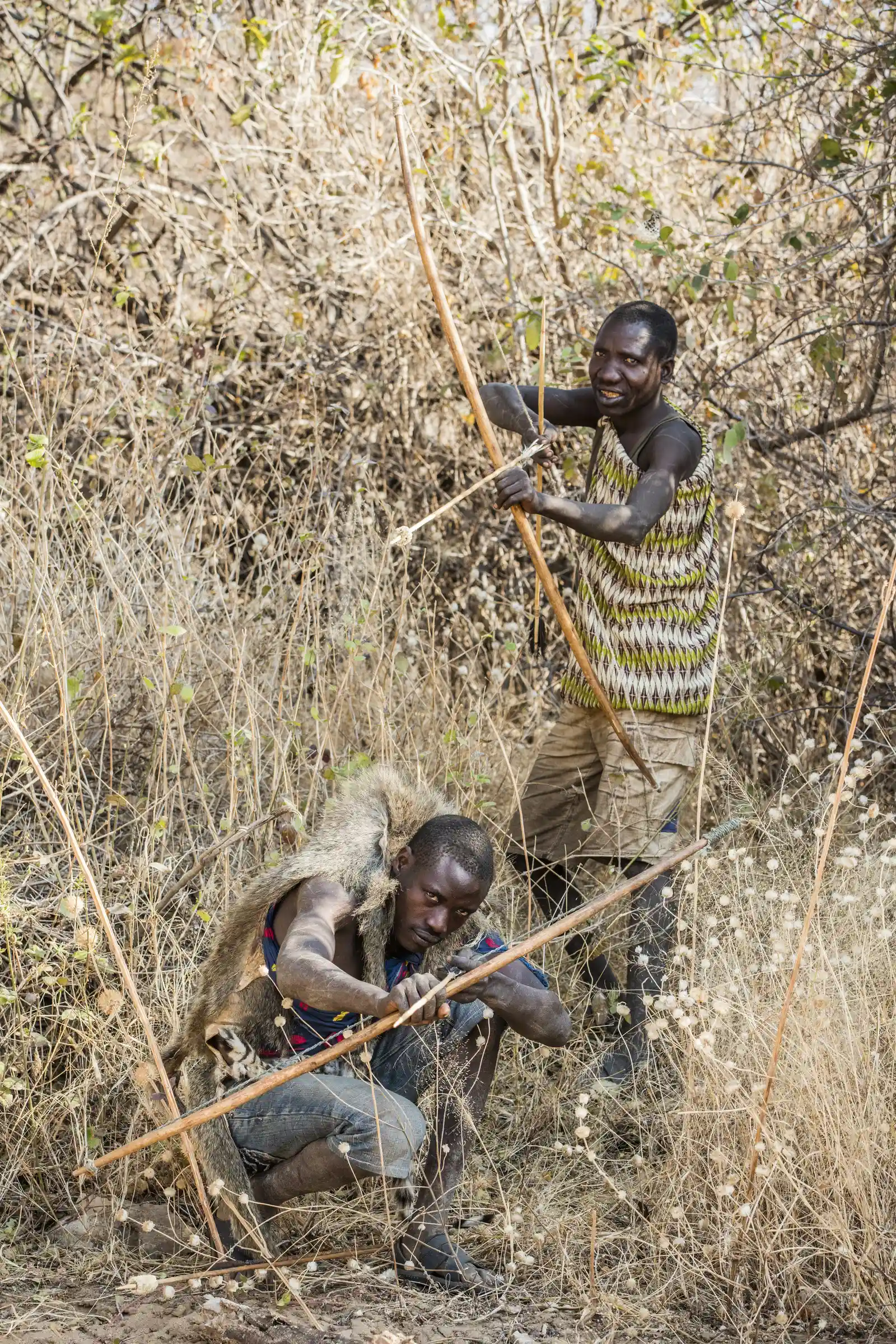
Walking with Hadza hunters near Lake Eyasi is physical. The pace is quick, the ground is stony, and every bush has thorns, so wear closed shoes with tough soles, long trousers and a hat, and carry water. Stay behind the hunters and to the side, never between a bow and its target, and stop when they stop. Talk little. If the group splits, follow your local guide, not the most photogenic hunter. Most walks go out in the cool of the early morning and are back before the heat; it is not a long trek, but it is not a stroll. You will not be asked to do anything, and you should not ask the hunters to repeat a shot or pose with a bow drawn. Our Hadzabe tribe tour page covers choosing a visit that pays the community fairly.
On my first hunt at Eyasi I spent the morning trying to get in front of the hunters for the face. The best frames came later, from behind, when I let them lead and just kept the bow and the bush in the picture.
Joseph Mak, tour leader, Unusual Expedition
Camera settings for a hunt
Camera settings for a Hadza hunt need to cope with moving people in mixed shade and sun. Keep it simple and lightweight.
| Situation | Lens | Settings to start from |
|---|---|---|
| Hunters walking through bush | 24-70mm | Shutter 1/500 s or faster, auto ISO, continuous focus |
| A hunter drawing a bow | 24-70mm or 70-200mm | 1/1000 s, focus on the eye or the arrow tip |
| Backlit in the early sun | 24-70mm | Expose for the face, let the background burn out |
| Shade under trees or rock | 24-70mm at a wide aperture | High ISO, 1/250 s, accept the grain |
A long telephoto is rarely needed: you are close, and a big lens slows you down in the thorns.
Photographing the hunt with respect
Photographing Hadza hunting is photographing people at work, so the rule is the same as anywhere: do not get in the way, and do not turn their work into a show for you. The fee for the visit pays for your presence, not for a staged kill. If a hunt is unsuccessful, that is the picture of the day. Never photograph children who follow the hunters, even from behind. When the men return and rest, the quieter frames come: arrows being straightened over the fire, bows restrung, people under a baobab. Our page on baobab trees around Lake Eyasi shows how those trees anchor a frame, and the Lake Eyasi photography FAQ covers heat, clothing and gear in more detail.
Join a hunt with us
Our Serengeti Photo Tour 2027 includes a Lake Eyasi visit; see the Tanzania photography tours page for current dates. For more than one morning with the hunters, we arrange a private trip.
Join the Lake Eyasi photography tour
Serengeti Photo Tour – Tanzania 2027 departs 21 Aug 2027 To 01 Sep 2027. Small group, photography first. All Lake Eyasi photography tours.
Explore Lake Eyasi in depth
- Lake Eyasi Photography Tour Guide: Hadzabe, Datoga and BaobabsTanzania
- Lake Eyasi Photography FAQ: Where the Hadzabe Live, Language, Heat and GearTanzania
- Hadzabe Tribe Tour: How to Get to Lake Eyasi and Whether It Is Worth ItTanzania
- Hadzabe Tribe in Tanzania: Who the Hadza Are and How to Photograph ThemTanzania
- Hadza People Culture at the Fire: Photographing Evenings near Lake EyasiTanzania
- Datoga Tribe in Tanzania: Herders and Smiths of Lake EyasiTanzania
- The Baobab Tree in Tanzania: Photographing Baobabs around Lake EyasiTanzania
Upcoming Photo Tours
- Egypt Photo Tour – EgyptEgypt 12 Dec 2026 To 20 Dec 2026
- Inner Mongolia Winter Owl Photo Tour – ChinaChina 01 Jan 2027 To 04 Jan 2027
- Inner Mongolia Winter Photo Tour – ChinaChina 05 Jan 2027 To 11 Jan 2027
- Mekong And Central Highland Vietnam Photo Tour - VietnamVietnam 16 Jan 2027 To 24 Jan 2027