
The Baobab Tree in Tanzania: Photographing Baobabs around Lake Eyasi
The baobab tree in Tanzania: where to find baobabs around Lake Eyasi, silhouettes, scale with people, and when they look best.
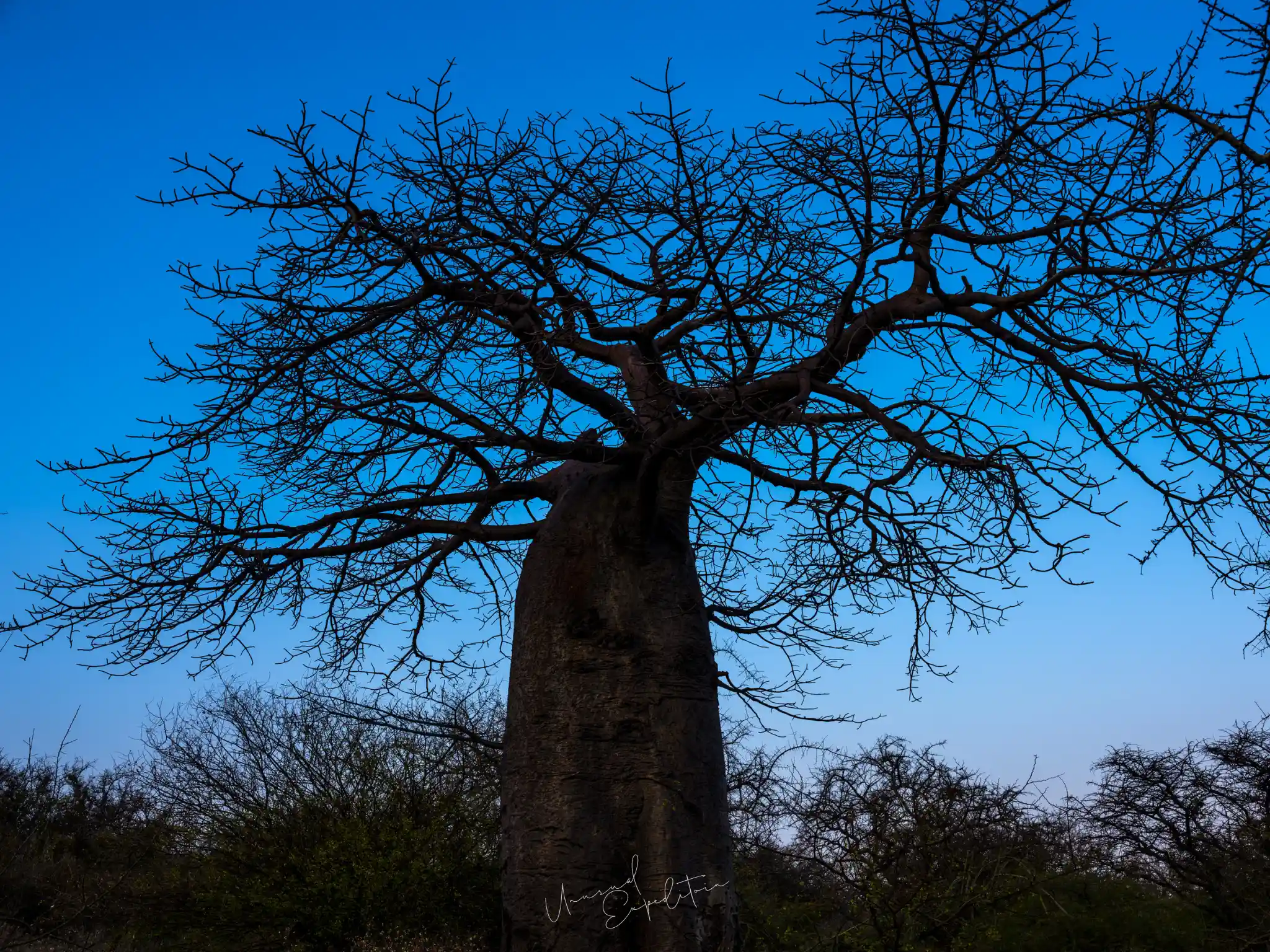
The baobab tree in Tanzania is the African baobab, Adansonia digitata, and the dry woodland around Lake Eyasi is one of the best places in the north to photograph it. Huge grey trunks stand above the thorn scrub, bare-branched for much of the dry season, with Hadza camps, hunters and fires often gathered at their feet. Shot against a clear blue sky or as a dusk silhouette, a baobab gives a Lake Eyasi set the sense of place that the hazy lake itself rarely does.
Baobabs are one part of a visit described in our Lake Eyasi photography tour guide.
The baobab tree in Tanzania
The baobab tree in Tanzania grows across the hot, dry lowlands, from the coast to the Rift Valley, and the woodland around Lake Eyasi has many fine specimens. Britannica describes the African baobab as a massive tree with a swollen trunk and a hard-shelled fruit whose pulp makes a refreshing drink; the trunk stores water, and the tree drops its leaves in the dry season. Through the long dry season the tree stands leafless, which is when its branches make those famous root-like silhouettes; leaves come back with the rains. For the Hadza the baobab is food as well as shade. Frank Marlowe, in his account of Hadza life, counts baobab fruit among the five main Hadza foods, and the dry, sour pulp is eaten straight from the shell. Bee nests in baobab trunks are also a source of honey, which Hadza men reach by climbing.
Where to find baobabs near Lake Eyasi
Baobabs near Lake Eyasi grow mostly in the woodland above the lake shore, on stony ground among acacias and granite boulders, the same country where Hadza camps are set up. You do not need to go looking for a particular tree; your local guide will walk you through camps and hunting ground where baobabs are part of every view. Some camps sit right under a big tree, and a fire at its foot at dusk makes one of the classic pictures of the area. The walk with the hunters is often the best baobab walk too, because it leads away from the tracks. Our page on evening fires near Lake Eyasi shows a baobab and a fire in the same frame, and Hadzabe tribe hunting covers the walk.
Photographing baobab silhouettes
Baobab silhouettes near Lake Eyasi work best against a clean sky, and the dry season gives you plenty of those. Get low and close with a 16-35mm, so the trunk fills the lower frame and the branches spread out across the sky. In strong daylight, a polariser deepens the blue behind the bare branches; at dusk, expose for the sky and let the tree go black. Walk round the tree before you shoot: from one side the crown is a tangle, from another it opens out into a clear fan. Keep the horizon low and the frame simple, since the shape is the subject.
| Light | Look | Lens | Tip |
|---|---|---|---|
| Bright day, blue sky | Grey trunk, dark branches on deep blue | 16-35mm with a polariser | Shoot upward from close to the trunk |
| Late afternoon | Warm bark texture, long shadows | 24-70mm | Side light shows the folds of the trunk |
| Dusk | Black silhouette on violet sky | 16-35mm or 24-70mm | Expose for the sky, add a fire for warmth |
| With people | Scale and story | 24-70mm | Ask first, place the person at the trunk |
The blue-sky silhouette is the frame most people want, and it needs almost nothing but a clear day.
Giving a baobab scale
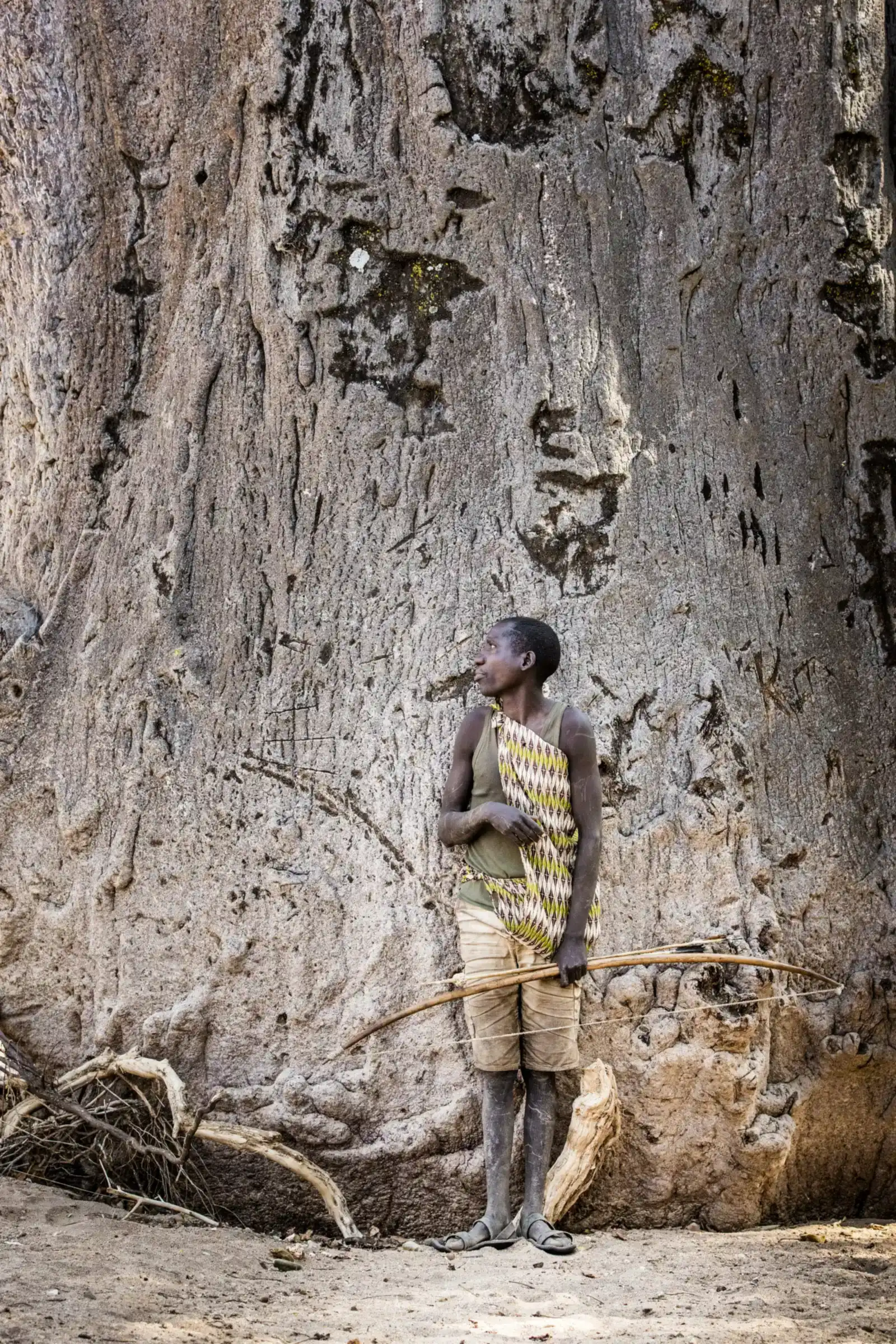
A baobab on its own can look smaller than it is, because nothing nearby gives a sense of size. A person at the foot of the trunk solves that immediately. Near Lake Eyasi that person is often a Hadza hunter who happens to be resting in the shade, and the picture should come from that moment, not from asking someone to pose as a measuring stick. Ask first, through your local guide, and keep the person natural, standing or sitting as they were. A vertical frame shows the full height of the trunk; a 24-70mm at the wide end lets you include the person and a good part of the tree without distortion. In the hottest part of the day the shade under a big baobab is where people gather, so you rarely have to look far for this picture.
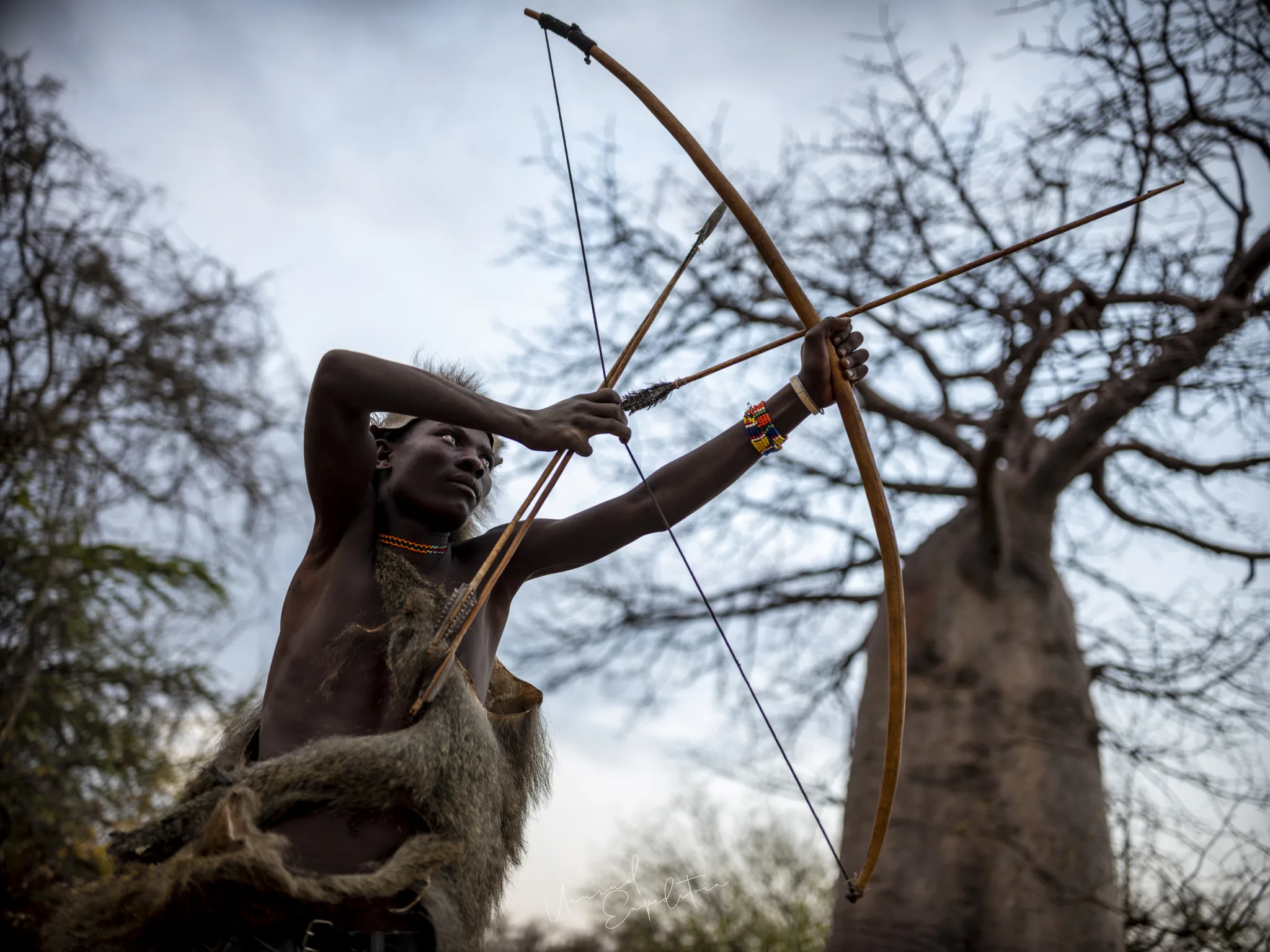
The baobabs at Eyasi are the one subject that never moves, so I leave them for the gaps: while the hunters rest, while the light is too hard for faces. Some of my favourite frames came from those quiet moments.
Joseph Mak, tour leader, Unusual Expedition
Lake Eyasi baobabs or the Avenue of the Baobabs?
Photographers who know Madagascar often ask how these trees compare with the Avenue of the Baobabs near Morondava. The Madagascar trees are a different species, tall and straight with a small crown, lined up along a road, and they are a landscape subject in their own right at sunset and at night. The baobabs around Lake Eyasi are the broad African species, scattered through woodland, and they work best as the setting for people: a camp, a fire, a hunter. If you want a pure tree landscape, Madagascar is the place; our Avenue of the Baobabs page covers it. If you want trees with a human story under them, Lake Eyasi gives you that in one walk.
When baobabs look their best
Baobabs near Lake Eyasi look their most striking in the dry season, roughly June to October, when the branches are bare and the skies are clear. After the rains the trees leaf out and the bush turns green, which is pretty but hides the shape. The Tanzania Tourist Board describes April and May, the long rains, as the hardest months for visiting the lake. Early morning and the last hour of daylight bring warm side light on the bark; the midday sun is flat and very hot. More practical answers are in the Lake Eyasi photography FAQ.
Photograph the baobabs with us
Lake Eyasi is part of our scheduled Serengeti Photo Tour 2027; current dates are on our Tanzania photography tours page. For more time in the woodland, we arrange a private trip at your pace.
Join the Lake Eyasi photography tour
Serengeti Photo Tour – Tanzania 2027 departs 21 Aug 2027 To 01 Sep 2027. Small group, photography first. All Lake Eyasi photography tours.
Explore Lake Eyasi in depth
- Lake Eyasi Photography Tour Guide: Hadzabe, Datoga and BaobabsTanzania
- Lake Eyasi Photography FAQ: Where the Hadzabe Live, Language, Heat and GearTanzania
- Hadzabe Tribe Tour: How to Get to Lake Eyasi and Whether It Is Worth ItTanzania
- Hadzabe Tribe in Tanzania: Who the Hadza Are and How to Photograph ThemTanzania
- Hadzabe Tribe Hunting: Bows, Honey and Photographing the HuntTanzania
- Hadza People Culture at the Fire: Photographing Evenings near Lake EyasiTanzania
- Datoga Tribe in Tanzania: Herders and Smiths of Lake EyasiTanzania
Upcoming Photo Tours
- Egypt Photo Tour – EgyptEgypt 12 Dec 2026 To 20 Dec 2026
- Inner Mongolia Winter Owl Photo Tour – ChinaChina 01 Jan 2027 To 04 Jan 2027
- Inner Mongolia Winter Photo Tour – ChinaChina 05 Jan 2027 To 11 Jan 2027
- Mekong And Central Highland Vietnam Photo Tour - VietnamVietnam 16 Jan 2027 To 24 Jan 2027