
Hadzabe Tribe in Tanzania: Who the Hadza Are and How to Photograph Them
The Hadzabe tribe in Tanzania: who the Hadza are, population, lifestyle today, and how to photograph them with consent.
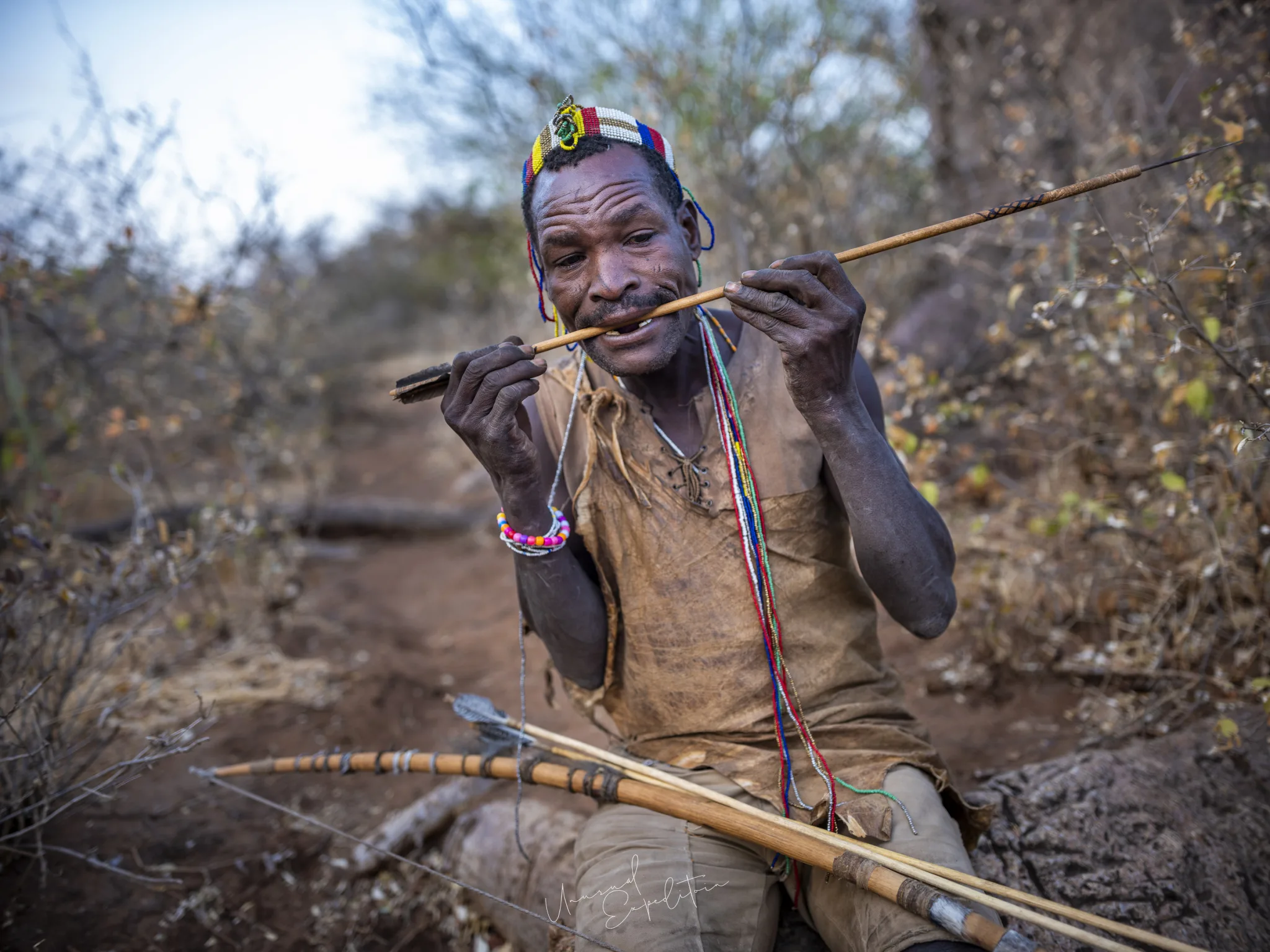
The Hadzabe tribe in Tanzania, who call themselves the Hadza, are a people of roughly 1,200 to 1,300 living in the dry bush around Lake Eyasi, south-west of the Ngorongoro highlands. A minority still live mainly by hunting with bows and gathering honey, berries, tubers and baobab fruit; many others mix foraging with cash work and visits from travellers. For a photographer they are one of the most rewarding and most sensitive subjects in East Africa, and the way you visit matters as much as the pictures.
Lake Eyasi as a whole, and how it fits into a Tanzania trip, is covered in our Lake Eyasi photography tour guide. The photographs here are our own, taken on our trips to Hadza camps near the lake; we hold the rights to them.
Who are the Hadzabe people?
The Hadzabe people are a small community of foragers whose land lies around Lake Eyasi and the Yaeda Valley to its south-east. "Hadzabe" is the name most Tanzanians and tour operators use; the people themselves say Hadza. Their language, Hadzane, is known for its click sounds, and most Hadza also speak Swahili, the national language. Researchers have worked with Hadza communities for decades, and the Max Planck Institute for Evolutionary Anthropology describes long-running fieldwork on how they share food, raise children and move between camps. Camps are small and change with the seasons: a few grass shelters in the dry woodland, or the overhang of a granite rock when the weather is hot. People move between camps freely, and a camp you visit one year may not be there the next.
Hadzabe tribe population
The Hadzabe tribe population is small, and every count comes with a caveat. The Max Planck Institute gives a figure of about 1,200, and summaries of the research literature put it at 1,200 to 1,300. National Geographic, in a long feature by Michael Finkel, reported that only about a quarter of the Hadza still lived mainly by hunting and gathering; the rest combine foraging with farm labour, tourism income or settled life near villages such as Mang'ola. Numbers fell in the past when herders and farmers moved into Hadza land, and land is still the main pressure today. In 2011 Hadza communities in the Yaeda Valley received a communal certificate of customary land rights, the first such title granted to a whole community in Tanzania, according to The Nature Conservancy, which supported the work.
Hadzabe tribe lifestyle today
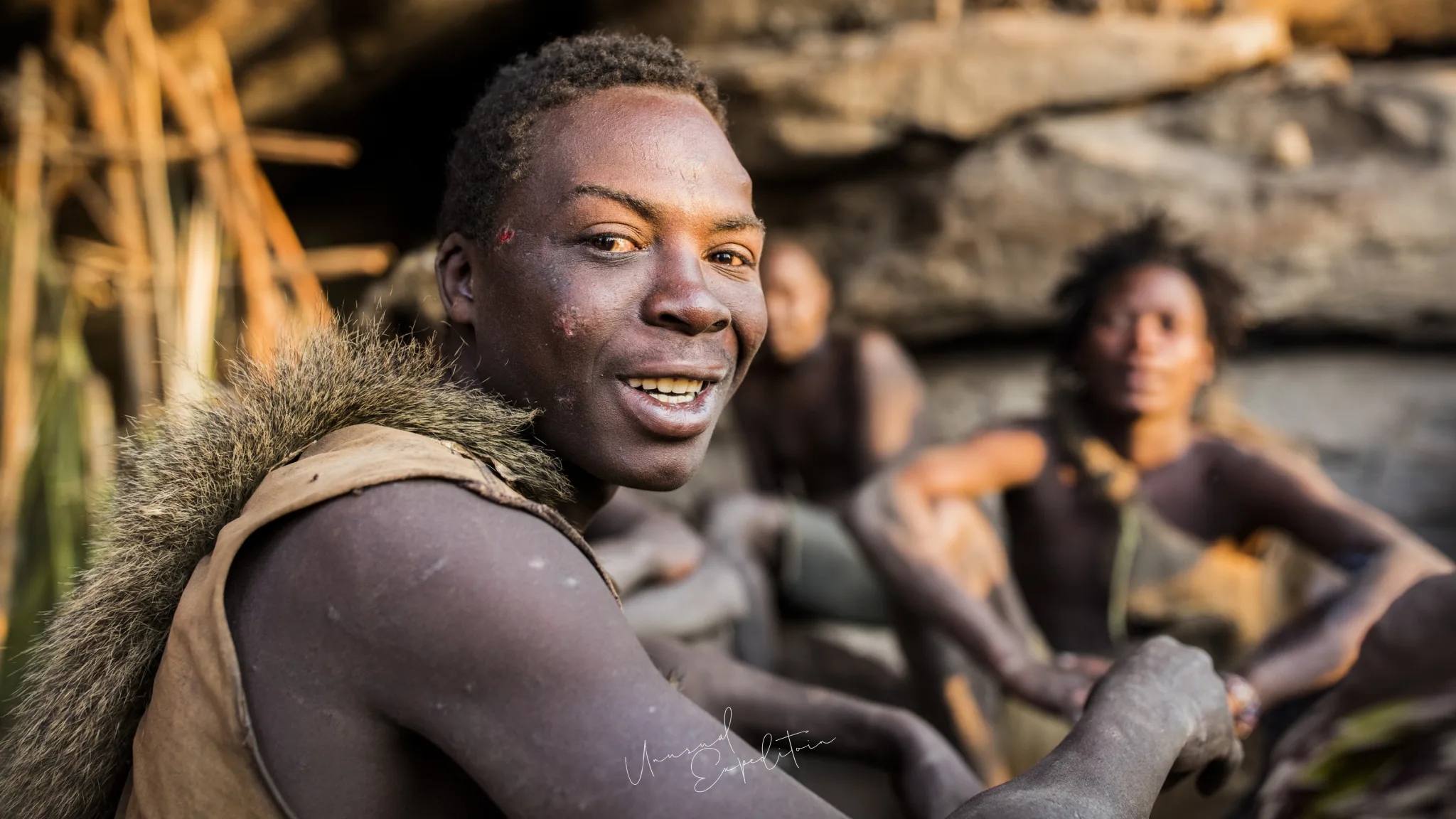
The Hadzabe tribe lifestyle today is a mix, and pretending otherwise does the people a disservice. In the camps we visited near Lake Eyasi the men still hunted with bows they made themselves, and meat from a hunt was shared out across the camp. People also wore football shirts and printed cloth, and they knew exactly how a tourist visit worked. The researcher Yatsuka, writing in the Globál e-journal, found that tourism around Mang'ola brought steady cash and easier access to maize flour, and also a stream of visitors that many Hadza found tiresome enough to leave for camps further out, coming back when they needed money. Both things are true at once. A good visit shows you a living community making its own choices, not a museum display.
Photographing Hadza portraits with consent
Hadza portraits work best when they come out of time spent together, after the hunt or at the fire, when people are relaxed and know who you are. Ask first, through your local guide, and accept a no. Show people the picture on the screen; it usually leads to laughter and a second, better frame. We never photograph children, even when parents wave them forward, and we leave women alone unless they invite the camera. Let people choose where to sit and when they have had enough; an elder straightening an arrow shaft is a better picture working than posing. A 24-70mm lens lets you stay close and talk to people, and a quiet shutter helps around a camp. Our page on Hadzabe tribe hunting covers photographing on the move.
The best Hadza portraits I have came after the camera had been on my lap for an hour. Once the men stopped watching me, they let me watch them.
Joseph Mak, tour leader, Unusual Expedition
What you see on a visit
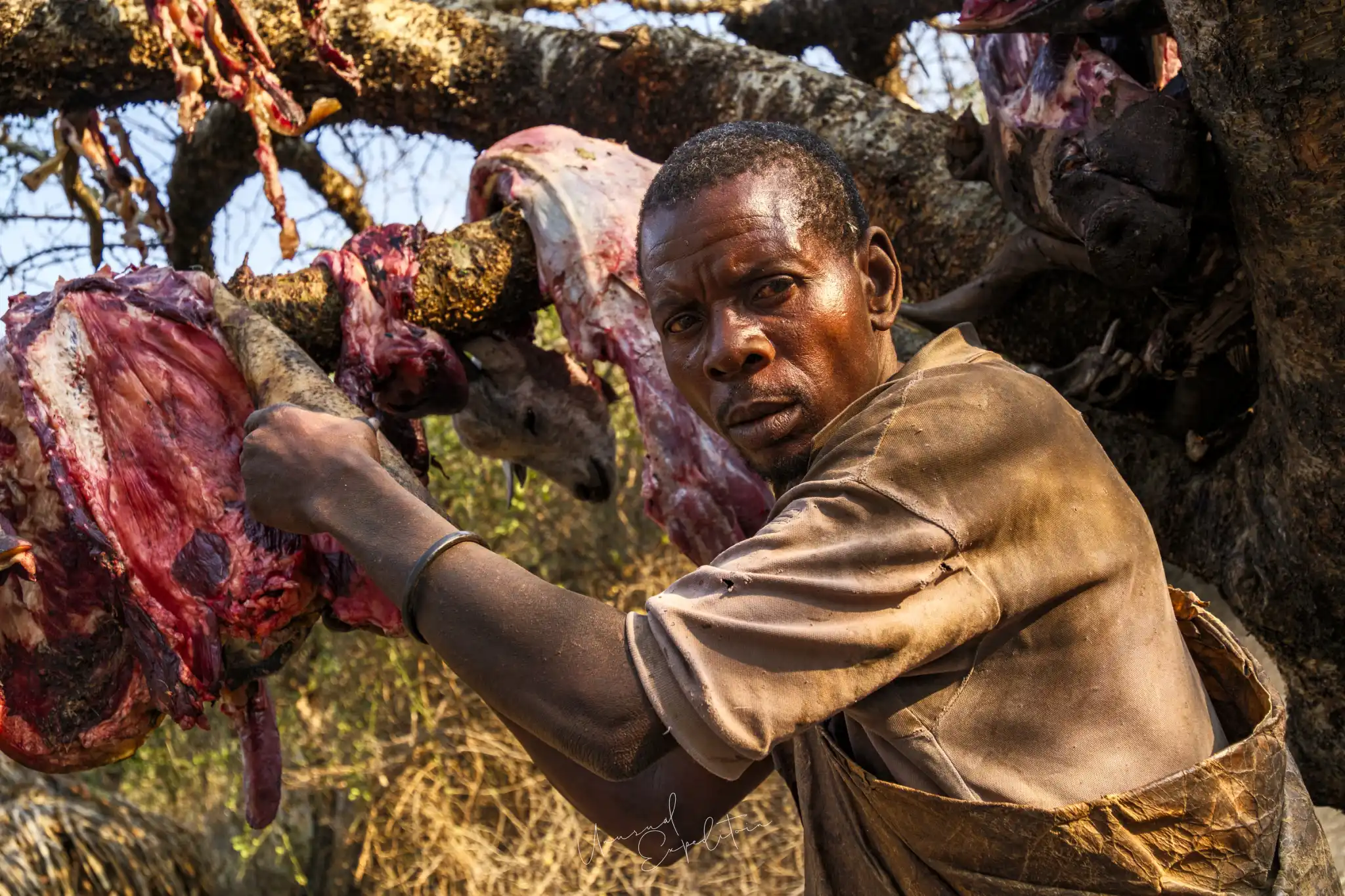
A visit with the Hadza near Lake Eyasi follows their day, not a programme. Early on, the men leave camp with bows, arrows and dogs, and you can walk with them as they track birds, small antelope and honey. When they come back, meat is cut up, cooked on a fire and shared; in a rock shelter the light is dim and warm, and the smoke catches it. Later people rest, repair arrows, straighten shafts over the fire, smoke and talk. Towards dusk the fire becomes the centre of camp again, which is when our evening fire pictures were made. You will not see everything on one visit, and that is fine; the camps do not perform. Nearby you can also visit Datoga herders, who are described on our Datoga tribe page.
Words we avoid, and why
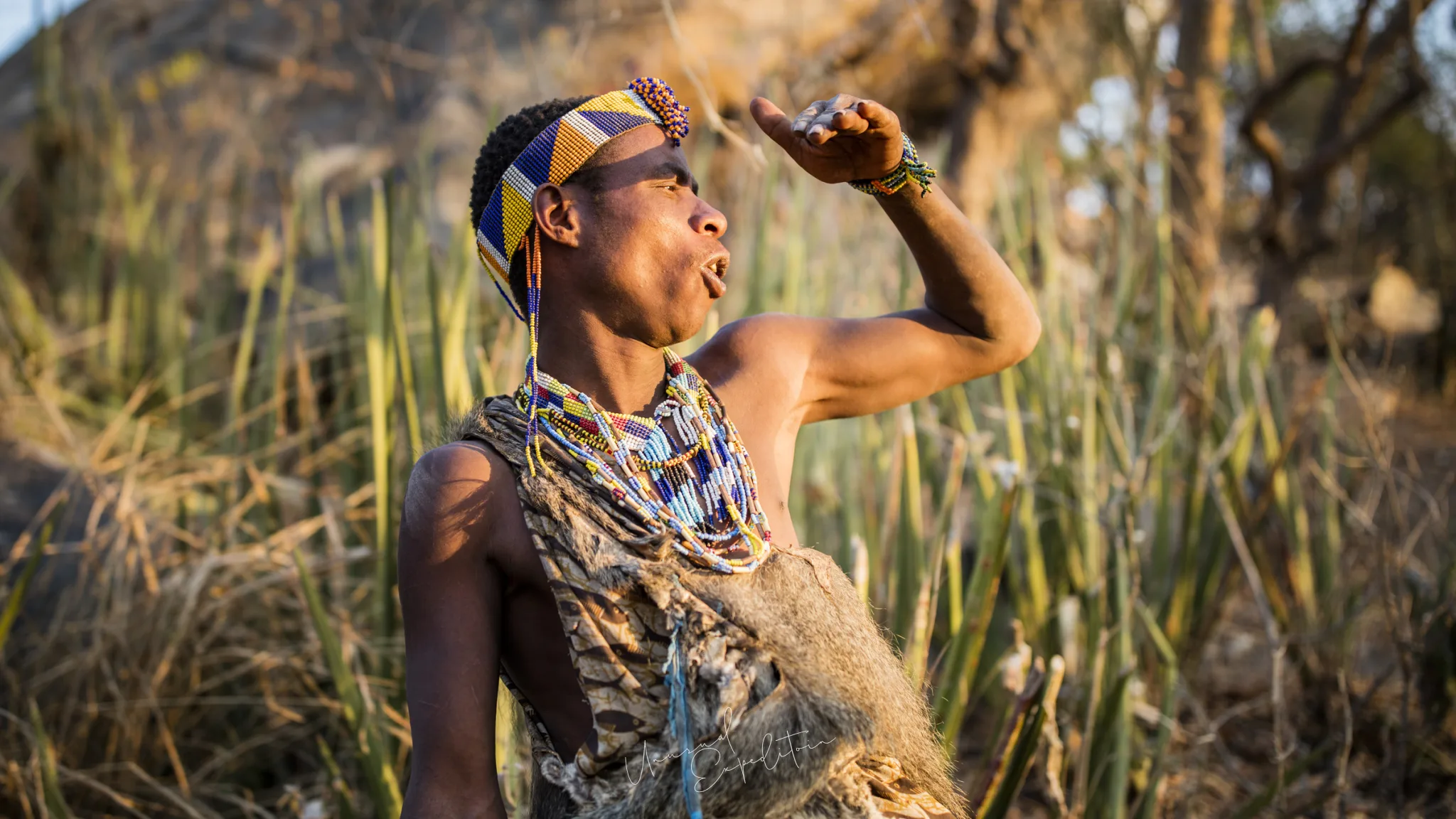
Travel writing about the Hadzabe often presents them as a people frozen in the past, cut off from the modern world. That picture is wrong. The Hadza trade for the metal of their arrowheads, sell honey, hold a land title, argue with their neighbours over grazing and water, and deal with district officials and tour operators every week. Their way of life has changed and keeps changing, as every community's does. Writing about them as relics also makes it easier for visitors to treat them as a spectacle. We describe what we saw and cite what researchers have found, and we let the photographs show people as they are.
Visit the Hadza with us
A Lake Eyasi visit is part of our scheduled Serengeti Photo Tour 2027; current dates are on the Tanzania photography tours page. If you would like more time with the Hadza, we arrange it as a private trip at your own pace.
Ask us about visiting the Hadza
Join the Lake Eyasi photography tour
Serengeti Photo Tour – Tanzania 2027 departs 21 Aug 2027 To 01 Sep 2027. Small group, photography first. All Lake Eyasi photography tours.
Explore Lake Eyasi in depth
- Lake Eyasi Photography Tour Guide: Hadzabe, Datoga and BaobabsTanzania
- Lake Eyasi Photography FAQ: Where the Hadzabe Live, Language, Heat and GearTanzania
- Hadzabe Tribe Tour: How to Get to Lake Eyasi and Whether It Is Worth ItTanzania
- Hadzabe Tribe Hunting: Bows, Honey and Photographing the HuntTanzania
- Hadza People Culture at the Fire: Photographing Evenings near Lake EyasiTanzania
- Datoga Tribe in Tanzania: Herders and Smiths of Lake EyasiTanzania
- The Baobab Tree in Tanzania: Photographing Baobabs around Lake EyasiTanzania
Upcoming Photo Tours
- Egypt Photo Tour – EgyptEgypt 12 Dec 2026 To 20 Dec 2026
- Inner Mongolia Winter Owl Photo Tour – ChinaChina 01 Jan 2027 To 04 Jan 2027
- Inner Mongolia Winter Photo Tour – ChinaChina 05 Jan 2027 To 11 Jan 2027
- Mekong And Central Highland Vietnam Photo Tour - VietnamVietnam 16 Jan 2027 To 24 Jan 2027