
Hanoi Street Photos: Life on the Pavement, in the City and Its Craft Villages
Hanoi street photos from the Old Quarter and the craft villages: where to stand, how to ask, settings, and the incense and fish trap lanes.
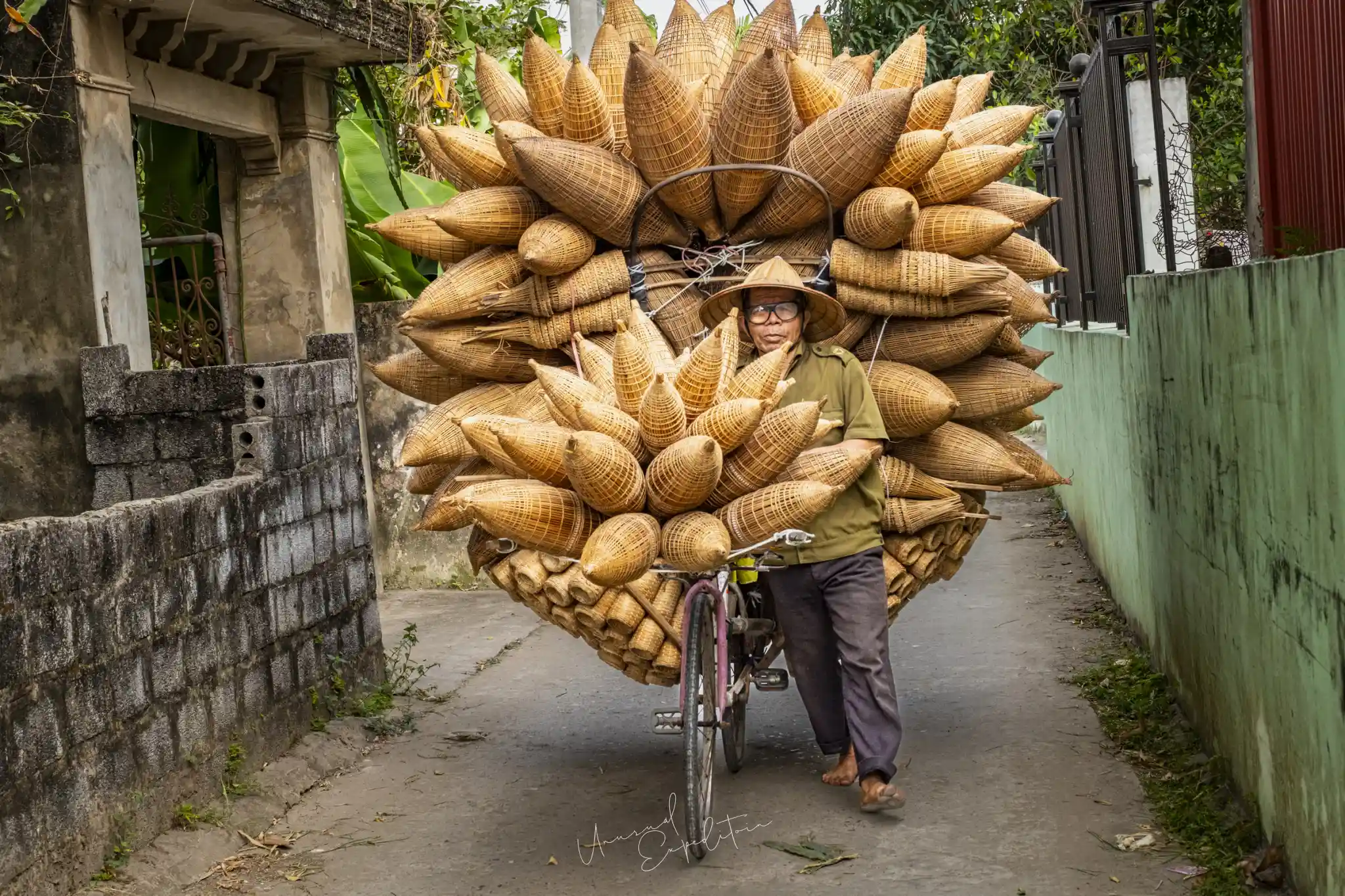
Hanoi street photos are made at pavement level, in the lanes and yards where people work in the open, and the best of ours come from the streets of the city's craft villages as much as from the Old Quarter itself: a man cycling home under a load of bamboo fish traps, a woman kneeling in a field of red incense, a hat maker in her doorway. This is our guide to Hanoi street photography, where to stand and how to behave, as part of the Vietnam photography tour guide.
Why Hanoi is a street photography city
Life in Hanoi happens outside. Kitchens, barbers, mechanics, card games and family dinners all take place on the pavement, in doorways and in the lanes called ngo that run off every street. There is no need to intrude to see it; you only need to slow down. The city is also compact and flat, so a morning on foot covers the Old Quarter, the lake, the cathedral and the French Quarter without transport. Add the villages on the edge of the city, where whole streets are given to one trade, and you have more street material than any other city in Vietnam, including Saigon.
Hanoi street photos in the city
Start at Hoan Kiem Lake at first light for the exercise crowd and the mist, then walk the market streets north of it while the stalls are being set. The lanes behind Hang Buom and Hang Giay are narrower and quieter than the main streets and give you doorways, shrines and steam. Long Bien bridge at dawn is a river of scooters on an iron deck, with the banana gardens of the river island below. In the afternoon the light is hard and the city is at its least photogenic; this is when we go to the villages, or sit in a cafe and wait for blue hour, when Ta Hien and Hang Ma come alive. Street by street detail is in Hanoi Old Quarter photos.
Hanoi city photos from the craft villages
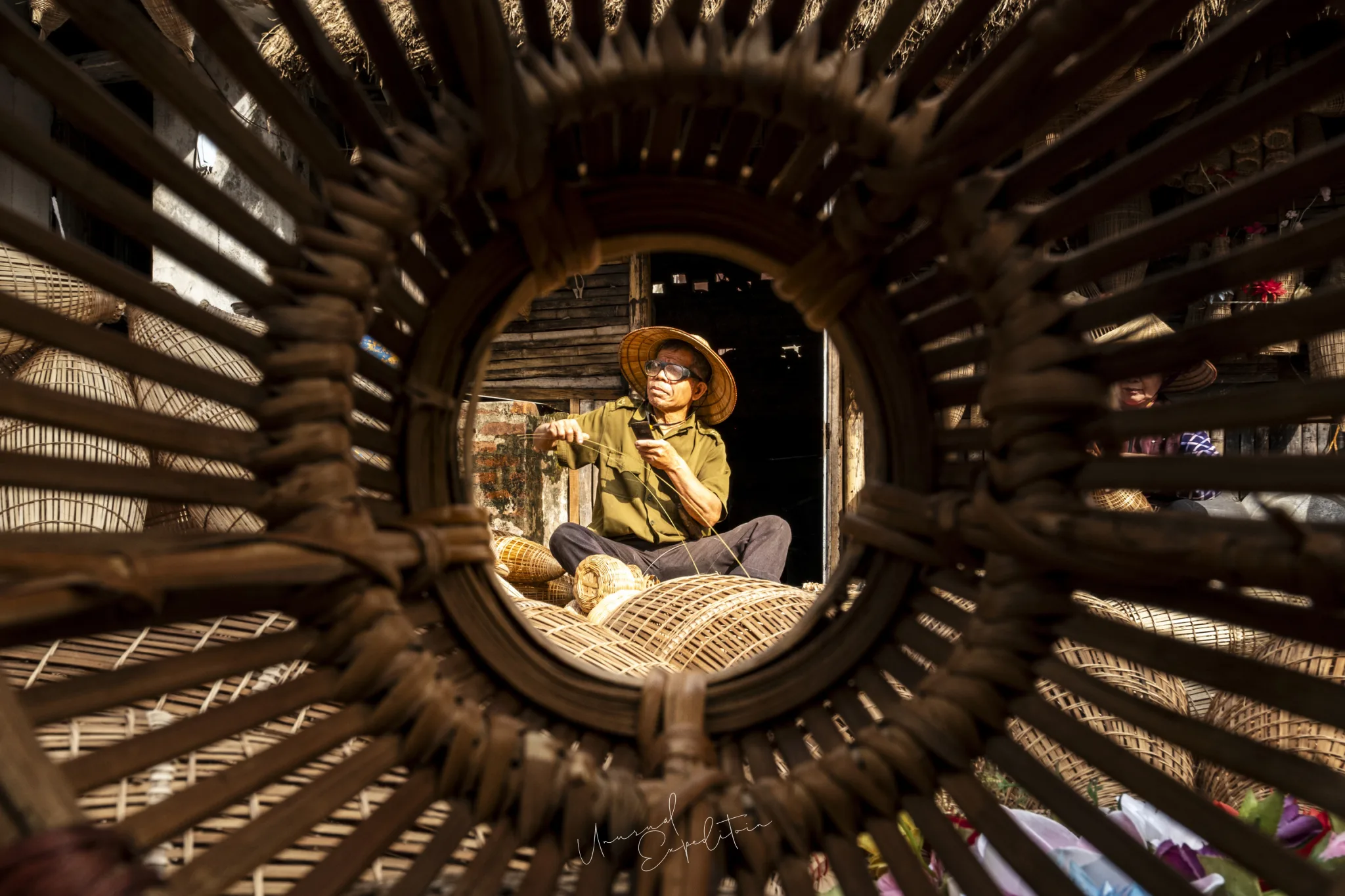
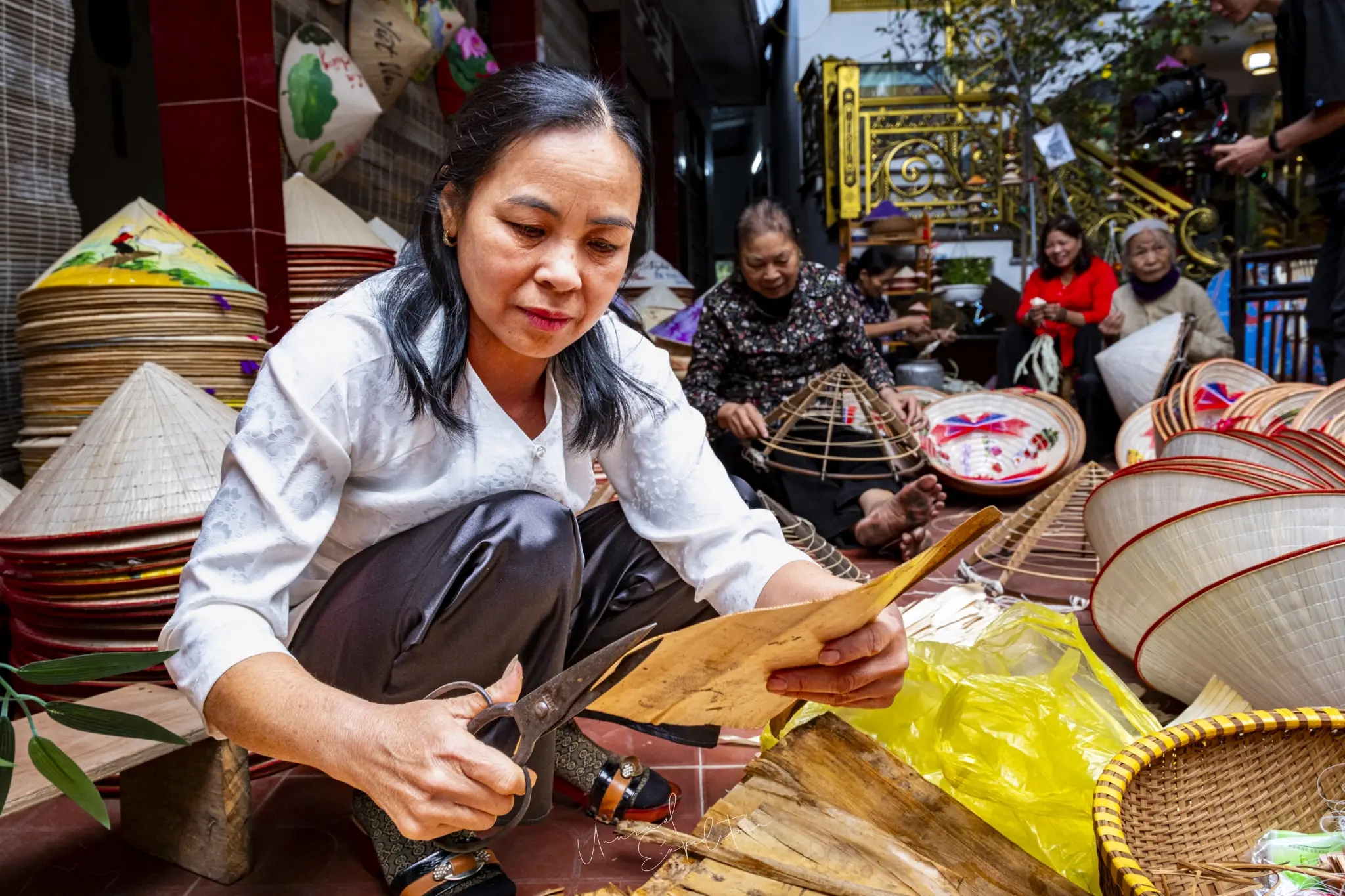
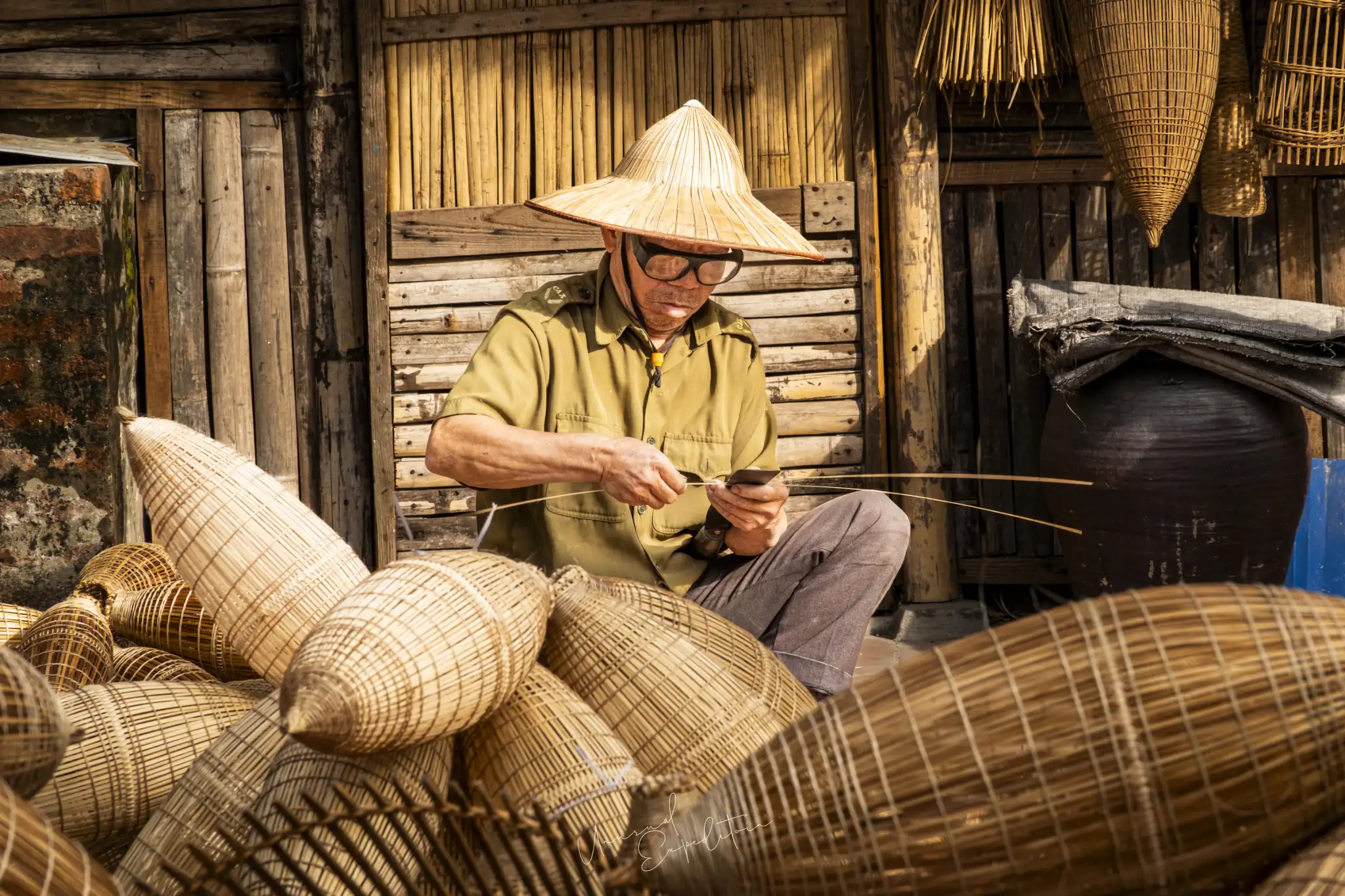
Three villages supply much of what you see for sale in Hanoi, and their streets are where our strongest frames come from. Chuong village, south-west of the city, stitches conical hats; the market in the communal house yard trades them by the stack, and the makers work in their front rooms with the door open. Quang Phu Cau, further south, makes incense, and in the dry season every yard and verge is a fan of red sticks, which from above becomes a pattern with a single worker in a conical hat at the centre. Thu Sy, across the line into Hung Yen province, weaves bamboo fish traps, and the lanes are where you meet the men carrying them, two hundred at a time, on a bicycle.
Hanoi best photos: what works and what does not
| Approach | Works | Does not work |
|---|---|---|
| Distance | Close, 24-70mm or a 35mm, after a nod | Long lens from across the street, nobody engages |
| Hour | First light and blue hour in the city, mid morning in the villages | Midday in the Old Quarter, flat and crowded |
| Position | Low, at the level of the stools and the work | Standing height, which gives you the tops of heads |
| Manners | Buy something, say hello, show the picture | Shooting into kitchens and homes without a word |
| Weather | Rain, steam, overcast colour | Waiting for sun; Hanoi is often grey |
Most of the difference between a tourist frame and a street photograph in Hanoi is in the first row: get close and ask.
"The fish trap man on his bicycle is the picture everyone wants, and the reason it works is that he has been doing that ride every market day for thirty years and does not care about you. Stand in the lane, keep the shutter fast, and let him come to you."
Joseph Mak, tour leader, Unusual Expedition
How to photograph people on the street in Hanoi
Hanoians are generally relaxed about cameras but direct about their space. Ask, with a gesture if you have no words, and accept a no. Street vendors are working; a purchase is the fairest ticket to a portrait. Children are everywhere and photogenic, and we do not publish identifiable pictures of them. In the villages, the families know we are coming and the makers are used to visitors, which gives you time to work a scene properly instead of grabbing one frame. Keep the camera up and visible; hiding it reads as sneaking.
Camera settings for Hanoi street photos
Keep one body and one lens on you, a 24-70mm or a fixed 35mm, and leave the 70-200mm in the bag unless you are on Long Bien bridge. Shutter speed above 1/500 second for scooters and cyclists, auto ISO with a ceiling you trust, and aperture around f/4 to f/5.6 so a moving subject stays sharp. Set exposure for the faces, not the sky; Hanoi's grey skies blow out anyway. In the villages, carry a step or use a doorway or a wall for the overhead frames of incense and hats, and a 16-35mm for the yards.
When the streets are best
October and November give dry pavements, clear mornings and the softest light of the year. The winter drizzle from December to February is good for reflections and steam if you dress for it. The weeks before Tet, in late January or February depending on the lunar calendar, fill Hang Ma with red and the flower markets with peach blossom and kumquat trees; it is the busiest and the most colourful street season. Summer is hot and stormy and best avoided for walking. See the best time to visit Vietnam for photography for the whole country.
Shoot Hanoi's streets with us
Hanoi and its villages are the northern part of a private trip we run for small groups; our scheduled Vietnam departures begin in Saigon. Current dates and the destination overview are on the Vietnam photography tours page, with fares indicatively S$2,700 to S$3,300 per person depending on the room. Write to us about the north and we will put a Hanoi street itinerary together around the light and the market days.
Join the Vietnam photography tour
Mekong And Central Highland Vietnam Photo Tour - Vietnam departs 16 Jan 2027 To 24 Jan 2027, led by Joseph Mak. Small group, photography first. All Vietnam photography tours.
Explore Vietnam in depth
- Vietnam Photography Tour: The Complete GuideVietnam
- Vietnam Photography Trip FAQVietnam
- The Best Time to Visit Vietnam for Photography, Region by RegionVietnam
- Vietnam Tour from Singapore: Flights, Visa and What to ExpectVietnam
- Sapa, Mu Cang Chai or Ha Giang: Which Northern Mountains to PhotographVietnam
- Mu Cang Chai Rice Terraces: Photography, Best Time and How to Get ThereVietnam
- Ninh Binh Photos: Is It Worth Visiting and How to Get There from HanoiVietnam
- Hue Photo Tour: the Citadel, the Tombs and the LagoonVietnam
- Dalat and the Central Highlands: Photos of Mist, Farms and the Elephant VillagesVietnam
- Vietnam Salt Fields and Fishing Villages: Photos from the South Central CoastVietnam
- Mekong Delta Photography Tour: the Can Tho Floating Market and the WaterwaysVietnam
- Saigon Photos: Markets, the River and the City at NightVietnam
Upcoming Photo Tours
- Egypt Photo Tour – EgyptEgypt 12 Dec 2026 To 20 Dec 2026
- Inner Mongolia Winter Owl Photo Tour – ChinaChina 01 Jan 2027 To 04 Jan 2027
- Inner Mongolia Winter Photo Tour – ChinaChina 05 Jan 2027 To 11 Jan 2027
- Mekong And Central Highland Vietnam Photo Tour - VietnamVietnam 16 Jan 2027 To 24 Jan 2027