
Hue Photo Tour: the Citadel, the Tombs and the Lagoon
How we photograph Hue: the star of sampans on Tam Giang lagoon at dawn, net fishermen at sunset, the Citadel, paper flowers, fish sauce.
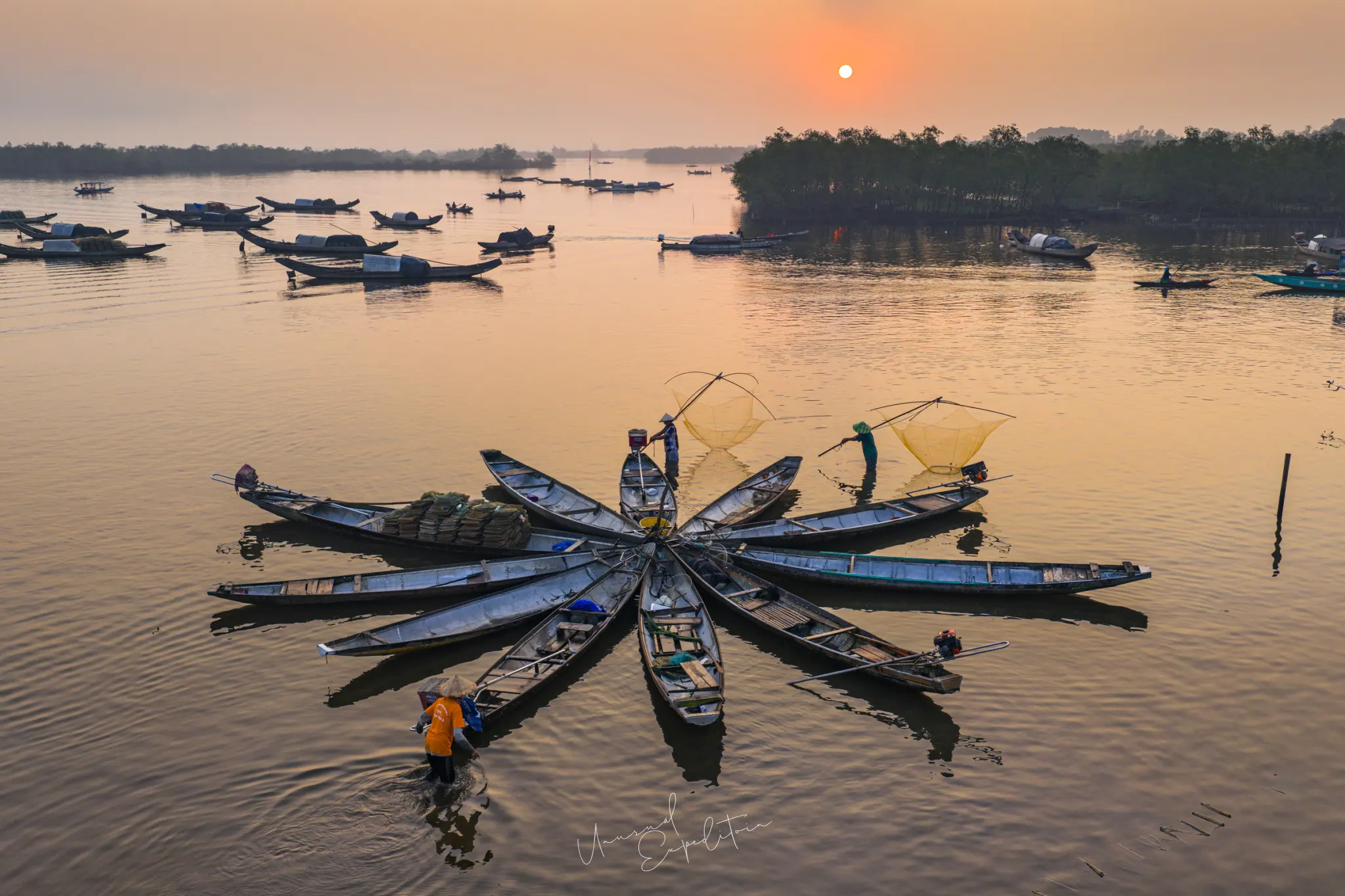
A Hue photo tour is less about the Citadel than people expect. The imperial city, the tombs and the Perfume River are the reasons Hue is on the map, and they photograph well in the right light, but the pictures that stay with you come from the lagoon east of the city, where net fishermen work star-shaped formations of sampans at dawn, and from the craft villages around it. Here is how we photograph Hue, as part of our complete guide to a Vietnam photography tour, and it is where the Central Vietnam departure ends.
Hue photo tour: the lagoon before the Citadel
Tam Giang is the largest lagoon system in Southeast Asia, a shallow sheet of brackish water running along the coast north and east of Hue, and it is worked by thousands of small boats. At dawn in the fishing villages along its edge the sampans gather and spread their lift nets in a circle, bow to bow, so that from above they form a star on the water with the nets fanned out around it. Seen from the bank it is silhouettes in gold light; seen from the air it is one of the most graphic pictures in Vietnam. The light lasts about an hour from first light, and it needs a still morning, so we give it more than one.
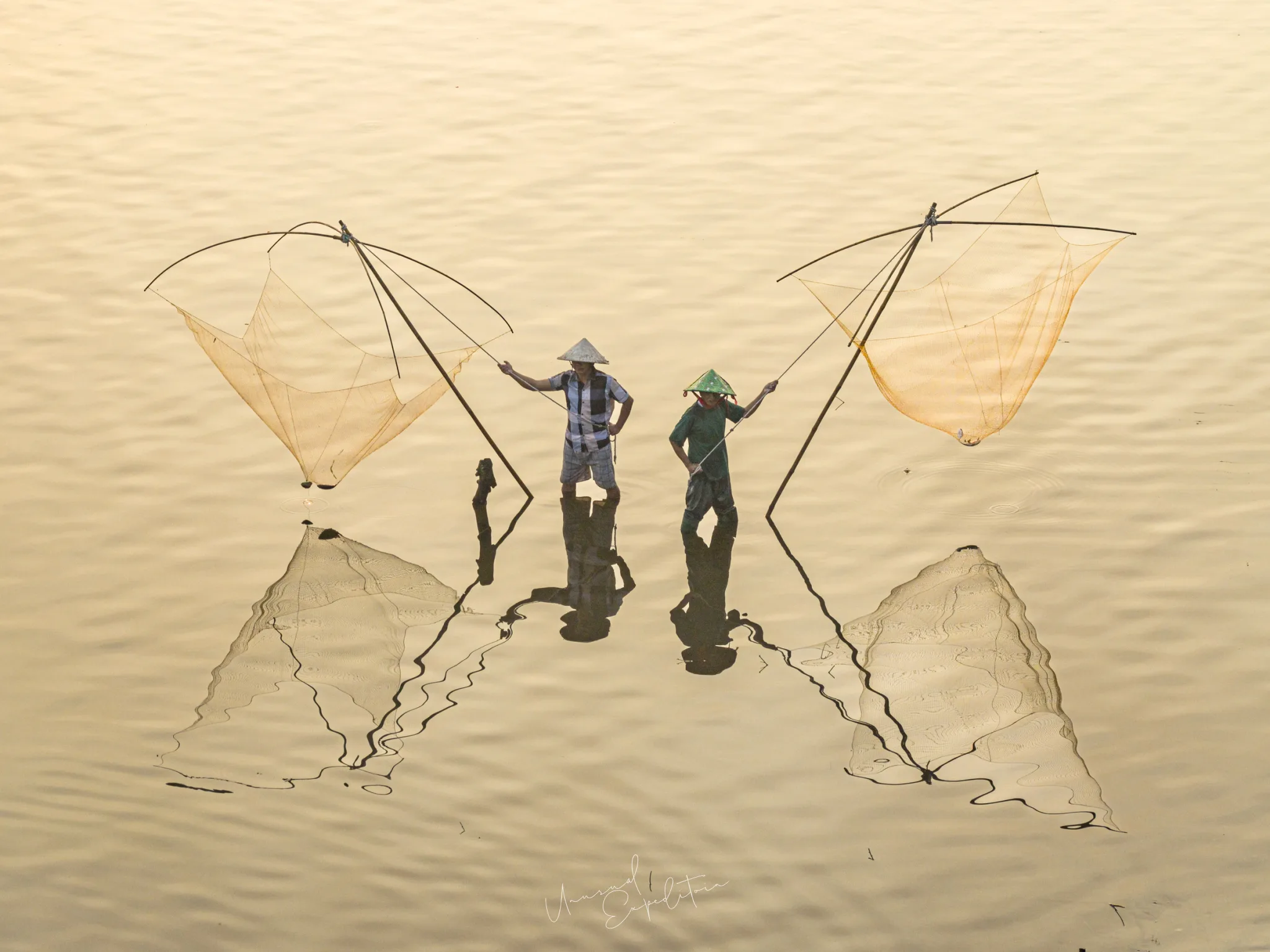
Net fishermen at sunset
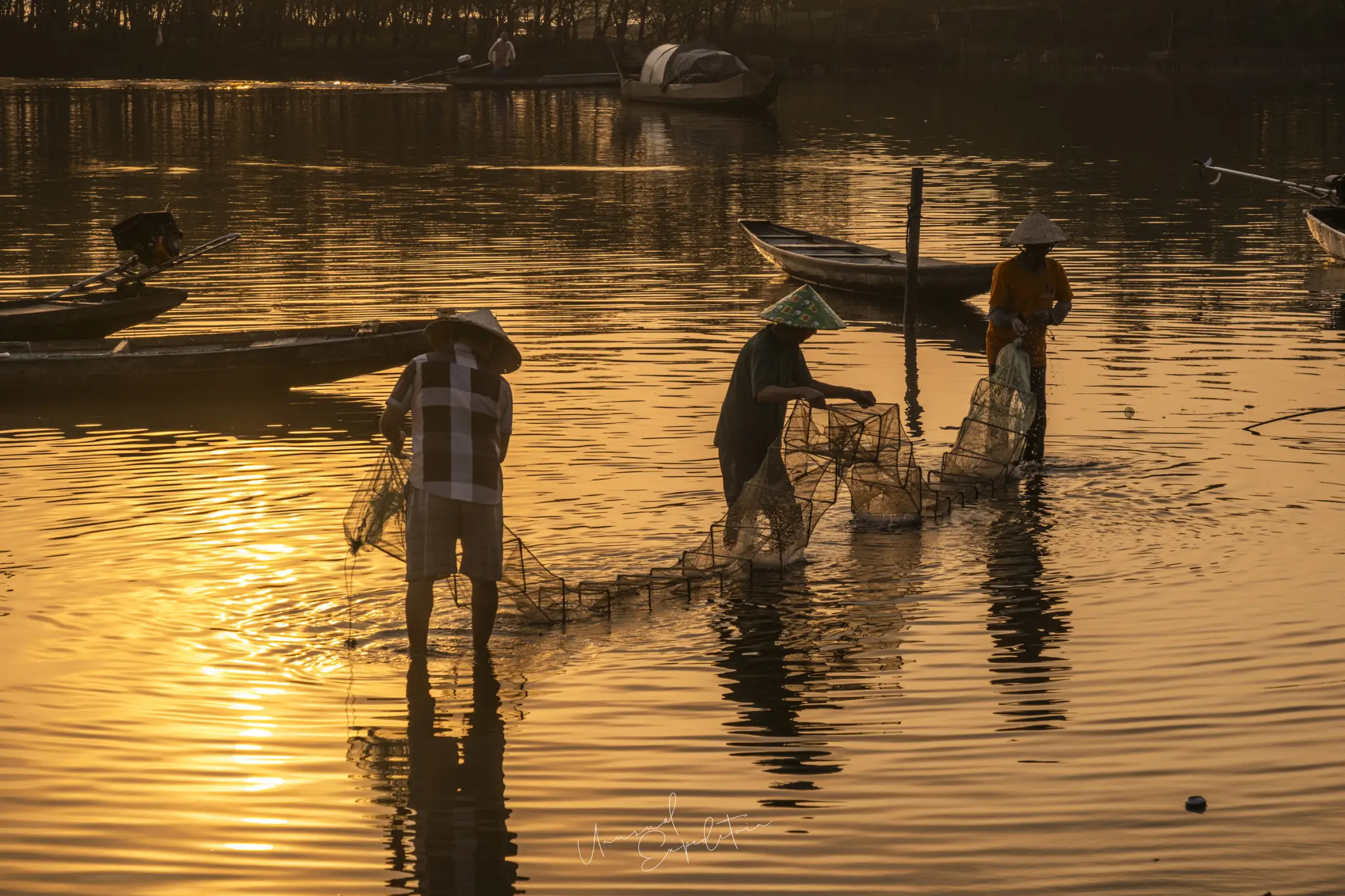
The same water in the evening gives the opposite picture: fishermen wading waist deep, lifting and casting nets against a sky that goes from orange to violet, with the boats as dark shapes behind. From the shore a 70-200mm compresses the figures and the reflections; from the water a 24-70mm gets the whole scene with the sky. The fishermen here are used to photographers and some will cast on request for a small fee, which is fair, because the casting is work and the light is theirs. Agree it before the sun goes down, not after.
Hue city photos: the Citadel, the tombs and the river
The Imperial City inside the Citadel was listed by UNESCO in 1993 and has been under restoration for decades; the gates, the moats and the long walls photograph best in the first hour after opening, before the groups, and in overcast light that keeps the detail in the red and gold woodwork. The royal tombs south of the city, Tu Duc with its lake and pines, Minh Mang in its symmetry, Khai Dinh with its grey concrete and mosaic interior, each want a different light: Tu Duc in soft morning, Khai Dinh at any time because it is mostly interior. Thien Mu pagoda sits above the Perfume River and is a late afternoon subject from a boat. Give the monuments a half day each, and expect crowds at the Citadel by mid morning.
Thanh Tien: the paper flower village
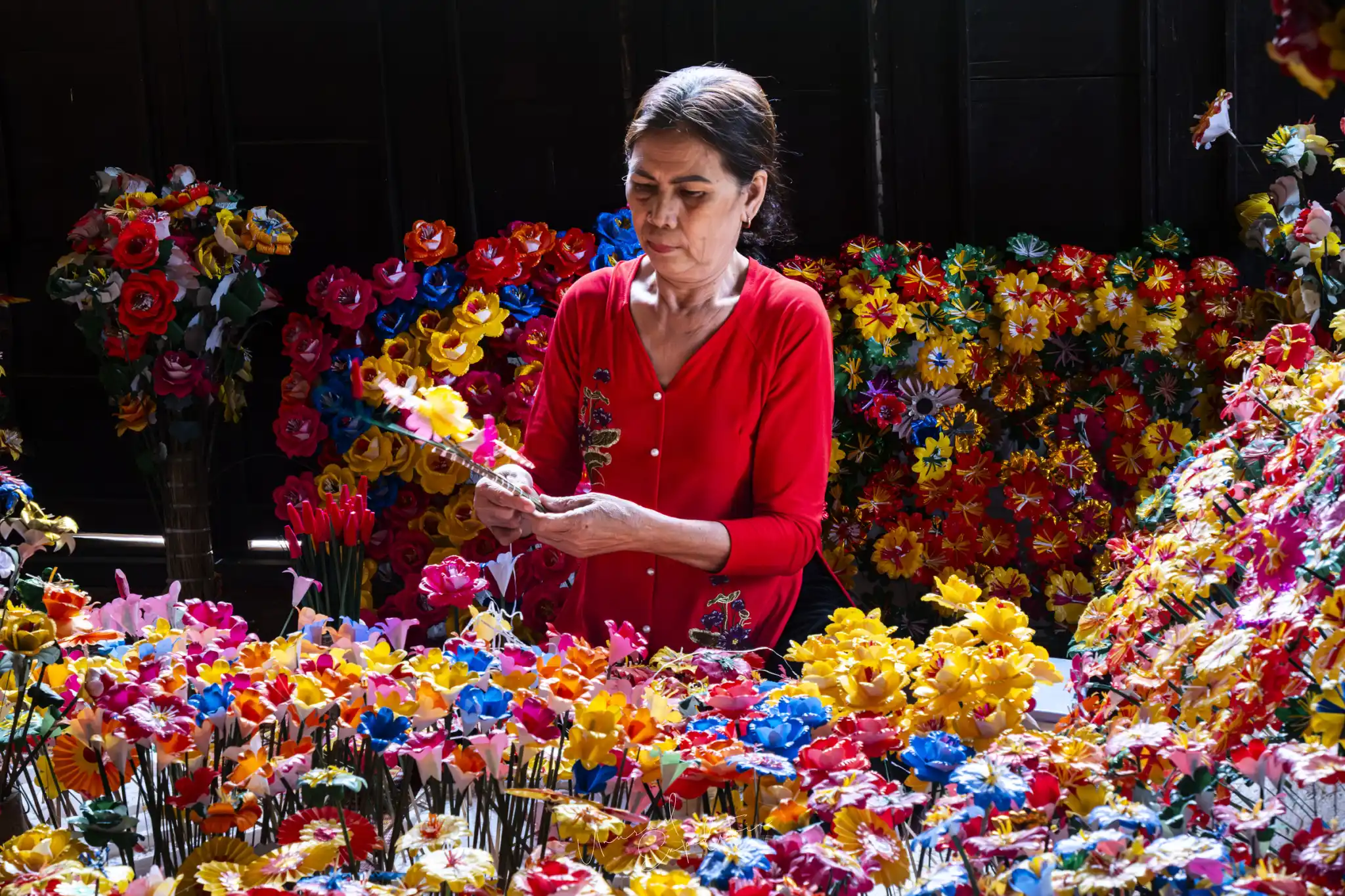
A short way downriver from the city, Thanh Tien village has made paper flowers for household altars for centuries, and the trade peaks before Tet, when the workshops are stacked to the roof with lotus and chrysanthemum in every colour. A maker at her bench, surrounded by flowers, lit from the door, is a portrait that needs nothing added. Nearby, villagers cycle the lanes with flowers lashed to the back of the bicycle, and the paddies along the road give a green frame to them. We ask, we buy, and we shoot with a 24-70mm from close in; this is a small-room subject.
Fish sauce and the drying yards from above
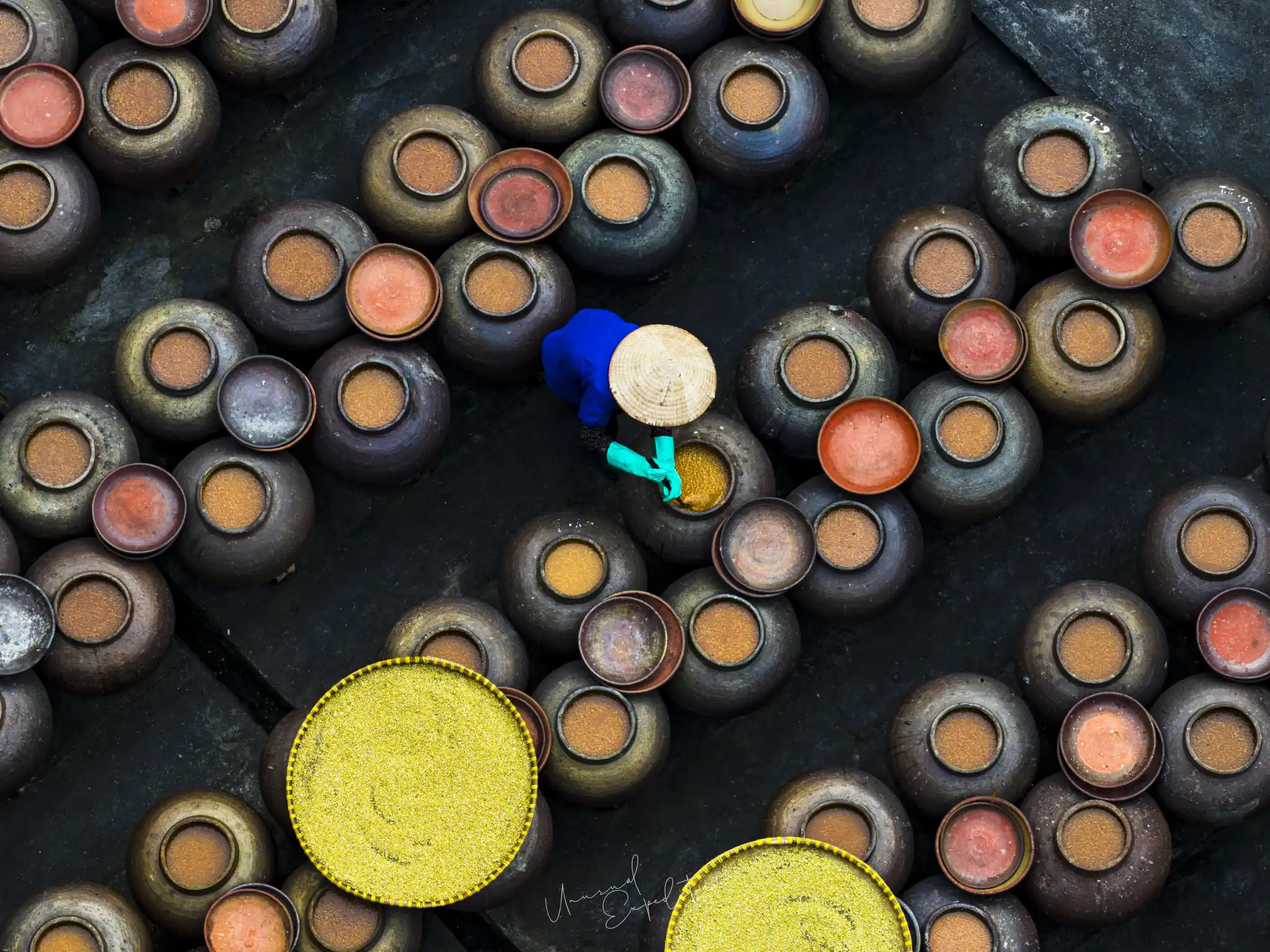
The central coast makes fish sauce in big clay jars left to ferment in the sun, and from the air a yard of them is a field of circles in brown, ochre and pink, with the occasional yellow lid and a worker in a conical hat for scale. It is a drone subject first; from the ground it is a smell and a row of jars. We fly in the late afternoon when the lids are lit from the side. The same yards often dry rice paper and seafood on round bamboo trays, which give a second pattern a few steps away. Permits again; we arrange them.
Portraits on the water at dusk
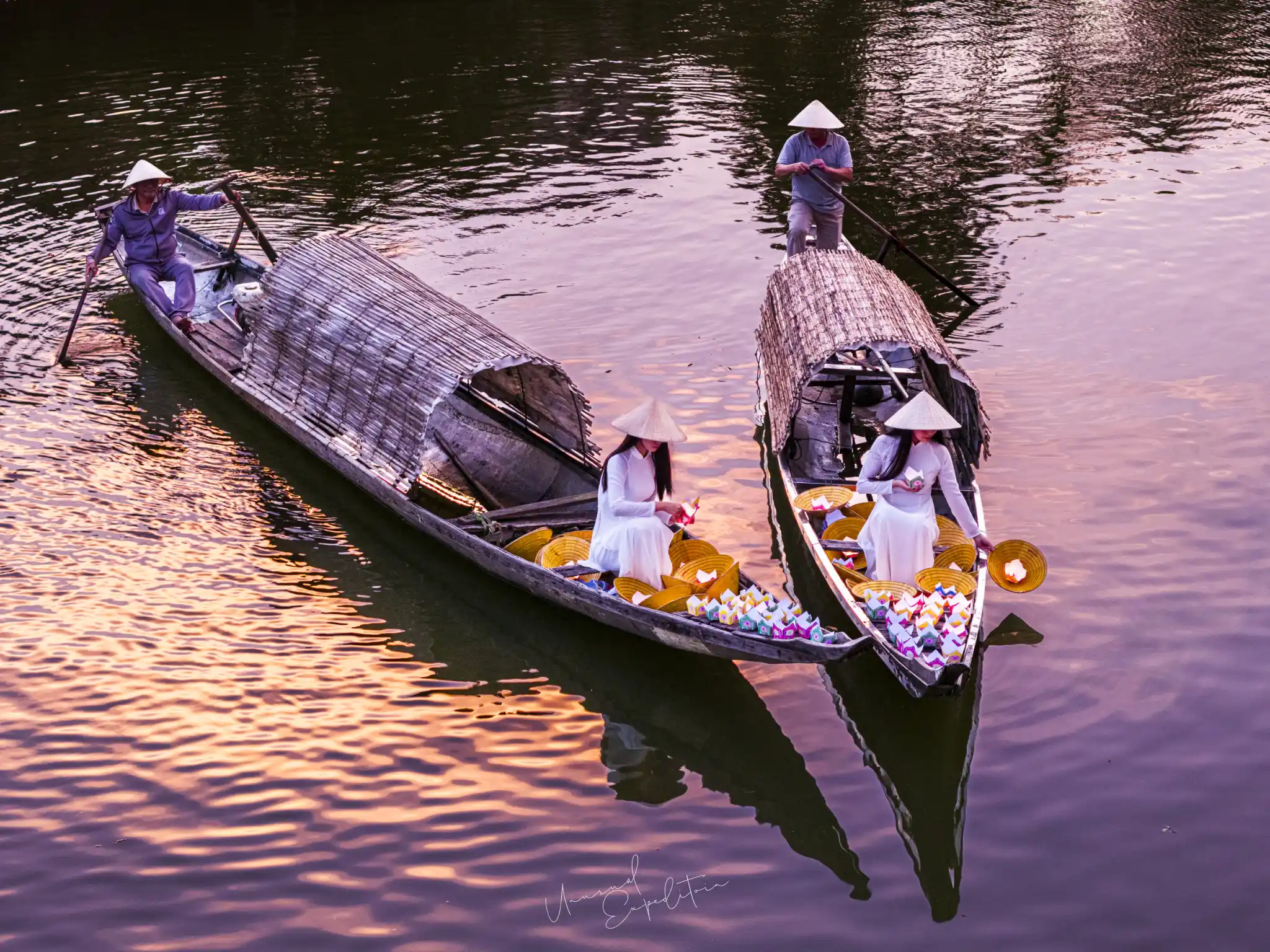
Hue is the home of the ao dai and the conical hat, and a portrait session on the lagoon at dusk, two sampans with women in white ao dai and baskets of flowers, is something we arrange with local models who do this work. Photographed from above, the boats and their reflections in pink water make the frame; from a third boat, a 70-200mm gives the faces. It is staged, and we say so in the captions, but it is staged in the place where the dress belongs, which is the difference between a cliché and a picture.
| Subject | Light | Position | Lens |
|---|---|---|---|
| Star formation of sampans | First hour of light, still air | From the air, or the bank | Drone, 70-200mm |
| Net fishermen | Last hour before dark | Shore or a boat | 70-200mm, 24-70mm |
| Imperial City | First hour after opening, overcast | Gates, moat, inner courts | 16-35mm, 24-70mm |
| Royal tombs | Morning for Tu Duc, any for Khai Dinh | Each a half day | 24-70mm |
| Thanh Tien paper flowers | Door light | Inside the workshop | 24-70mm |
| Fish sauce yards | Late afternoon | From the air | Drone, permit arranged |
Two of the six are monuments; the rest are people and water, which is the balance a Hue photo tour should have.
"The first time I saw the boats make their star on the lagoon I stopped shooting for a moment, which does not happen often. Hue has the Citadel and everyone knows it. The lagoon at dawn is the reason I keep going back."
Joseph Mak, tour leader, Unusual Expedition
Hue weather and when to go
Hue is the wettest of the big central cities, with a long rainy season from early autumn to the turn of the year and flooding in the worst years. Spring and early summer are dry, warm and the best for the lagoon, which needs calm mornings; high summer is hot but clear. Our Central Vietnam departure reaches Hue in late spring for that reason. If you come in the rainy months, the Citadel in drizzle has a mood of its own and the tombs empty out, but the lagoon mornings are a gamble. The whole year's pattern is in the best time to visit Vietnam for photography, and the coast you pass through to get here is in where we shoot on a Hoi An photo tour.
End the coast in Hue with us
Hue is the last stop of the Central Vietnam photo tour, after the salt fields, the fishing villages and Hoi An. The current departure is on the Vietnam photography tour page.
Join the Vietnam photography tour
Mekong And Central Highland Vietnam Photo Tour - Vietnam departs 16 Jan 2027 To 24 Jan 2027, led by Joseph Mak. Small group, photography first. All Vietnam photography tours.
Explore Vietnam in depth
- Vietnam Photography Tour: The Complete GuideVietnam
- Vietnam Photography Trip FAQVietnam
- The Best Time to Visit Vietnam for Photography, Region by RegionVietnam
- Vietnam Tour from Singapore: Flights, Visa and What to ExpectVietnam
- Sapa, Mu Cang Chai or Ha Giang: Which Northern Mountains to PhotographVietnam
- Mu Cang Chai Rice Terraces: Photography, Best Time and How to Get ThereVietnam
- Ninh Binh Photos: Is It Worth Visiting and How to Get There from HanoiVietnam
- Dalat and the Central Highlands: Photos of Mist, Farms and the Elephant VillagesVietnam
- Vietnam Salt Fields and Fishing Villages: Photos from the South Central CoastVietnam
- Mekong Delta Photography Tour: the Can Tho Floating Market and the WaterwaysVietnam
- Saigon Photos: Markets, the River and the City at NightVietnam
- Saigon Photo Tour: Where We Shoot in Ho Chi Minh CityVietnam
Upcoming Photo Tours
- Egypt Photo Tour – EgyptEgypt 12 Dec 2026 To 20 Dec 2026
- Inner Mongolia Winter Owl Photo Tour – ChinaChina 01 Jan 2027 To 04 Jan 2027
- Inner Mongolia Winter Photo Tour – ChinaChina 05 Jan 2027 To 11 Jan 2027
- Mekong And Central Highland Vietnam Photo Tour - VietnamVietnam 16 Jan 2027 To 24 Jan 2027