
Saigon Photo Tour: Where We Shoot in Ho Chi Minh City
A Saigon photo tour on foot: Cholon pagodas at first light, markets, the alleys, Bui Vien at night, best photo spots, lenses and timing.
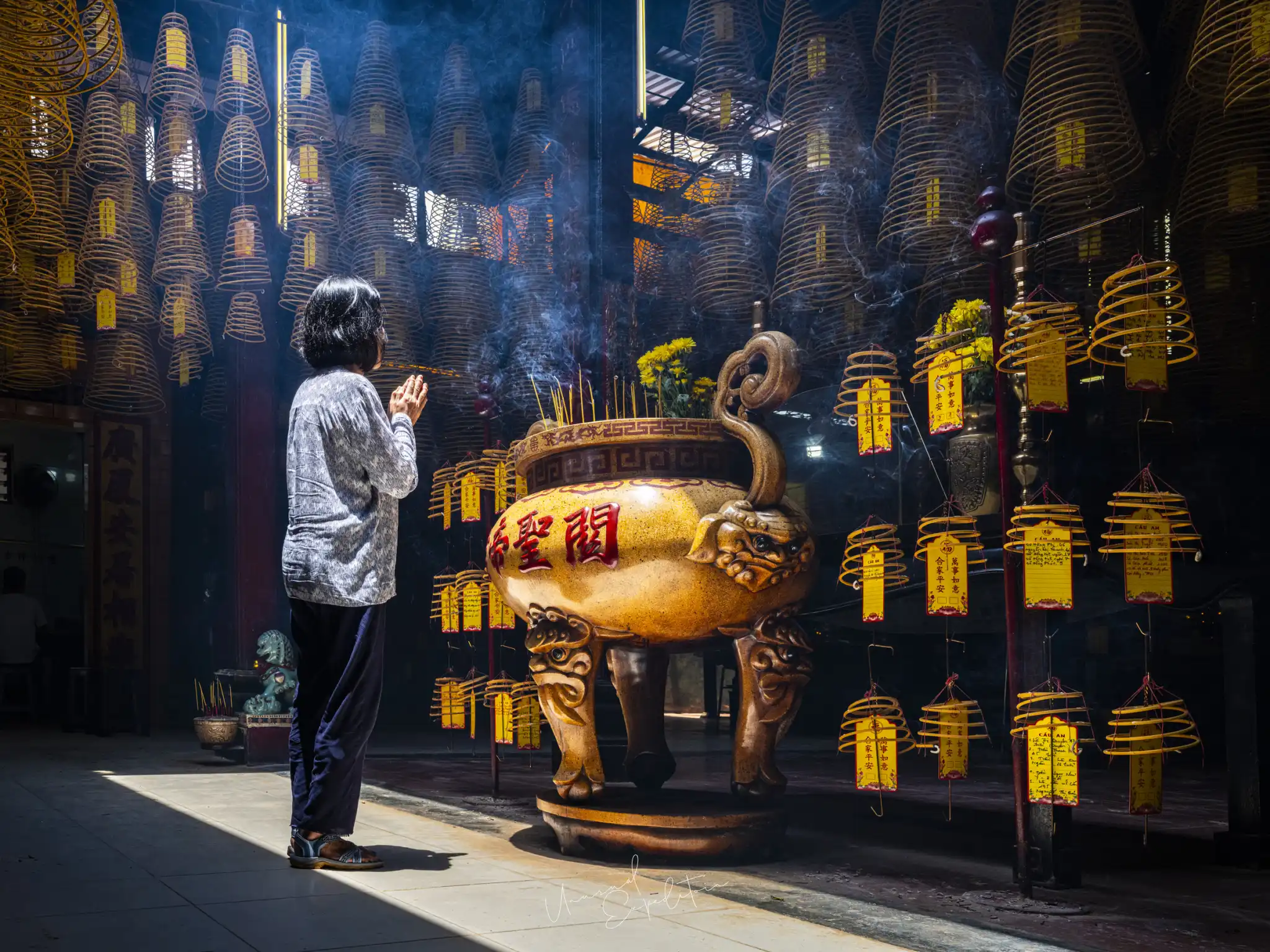
A Saigon photo tour is a day or two on foot in Ho Chi Minh City, built around the places where the city still shows itself: the incense halls of Cholon, the wet markets before the heat, the alleys where life happens on the pavement, and the neon of District 1 after dark. We run it as the opening of our Vietnam photography tours, which start and end in Saigon, and as a standalone photo walk for people with a spare day in the city. Here is where we shoot, in what order of light, and with which lens.
Saigon photo tour: what a photo walk in Ho Chi Minh City covers
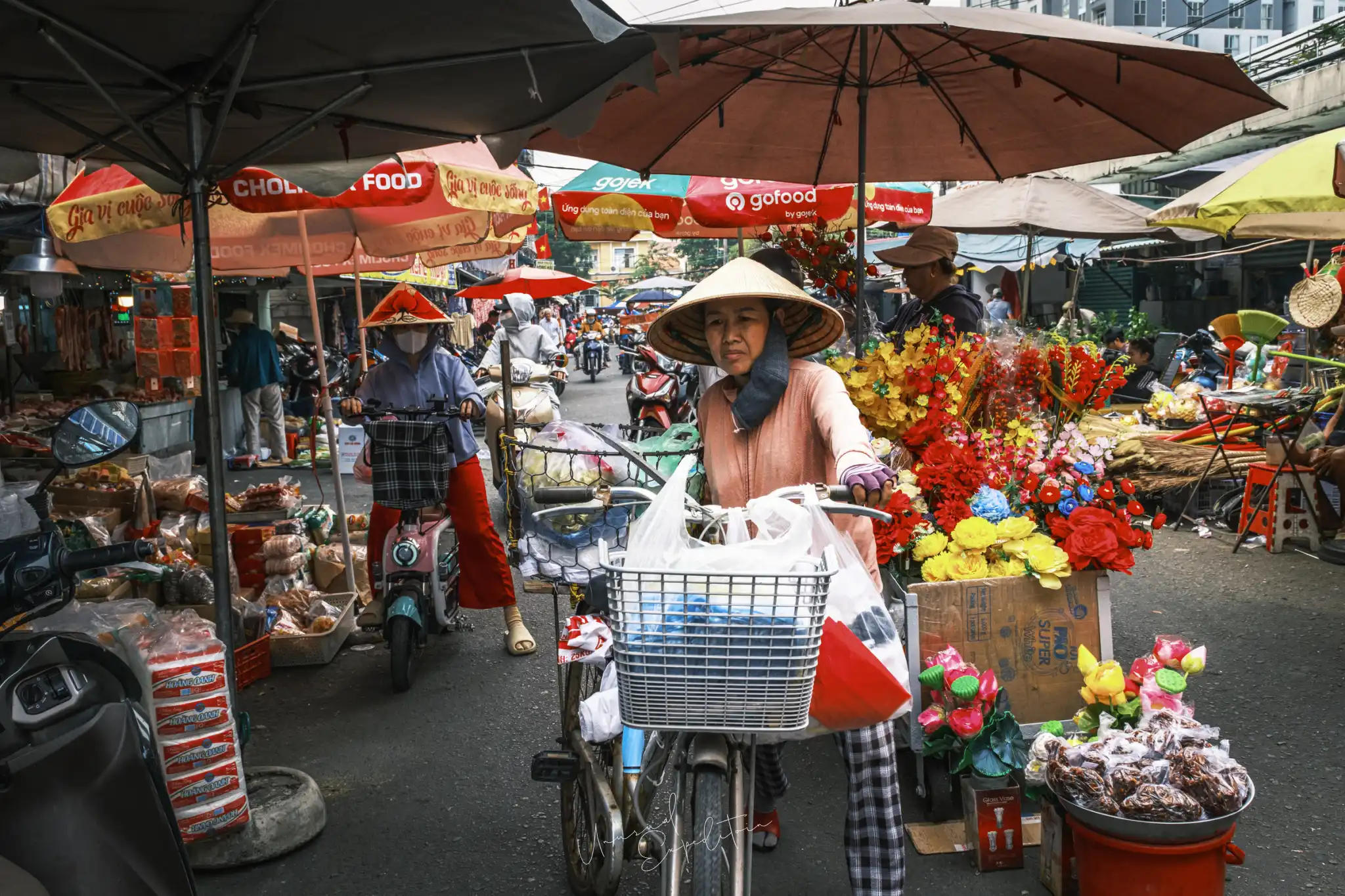
Saigon is not a city of landmarks. The cathedral has been under scaffolding for years, the Post Office is a queue of selfies, and the skyline is best seen from the far bank at dusk. What the city has instead is density: nine million people, most of them outdoors for a good part of the day, cooking, trading, repairing and eating on pavements that double as living rooms. A photo tour here is a street photography tour. The planning is about neighbourhoods and the hour, not monuments. We spend one dawn in a market, one morning in Cholon, one afternoon in the alleys around District 3 or District 4, and one evening on the river and in the bars. The Saigon photos page shows what each of those blocks produced.
Saigon best photo spots: District 1 and the river
District 1 is where everyone starts and where the pictures are hardest. The classic frames are the Central Post Office interior with its arched hall, the view down Nguyen Hue walking street from the Cafe Apartment balconies, the Opera House in evening light, and the skyline of Bitexco and Landmark 81 from the Thu Thiem bank across the Saigon River. The river side works best in the half hour before sunset, when the towers catch the last light and the water traffic is still moving. For street work, the lanes behind Ben Thanh market and the blocks along Pasteur and Ly Tu Trong are busier and more photogenic than the boulevards. The motorbike tide at the big junctions near the market photographs well from an upper floor with a long lens, or at pavement level with a wide one and a slow shutter.
Cholon: the pagodas and the markets
Cholon, the Chinese quarter across Districts 5 and 6, is the strongest half day of any Saigon photo walk. Thien Hau pagoda on Nguyen Trai street has coils of incense hanging from the roof beams, and when the morning sun comes through the open courtyard the smoke turns to solid shafts of light. Arrive early, stand to the side of the main hall and wait for a worshipper to walk into the beam. Ong Bon and Quan Am pagodas nearby are quieter. Binh Tay market, the wholesale market of Cholon, is a working building with a central courtyard and galleries on the upper floor that look down on the stalls. Photograph people and goods there, not the architecture. Dried goods, paper offerings and the herbalists along Hai Thuong Lan Ong street fill the rest of the morning. Respect in the temples is simple: no flash, no stepping in front of people praying, a nod before a close portrait.
Street life in the hem
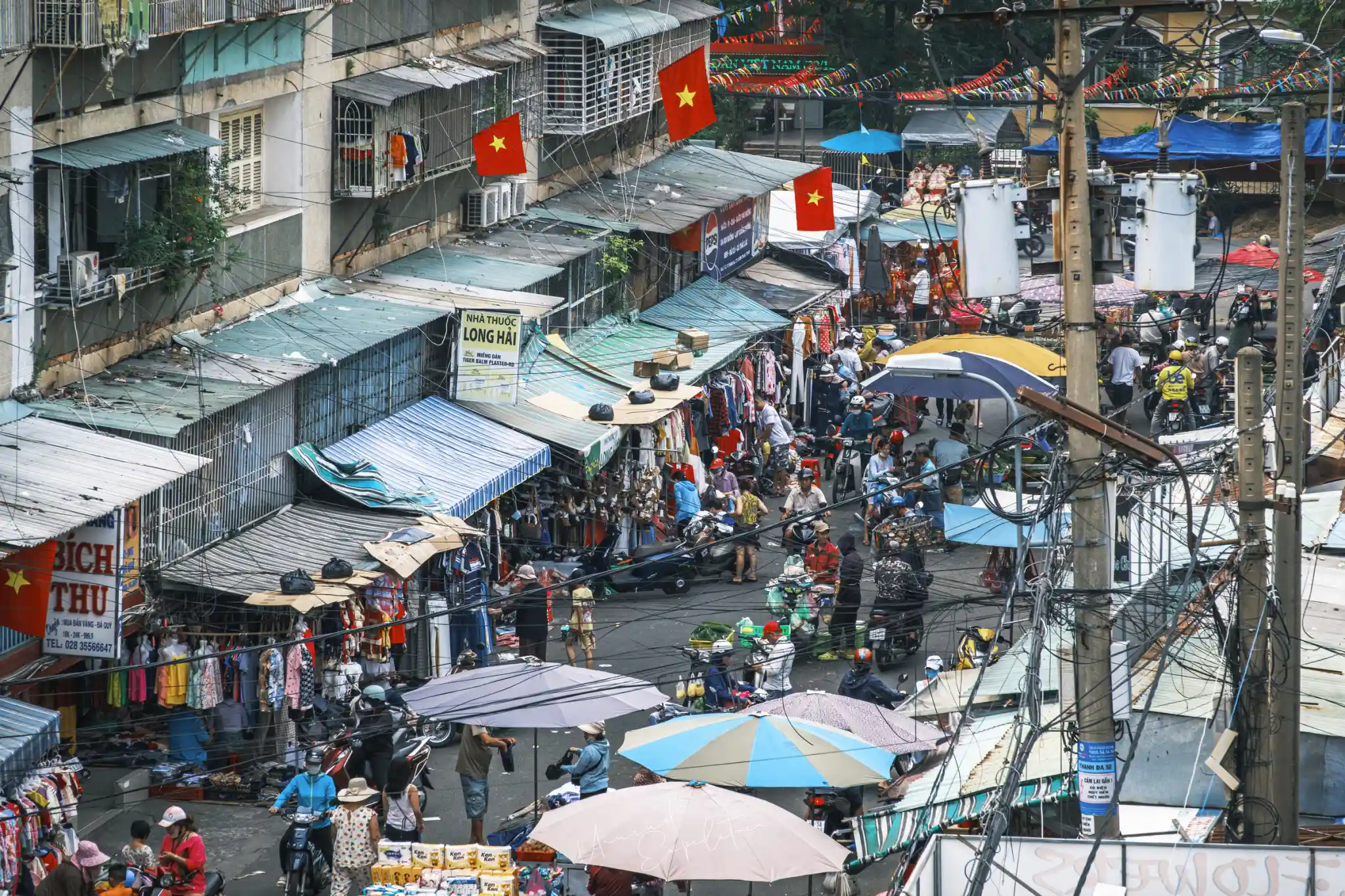
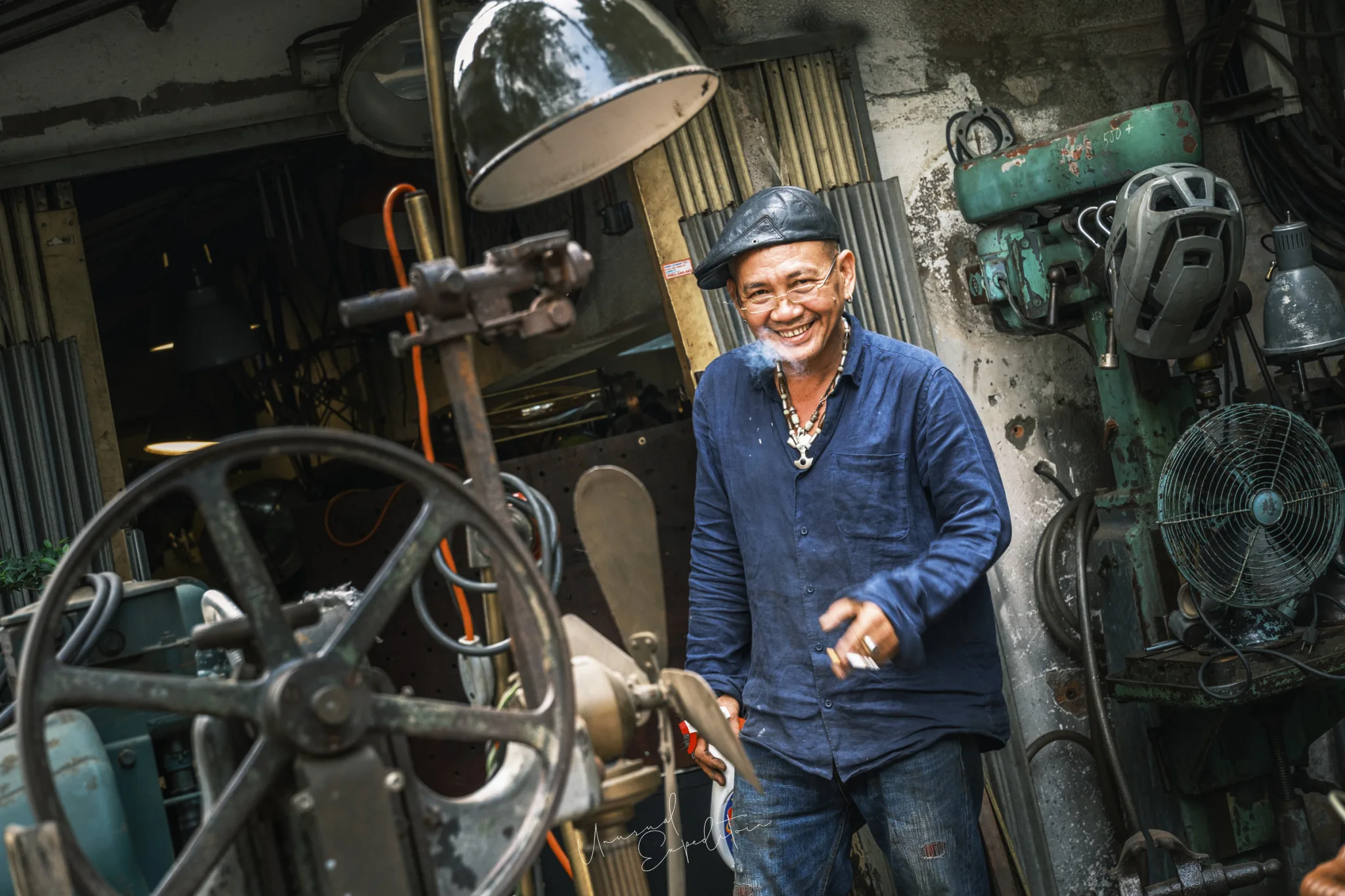
A hem is an alley, and Saigon is a city of them. Behind every boulevard there is a grid of lanes a motorbike wide, where breakfast is cooked on the step, barbers work under a mirror nailed to a wall, and mechanics run whole workshops from a doorway. This is the Saigon that repays patience. Walk slowly, go in with a smile and a greeting, let people see the camera, and most will carry on with what they were doing. The best alleys we use are around the old apartment blocks of District 1 and District 4, where the galleries on each floor look over an inner street, and in the residential lanes off Vo Van Tan in District 3. We do not publish addresses, because an alley that works one year is a cafe the next.
Saigon photo walk at night: Bui Vien and the food carts
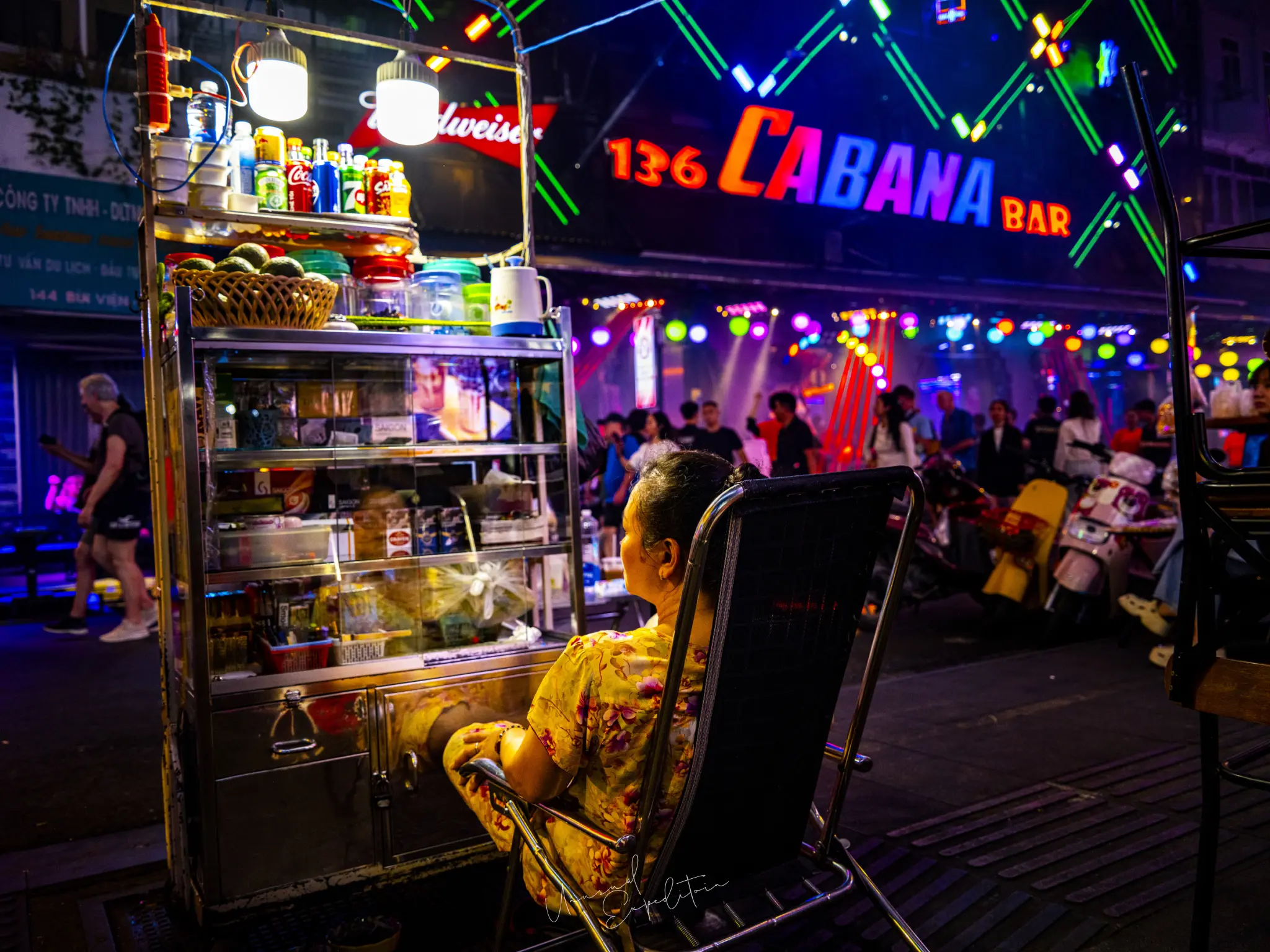
Bui Vien is the backpacker street, and by day it is nothing. After dark it becomes a corridor of LED signs, speaker stacks and plastic stools, and the food carts parked at the edge of the light are the pictures. A carried cart, lit by its own bulb and the neon behind it, photographed at a wide aperture and a moderate ISO, gives colour that no daytime Saigon frame has. Work the edges of the street rather than the middle, where the touts are. Elsewhere at night, the river promenade at Bach Dang, the Nguyen Hue fountain crowds and the night markets around Ben Thanh are calmer options. Carry nothing you cannot afford to lose, keep the strap across the body, and the city is as safe as any for a photographer at night.
What time of day to shoot in Saigon
Markets at first light, before the heat and the motorbikes; temples in the hour after sunrise when the sun is low enough to come in sideways; alleys in the late afternoon when the light bounces off the walls and people come home; the river and the bars after sunset. The middle of the day is for a cafe, an air-conditioned museum or the ride to the next district. In the dry season from December to April the light is clean and hard; in the wet season, from May to November, the afternoon storm clears the air and the hour after it is the best of the day.
What lens for a Saigon photo walk
| Subject | Lens | Why |
|---|---|---|
| Alleys and markets | 24-70mm or a 35mm prime | Close quarters, wide enough for context, fast enough for shade |
| Temples | 16-35mm | Incense coils and roof beams need the width; shoot at a slow shutter from a rail |
| Junctions and skyline | 70-200mm | Compresses the motorbike tide and pulls Landmark 81 into the frame from Thu Thiem |
| Night streets | Fast 35mm or 50mm | Neon and bulbs at f/1.8 keep ISO sensible |
One body and two lenses is the right load for a city where you walk all day in heat.
"Saigon taught me to stop looking for buildings. The picture is the woman frying bananas on the step with a motorbike going past her elbow. If you can get that frame sharp and kind, you can shoot anywhere in Vietnam."
Joseph Mak, tour leader, Unusual Expedition
How Saigon fits our Vietnam tours
Both of our scheduled Vietnam departures begin in Saigon. The January tour leaves the city for the Can Tho floating market and the Mekong Delta before turning north along the coast to Dalat and the highlands; the late May tour follows the coast to Hoi An and Hue. In both cases the first evening and the last morning are in Saigon, and people who arrive a day early get a photo walk with us. Flights from Singapore take about two hours and land close to the centre, which is covered in Vietnam tour from Singapore.
Is Saigon safe for photographers?
Yes, with the ordinary precautions of a big city. Bag snatching from motorbikes is the one real risk, so keep the camera strap across the body and the phone out of the back pocket. Traffic is the other: cross slowly and steadily and the motorbikes flow around you. People are used to cameras and most enjoy them. The Vietnam National Authority of Tourism lists the tourist police numbers for Ho Chi Minh City, and hotels will call them for you. Drones are regulated and need a permit; do not fly in the city.
Walk Saigon with us
If you want a photographer to take you through Cholon at first light and the alleys in the afternoon, join a Vietnam photography tour; the scheduled departures start in Saigon and the destination page has the current dates. Fares are indicatively S$2,700 to S$3,300 per person depending on the room, and a standalone Saigon photo walk can be arranged for people in the city on other business.
Join the Vietnam photography tour
Mekong And Central Highland Vietnam Photo Tour - Vietnam departs 16 Jan 2027 To 24 Jan 2027, led by Joseph Mak. Small group, photography first. All Vietnam photography tours.
Explore Vietnam in depth
- Vietnam Photography Tour: The Complete GuideVietnam
- Vietnam Photography Trip FAQVietnam
- The Best Time to Visit Vietnam for Photography, Region by RegionVietnam
- Vietnam Tour from Singapore: Flights, Visa and What to ExpectVietnam
- Sapa, Mu Cang Chai or Ha Giang: Which Northern Mountains to PhotographVietnam
- Mu Cang Chai Rice Terraces: Photography, Best Time and How to Get ThereVietnam
- Ninh Binh Photos: Is It Worth Visiting and How to Get There from HanoiVietnam
- Hue Photo Tour: the Citadel, the Tombs and the LagoonVietnam
- Dalat and the Central Highlands: Photos of Mist, Farms and the Elephant VillagesVietnam
- Vietnam Salt Fields and Fishing Villages: Photos from the South Central CoastVietnam
- Mekong Delta Photography Tour: the Can Tho Floating Market and the WaterwaysVietnam
- Saigon Photos: Markets, the River and the City at NightVietnam
Upcoming Photo Tours
- Egypt Photo Tour – EgyptEgypt 12 Dec 2026 To 20 Dec 2026
- Inner Mongolia Winter Owl Photo Tour – ChinaChina 01 Jan 2027 To 04 Jan 2027
- Inner Mongolia Winter Photo Tour – ChinaChina 05 Jan 2027 To 11 Jan 2027
- Mekong And Central Highland Vietnam Photo Tour - VietnamVietnam 16 Jan 2027 To 24 Jan 2027