
Inner Mongolia Horses: How to Photograph Mongolian Horses in Water and Snow
Inner Mongolia horses on the Ulan Butong grassland: the Mongolian horse, autumn water runs, winter snow runs, lenses and settings.
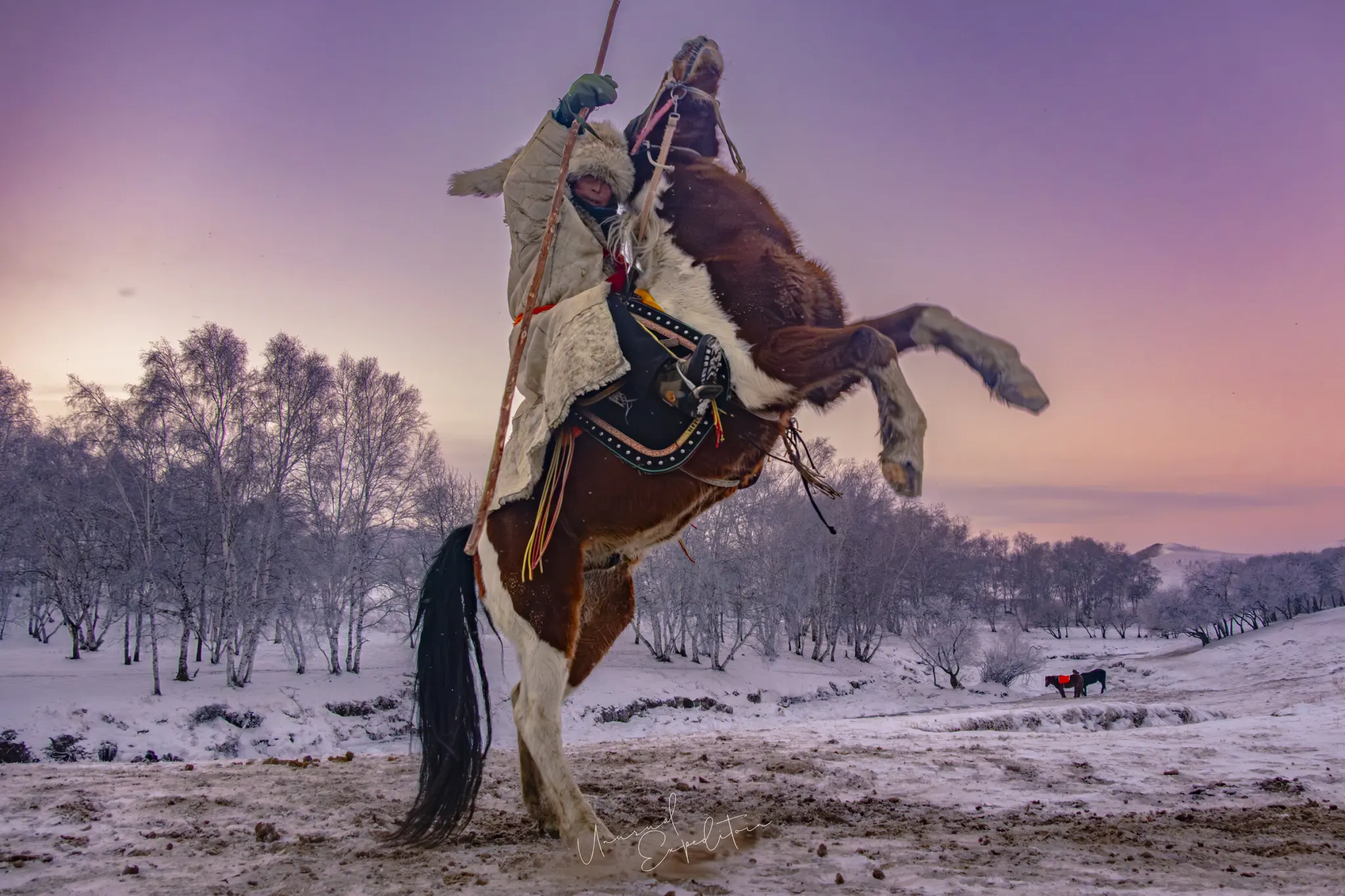
Inner Mongolia horses are photographed on the Ulan Butong grassland, where herding families drive their Mongolian horses across streams in autumn and through deep snow in winter. The runs give spray, flying manes, powder snow and backlight, and between runs the horses stand close enough for portraits. Inner Mongolia horse photography is fast action work with a long lens, planned around the light and the direction the herd will run. Below are the horses, the runs and the camera settings.
Horses are the main subject of our Inner Mongolia photography tour guide, and this article goes deeper into how the horse sessions work and how to photograph them well.
The Mongolian horse
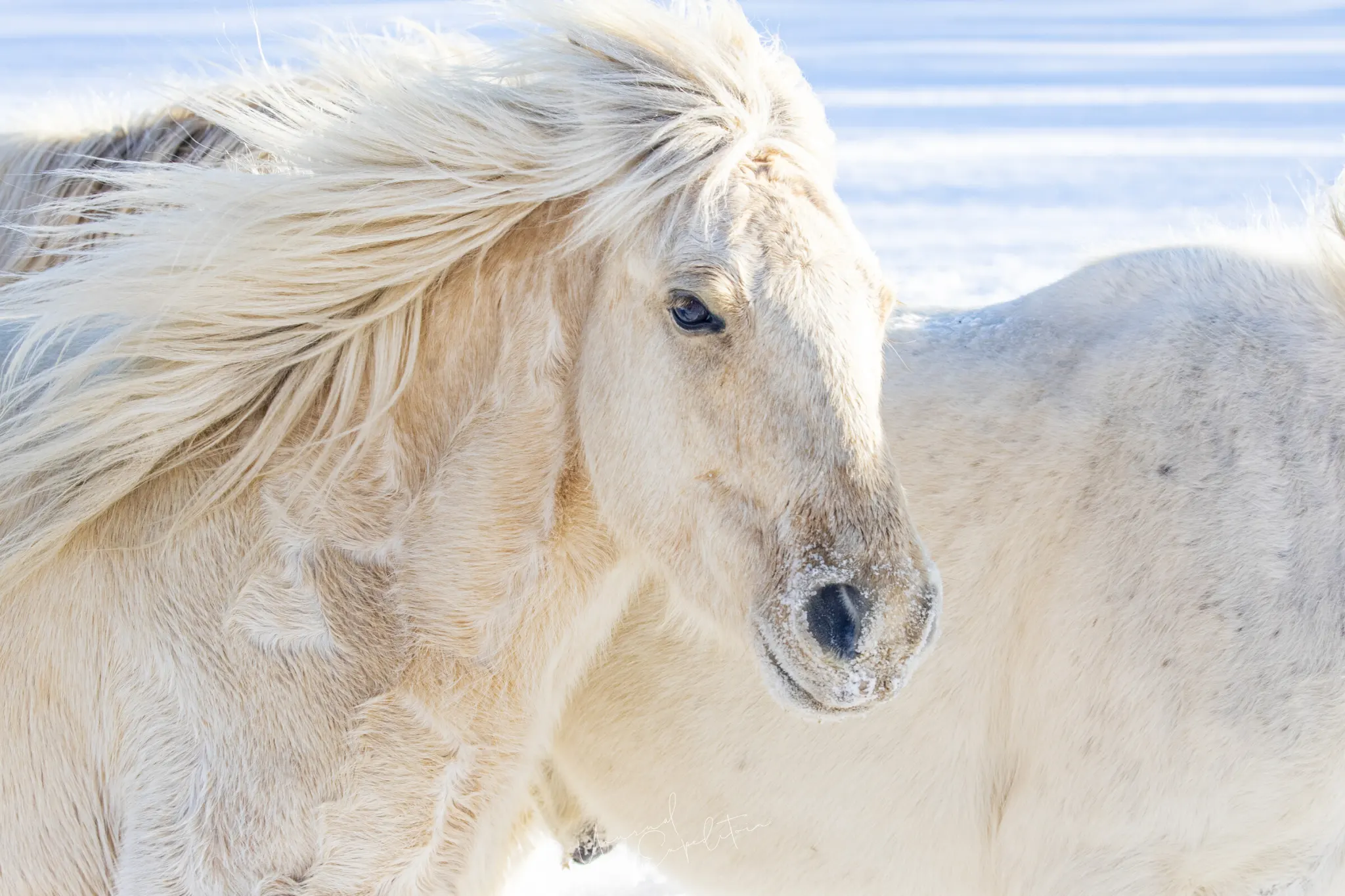
The Mongolian horse is a small, stocky, hardy breed with a large head, a thick neck, short strong legs and a heavy mane and tail. The Breeds of Livestock reference at Oklahoma State University describes the breed as frugal and tough, living outdoors through the year and pawing through snow to reach grass in winter. In Inner Mongolia the herds are mixed in colour: bays, chestnuts, blacks, duns, greys and pure white horses, which photograph beautifully against both autumn gold and winter snow. An Inner Mongolian horse in January grows a long, shaggy coat, and frost forms on the whiskers and mane on cold mornings, which is one of the reasons photographers come in the coldest month.
How an Inner Mongolia horse run works
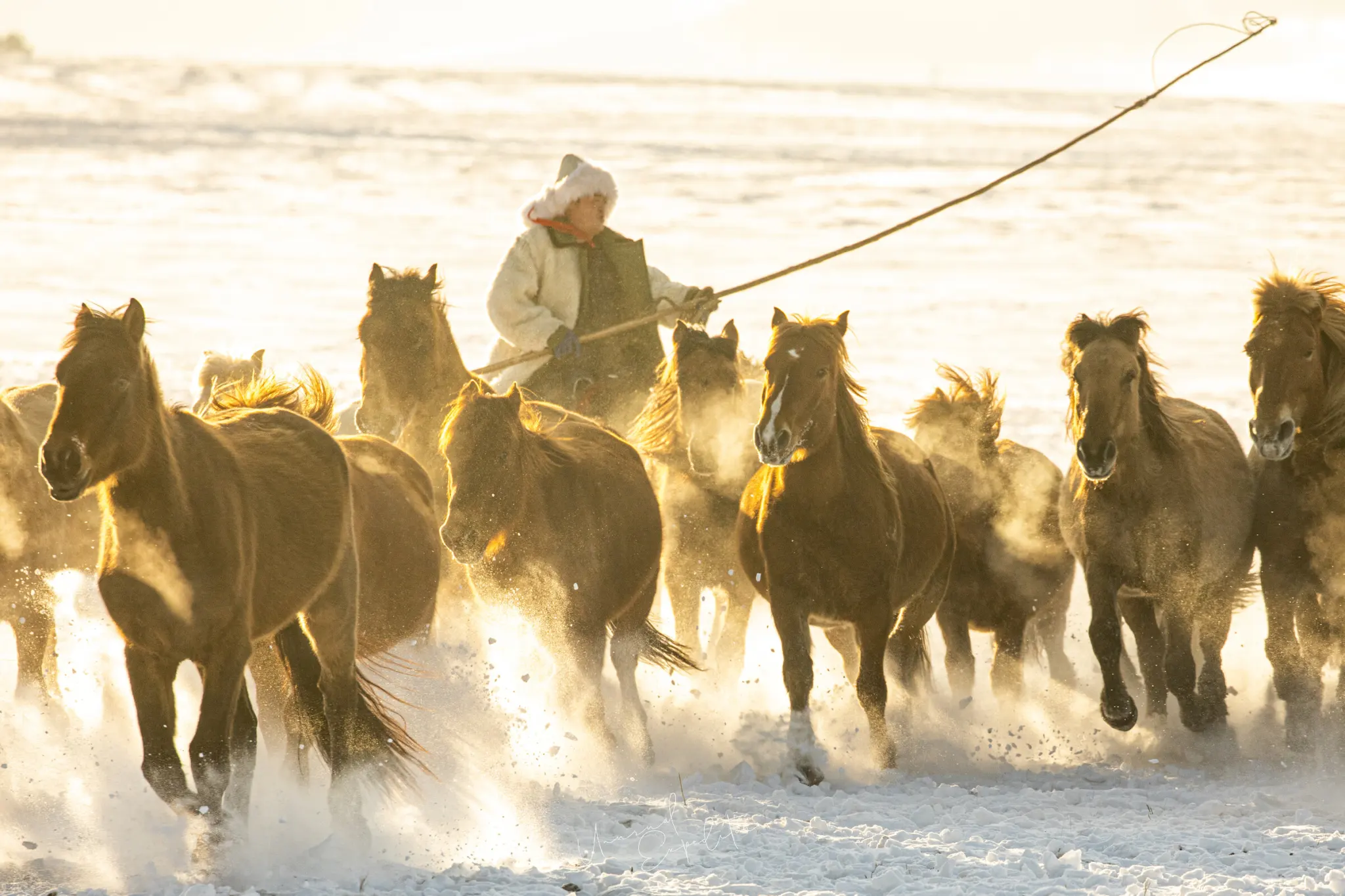
An Inner Mongolia horse run is arranged with a local herding family. The herders gather the horses out of sight, the group sets up on a line chosen for the light and background, and then the horsemen drive the herd past at speed, usually several times in a session. Before each run the guide tells you where the horses will enter and leave the frame, so you can choose a focal length and a position in advance. Riders in traditional winter dress, with fur hats, sashes and long lasso poles, ride alongside the herd and are part of the picture. The family decides how hard the horses work; when the horses need rest, the session stops.
Horses in water: the autumn runs
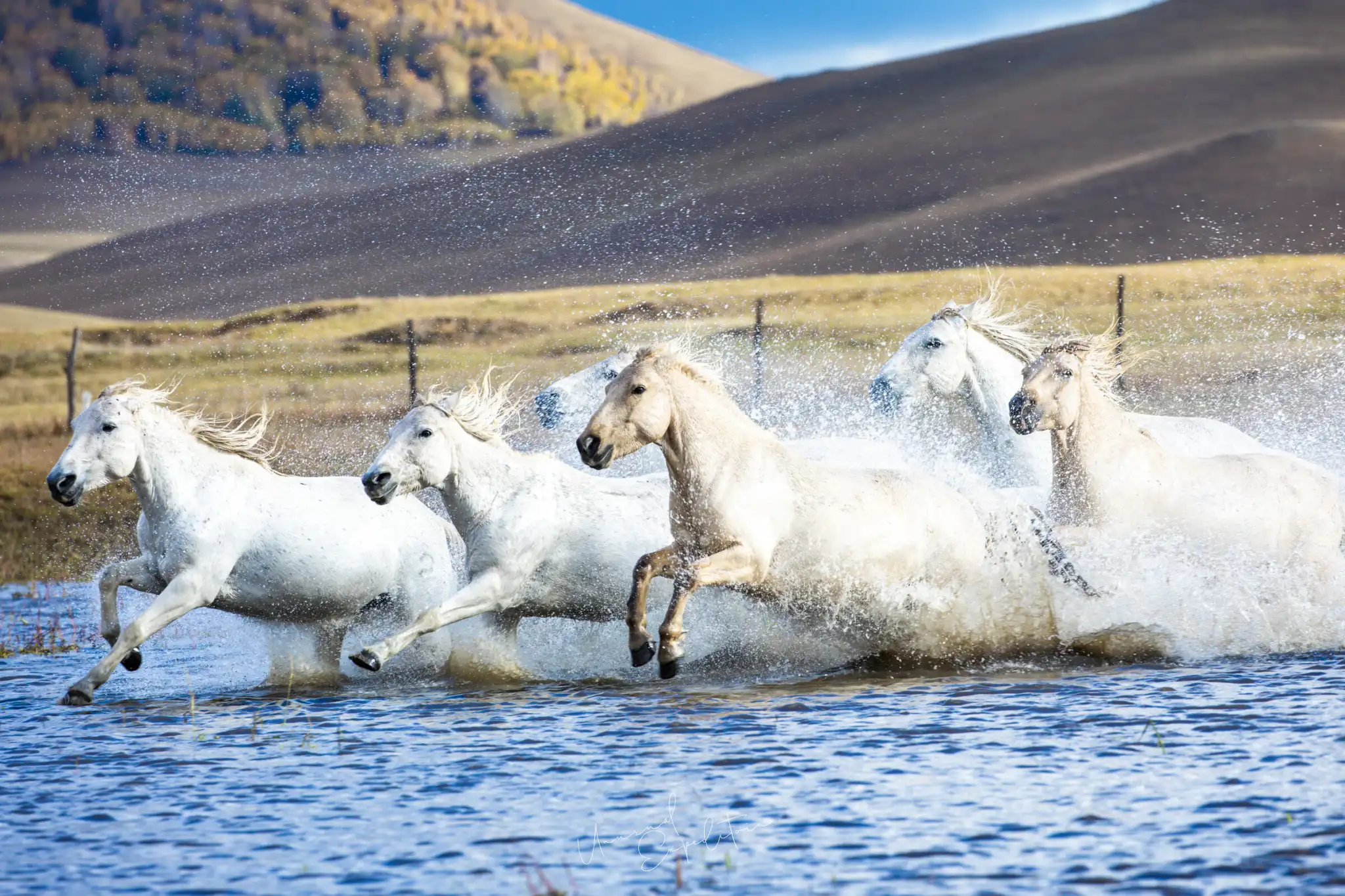
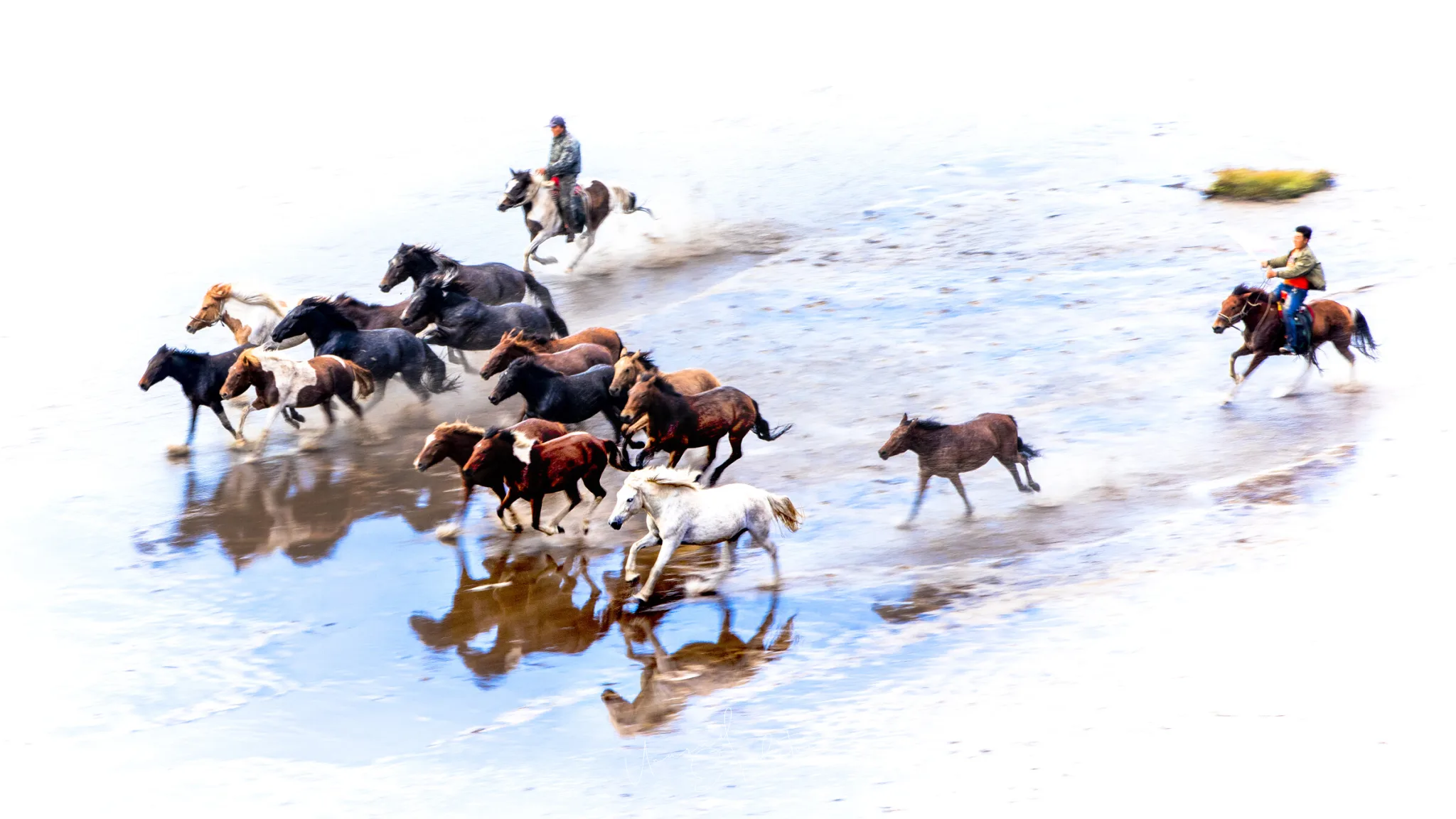
Horses running through water are the classic autumn frame on the Bashang grassland. Herds are driven through shallow streams and lake edges, and the spray, lit from behind by low sun, gives a curtain of light around the legs. White horses through blue water in clear midday light give a different, cleaner picture. The autumn runs happen from about the middle of September into early October, when the groves along the streams are gold, and they need a fast shutter speed, a clear view along the water and a position low enough to put the horses against the far bank or the sky.
Horses in snow: the winter runs
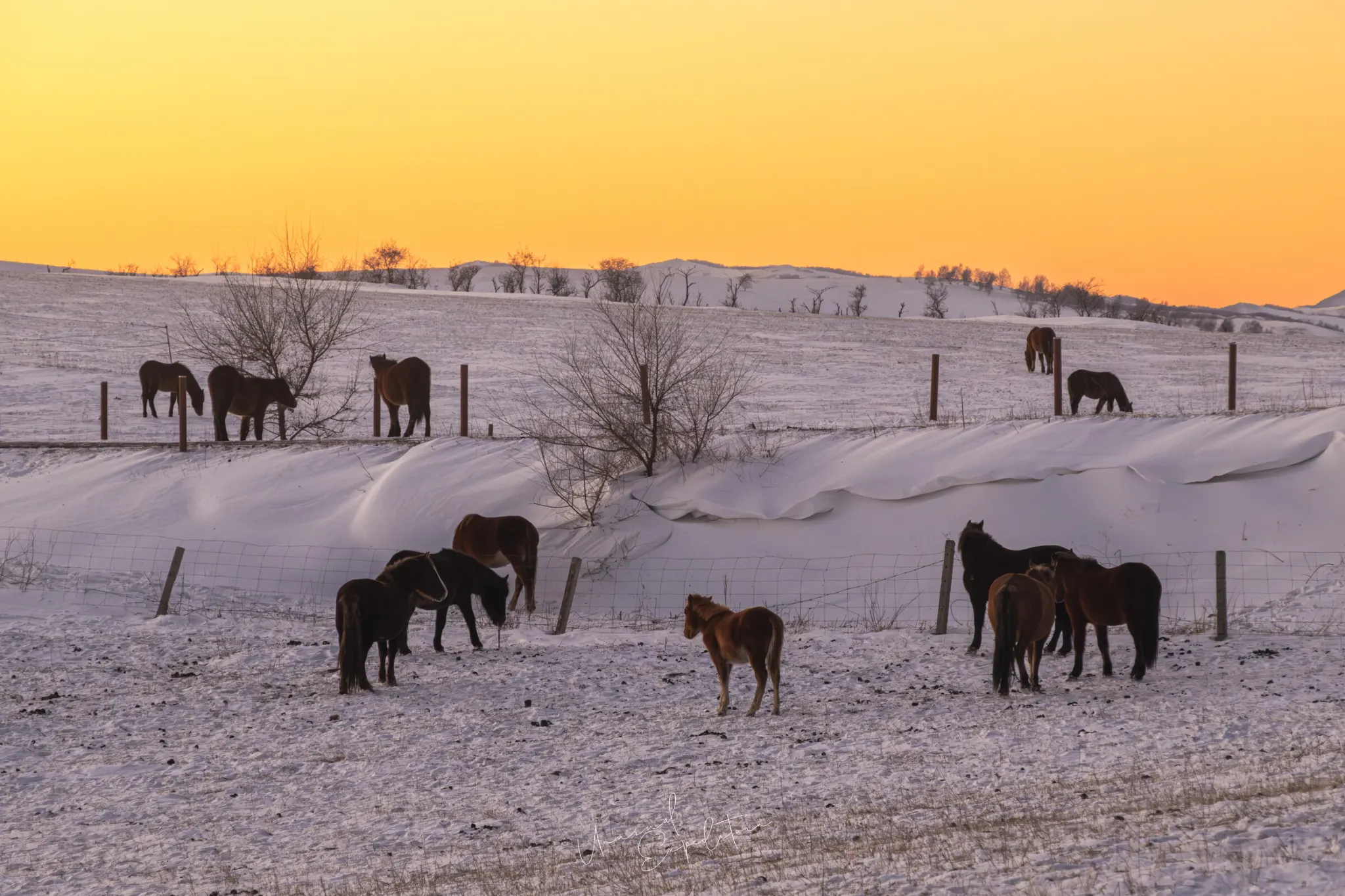
Horses in snow are the reason most photographers choose Inner Mongolia in winter. On a cold January morning the herd kicks up powder that hangs in the air and catches the sun, and the horses' breath steams. From a distance a whole herd crossing a white slope becomes a pattern of dots and lines; from close, a single horse with snow flying from its hooves fills the frame. The best winter runs come in the first and last hours of sun, when the light is low enough to backlight the snow dust and frost on the horses' coats; at midday the same run looks flat and grey. Fresh snow helps too, because the horses throw up more powder. Our Inner Mongolia winter photography guide covers the rest of the winter subjects, from frosted forest to camel caravans.
Lenses and settings for horse photography
| Shot | Lens | Settings to start from |
|---|---|---|
| Frozen action, head-on herd | 70-200mm or 100-400mm | 1/2000s to 1/3200s, f/5.6, continuous AF, tracking |
| Panning blur | 70-200mm | 1/30s to 1/60s, f/11, follow one horse's head |
| Herd in the landscape | 24-70mm | 1/1600s, f/8, leave space in front |
| Portraits between runs | 70-200mm or 85mm | 1/1000s, f/4, eye detection for animals |
Snow and spray fool the meter, so add exposure compensation in snow and check the highlights on white horses. Commit to either a frozen frame or a panned frame on each run rather than switching halfway.
Horse show and horse culture on the grassland
Searches for an Inner Mongolia horse show usually mean one of two things: a staged riding performance at a tourist camp, or the traditional horse events of the grassland. Herders in the region still race horses, and Mongolian riding culture includes horseback archery and the long lasso pole called an uurga. CGTN has reported the Ulan Butung Horse Culture Festival held in January, with racing and riding on the snow. Our sessions are not shows; they are working herds run for photographers, with horsemen in traditional dress. At dusk a horseman may rear his horse against the evening sky, which is one of the most striking frames of a winter trip.
People expect the horses to be the hard part. The hard part is the snow in your face after the herd goes by. Shoot the run, then turn your back, wipe the lens and laugh, because the next run is already coming.
Joseph Mak, tour leader, Unusual Expedition
Respect for the horses and the herders
Mongolian horses are working animals and the families who own them decide how they are used. We keep runs short, stop when the horses are tired or the snow is too deep, and never ask riders to take risks for a picture. Stay behind the line the guide sets, never walk toward a running herd, and keep bags and tripods out of the horses' path. The herders are also people you photograph: ask before a close portrait, and show them the picture on the back of the camera. Our best time to visit Inner Mongolia guide explains when each type of run happens.
Photograph Inner Mongolia horses with us
Our January horse trip is on the Ulan Butong grassland and is indicatively S$2,400 to S$2,600 per person depending on the room; the autumn trip runs in late September. Dates and details are on our China photography tours page.
Join the Inner Mongolia photography tour
Inner Mongolia Winter Owl Photo Tour – China departs 01 Jan 2027 To 04 Jan 2027, led by Joseph Mak. Small group, photography first. All Inner Mongolia photography tours.
Explore Inner Mongolia in depth
- Inner Mongolia Photography Tour: The Complete GuideChina
- Inner Mongolia Winter: Snow, Frost, Camels and Dusk on the GrasslandChina
- Ulan Butong Grassland: Photographing Wulan Butong in Autumn and WinterChina
- Inner Mongolia Tour from Singapore: Flights, Visa, Cold and What to WearChina
- Inner Mongolia Photos: What the Grassland Looks Like Through the YearChina
- Inner Mongolia Owl Photography: Great Grey Owls and Snowy Owls in HulunbuirChina
- Best Time to Visit Inner Mongolia for Photography: Autumn or WinterChina
Upcoming Photo Tours
- Egypt Photo Tour – EgyptEgypt 12 Dec 2026 To 20 Dec 2026
- Inner Mongolia Winter Owl Photo Tour – ChinaChina 01 Jan 2027 To 04 Jan 2027
- Inner Mongolia Winter Photo Tour – ChinaChina 05 Jan 2027 To 11 Jan 2027
- Mekong And Central Highland Vietnam Photo Tour - VietnamVietnam 16 Jan 2027 To 24 Jan 2027