
Karnak Temple Hypostyle Hall: Photographing the Columns
Karnak temple hypostyle hall: where to stand among the 134 columns, when the light enters, Karnak at night and the rules.
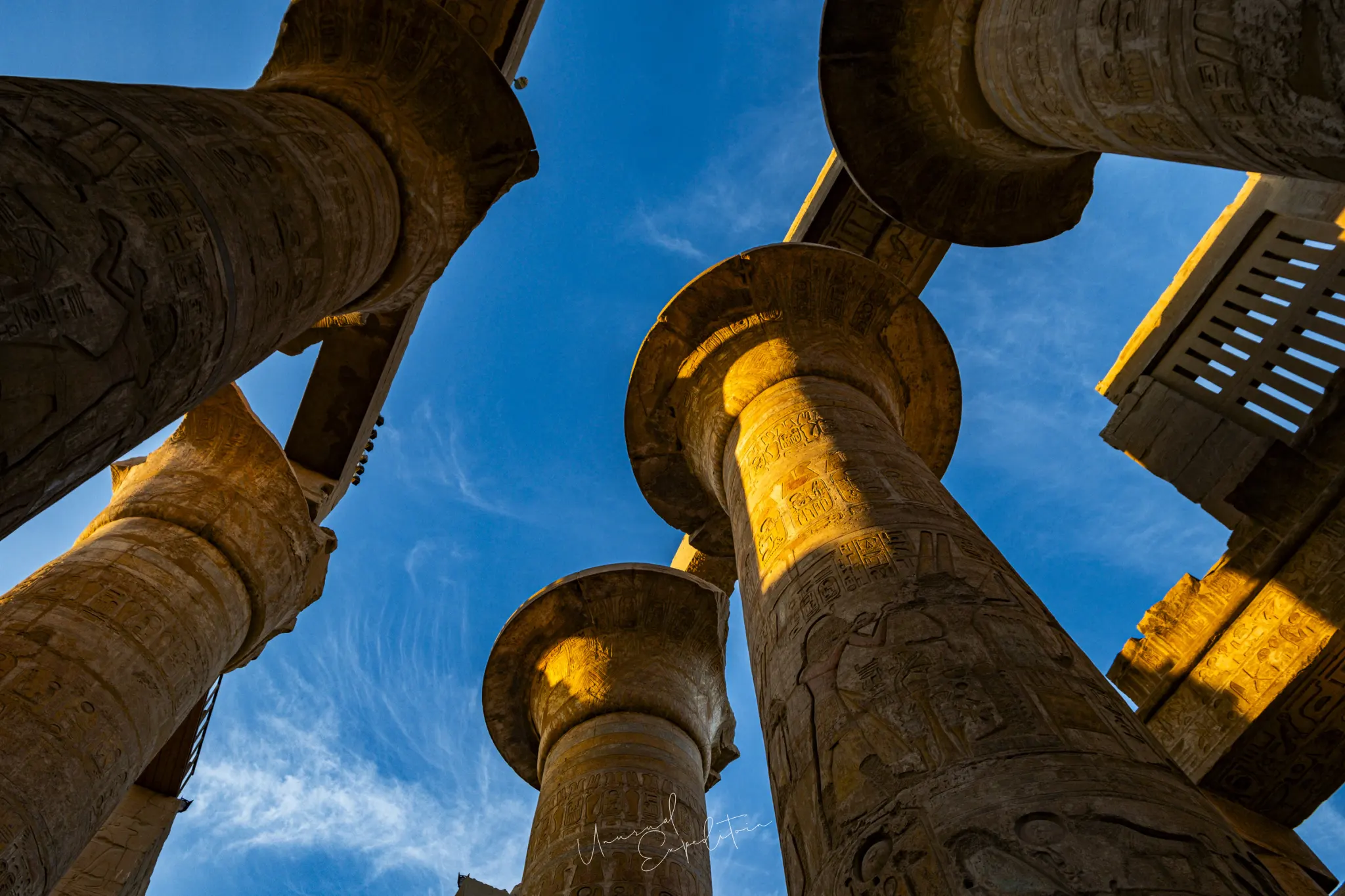
The Karnak temple hypostyle hall is a roofless forest of 134 carved sandstone columns at the heart of the Temple of Amun in Luxor, and the way to photograph it is to come late in the day, stand among the shafts and look up. When the sun drops low, light slides between the columns in narrow beams, lights one capital at a time and leaves the rest in shadow, which turns a crowded hall into a picture with shape and depth.
Karnak is the centre of our Luxor photography tour guide. This guide is about the hall itself and the rest of the complex: where to stand, when the light enters and how to keep the crowds out of the frame.
Karnak temple hypostyle hall: what you are looking at
The Great Hypostyle Hall stands between the second and third pylons of Karnak. The University of Memphis Great Hypostyle Hall Project, which has recorded the hall for decades, describes 134 columns in 16 rows, shaped like papyrus stalks. The twelve in the central aisle are the tallest, about 20 metres high, with capitals that open like papyrus flowers; the rest are shorter, with closed bud capitals. Smarthistory and the Memphis project date the hall to Sety I and Ramesses II: it was raised under Sety I, and much of its decoration was carved under his son. The roof has gone, apart from some stone beams, so sunlight falls straight in, and every column is covered from foot to capital with carved figures and hieroglyphs. Some traces of the original paint survive high up, under the beams.
Where to stand in the hypostyle hall
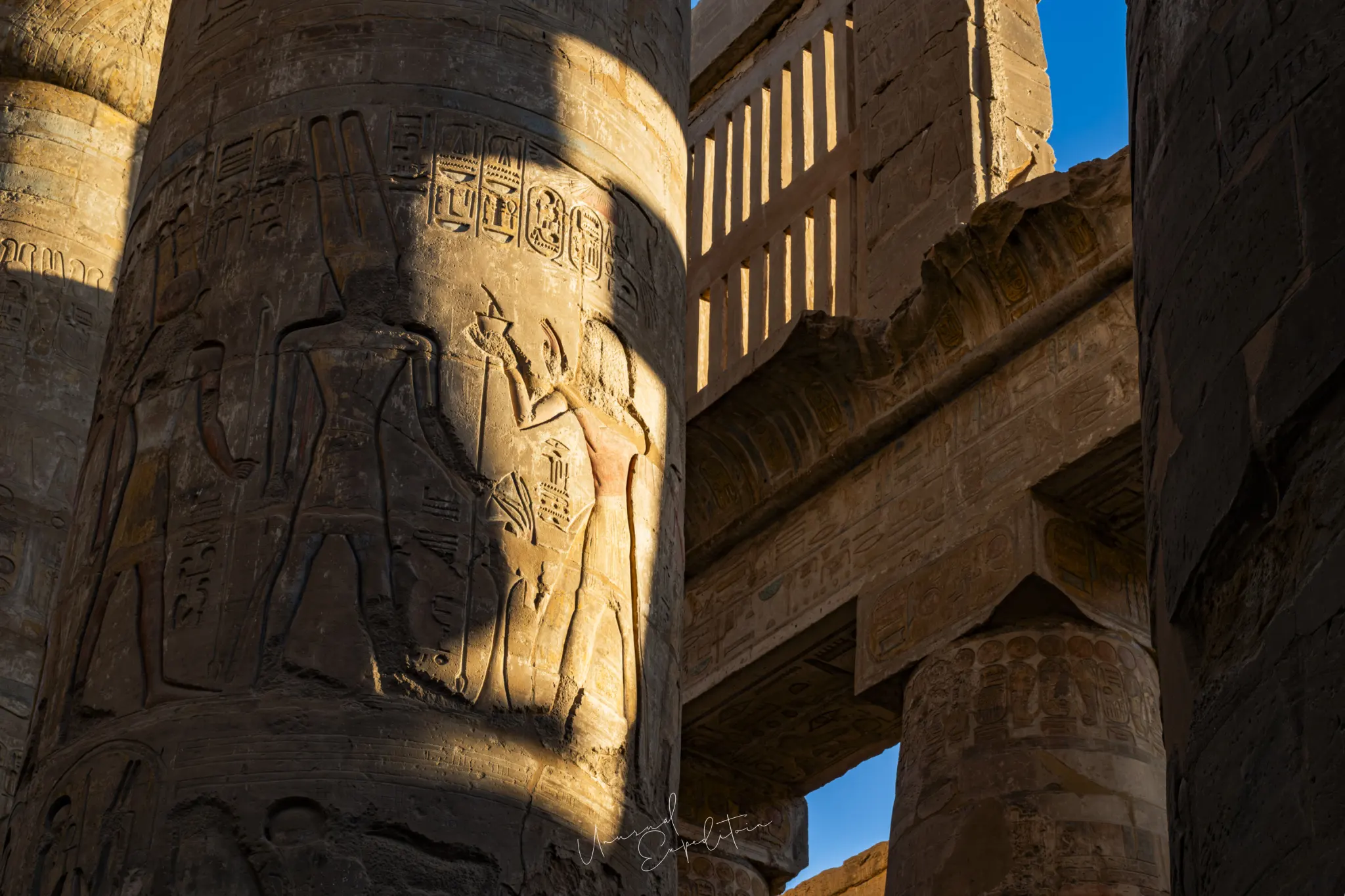
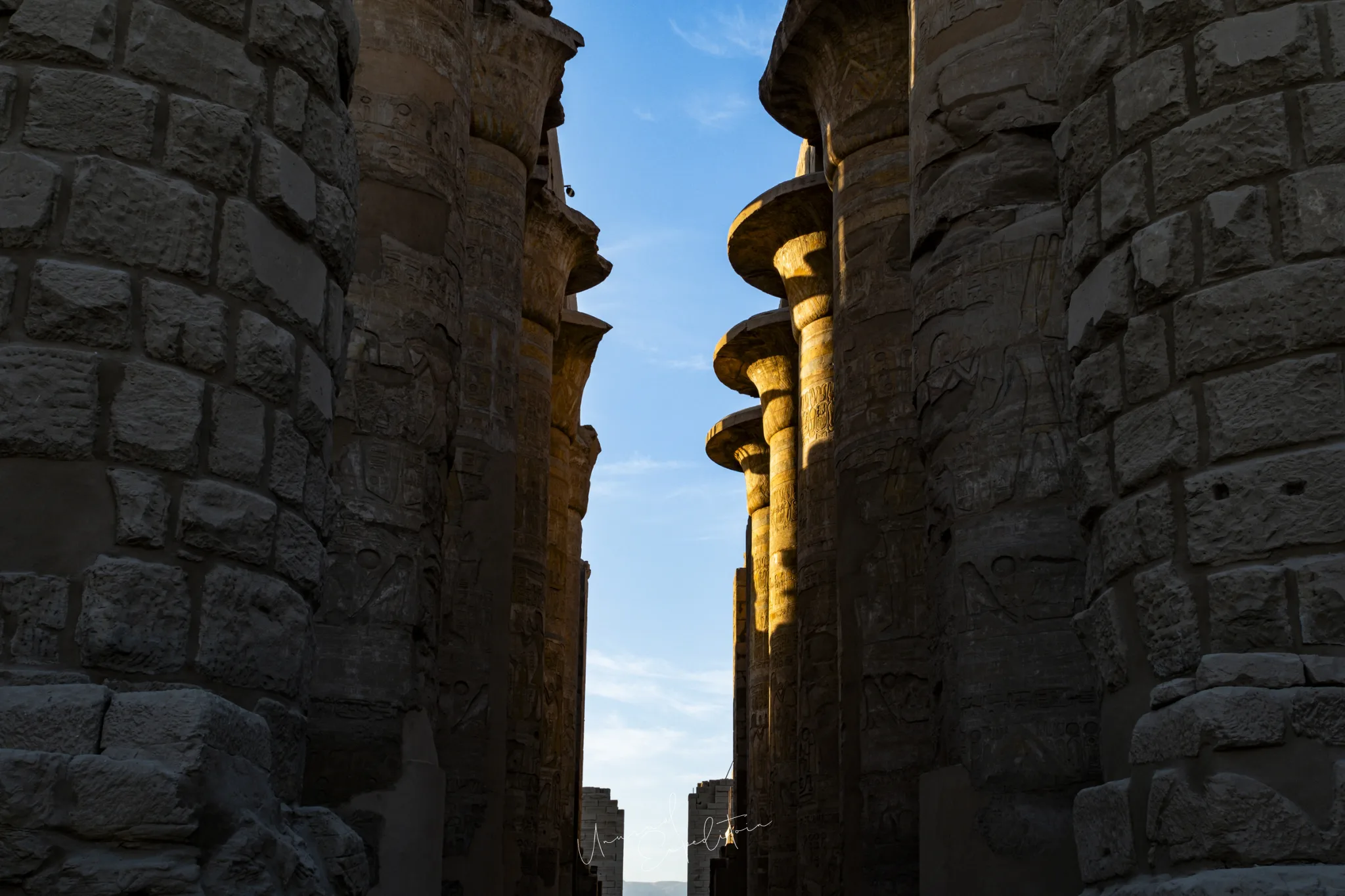
In the Karnak hypostyle hall the classic frame is from the central aisle looking up at the open capitals, with blue sky between them. It works, but it is where everyone stands. Move one or two rows into the side aisles and the picture changes: the columns overlap, the gaps close into narrow slots of sky, and you can isolate a single shaft with a carved king or god lit on one side. Look for places where a stone beam still bridges two capitals, because it frames the sky and gives the eye a line to follow. A wide lens close to a column makes it tower; a longer lens from further back stacks the columns into a wall of stone.
When the light is best at Karnak
Karnak faces west towards the Nile, and the late afternoon is when the hall comes alive. The sun is low enough to reach under the beams and between the shafts, the stone turns from pale grey to honey, and the long shadows give the carvings relief. At midday the light falls straight down, the floor is bright and the columns are flat. In the cooler months the complex is busiest in the morning, when coach groups arrive, and quieter in the last hour before closing, which suits the light as well. Our best time to visit Luxor guide covers the seasons and the heat.
Karnak temple photos beyond the hall
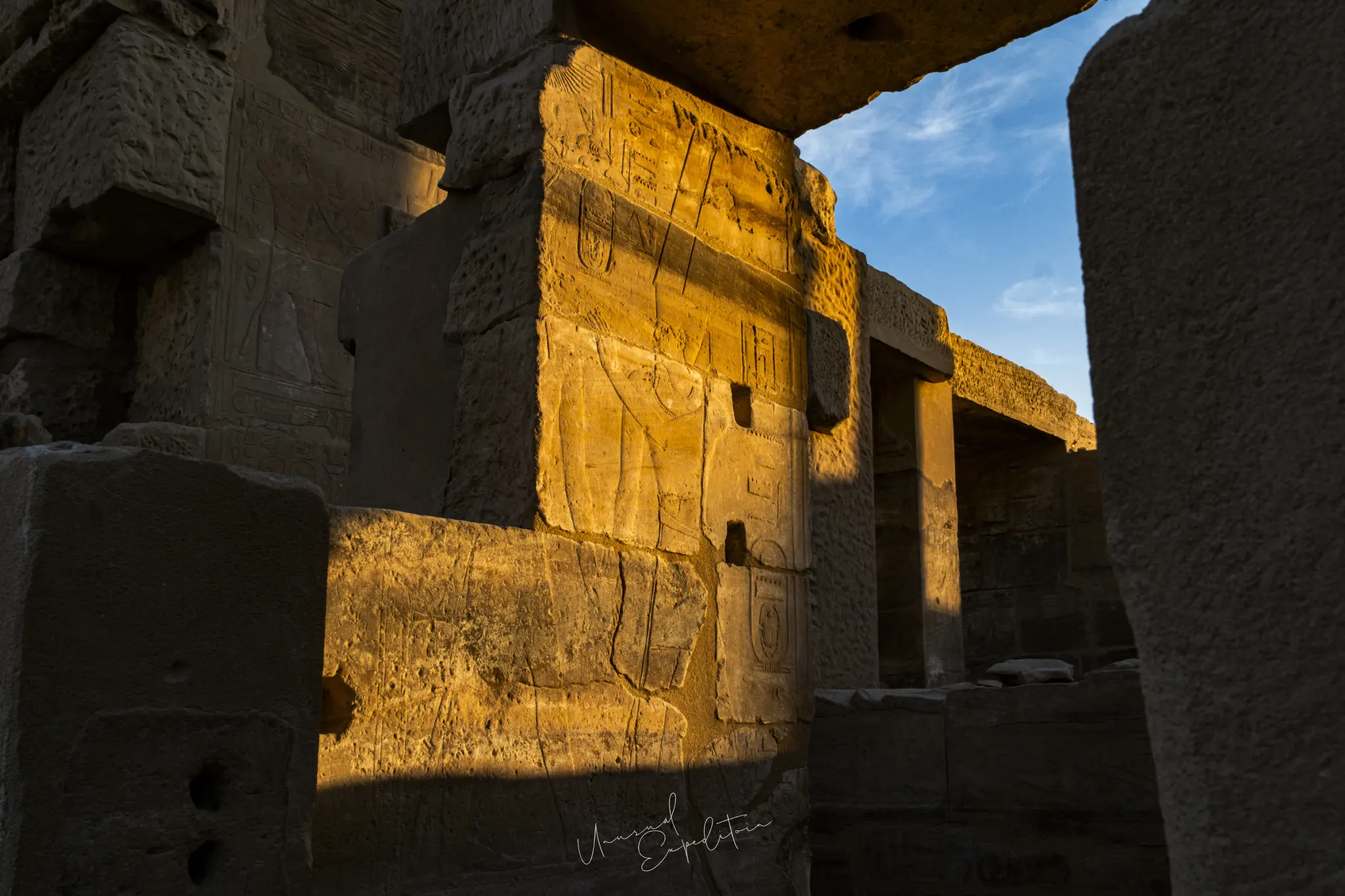
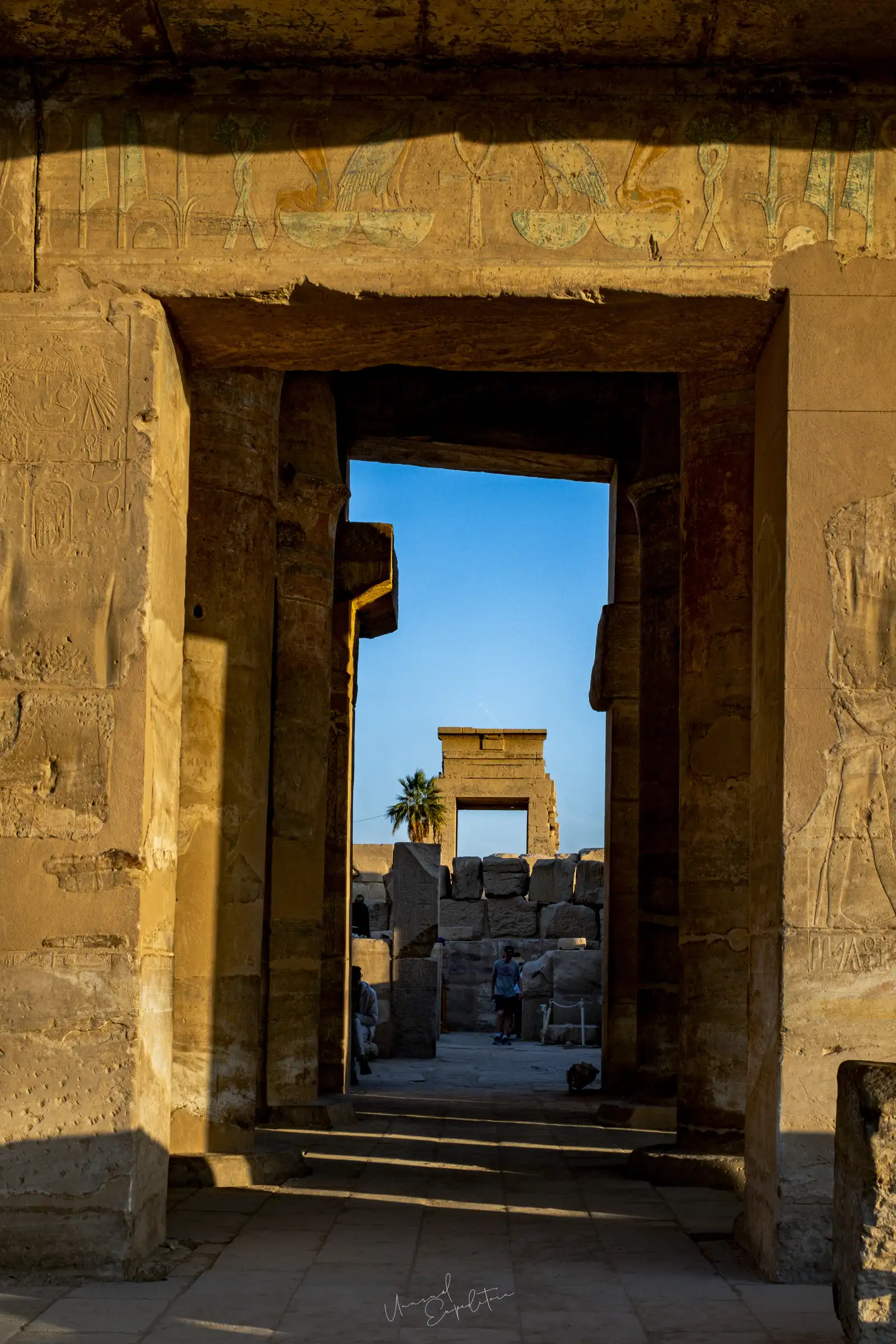
Karnak is far more than the hypostyle hall, and some of our favourite Karnak temple photos come from the quieter corners. Doorways line up along the main axis so that one frames the next, with a gateway in the far distance. Fallen blocks and broken walls catch the late sun on a single carved face. The great first pylon at the entrance becomes a silhouette at sunset, and the sacred lake and the obelisks of Hatshepsut and Thutmose I give you other subjects. Give yourself time to walk the edges of the complex instead of leaving after the hall.
| Subject at Karnak | Lens | Light |
|---|---|---|
| Open capitals against the sky | 16-35mm | Late afternoon, sun on the capitals |
| Single carved column | 24-70mm | A beam of sun across the shaft |
| Columns stacked in rows | 70-200mm | Side light, from the edge of the hall |
| Doorways on the axis | 24-70mm, vertical | Afternoon, bright far gate |
| First pylon in silhouette | 24-70mm | Sunset and blue hour |
Most of the strongest pictures here come from the last two hours of light, so plan the visit backwards from sunset.
Karnak temple at night and the sound and light show
Karnak temple at night belongs to the sound and light show, which has run for decades and walks the audience through the complex before seating them by the sacred lake. Narration rotates between languages on different evenings, and the schedule changes, so check it on the day. We have no photographs of the show, and it is not a photography session: you move with the crowd, tripods are impractical and the lighting is coloured. If you go, set a high ISO, keep a wide lens on and treat it as an evening out with a few pictures.
"In the hypostyle hall I tell people to put the camera down for five minutes and just watch the light move. A beam lands on a column, climbs it and goes. Once you see that, you know where to stand."
Joseph Mak, tour leader, Unusual Expedition
Practical notes for photographing Karnak
Personal photography without flash is allowed at Karnak under the Supreme Council of Antiquities rules, as at other sites run by the Ministry of Tourism and Antiquities. A tripod is awkward among the visitors, so raise the ISO and brace against a column base instead. The floor is uneven and there are blocks everywhere, so watch your feet when you are looking up. Wear a hat and carry water; there is little shade outside the hall. Karnak and Luxor Temple are often compared, and our Luxor Temple photos guide sets the two side by side.
Photograph Karnak with us
Our Egypt Photo Tour includes Karnak and its hypostyle hall, and also covers the West Bank, Aswan, Abu Simbel, Cairo and Giza. The current departure is on the Egypt photography tours page.
Join the Luxor photography tour
Egypt Photo Tour – Egypt departs 12 Dec 2026 To 20 Dec 2026, led by Joseph Mak. Small group, photography first. All Luxor photography tours.
Explore Luxor in depth
- Luxor Photography Tour Guide: Karnak, the West Bank and the BalloonsEgypt
- Medinet Habu Temple: Colour, Reliefs and Quiet on the West BankEgypt
- West Bank of Luxor: Hatshepsut, the Valley of the Kings and Medinet HabuEgypt
- Luxor Temple Photos: Columns, Reliefs and the LightEgypt
- Luxor Hot Air Balloon at Sunrise: A Photographer's GuideEgypt
- Best Time to Visit Luxor for Photography: Weather and LightEgypt
Upcoming Photo Tours
- Egypt Photo Tour – EgyptEgypt 12 Dec 2026 To 20 Dec 2026
- Inner Mongolia Winter Owl Photo Tour – ChinaChina 01 Jan 2027 To 04 Jan 2027
- Inner Mongolia Winter Photo Tour – ChinaChina 05 Jan 2027 To 11 Jan 2027
- Mekong And Central Highland Vietnam Photo Tour - VietnamVietnam 16 Jan 2027 To 24 Jan 2027