
West Bank of Luxor: Hatshepsut, the Valley of the Kings and Medinet Habu
West bank of Luxor for photographers: the Valley of the Kings and temple of Hatshepsut, Medinet Habu and the morning light.
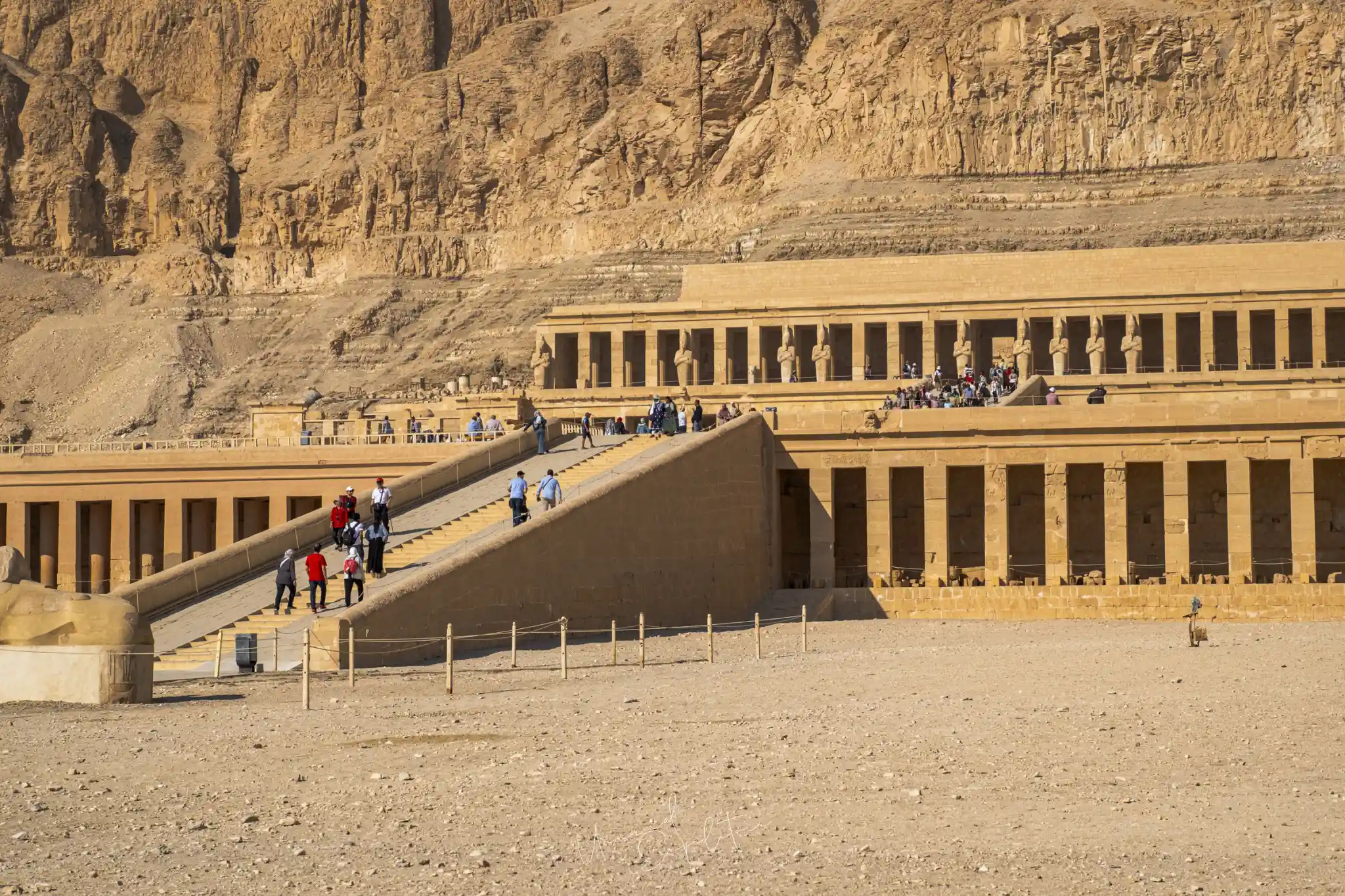
The West Bank of Luxor is the old Theban necropolis, the side of the Nile where the pharaohs were buried and worshipped, and for a photographer its three anchors are Hatshepsut's terraced temple under the cliffs of Deir el-Bahari, the painted courts of Medinet Habu and the tombs of the Valley of the Kings. Green fields run right up to the desert, the limestone hills glow at sunrise, and the light is best early, before the sun climbs high over the cliffs.
This guide is part of our Luxor photography tour guide. It covers what each West Bank site gives a photographer, the order of light through a morning and the rules inside the tombs.
West bank of Luxor: what is there
The West Bank of Luxor stretches along the edge of the Theban hills opposite the modern city. From north to south you meet the Valley of the Kings in a dry wadi behind the cliffs, Hatshepsut's temple at Deir el-Bahari, the tombs of the nobles scattered over the hillside, the Ramesseum, the two seated Colossi of Memnon by the road and Medinet Habu at the southern end. The Valley of the Queens and the workers' village of Deir el-Medina lie in the hills behind. UNESCO includes the whole necropolis in the World Heritage Site of ancient Thebes. For photography the West Bank is a mix of landscape and monument: the cliffs and the cultivated plain are as much a subject as the temples, and the contrast between bright green fields and bare desert is clearest in the low light of morning.
Valley of the Kings and temple of Hatshepsut
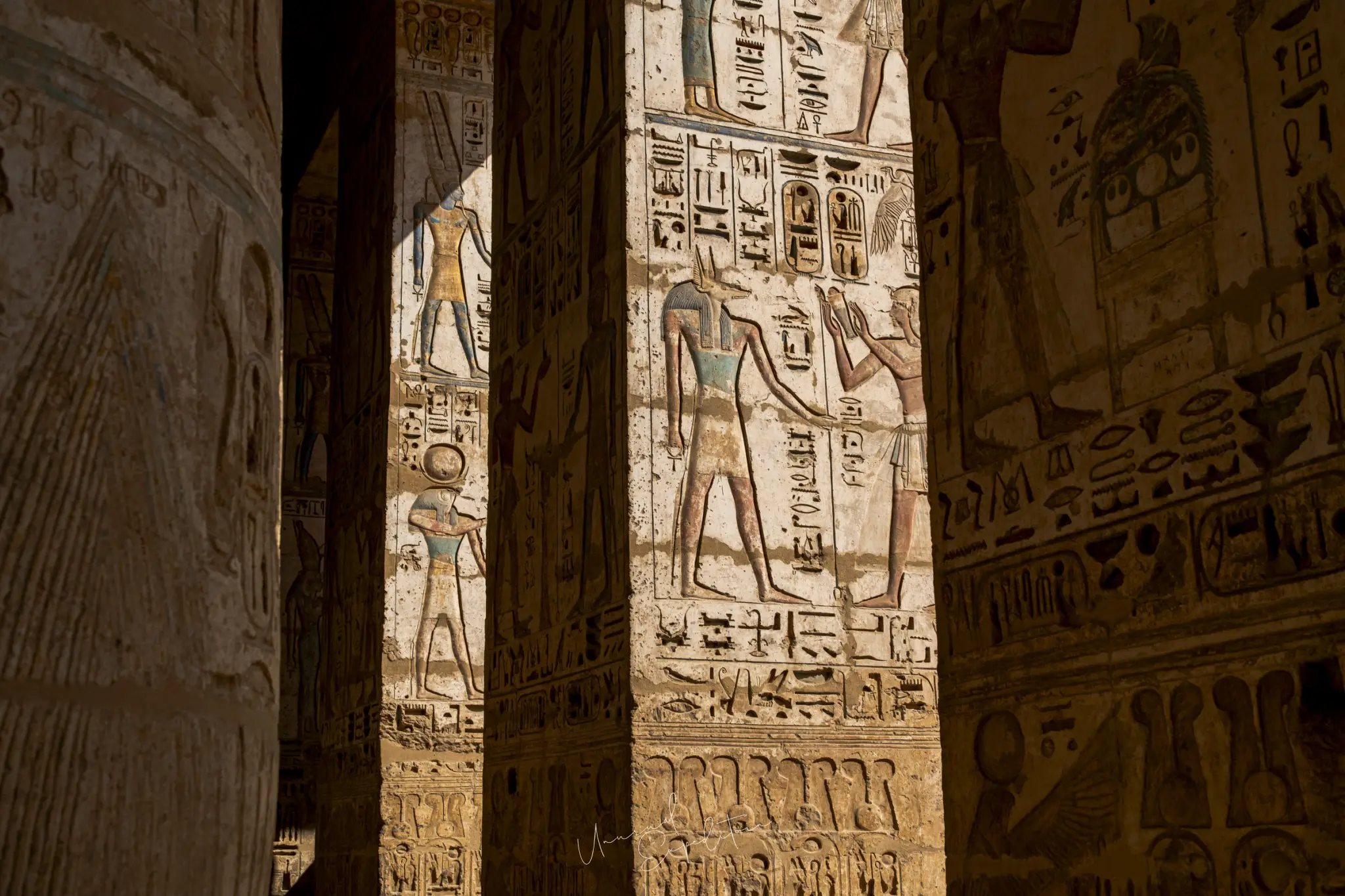
The Valley of the Kings and the temple of Hatshepsut sit back to back, separated by the ridge of the Theban hills. The Theban Mapping Project, which has documented the valley for decades, counts more than sixty tombs there, of which a rotating handful are open on any day; the general ticket covers a set number, and a few, Tutankhamun's among them, need a separate ticket. Inside, the painted corridors are the subject, but they are narrow, crowded and lit by electric light, so a wide lens and a high ISO matter more than anything else. We have no photographs from inside the tombs in these destination guides. Hatshepsut's temple, on the other side of the ridge, is the opposite: an open, terraced building of colonnades and ramps set against a sheer cliff, best photographed from a distance with the whole face of rock behind it.
Hatshepsut temple photo: where and when
The classic Hatshepsut temple photo is from the forecourt, square on, with the three terraces stacked up the frame and the cliff filling the background. Early morning is the time. The temple faces east, so the first sun lights the colonnades and the rock behind them, and the shadows under the porticoes give the building its shape; by late morning the cliff and the temple flatten into one pale wall. A 24-70mm covers the whole facade from the forecourt, and a 70-200mm picks out the Osiride statues on the upper terrace or the line of the ramp. The terraces are open to visitors, and the reliefs of the expedition to the land of Punt on the middle terrace are worth a closer look, though they are faded compared with Medinet Habu.
Light on the West Bank through a morning
| Site | Photograph | Light that works |
|---|---|---|
| The fields and the cliffs | Green plain against desert | Sunrise, from a balloon or the road |
| Hatshepsut's temple | Terraces and cliff face | Early morning, sun on the facade |
| Valley of the Kings | Painted tomb corridors | Any time, electric light |
| Medinet Habu | Painted reliefs, deep carving | Mid-morning in the shaded courts |
| Colossi of Memnon | Two seated statues by the road | Early morning, sun on their faces |
The open sites want the early sun, and the tombs and shaded courts can take the harder light later on.
Medinet Habu and the quieter temples
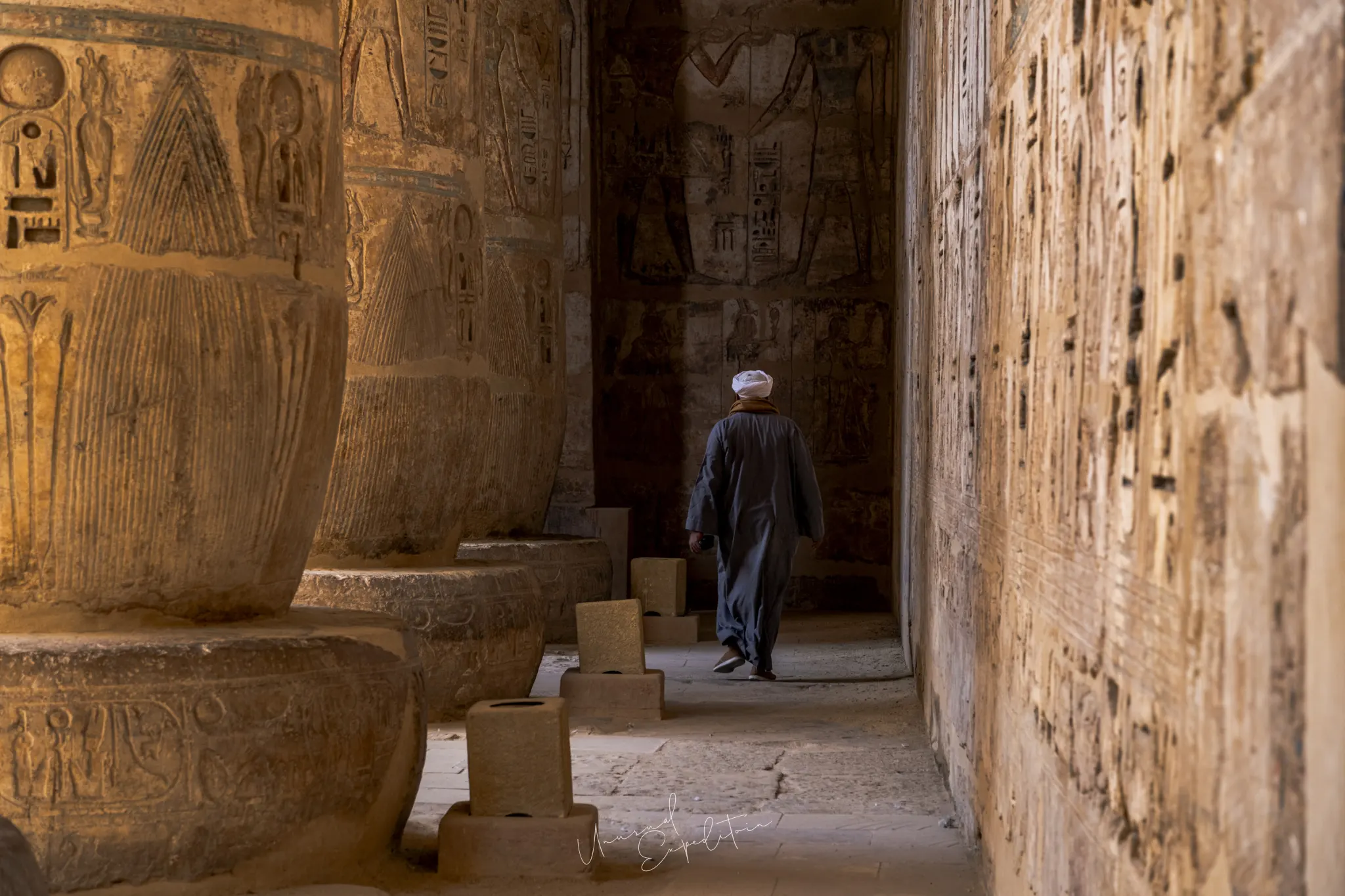
Medinet Habu, at the southern end of the West Bank, is where we would spend the most time with a camera: the second court is lined with pillars that still carry their paint, the side aisles fall into deep shade, and there are far fewer visitors than at the valley. Our Medinet Habu temple guide covers it in detail. The Ramesseum, with its fallen colossus, is another quiet temple worth an hour if you have it.
Luxor west bank: getting around
The Luxor West Bank is reached by the road bridge south of the city or by the public ferries and motorboats across the river from the Corniche. Sites are spread out over several kilometres, so most visitors use a car with a driver or a taxi hired for the morning; cycling is possible in the cooler months. Tickets for most sites are sold at the individual gates or at a central ticket office, and arrangements change, so check on the day. Personal photography without flash is allowed under the Supreme Council of Antiquities rules, and Singapore's Ministry of Foreign Affairs reminds visitors that drones need prior permission from the Egyptian Civil Aviation Authority.
"On the West Bank I want to be at Hatshepsut's temple with the first sun on the cliff. Half an hour later the rock goes white and the temple disappears into it, and you are left with a postcard."
Joseph Mak, tour leader, Unusual Expedition
The West Bank from the air
The best way to understand the West Bank is from a balloon at sunrise, when you see the line where the farmland stops and the desert begins, and the temples sitting along it. Our Luxor hot air balloon guide explains the flight, and the best time to visit Luxor covers the season.
Photograph the West Bank with us
Our Egypt Photo Tour includes the Valley of the Kings, Hatshepsut's temple and an optional sunrise balloon flight on the West Bank, with Karnak, Aswan, Abu Simbel, Cairo and Giza. The current departure is on the Egypt photography tours page.
Ask us about the West Bank of Luxor
Join the Luxor photography tour
Egypt Photo Tour – Egypt departs 12 Dec 2026 To 20 Dec 2026, led by Joseph Mak. Small group, photography first. All Luxor photography tours.
Explore Luxor in depth
- Luxor Photography Tour Guide: Karnak, the West Bank and the BalloonsEgypt
- Medinet Habu Temple: Colour, Reliefs and Quiet on the West BankEgypt
- Luxor Temple Photos: Columns, Reliefs and the LightEgypt
- Luxor Hot Air Balloon at Sunrise: A Photographer's GuideEgypt
- Karnak Temple Hypostyle Hall: Photographing the ColumnsEgypt
- Best Time to Visit Luxor for Photography: Weather and LightEgypt
Upcoming Photo Tours
- Egypt Photo Tour – EgyptEgypt 12 Dec 2026 To 20 Dec 2026
- Inner Mongolia Winter Owl Photo Tour – ChinaChina 01 Jan 2027 To 04 Jan 2027
- Inner Mongolia Winter Photo Tour – ChinaChina 05 Jan 2027 To 11 Jan 2027
- Mekong And Central Highland Vietnam Photo Tour - VietnamVietnam 16 Jan 2027 To 24 Jan 2027