
Luxor Temple Photos: Columns, Reliefs and the Light
Luxor Temple photos: where to stand, morning light on the reliefs, Luxor Temple vs Karnak, sunset and the temple at night.
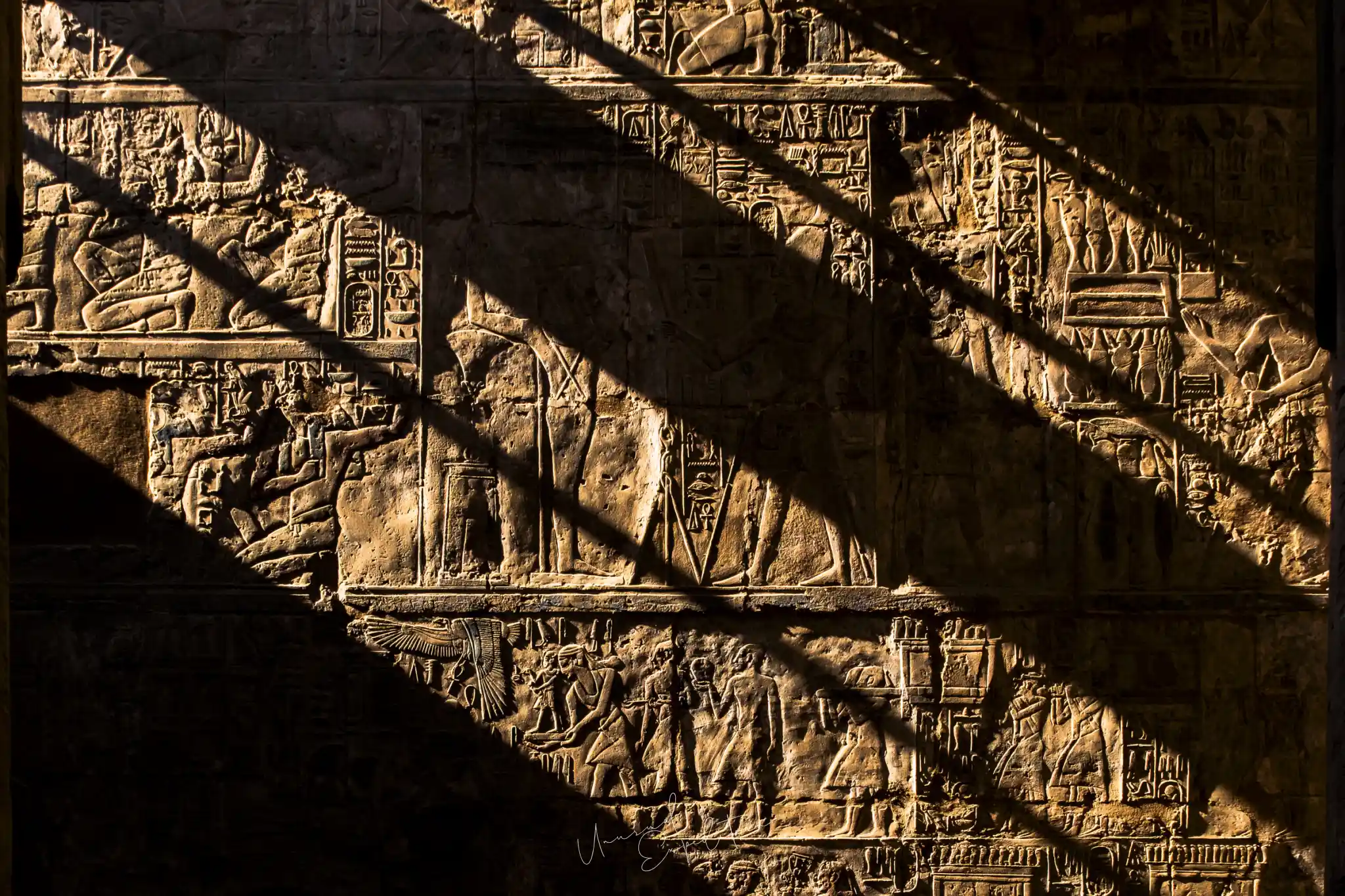
Luxor Temple photos are at their best in the morning, when low sun rakes across the walls and the shadows of roof beams fall in diagonal bars over the carved reliefs. The temple stands in the middle of modern Luxor on the East Bank of the Nile, a long run of courts and colonnades, and it is easier to read in a single frame than Karnak: columns in lines, walls of figures and hieroglyphs, and a clear axis from the pylon to the sanctuary.
This is one of the destination guides in our Luxor photography tour guide. The photographs here are our own, taken on our trips to Luxor; we hold the rights to them, and the notes come from walking these courts with a camera.
Luxor Temple photos: what the temple looks like
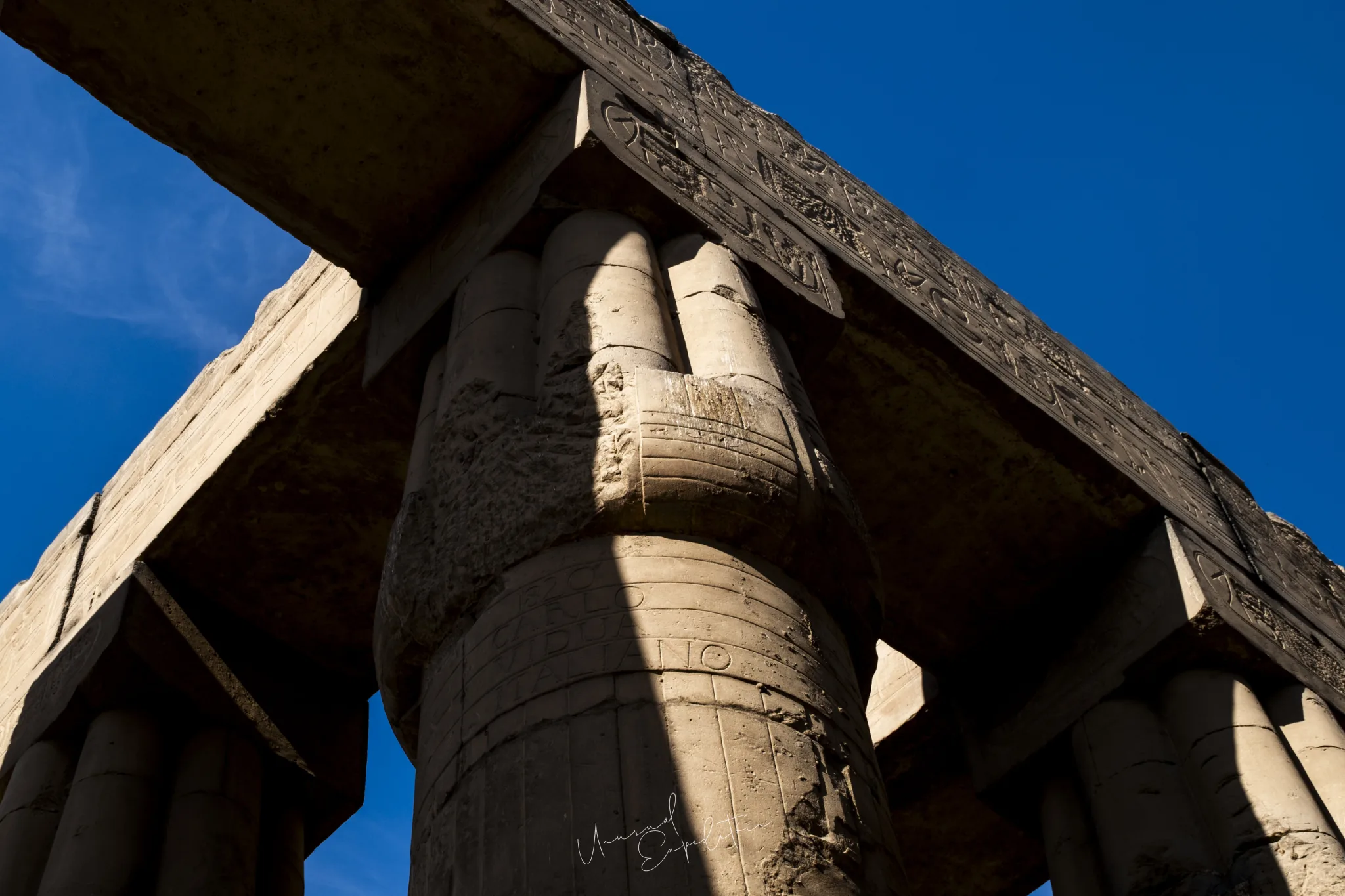
Luxor Temple opens with a pylon carved with Ramesses II's battle scenes, a single obelisk and seated colossi at the gate. Behind it lie the court of Ramesses II, the tall processional colonnade of Amenhotep III and then his great sun court, ringed with columns shaped like bundles of papyrus stems with closed buds. Deeper in are the halls and the sanctuary, where later rulers, Alexander among them, left their mark. UNESCO lists the temple as part of ancient Thebes, a World Heritage Site. For photography the temple is a sequence of strong lines: rows of bundled columns, stone beams still in place across many of them, and walls with relief at eye level. The palette is warm sandstone against a hard blue sky, so the pictures are about shape and shadow more than colour.
Where to stand at Luxor Temple
In Luxor Temple the strongest positions are inside the colonnades, not in the open courts. Stand close to a column and shoot up along it to the beam and the sky; the bundled stems and the carved bands make a texture no wide view shows. Inside the covered halls, look for the bars of sun and shadow that fall through gaps in the roof and across the reliefs; a 70-200mm lets you crop to one figure crossed by light. At the front, the pylon and the avenue of sphinxes work best from a little distance with the whole facade in the frame. The temple sits in town, so a step to the left or right decides whether a modern building or a minaret appears behind the columns, which can be a feature: the mosque of Abu al-Haggag is built into the temple itself.
Luxor temple vs Karnak temple
| Luxor Temple | Karnak | |
|---|---|---|
| Size and layout | Compact, one clear axis | Vast complex of temples, pylons and halls |
| Signature subject | Colonnades and wall reliefs | The Great Hypostyle Hall |
| Best light for us | Morning side light | Late afternoon among the columns |
| After dark | Floodlit, reported to stay open into the evening | Sound and light show |
| Crowds | Steady through the day | Busiest mid-morning |
If you have time for only one at its best, choose Karnak for scale and Luxor Temple for detail you can frame.
The question of Luxor temple vs Karnak temple usually comes down to time. Karnak is the bigger experience and needs hours; Luxor Temple can be covered well in a morning. The two were linked in antiquity by the processional Avenue of Sphinxes, which reopened in 2021 after years of excavation, as PBS NewsHour and the Associated Press reported, so you can walk part of the route between them. Our Karnak temple hypostyle hall guide covers the larger temple.
Luxor temple at sunset
Luxor temple at sunset is popular for the sky more than for the stone. The front pylon faces roughly north-northeast, so at sunset the facade is in shade or at most lit from the side; the picture is the pylon, the obelisk and the avenue of sphinxes against the colour over the Nile, and then the floodlights coming on at blue hour. Inside, the courts go into shade quickly and the reliefs lose their edge. We prefer the morning for the interior and keep the last light for Karnak, which is the better place to be at sunset; see the best time to visit Luxor for how we split the day.
Luxor temple at night
Luxor temple at night is floodlit, and the temple is widely reported to stay open after dark, which makes it the one major site in Luxor you can photograph in the evening without a show. We have not photographed it at night ourselves, so there is no night frame in this guide. Check the current opening hours at the ticket office before you plan around it. Personal photography without flash is allowed under the Supreme Council of Antiquities rules, and a small travel tripod or a beanbag on a column base will help with the long exposures.
Luxor Temple photos: details worth finding
Beyond the colonnades, Luxor Temple hides details that make quieter pictures. Deep inside is a chamber used by the Romans for the imperial cult, where painted plaster of Roman officials survives over the older reliefs; the American Research Center in Egypt cleaned and conserved those paintings, and the colours are now clear enough to photograph in the dim light. Further back, Alexander the Great appears as pharaoh in the reliefs of the barque shrine. On the outer walls, look for the long battle scenes of Ramesses II, and near the front, the remaining obelisk, whose twin stands in the Place de la Concorde in Paris. Each of these rewards a slower walk and a longer lens.
"Luxor Temple is where I teach people to look at shadows. The sun comes through the gaps in the roof and lays stripes across the carvings, and if you wait a few minutes the stripe moves onto the face of a god."
Joseph Mak, tour leader, Unusual Expedition
Practical notes
Luxor Temple is in the centre of town and easy to reach on foot or by taxi from the Corniche. Arrive at opening for the emptiest courts and the lowest sun. A 24-70mm and a 70-200mm cover almost everything; a wide lens helps in the colonnade. Respect the mosque of Abu al-Haggag, which is a working place of worship: do not photograph people at prayer. For the temples across the river, read our West Bank of Luxor guide.
Photograph Luxor Temple with us
Our Egypt Photo Tour includes Luxor Temple, Karnak and the West Bank, together with Aswan, Abu Simbel, Cairo and Giza. The current departure and rate are on the Egypt photography tours page.
Join the Luxor photography tour
Egypt Photo Tour – Egypt departs 12 Dec 2026 To 20 Dec 2026, led by Joseph Mak. Small group, photography first. All Luxor photography tours.
Explore Luxor in depth
- Luxor Photography Tour Guide: Karnak, the West Bank and the BalloonsEgypt
- Medinet Habu Temple: Colour, Reliefs and Quiet on the West BankEgypt
- West Bank of Luxor: Hatshepsut, the Valley of the Kings and Medinet HabuEgypt
- Luxor Hot Air Balloon at Sunrise: A Photographer's GuideEgypt
- Karnak Temple Hypostyle Hall: Photographing the ColumnsEgypt
- Best Time to Visit Luxor for Photography: Weather and LightEgypt
Upcoming Photo Tours
- Egypt Photo Tour – EgyptEgypt 12 Dec 2026 To 20 Dec 2026
- Inner Mongolia Winter Owl Photo Tour – ChinaChina 01 Jan 2027 To 04 Jan 2027
- Inner Mongolia Winter Photo Tour – ChinaChina 05 Jan 2027 To 11 Jan 2027
- Mekong And Central Highland Vietnam Photo Tour - VietnamVietnam 16 Jan 2027 To 24 Jan 2027