
Leopard in South Africa: How to Photograph It, Settings and Light
Leopard in South Africa: where to look, when, settings and light for photographing leopards from a safari vehicle.
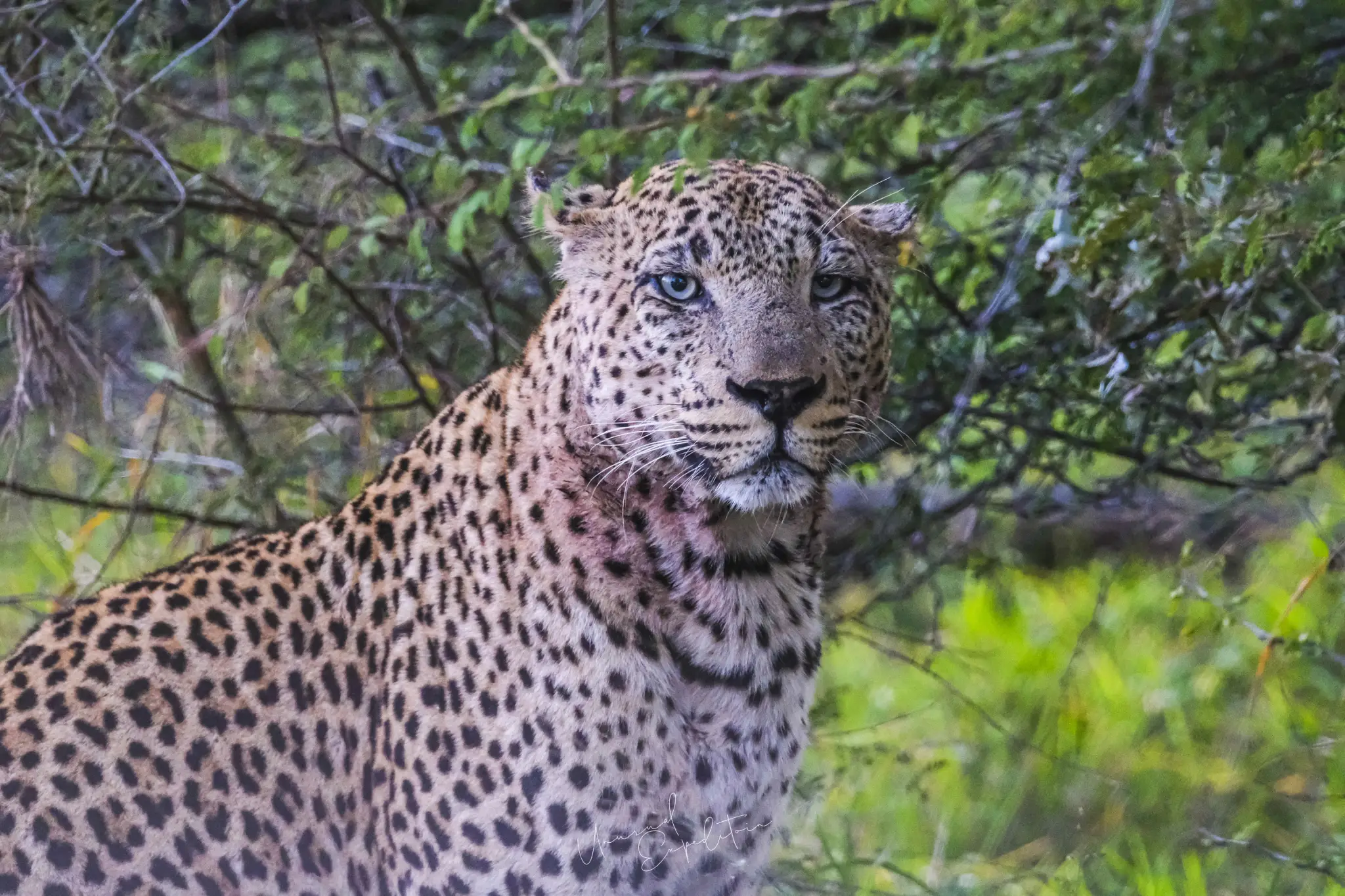
A leopard in South Africa is the animal most photographers hope for on safari and the one that asks the most patience: it is solitary, well camouflaged and often resting in thick bush or up a tree. In a game reserve, the best chances come in the cool, quiet hours, when a leopard walks a road or hunts the edge of the grass. What we photographed, how to read the behaviour and the settings that worked from a vehicle follow.
Leopards are the highlight of our South Africa safari photography guide, which sits in the wider South Africa photography tour guide. The other big subjects have their own pieces: elephants, buffalo and hippos and giraffes.
Where can you see a leopard in South Africa?
Leopards live in several of South Africa's game reserves, and a good reserve with trained rangers is the sensible place to look. We photographed ours in a South African game reserve whose name the frames do not give, so we do not name it. Sightings are never guaranteed. The IUCN Red List classes the leopard as Vulnerable, which is part of why it is hard to find, and the reserve's own rangers know which animals use which stretches. The right question for an operator is not "will we see one" but "how do your rangers track them".
When is the best time to see a leopard?
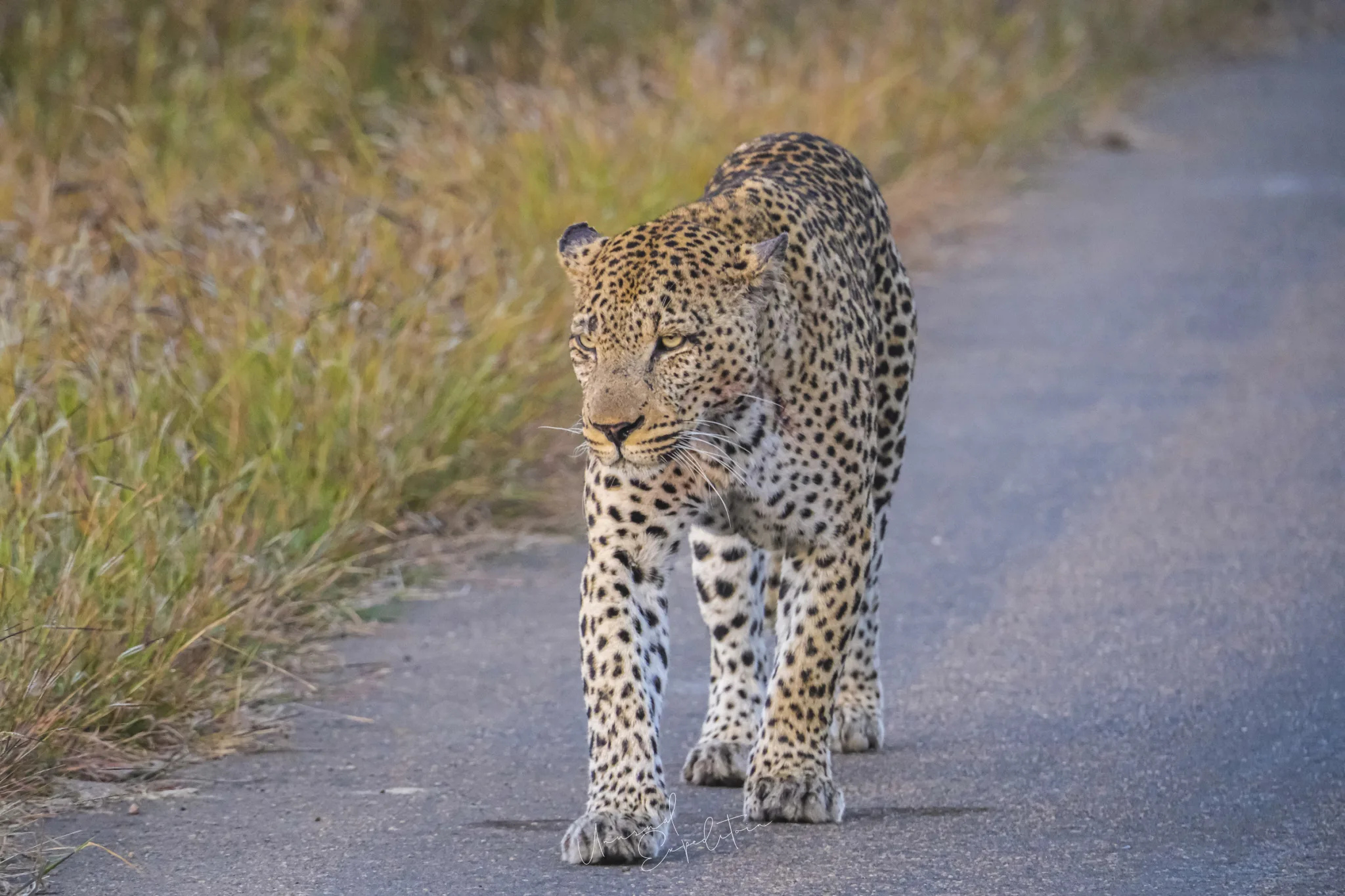
Leopards are active mostly at night, and the hours around dawn and dusk give the best chance of a sighting in the open. In the dry winter months, which sources such as SafariBookings describe as May to September in the north and east, the grass is lower and the bush thinner, so a resting cat is easier to spot. We worked in winter, and that helped: more than one of our leopards was out in the open, on a road or at the edge of the grass. Early mornings are cold, so dress for a long wait.
How to photograph a leopard in a tree
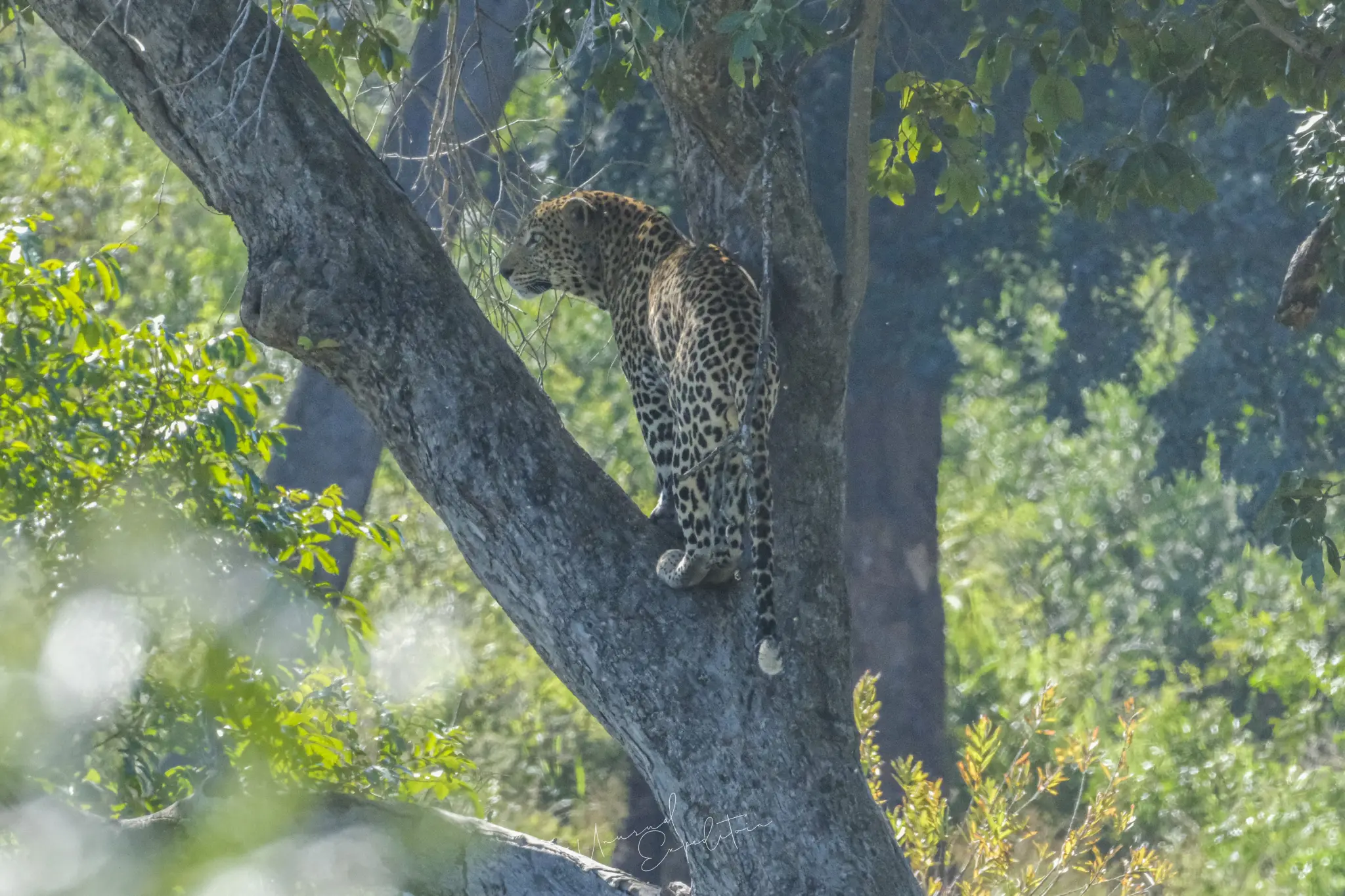
A leopard in a tree is the classic and the hardest. The animal is often partly hidden by leaves, the light is dappled, and the background is a mess of branches. Wait for the head to turn and for a gap in the foliage, and use a fast shutter speed because even a still leopard flicks an ear or a tail. Our frame of a leopard climbing down a trunk shows the problem: the animal is the right subject but the light is soft and the branches fight for attention. A lens of at least 400mm helps keep the background clean.
Leopard photography settings
Use a 150-600mm or 100-400mm lens, a shutter speed of at least 1/1000 second, and continuous autofocus with eye detection if your camera has it. Set the aperture wide enough to blur grass in front of the animal, usually around f/6.3 to f/8 on a long zoom. Underexpose a little if the cat sits against bright grass, as the spots hold their detail better when the highlights stay under control. Shoot raw, and lean the lens on a beanbag, not your lap, so a long wait does not turn into blurred frames.
Leopard behaviour: what to watch for
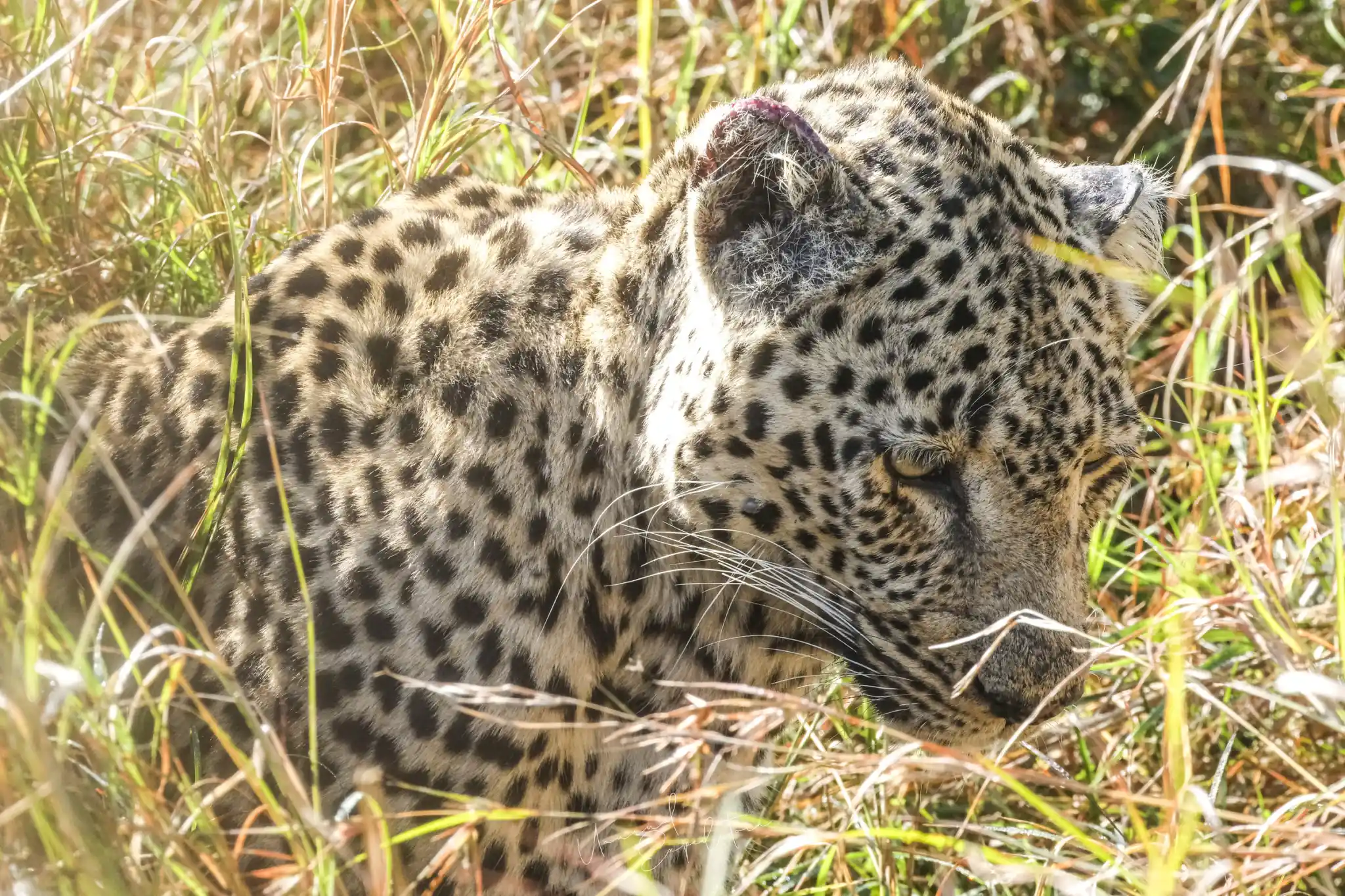
Leopards give signals before they move. A cat that sits with its head up and ears forward is watching something. A cat that lowers its shoulders and stops is stalking. A cat that licks its paws or yawns is relaxed, and you may have time to compose. Resting animals in tall dry grass blend into the background, as in our frame below, so look for the face and the eyes first, and then shoot through the gaps in the stems.
Leopard photography: stalking and moving
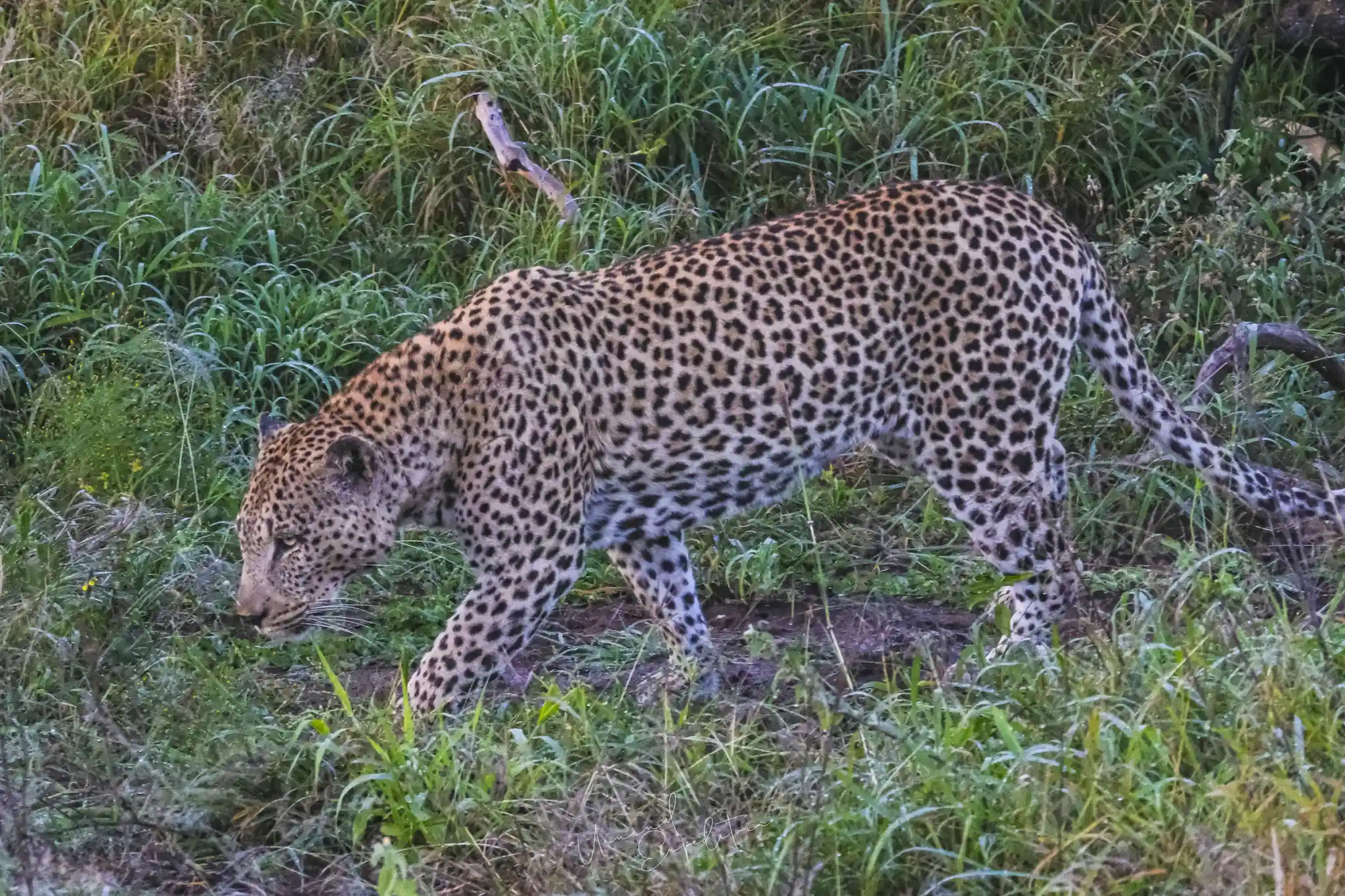
When a leopard moves, you get seconds. A walking cat is easier than one stalking, because it keeps its head up and the legs show a clear pattern. A stalking cat lowers its head and shoulders and slides through the grass, and the picture becomes a study of line and spots. Anticipate the direction, pre-focus on where the animal will emerge, and shoot in short bursts. We caught one cat in green grass with its head down following a scent, which gave us a profile and a clean line along the back.
A quick guide to leopard light and lenses
| Situation | What it needs | Lens |
|---|---|---|
| On the road in early light | Side light and a clean background | 150-600mm |
| In a tree | A gap in the foliage and patience | 400mm or longer |
| Resting in grass | Focus on the eye through the stems | 150-600mm |
| Stalking or moving | Bursts and pre-focus | 100-400mm |
A long zoom is the only lens you will use most of the time.
Our photographs of leopards in South Africa
The photographs in this guide are our own, taken in a South African game reserve on our trip; we hold the rights to them, and the notes come from knowing these animals first hand.
A leopard looks straight at you for perhaps two seconds, and in that time you decide whether you are a photographer or a spectator. Be ready, and press the button.
Joseph Mak, tour leader, Unusual Expedition
Photograph leopards with us
We run South Africa as a private trip on request, with no scheduled departure at the moment, for individuals, couples, families or photographers who want their own pace and every piece of logistics arranged around them. It can cost less than a group tour because no tour leader travels, and a photographer or coach can be added at extra cost. Ask at least two months ahead; last-minute requests can often be arranged. See private tours and the South Africa photography tours page.
Ask us about leopards in South Africa
South Africa Safari photography tours
The next South Africa Safari departure is announced on the South Africa Safari photography tours page, with previous expeditions and all the planning guides.
Explore South Africa Safari in depth
- South Africa Safari Photography: Leopards, Giraffes, Elephants and BirdsSouth Africa
- Giraffe Photography in South Africa: Light, Composition and LensesSouth Africa
- Elephants, Buffalo and Hippos in South Africa: Photography GuideSouth Africa
- Birds of South Africa: Rollers, Bee-eaters, Kingfishers and VulturesSouth Africa
Upcoming Photo Tours
- Egypt Photo Tour – EgyptEgypt 12 Dec 2026 To 20 Dec 2026
- Inner Mongolia Winter Owl Photo Tour – ChinaChina 01 Jan 2027 To 04 Jan 2027
- Inner Mongolia Winter Photo Tour – ChinaChina 05 Jan 2027 To 11 Jan 2027
- Mekong And Central Highland Vietnam Photo Tour - VietnamVietnam 16 Jan 2027 To 24 Jan 2027