
Lofoten Photo Spots: Beaches, Fjords, Villages and Racks
Lofoten photo spots and photography locations: boulder beaches, tidal pools, mirror fjords, churches and villages, with lenses and light.
The best Lofoten photo spots fall into four groups: the red-cabin villages of Hamnoy and Reine, the boulder beaches and tidal pools of the outer coast, the mirror-calm fjords and bays on the sheltered side, and the stockfish racks that stand wherever there is wind. Between them they cover almost every kind of picture the islands offer, and most can be reached from the main road that links the islands. This guide lists the spots we photographed, what to do at each, and what the weather tends to allow.
For the whole archipelago, start with the Lofoten photography tour guide. The photographs here are our own, taken on our trips to the islands; we hold the rights to them, and the notes come from knowing these places first hand.
Lofoten photography locations: where to start
Start with the villages, then move to the coast. Hamnoy and Reine give the postcard view and are covered in detail in Hamnoy and Reine, Lofoten. Once you have those, the quieter places are where a trip becomes your own: a west-facing beach at low sun, a fjord head at first light, a church on a headland. Lofoten is compact, so you can see several kinds of scene in a single day, and you can change plan when the sky does. Look at the forecast from the Norwegian Meteorological Institute at yr.no each morning, and choose between the coast, which wants clear horizons, and the sheltered bays, which suit cloud and mist.
Lofoten beaches: boulders, surf and long exposures
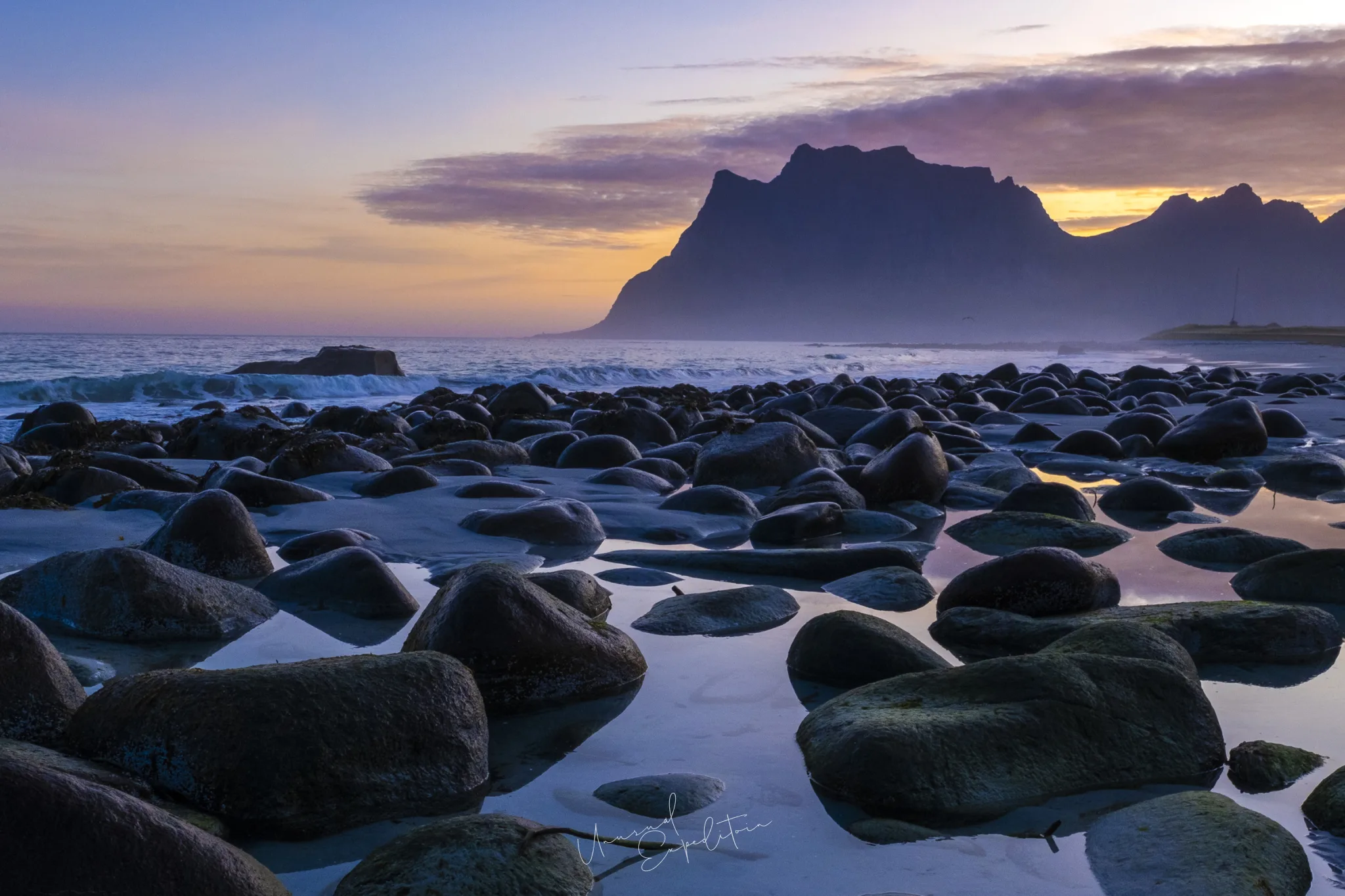
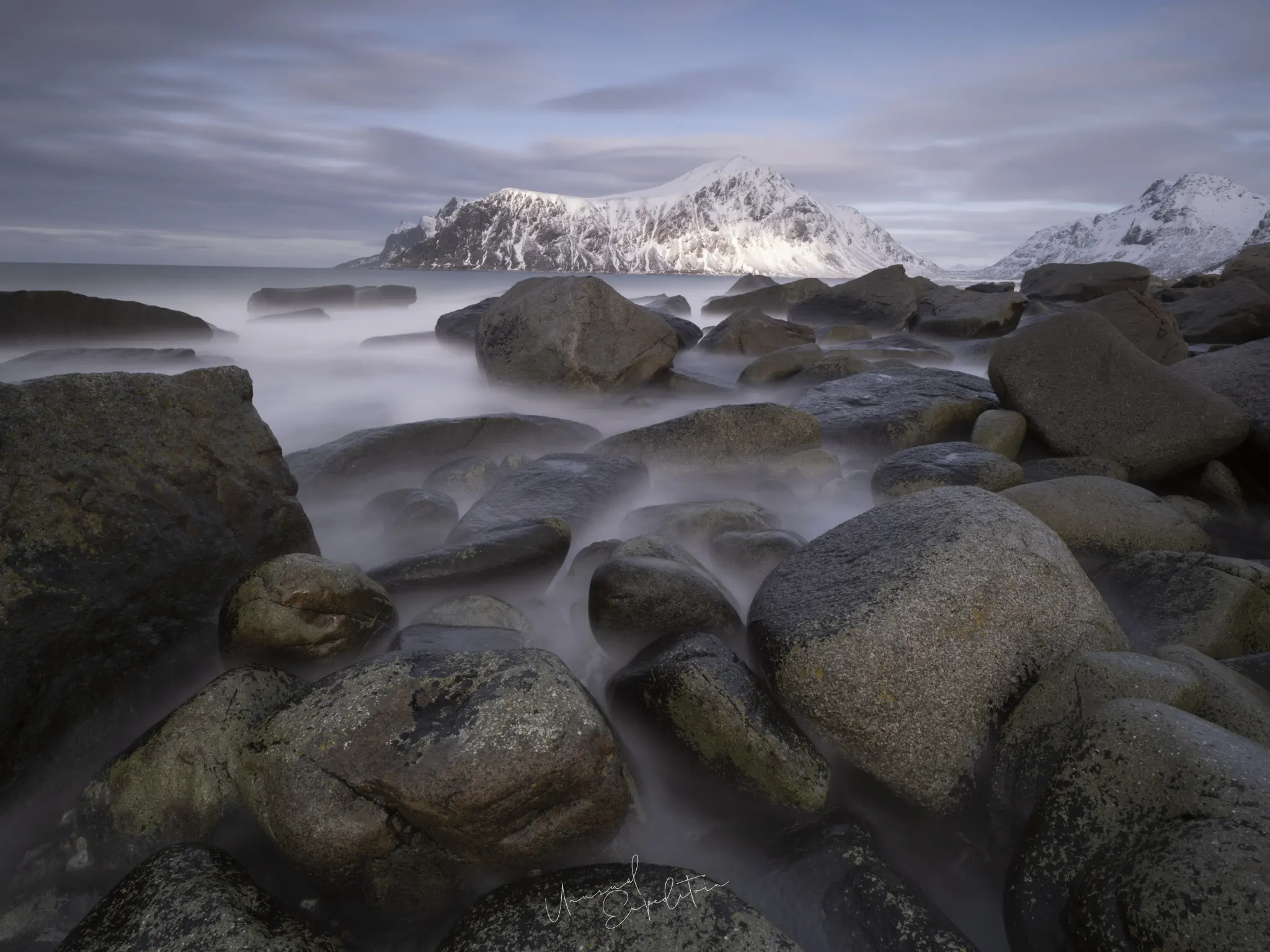
Lofoten beaches are not for sunbathing. Several face the open sea and are scattered with rounded boulders, with a peak standing at the end of the bay. They are the best places on the islands for long exposures: a 70-200mm lens compresses the peak behind the stones, while a 16-35mm lens put close to the water makes the boulders large and the surf a soft white. In winter the beach is framed by snow on the slopes above, as in our frame below; in summer the same stones glow in the low sun. Wet rock is slippery and waves come in sets, so keep your tripod legs short and your eyes on the sea.
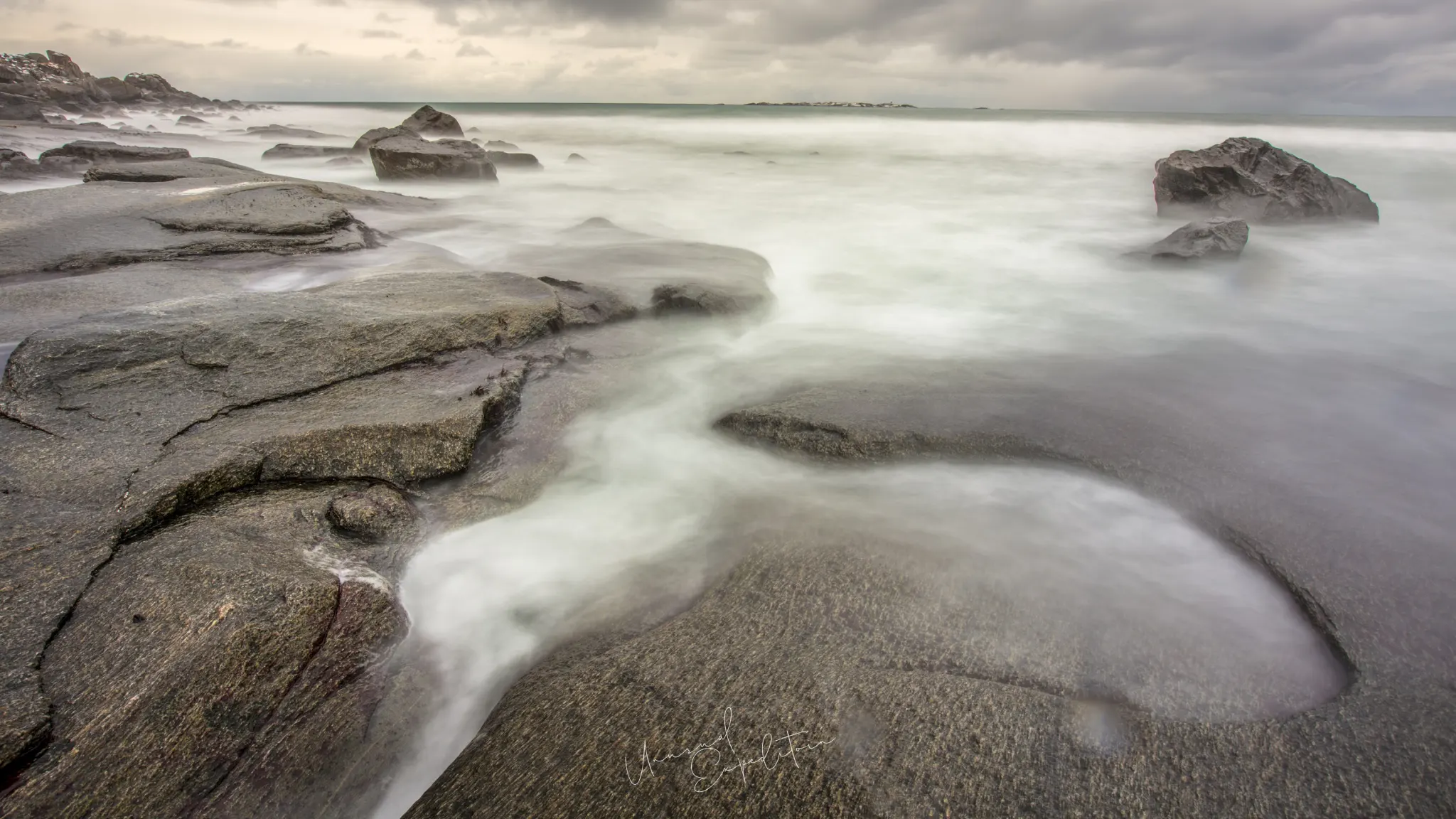
Tidal pools and rock slabs on the Lofoten coast
Where the coast is flat rock not boulders, the tide leaves pools and channels that fill and drain with every wave. A slow shutter turns that movement into a swirl, and a wide lens close to the water lets the spiral dominate the frame. The pattern changes every few seconds, so take many frames and choose later. This kind of shot works best in flat, grey light, which suits Lofoten's changeable weather, and it needs very little else: no sunrise, no colour, just water and stone.
Mirror-calm fjords and island villages
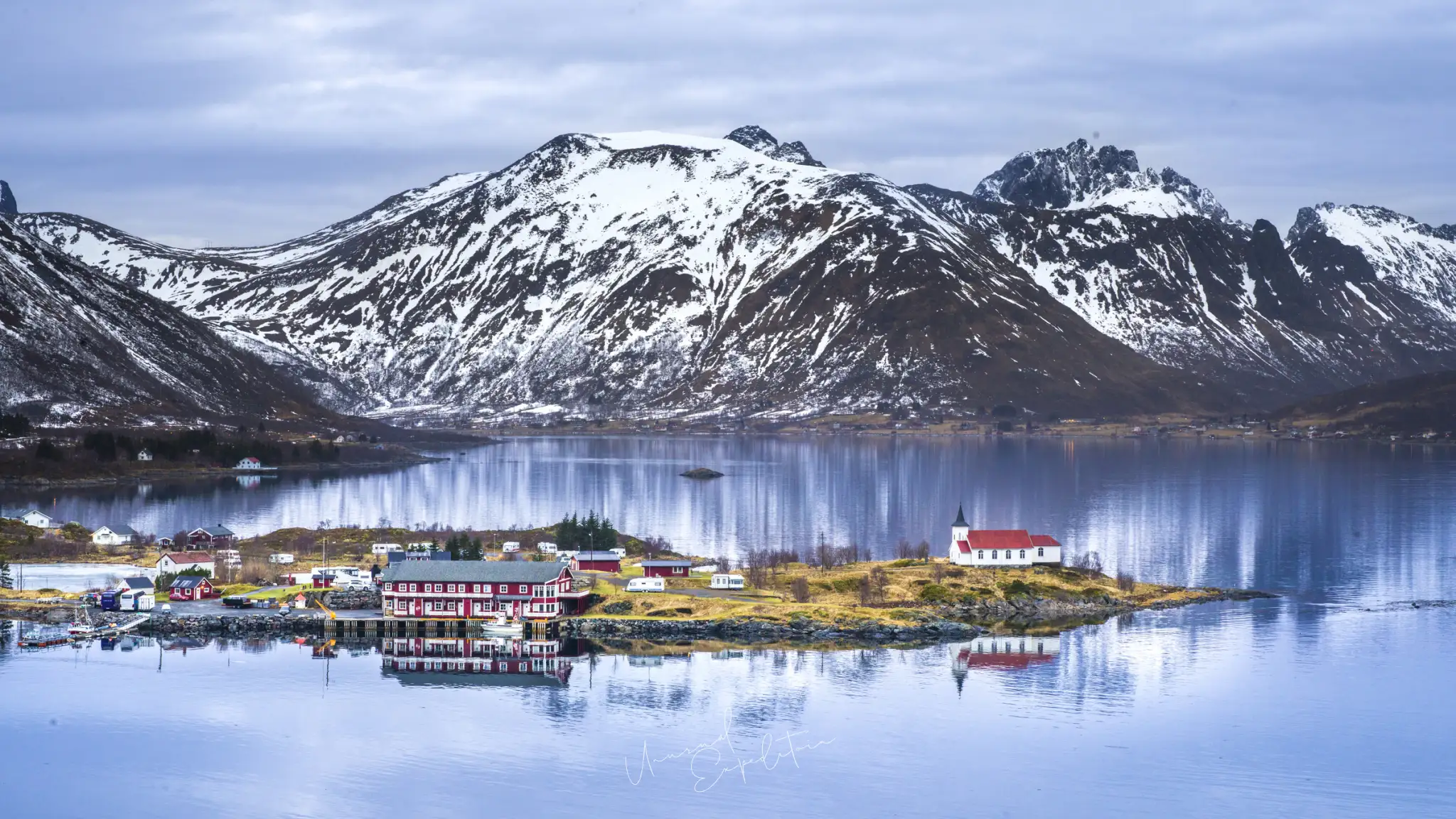
On the sheltered side of the islands the water can go completely still, usually early in the day before the wind gets up. Then the mountains double themselves in the fjord, and a small village sitting on a spit of land becomes a symmetrical picture. A 24-70mm lens is enough; the skill is waiting for the surface to settle and keeping the horizon level. After a cold night, thin ice can break the reflection into patterns, which is a picture of its own.
Churches, farms and the quiet corners
Lofoten photography is not only about the famous views. A white wooden church on a headland, a lone farmhouse under a ridge, or a red barn in a field are quieter subjects that make a set of pictures feel like a place, not a list of postcards. Look for them in late afternoon when the sun is low, or under cloud, when the colours of painted wood stand out against the water. Treat houses and farms as private property: shoot from the road or a public place, and ask before you step onto anyone's land.
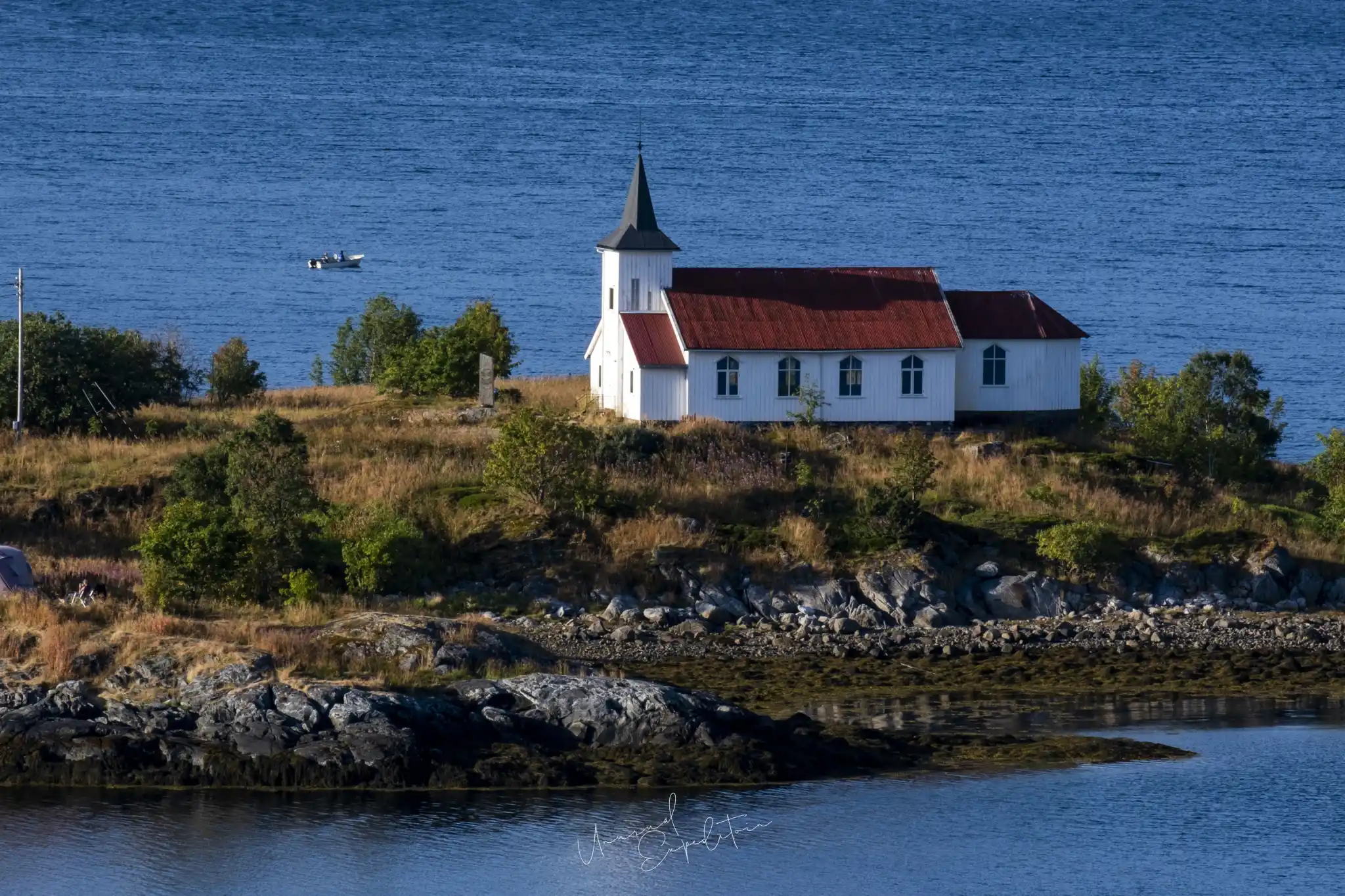
Photo spots for each season
| Subject | Best light | Lens | What to watch |
|---|---|---|---|
| Boulder beaches | Low sun, late evening in summer; clear twilight in winter | 16-35mm and 70-200mm | Waves in sets, slippery rock |
| Rock slabs and tidal pools | Flat grey light | 16-35mm | Tide, spray on the front element |
| Sheltered fjords | Calm early morning | 24-70mm | Wind, which breaks the reflection |
| Churches and farms | Low sun or cloud | 24-70mm | Private property |
| Stockfish racks | Snow light, or low sun | 24-70mm | Smell, wind, working racks |
The sheltered spots suit bad weather, and the outer beaches need a clear horizon.
Access, parking and respect on the coast
Most Lofoten photo spots sit beside a road, but the roadside is not always a place to stop. Park only in marked spaces, keep gateways and passing places clear, and do not leave a car where it narrows a village street. Many beaches and viewpoints lie on or next to private land or grazing, so close gates behind you and keep to existing paths. The residents' code of conduct reported by News in English in 2019 asks visitors to respect private property and take litter home, and it is a good rule for every spot on this list.
The best spot in Lofoten is usually the one you did not plan. We would be driving to a famous view, see a bay go still, and stop. Those are the frames people remember afterwards.
Joseph Mak, tour leader, Unusual Expedition
More Lofoten guides
For timing, read best time to visit Lofoten. For the racks that appear on so many coasts, see Lofoten stockfish and fishing villages.
Photograph Lofoten with us
We run Lofoten as a private trip on request, with all the logistics arranged around your needs, at your own pace. A private trip can cost less than a group tour because no tour leader travels, and a photographer or photography coaching can be added at extra cost. Please ask at least two months ahead. More on private tours, and our guides and departures are on the Norway photography tours page.
Ask us about Lofoten photo spots
Lofoten photography tours
The next Lofoten departure is announced on the Lofoten photography tours page, with previous expeditions and all the planning guides.
Explore Lofoten in depth
- Lofoten Photography Tour: Peaks, Red Cabins, Aurora and Midnight SunNorway
- Lofoten Stockfish: Drying Racks and Fishing Villages to PhotographNorway
- Is Lofoten Worth Visiting? Photography Trip FAQNorway
- Lofoten Northern Lights: When, Where and How to Photograph ThemNorway
- Lofoten Midnight Sun: Dates, Best Places and Photography TipsNorway
- Hamnoy and Reine, Lofoten: Photo Viewpoints, Light and EtiquetteNorway
- Best Time to Visit Lofoten: Winter Light, Thaw and Midnight SunNorway
Upcoming Photo Tours
- Egypt Photo Tour – EgyptEgypt 12 Dec 2026 To 20 Dec 2026
- Inner Mongolia Winter Owl Photo Tour – ChinaChina 01 Jan 2027 To 04 Jan 2027
- Inner Mongolia Winter Photo Tour – ChinaChina 05 Jan 2027 To 11 Jan 2027
- Mekong And Central Highland Vietnam Photo Tour - VietnamVietnam 16 Jan 2027 To 24 Jan 2027