
Photographing the Alms Giving Ceremony in Luang Prabang, Respectfully
How to photograph the alms giving ceremony in Luang Prabang and Vientiane: where to stand, etiquette, settings and the long lens rule.
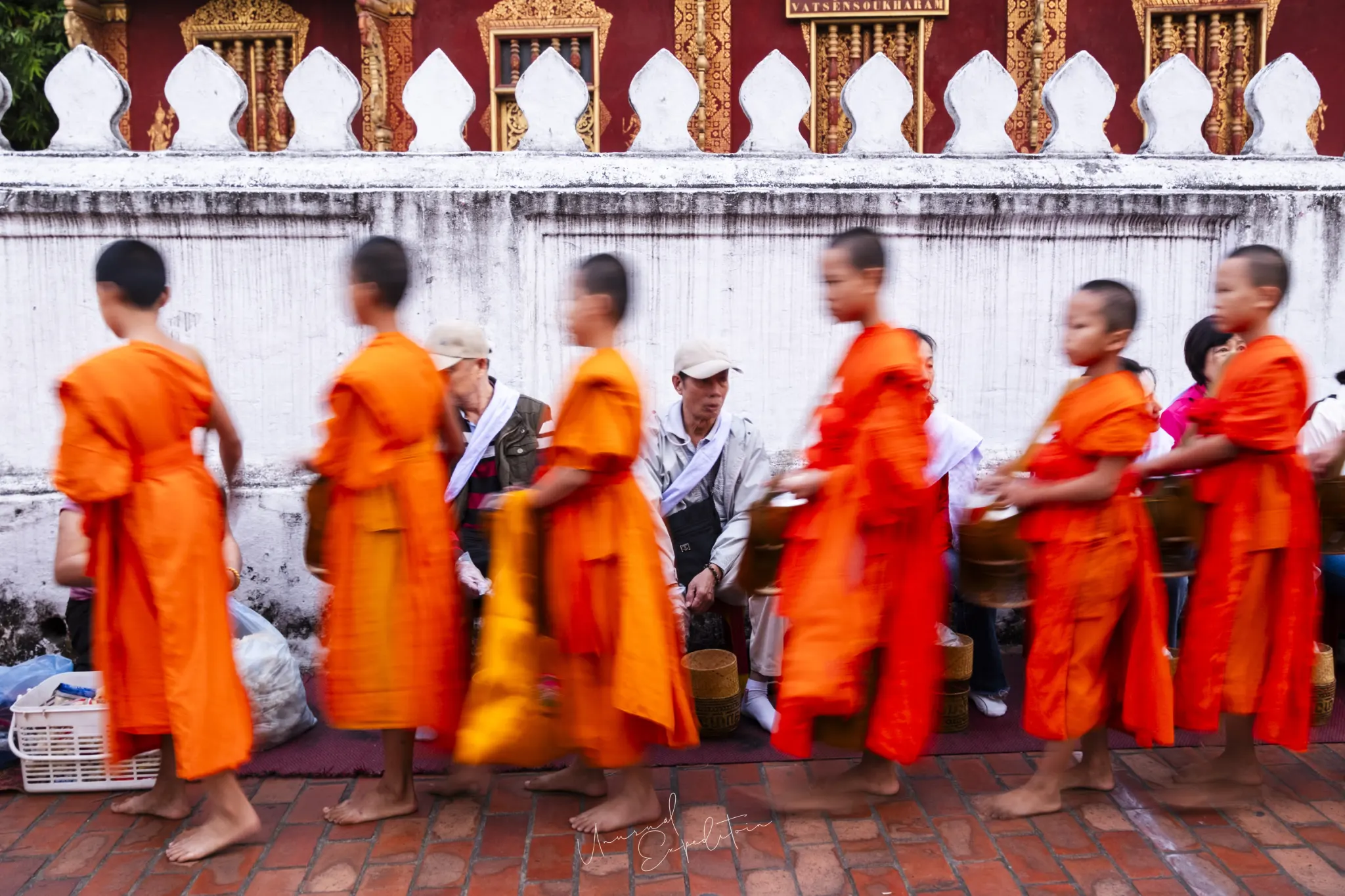
Photographing the alms giving ceremony in Luang Prabang comes down to one rule: the ceremony is for the monks and the people feeding them, not for you. Stand across the road, use a long lens, no flash, no talking, and give the line the right of way. Done that way, tak bat is one of the quietest and most moving things you will photograph in Asia. This is how we approach it on the Laos photography tour, in Luang Prabang and in Vientiane, where the same ritual happens with almost no tourists.
What is the alms giving ceremony?
Every morning at first light the monks and novices of each temple walk barefoot in single file through the streets with their alms bowls, and lay people kneel or sit on low stools along the route to put sticky rice, fruit or small packets into each bowl. The food is the monks' meal for the day; the merit is the giver's. It happens in every Lao town. In Luang Prabang, with more than thirty working temples in a small old quarter, several hundred monks pass through the streets within half an hour, which is why it became famous and why the Lao Ministry of Information, Culture and Tourism now posts etiquette signs along the route.
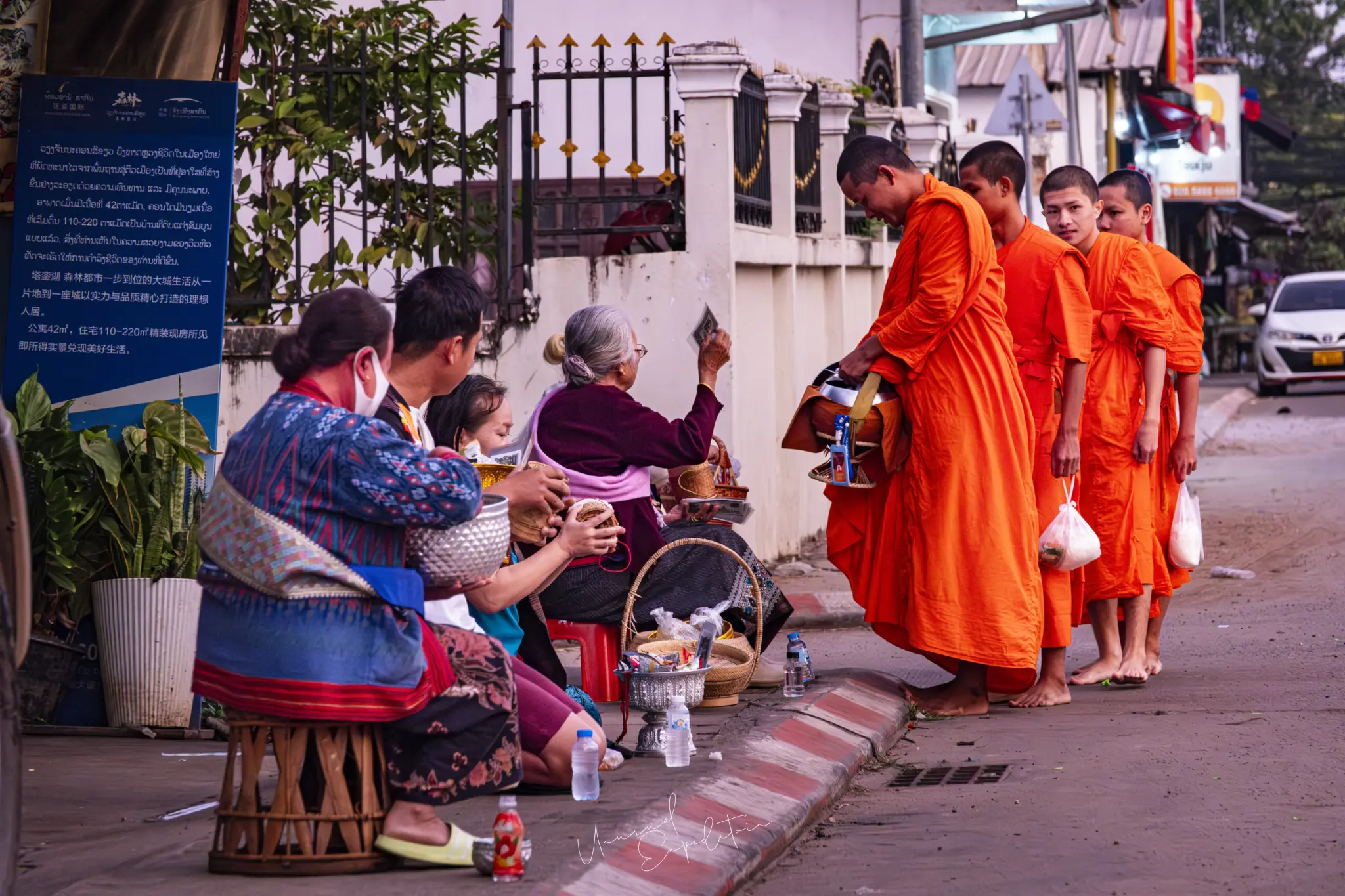
Where to photograph the alms giving in Luang Prabang
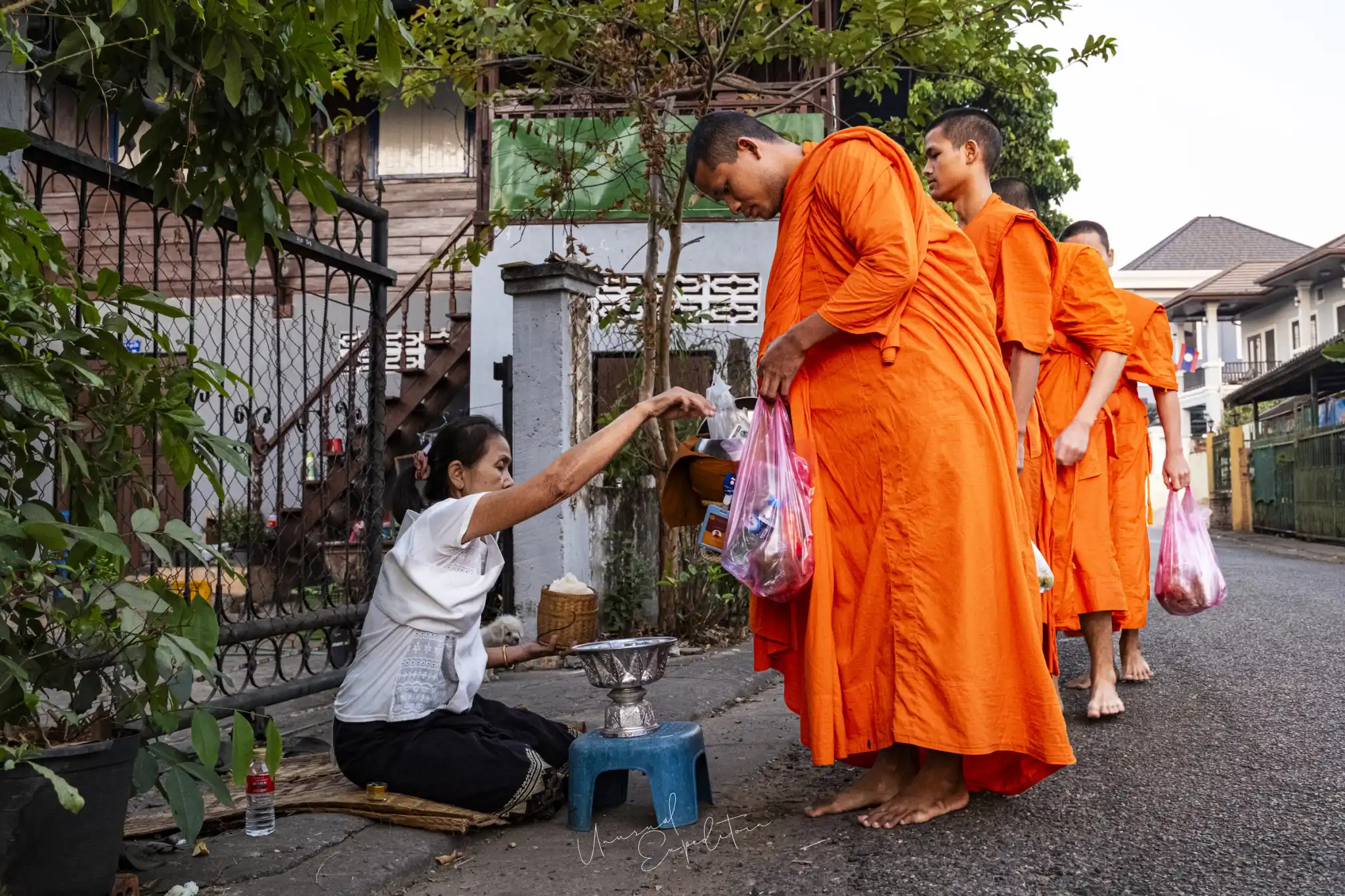
Sakkaline Road, the main street of the old quarter, carries the biggest procession and the biggest crowd of visitors, some of whom stand in the road with phones. Avoid it. Every temple sends its line down its own side street towards the river, and on those streets the givers are local families, the light is the same and there is room to stand well back. The quietest lines are near the tip of the peninsula and along the Nam Khan side. In Vientiane the ceremony happens outside almost every wat with no visitors at all; the frame below is from a residential street there.
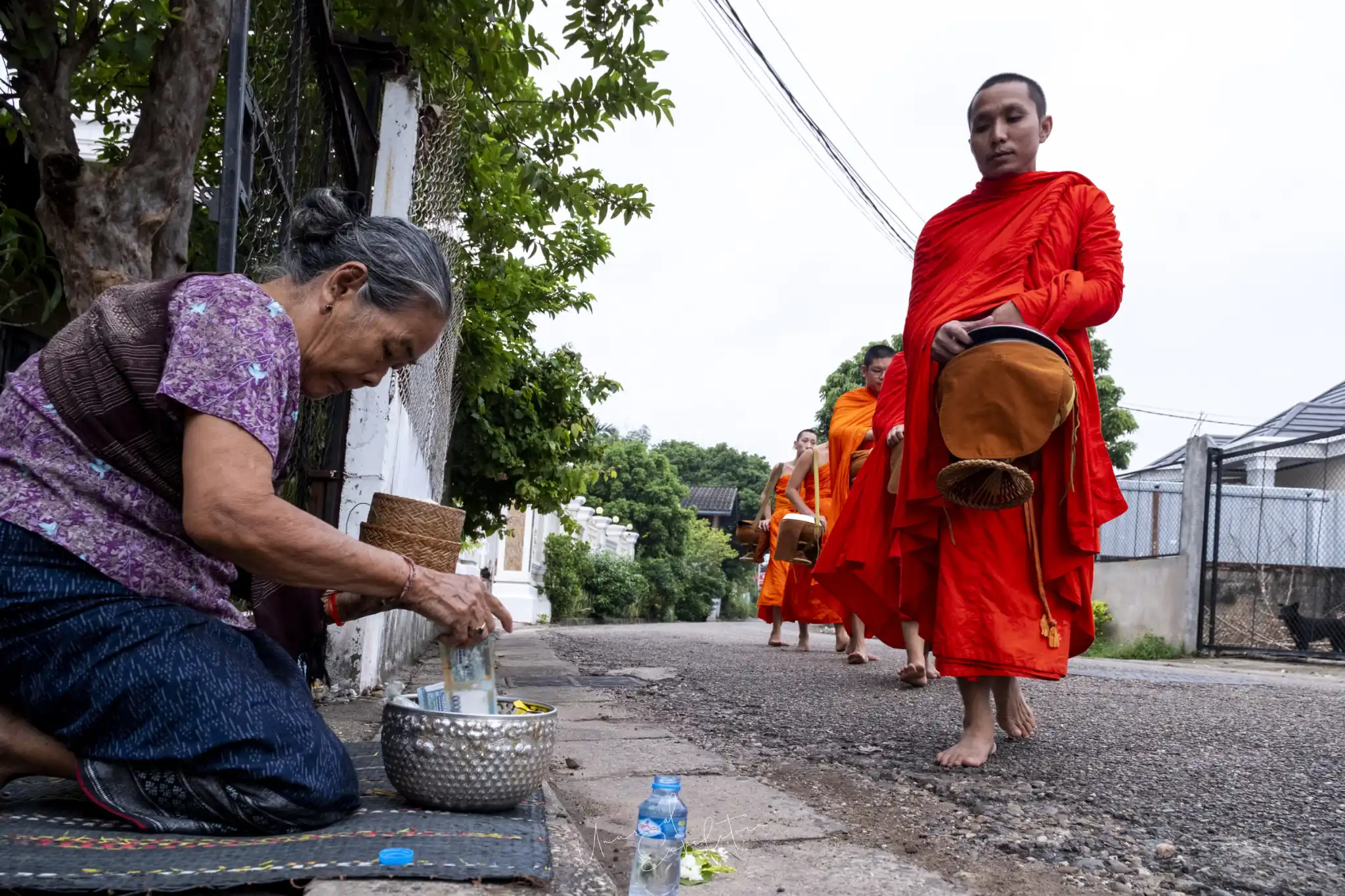
How to photograph tak bat respectfully
Keep a road's width between you and the line, and more if you can. Use a 70-200mm so you never need to step closer. Switch off the flash and the focus-assist lamp; the light is low but a modern camera handles it at a high ISO. Do not stand above the monks, do not walk alongside them, do not touch them or their bowls, and do not lean into the givers' space to shoot over their shoulders. Dress with shoulders and knees covered. If you want to give alms, buy the rice from your guesthouse, not from the street sellers who follow tourists, and kneel with the locals rather than next to your tripod. The Luang Prabang etiquette signs say all of this in four languages, and the people who ignore them are the reason the monks sometimes change their route.
Camera settings for the alms line
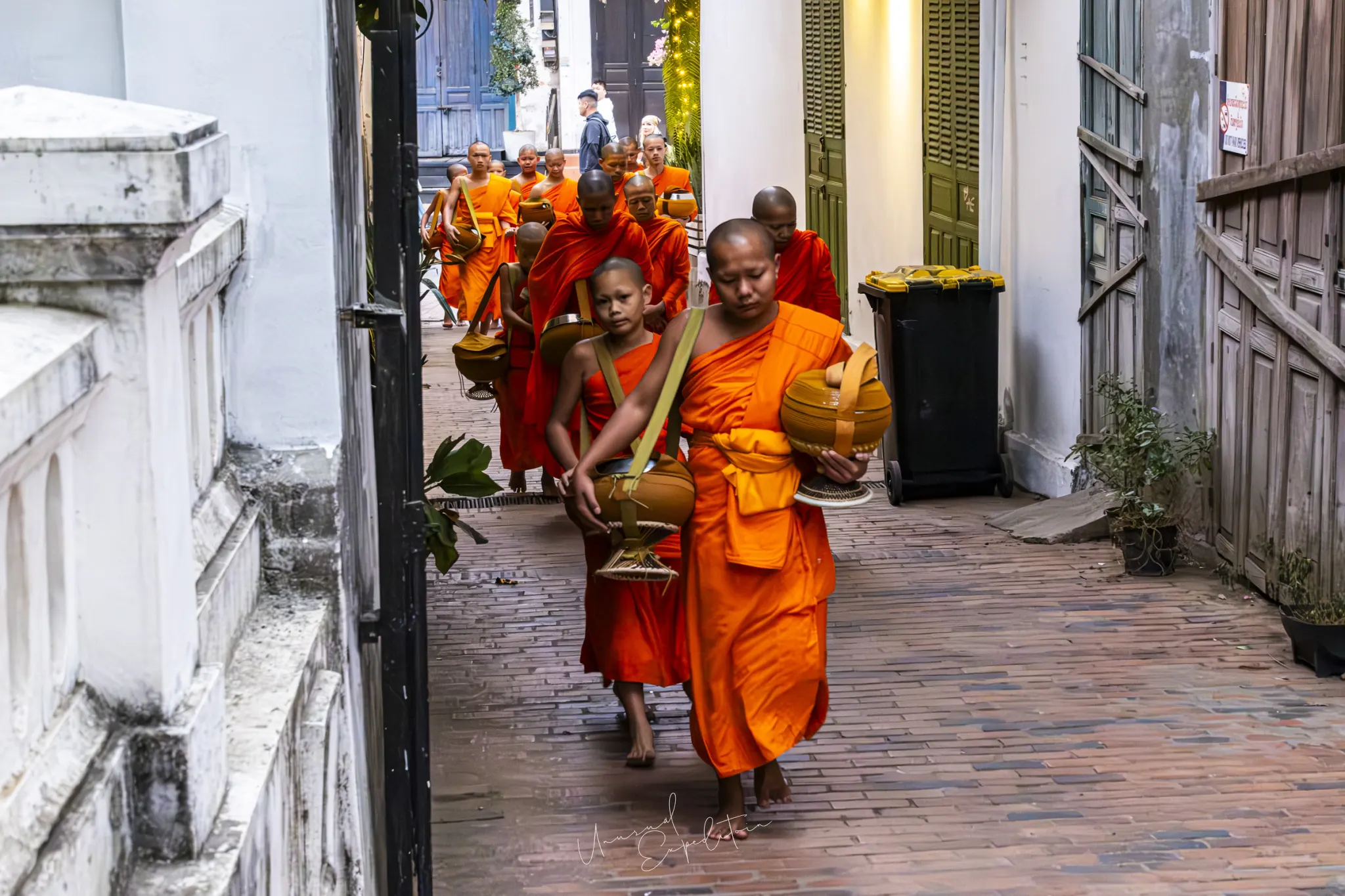
The ceremony starts in the dark and ends in daylight, so the settings change as you work. Begin at ISO 3200 to 6400 with the lens wide open and a shutter speed around 1/125 second for a sharp figure; as the light grows, bring the ISO down. Alternatively slow the shutter to around 1/15 second on a wall or railing and let the robes blur into a stroke of orange while the wall and the temple stay sharp, which is the frame below. Expose for the robes, not the sky, and shoot in RAW so the orange does not clip. Set a single focus point on the nearest face in the line and let the rest fall off.
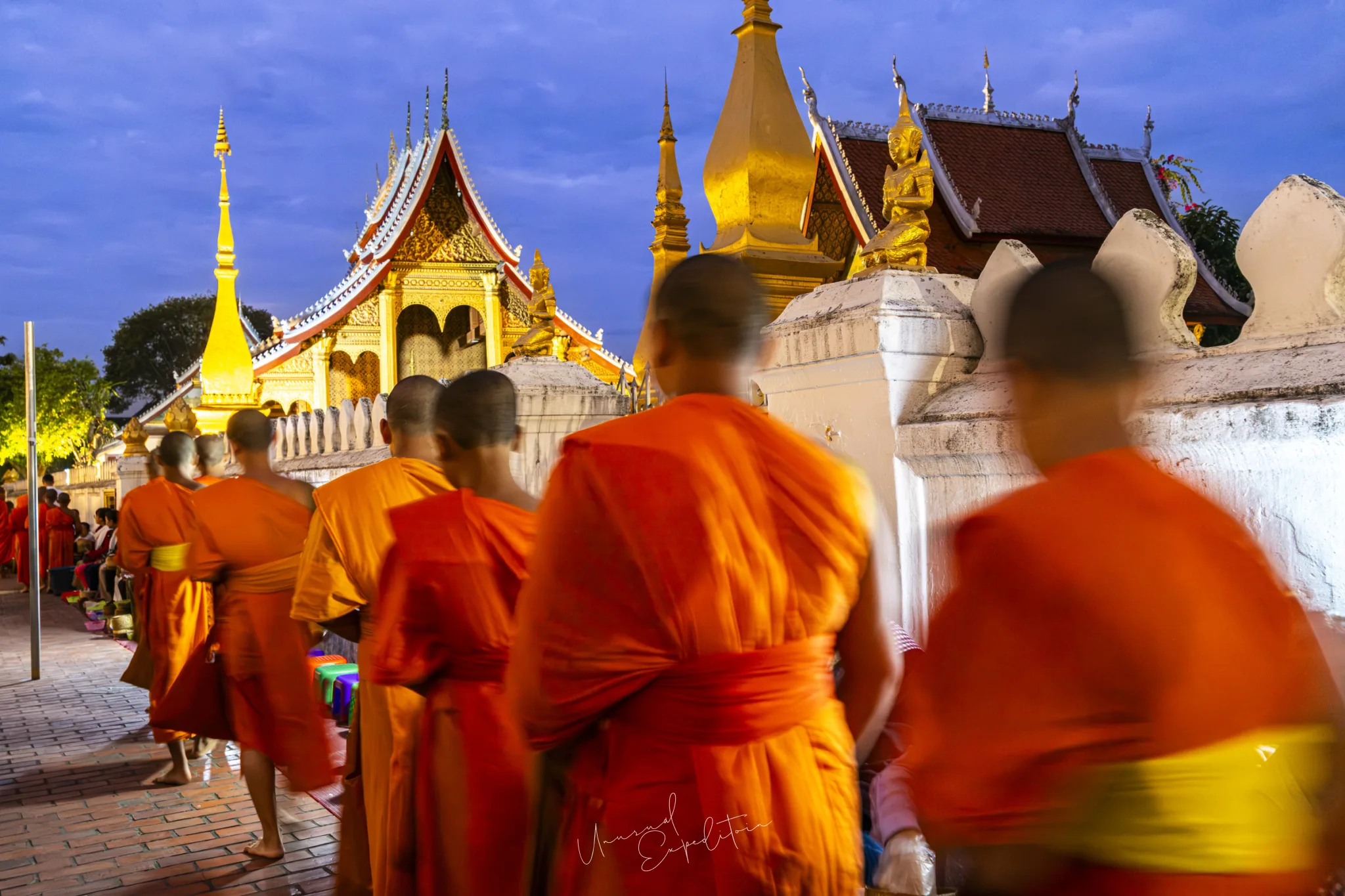
Luang Prabang alms giving ceremony view: wide or close?
Both, but in that order. Start wide from the far pavement, with the whole street in the frame: the line, the givers, the temple wall, the first light on the roofs. Then pick details with the long lens: a bowl receiving rice, bare feet on cold pavement, a grandmother's hands. What you should not try for is a close portrait of an individual monk looking at the camera. They are not posing, and the picture everyone wants, the row of young faces, is the picture that has made the ceremony difficult. Faces turned away, hands, feet and the line as a whole say more.
| Approach | Lens | Position | Result |
|---|---|---|---|
| Wide street scene | 24-70mm | Far pavement, kneeling height | Line, givers and temple together |
| Compressed line | 70-200mm | End of the street, shooting along it | Robes stacked, faces turned away |
| Slow shutter | 24-70mm on a wall | Across the road | Orange blur, sharp givers |
| Details | 70-200mm | Same spot | Bowls, hands, feet |
The long lens is doing two jobs: filling the frame, and keeping you out of the ceremony.
"I tell every group the same thing before the alms line: you are a guest at someone's prayer. The 70-200mm is not for a tighter picture, it is so you never have to take a step towards them."
Joseph Mak, tour leader, Unusual Expedition
Alms giving in Vientiane and the villages
Our tour photographs the ceremony twice: once in Vientiane on the first morning, where a single temple's line passes through an ordinary neighbourhood and the givers outnumber the visitors a hundred to one, and once in Luang Prabang. The Vientiane version is the better photograph for most people because nobody is performing and nobody is watching you. In the villages around Muang Xai, novices from the Buddhist academy walk through the mist with the same bowls; that is covered in the railway and Muang Xai article.
After the ceremony
When the last line has passed, the street empties in minutes and the monks eat. That is the moment to put the camera down for a while and walk to the morning market behind the palace, where the same families are buying breakfast; the markets article covers it. Novices sweeping temple yards and studying on the steps later in the morning are a gentler way to photograph monastic life, and in those settings a smile and a nod will often get you a yes.
Photograph it with us, properly
We brief every group the evening before, position people before the first line appears and keep the group together on the far pavement. Fares for the Laos photography tour are indicatively S$2,500 to S$2,900 per person depending on the room; the Laos photography tour page has the current departure. For the rest of the day in the old town, read the photo spots we use.
Join the Laos photography tour
Laos Photo Tour – Laos departs 06 Mar 2027 To 13 Mar 2027, led by Joseph Mak. Small group, photography first. All Laos photography tours.
Explore Laos in depth
- Laos Photography Tour: The Complete GuideLaos
- Kuang Si Falls Photos and How to Get ThereLaos
- Laos Photography Trip FAQ: Days, Cost, Visa, Monks and ElephantsLaos
- The Best Time to Visit Laos for PhotographyLaos
- Laos Tour from Singapore: How to Get There and What to ExpectLaos
- The Laos-China Railway North: Muang Xai and the Villages Beyond Luang PrabangLaos
- Vientiane Photos: Is Vientiane Worth Visiting for a Photographer?Laos
- Luang Prabang Morning Market and Night Market PhotosLaos
- Sunrise and Sunset in Luang Prabang: Where to Watch and the Light by MonthLaos
- Luang Prabang Photo Tour: the Photo Spots We UseLaos
- Luang Prabang Photos: What the Old Town Really Looks LikeLaos
Upcoming Photo Tours
- Egypt Photo Tour – EgyptEgypt 12 Dec 2026 To 20 Dec 2026
- Inner Mongolia Winter Owl Photo Tour – ChinaChina 01 Jan 2027 To 04 Jan 2027
- Inner Mongolia Winter Photo Tour – ChinaChina 05 Jan 2027 To 11 Jan 2027
- Mekong And Central Highland Vietnam Photo Tour - VietnamVietnam 16 Jan 2027 To 24 Jan 2027