
Luang Prabang Photo Tour: the Photo Spots We Use
The Luang Prabang photo spots we use: alms side streets, temple stairs, Wat Xieng Thong, Phousi and the Mekong, with light and lens.
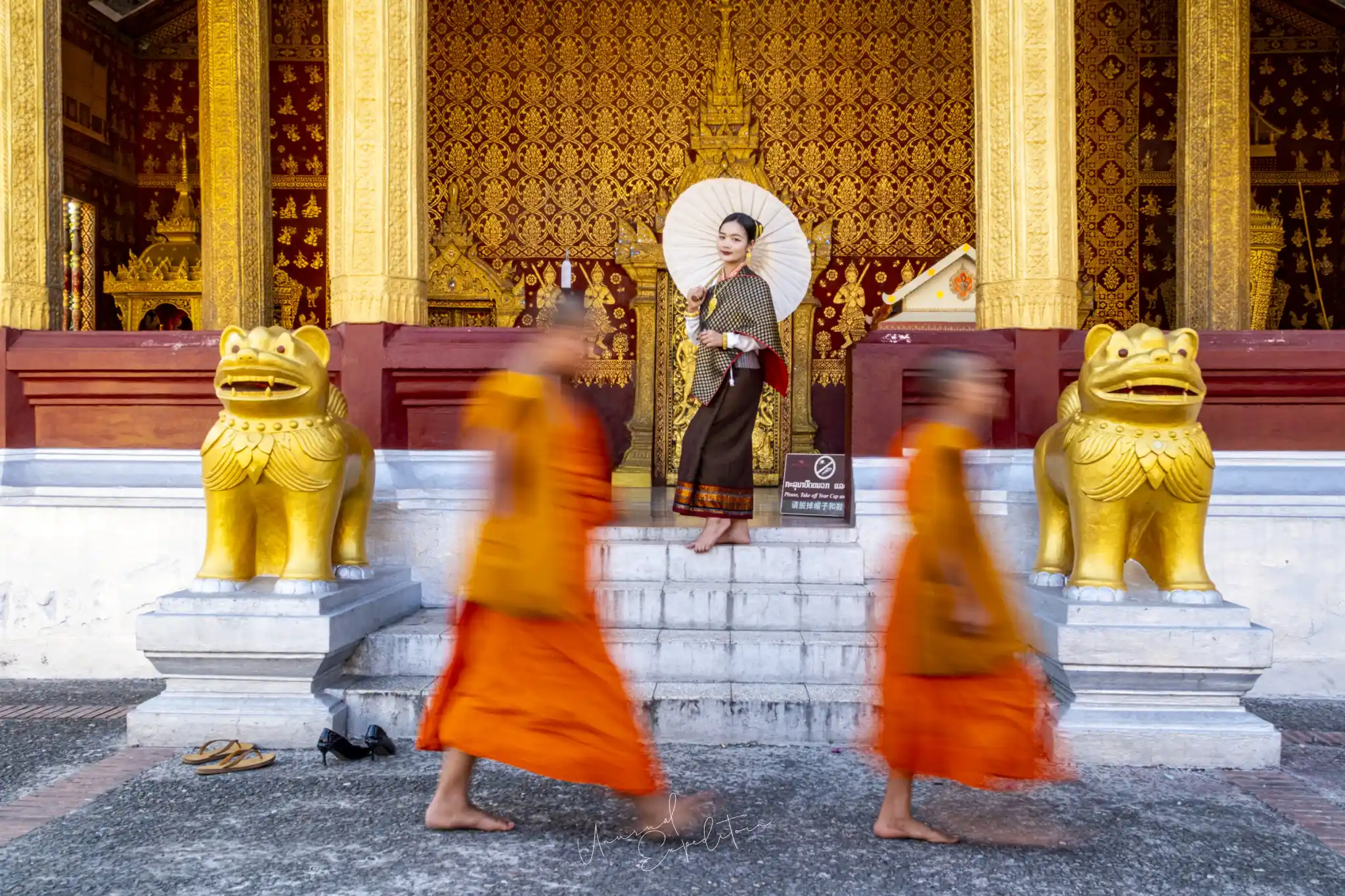
A Luang Prabang photo tour is really a list of places to stand and times to be there, and this is ours. The old town is small enough to cover on foot, so the work is in choosing the hour: the alms line and the Nam Khan at first light, the temples before the groups, the markets mid morning, the Mekong and Mount Phousi at the end of the day. These are the photo spots we use on the Laos photography tour, with the light, the lens and the catch for each.
Photo spots Luang Prabang: the short list
If you have two days, the spots that repay a second visit are Wat Xieng Thong, the alms route along Sakkaline Road and its side streets, the morning market behind the Royal Palace, the Nam Khan bamboo bridge, the Mekong bank near the ferry crossing, Mount Phousi, and the night market on Sisavangvong Road. Each has a best hour and a worst one, and most of the disappointing Luang Prabang pictures come from visiting them in the wrong order. The table below is the version we hand out on the first evening.
| Spot | Best light | Lens | The catch |
|---|---|---|---|
| Alms route, side streets | Dawn | 70-200mm | Stay across the road, no flash, do not block the line |
| Wat Xieng Thong | First hour, and blue hour | 16-35mm, 24-70mm | Groups from mid morning |
| Morning market | Early to mid morning | 24-70mm | Ask before close portraits |
| Nam Khan bamboo bridge | Early morning, late afternoon | 24-70mm | Dry season only, small toll |
| Mekong bank, ferry crossing | Sunset | 70-200mm | Haze in March flattens it |
| Mount Phousi | Sunset for the view, sunrise for the quiet | 24-70mm | Very crowded at sunset |
| Night market from a balcony | Blue hour | 24-70mm | Find the balcony before dark |
The pattern is simple: temples and the river early, people in the middle of the day, height at the end.
Where do the novices walk?
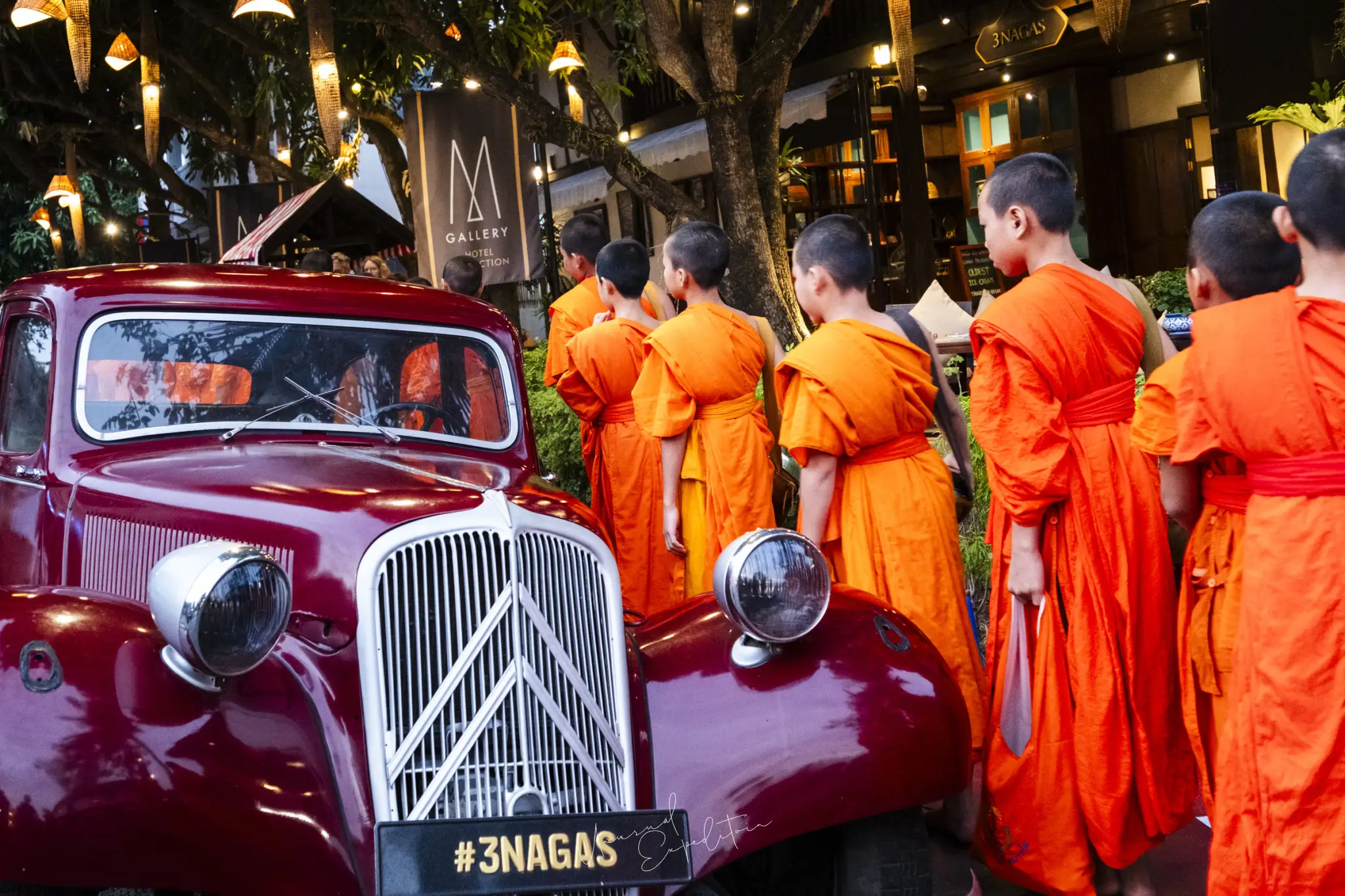
The alms line is covered in detail in our alms giving article, so here only the geography. The main procession follows Sakkaline Road through the old quarter, and that stretch has the most monks and the most tourists. Every temple also sends its own line down the side streets towards the river, and those lines pass whitewashed walls, red doors and old Citroens with nobody watching. The frame below, novices passing a vintage car outside a hotel, was made on one of those side streets with a 24-70mm from the far pavement.
Temple stairs and white walls
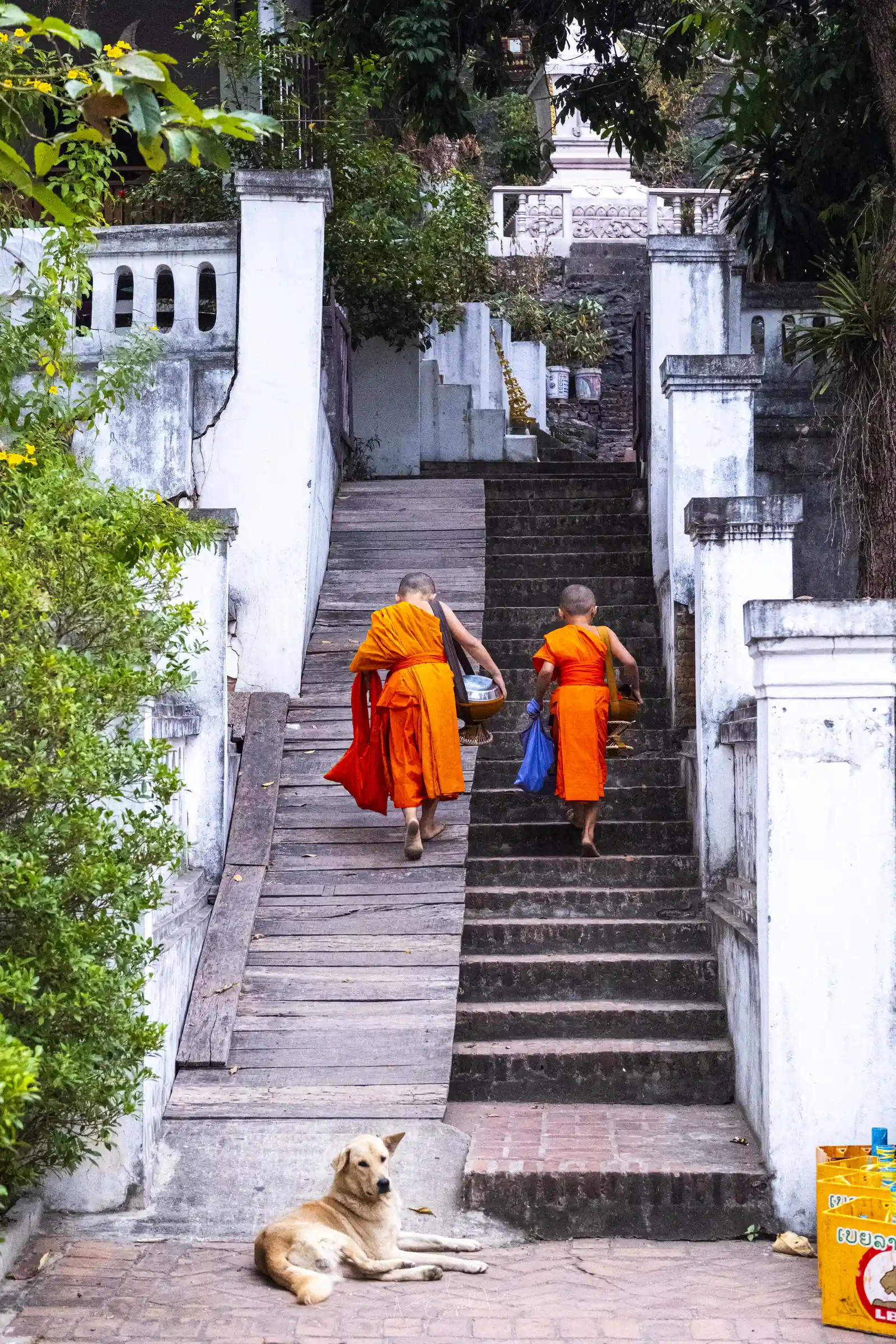
Luang Prabang is full of white: temple walls, stair balustrades, the plaster of the shophouses. Orange robes against white is the town's own colour scheme, and the stairs that climb from the Mekong road to the temples above it are the place to use it. Stand at the bottom, wait for someone to climb, and the stairs give you leading lines and a clean background in one. The frame below was made from the pavement with a 70-200mm; the novices were on their way back from the morning round and did not notice the camera.
Luang Prabang photography from the air
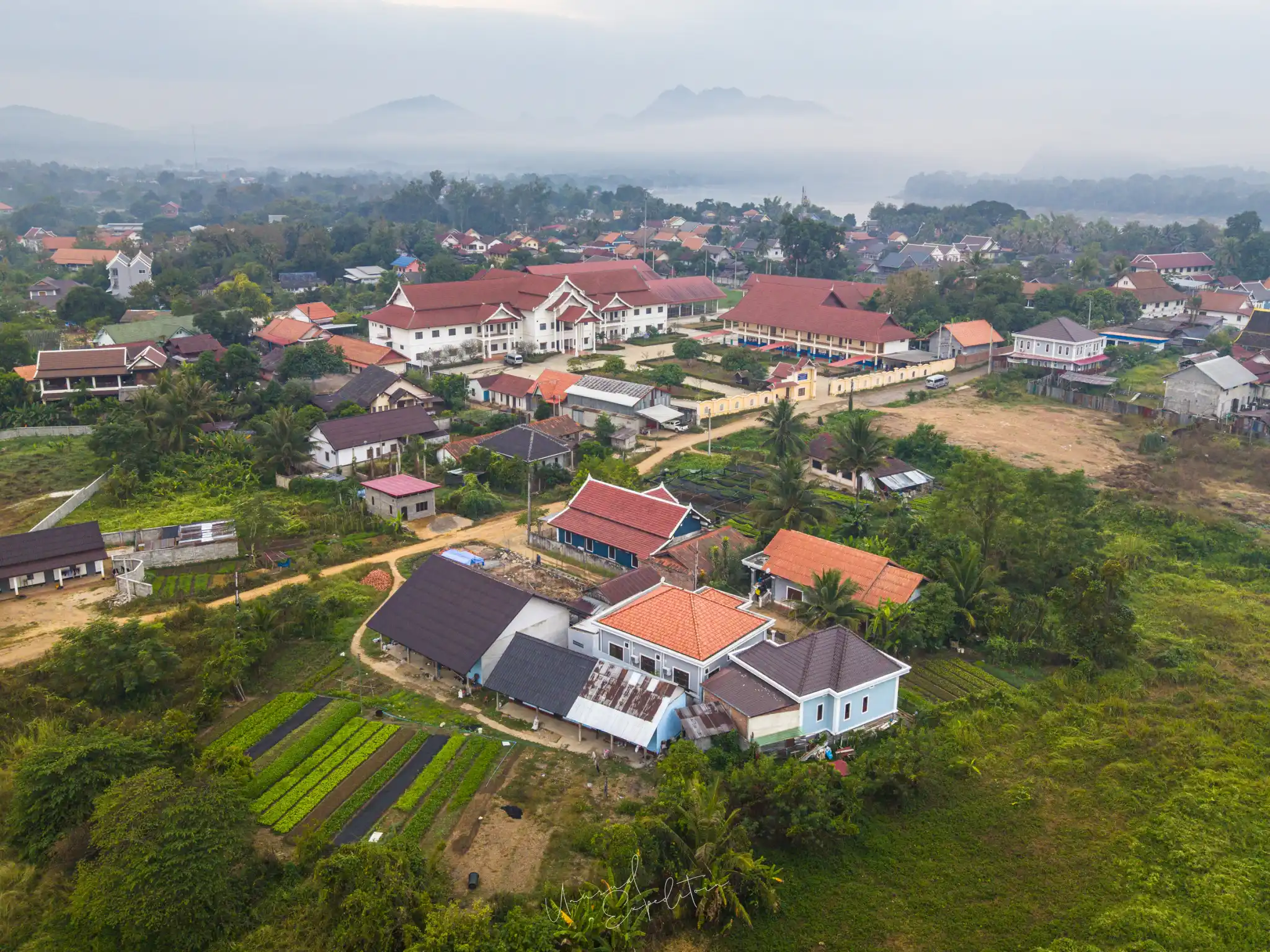
The one view no street gives you is the whole peninsula at once, and for that you need height. Mount Phousi gives it to the naked eye, and a drone gives it to the camera, but drones in Laos need a permit and may not fly over temples or the alms line, so this is something we arrange in advance, never improvise. In the frame below, made at first light, the temple compound sits among the roofs with the river beyond; the mist that makes it work lasts about an hour after sunrise in the cool season.
The lanes behind the temples
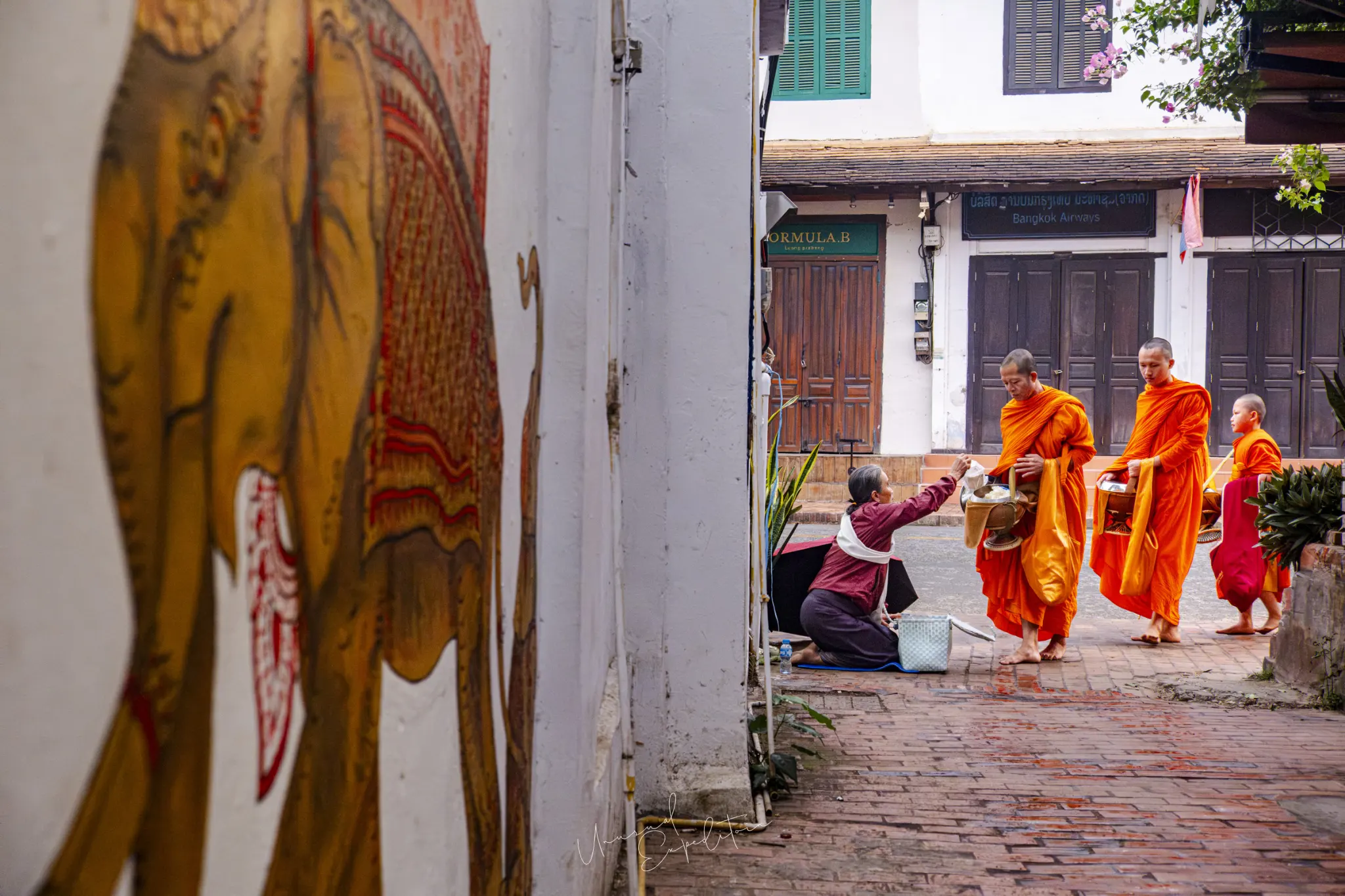
Between the main road and the Nam Khan the lanes narrow and the light drops. Stairs climb between walls, bougainvillea hangs over them, and a figure in orange turns the whole frame on. This is a place for standing still, not walking: pick a stair with light at the top, wait, and let people come to you. A 24-70mm covers it. In our experience the best hour here is late morning, when the sun is high enough to reach the top of the stairs but the lane itself is still in shade.
"In Luang Prabang I stop people walking. Pick a white wall or a stair with light on it, stand across the road with the long lens, and wait. The orange robes come to you within ten minutes, every time."
Joseph Mak, tour leader, Unusual Expedition
Mount Phousi: sunrise or sunset?
Mount Phousi is the hill in the middle of town with about 300 steps and a gold stupa on top, and at sunset it holds several hundred people on a platform built for fifty. The view west over the Mekong is real, but you will be shooting over heads. Go at sunrise instead: a handful of people, the mist in the valley, the Nam Khan side lit first. Sunset is better spent on the Mekong bank or on a boat, where the sun drops behind the far hills and the river carries the colour. Sunrise and sunset in Luang Prabang gives the month-by-month timing.
Is Luang Prabang worth it for a photographer?
Yes, with one condition: come for the daily life, not the monuments. The temples are beautiful, but the pictures that stay are the novices on the stairs, the market women at mid morning, the ferryman in the mist and the grandmother kneeling on her mat at dawn. The town has been a UNESCO World Heritage site since 1995 and the Lao Ministry of Information, Culture and Tourism keeps the old quarter free of high buildings, so the frames you make here will still look like the place in twenty years.
Walk it with us
We run these spots as part of the Laos photography tour, two days in Luang Prabang after the railway journey north and the villages around Muang Xai. Fares are indicatively S$2,500 to S$2,900 per person depending on the room; the Laos photography tour page has the current departure. For what the town looks like beyond the spots, see our Luang Prabang photos.
Join the Laos photography tour
Laos Photo Tour – Laos departs 06 Mar 2027 To 13 Mar 2027, led by Joseph Mak. Small group, photography first. All Laos photography tours.
Explore Laos in depth
- Laos Photography Tour: The Complete GuideLaos
- Kuang Si Falls Photos and How to Get ThereLaos
- Laos Photography Trip FAQ: Days, Cost, Visa, Monks and ElephantsLaos
- The Best Time to Visit Laos for PhotographyLaos
- Laos Tour from Singapore: How to Get There and What to ExpectLaos
- The Laos-China Railway North: Muang Xai and the Villages Beyond Luang PrabangLaos
- Vientiane Photos: Is Vientiane Worth Visiting for a Photographer?Laos
- Luang Prabang Morning Market and Night Market PhotosLaos
- Sunrise and Sunset in Luang Prabang: Where to Watch and the Light by MonthLaos
- Photographing the Alms Giving Ceremony in Luang Prabang, RespectfullyLaos
- Luang Prabang Photos: What the Old Town Really Looks LikeLaos
Upcoming Photo Tours
- Egypt Photo Tour – EgyptEgypt 12 Dec 2026 To 20 Dec 2026
- Inner Mongolia Winter Owl Photo Tour – ChinaChina 01 Jan 2027 To 04 Jan 2027
- Inner Mongolia Winter Photo Tour – ChinaChina 05 Jan 2027 To 11 Jan 2027
- Mekong And Central Highland Vietnam Photo Tour - VietnamVietnam 16 Jan 2027 To 24 Jan 2027