
Mount of Olives Sunset: The Classic View of Jerusalem and How to Shoot It
Mount of Olives sunset: where to stand, sunrise vs sunset light, blue hour on the floodlit walls, the cemetery and the Kidron tombs.
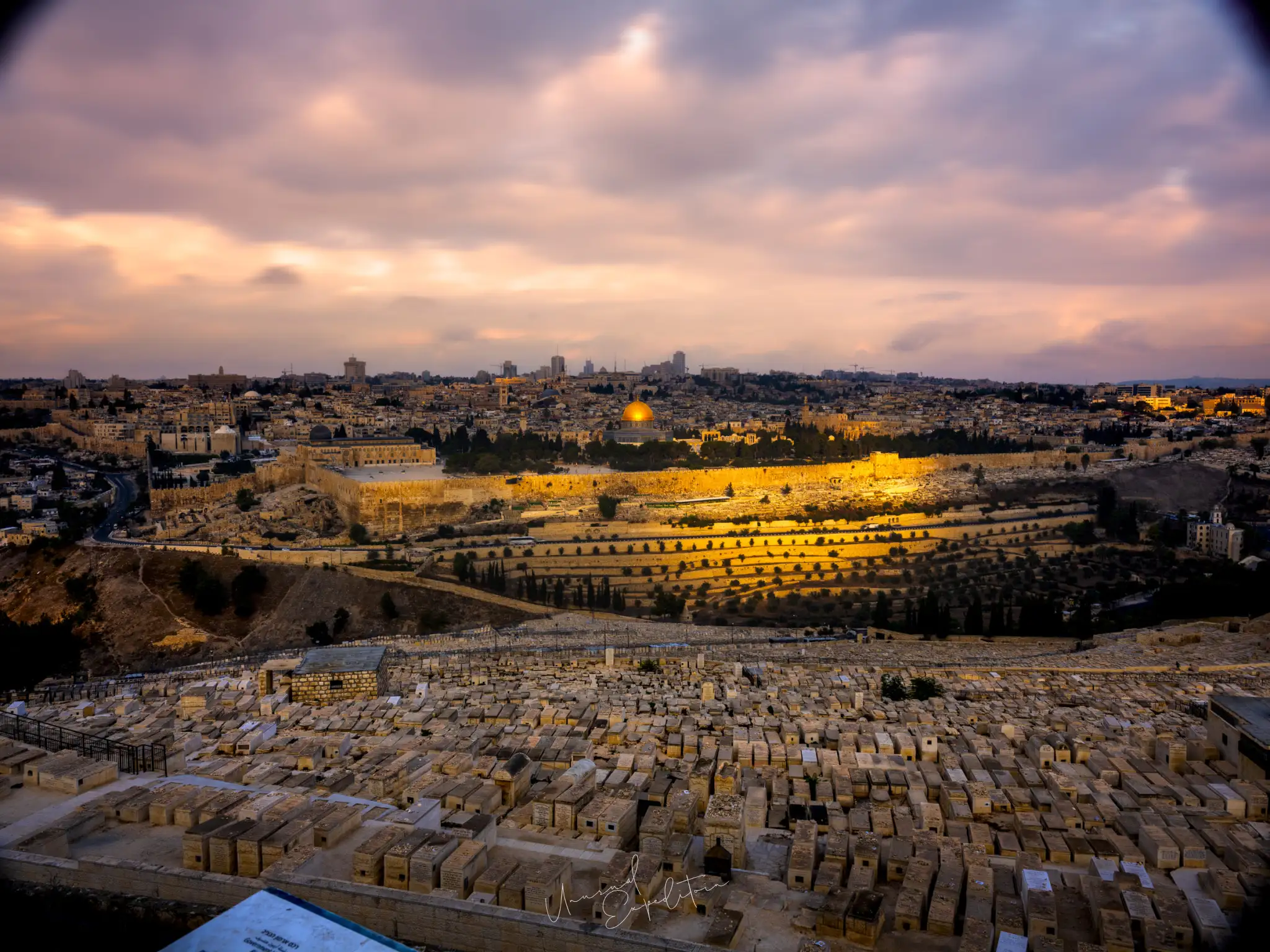
The Mount of Olives viewpoint at sunset gives you the most famous view of Jerusalem: the Old City walls, the gold Dome of the Rock and the white terraces of the Jewish cemetery, seen from the lookout on the ridge east of the city. Because you face west, the sun goes down behind the Old City, so sunset is about sky colour, silhouettes and the floodlit walls at blue hour, while sunrise, with the sun behind you, lights the stone directly. Both are worth a visit; they make different pictures.
The view is one stop in a much larger city, so read our Jerusalem photography tour guide for the rest. Here we cover where to stand, how the light behaves and what else on the slope deserves your time.
Mount of Olives viewpoint: where to watch the sunset
The main lookout is a paved terrace near the top of the Mount of Olives, beside the Seven Arches Hotel, where a low wall runs along the edge and the whole Old City lies across the Kidron Valley in front of you. Tour coaches stop here through the day, but the crowd thins as the light goes. The terrace is wide enough that you can move along it to change the angle: from the northern end the Dome of the Rock lines up with the Church of the Holy Sepulchre behind; from the southern end you see more of the cemetery and the city walls running down toward the City of David. Below the terrace, paths lead down through the cemetery itself, which gives you a lower, closer view with headstones in the foreground. Stay on the paths and remember that this is a working cemetery where families visit graves.
Mount of Olives sunset or sunrise: which light is better?
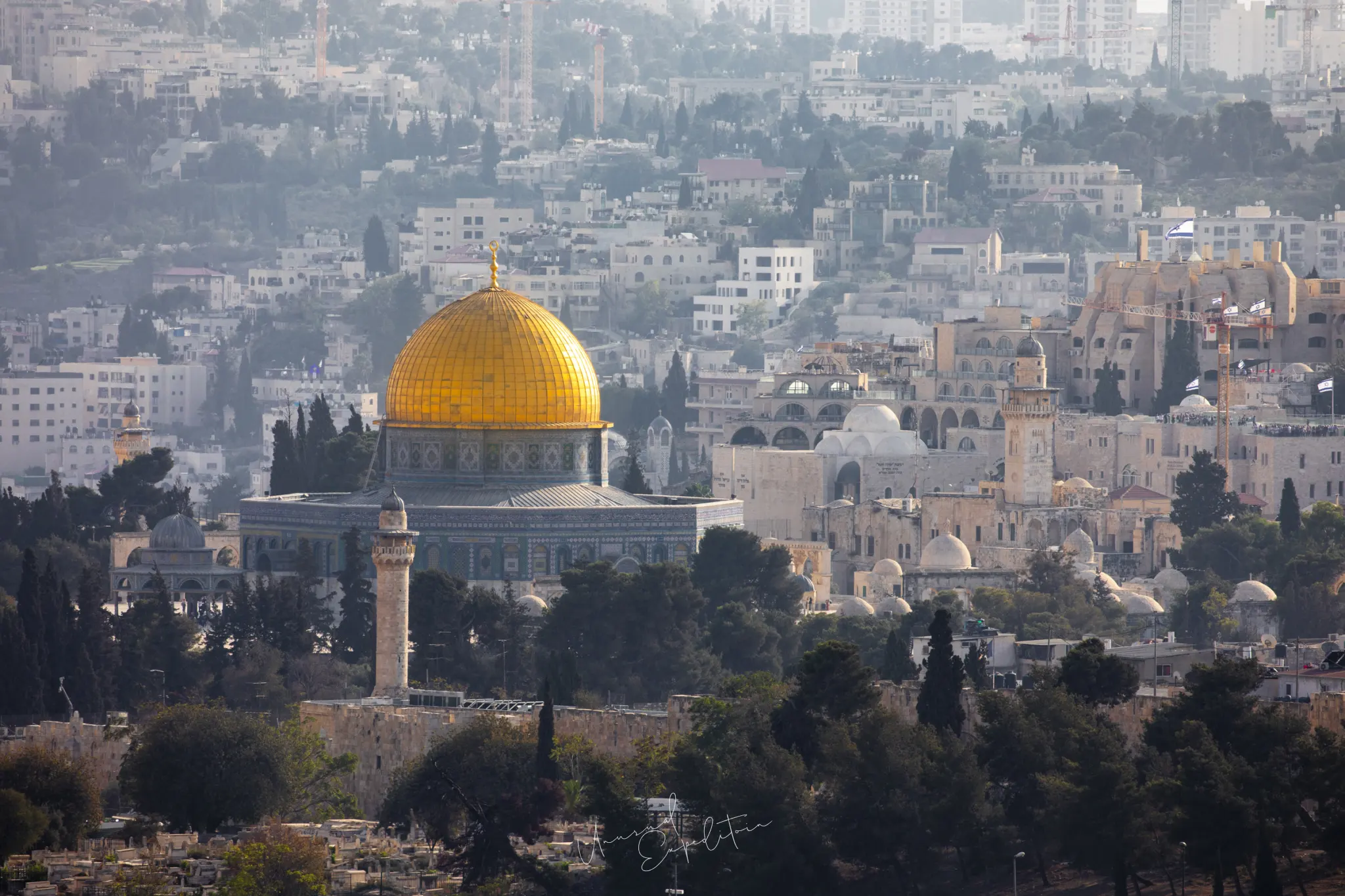
The Mount of Olives faces the city from the east, so the two ends of the day work in opposite ways. At sunrise the sun comes up behind you and falls straight onto the eastern walls and the Dome of the Rock, which glows; the cemetery terraces pick up long shadows that show their shape. It is the cleanest, most detailed light of the day and the terrace is almost empty. At sunset the sun drops behind the Old City, so the walls go into shade and the sky does the work: on a day with high cloud it turns orange and pink over the skyline. Then, as the sky darkens, the floodlights come on along the walls and on the dome, and for a short spell of blue hour the lit stone and the coloured sky balance. That is the frame most people want, and it is why staying after the sun has gone matters.
| Light | Sun position | What you get | Lens |
|---|---|---|---|
| Sunrise | Behind you | Walls and dome lit directly, long shadows | 24-70mm, 70-200mm |
| Midday | High | Flat, hazy, cemetery glare | Skip or scout |
| Sunset | Behind the city | Coloured sky, walls in shade | 24-70mm |
| Blue hour | Below the horizon | Floodlit walls and dome, deep blue sky | 24-70mm on a tripod |
If you can only come once, come for the end of the day and stay into blue hour.
Settings and kit for the view
For the panorama, a 24-70mm covers the walls from end to end, and a 70-200mm lets you pull the Dome of the Rock, the Dormition Abbey on Mount Zion or the domes of the Holy Sepulchre out of the skyline. Haze is common over Jerusalem, especially in the dry months, and a long lens shows it most; it can be beautiful, softening the city into layers, but it rarely gives crisp detail at distance. At blue hour you need a tripod or a steady place on the wall for exposures of a second or more. Bracket the exposure: the sky and the floodlit stone are several stops apart for a while, and blending two frames is easier than rescuing one. Keep a lens cloth handy, because dust blows up from the valley.
Mount of Olives Jewish cemetery
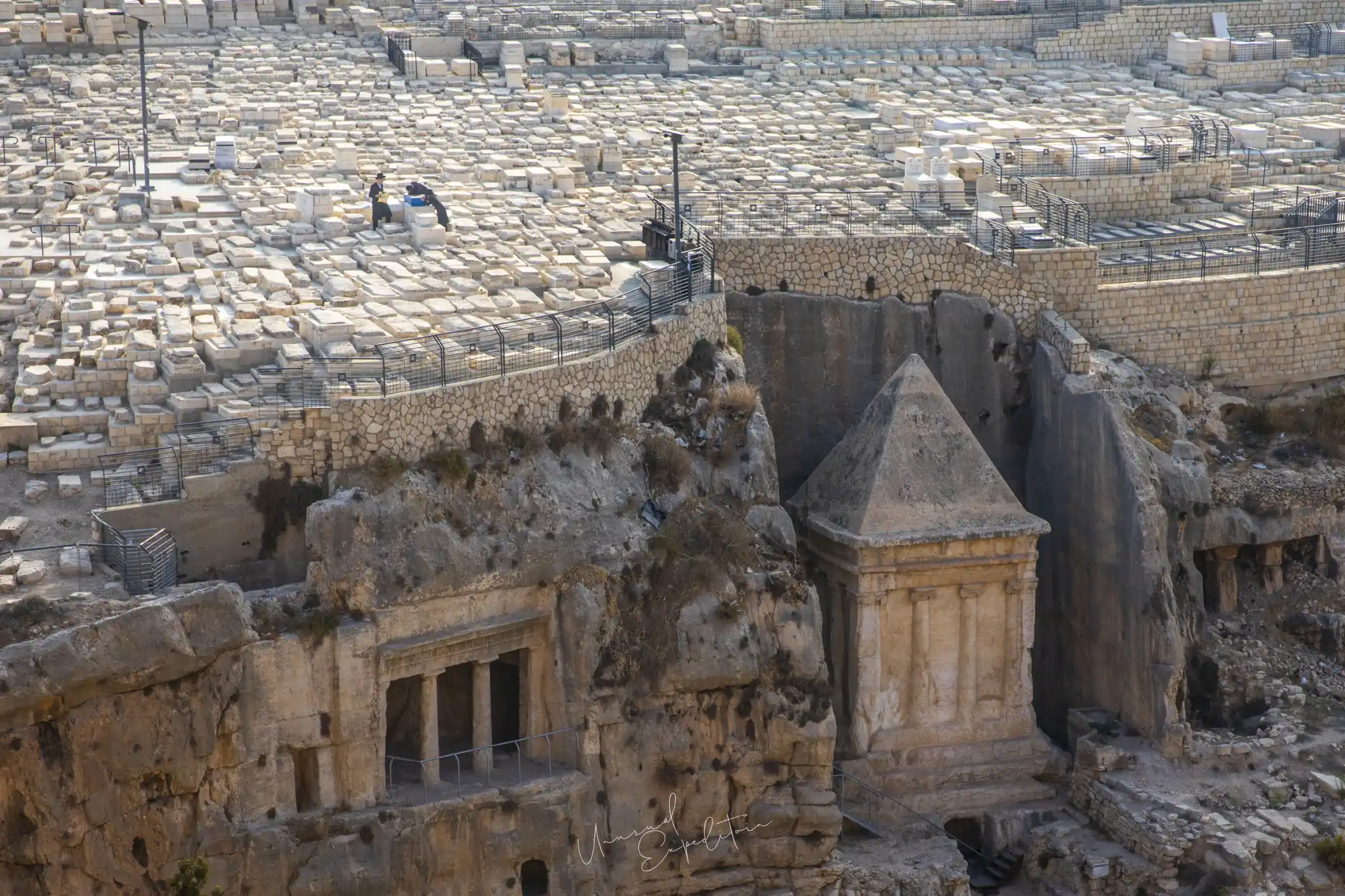
The slope between the lookout and the valley is covered by the Jewish cemetery of the Mount of Olives, an ancient burial ground still in use, with thousands of flat limestone tombs laid in rows down the hill. From the lookout it reads as texture, a sea of white blocks that catches the low sun at either end of the day. Up close it is a place of mourning and prayer. You will see visitors placing small stones on graves, and Orthodox men walking between the rows. Photograph them from a distance and from behind or the side, as we did, and never ask anyone to pose. A telephoto from the lookout gives you figures in the landscape without intruding.
The Kidron Valley tombs
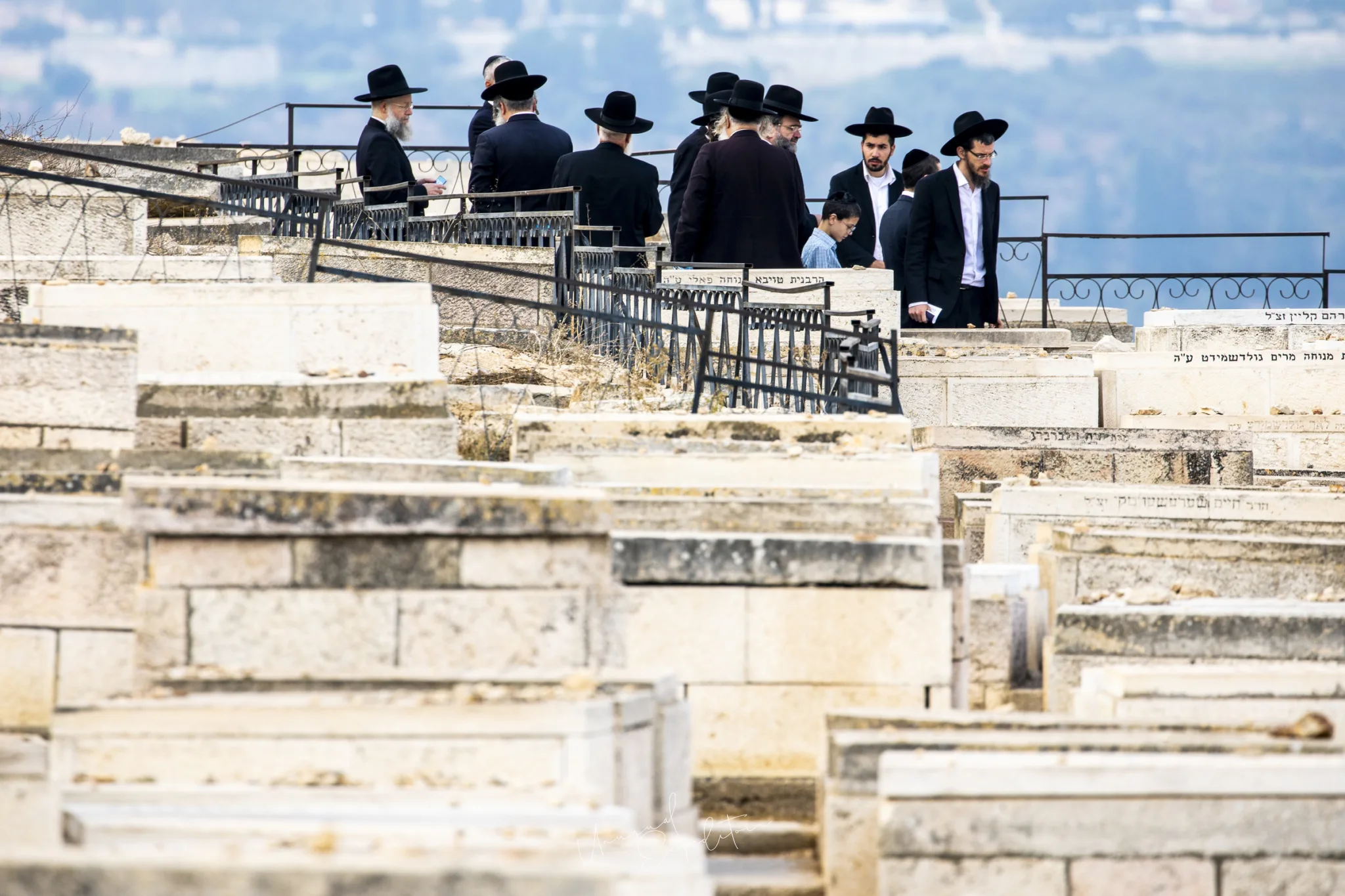
At the foot of the Mount of Olives, in the Kidron Valley between the slope and the Old City walls, stand a group of monumental tombs cut from the bedrock, among them the Tomb of Absalom and the Tomb of Zechariah with its pyramid roof. From the cemetery path above, they make a strong composition with olive trees and the slope behind. The valley is in shade early and late, so midday, when the lookout is at its weakest, is a fair time for these.
Everyone packs up when the sun disappears behind the city. Wait. The floodlights come on and the sky turns blue, and that is the picture you came for.
Joseph Mak, tour leader, Unusual Expedition
Churches on the slope of the Mount of Olives
Several churches stand on the western slope of the Mount of Olives, and they are worth combining with the view. Dominus Flevit, a small church shaped like a teardrop, has a window that frames the Dome of the Rock across the valley, one of the best-known compositions in the city. Lower down, the Church of All Nations stands beside the Garden of Gethsemane, with ancient olive trees in front and a mosaic facade that catches the afternoon sun. Both are looked after by the Custody of the Holy Land, the Franciscan body that cares for many Christian sites in Jerusalem, and both keep church hours, so they are daytime subjects. The Russian Church of Mary Magdalene, with its gold onion domes among the trees, is another landmark you will see from the path.
Getting up the Mount of Olives
The road to the top is steep, narrow and busy with traffic, so most visitors take a taxi or come with a driver to the lookout and walk down through the slope afterwards. Walking up from the Old City through Lions' Gate and the Kidron Valley is possible but hard work in the heat, with heavy camera bags. For sunrise, arrange transport the evening before. Travel advice changes with the region, so check the current position from Singapore's Ministry of Foreign Affairs before you go, and see our Jerusalem photography FAQ for the practical questions.
More of Jerusalem from above
The Mount of Olives is the grandest viewpoint, but not the only one. The Lutheran church tower in the Muristan and the roof of the Austrian Hospice give views from inside the walls, listed in our Jerusalem Old City photos guide. For the archaeology on the ridge to the south, which you can see from the lookout, read our City of David guide, and for the plaza and the dome you are looking at, see Western Wall and Dome of the Rock photos.
See this view with us
We run Jerusalem as a private trip on request when the travel advice allows, with the Mount of Olives timed for the light you want. Our Israel photography tours page has every guide for the country.
Jerusalem photography tours
The next Jerusalem departure is announced on the Jerusalem photography tours page, with previous expeditions and all the planning guides.
Explore Jerusalem in depth
- Jerusalem Photography Tour Guide: The Old City, Its Walls and Its LightIsrael
- Western Wall and Dome of the Rock Photos: The Plaza, the Mount and the RulesIsrael
- Via Dolorosa and the Church of the Holy Sepulchre: A Photographer's GuideIsrael
- Jerusalem Photography FAQ: Days, Visa, Safety, Dress and BethlehemIsrael
- Jerusalem Old City Photos: The Best Spots, Walls and ViewpointsIsrael
- Jerusalem Old City Market: Photographing the Souks and Their PeopleIsrael
- City of David, Jerusalem: Is It Worth Visiting for Photographers?Israel
Upcoming Photo Tours
- Egypt Photo Tour – EgyptEgypt 12 Dec 2026 To 20 Dec 2026
- Inner Mongolia Winter Owl Photo Tour – ChinaChina 01 Jan 2027 To 04 Jan 2027
- Inner Mongolia Winter Photo Tour – ChinaChina 05 Jan 2027 To 11 Jan 2027
- Mekong And Central Highland Vietnam Photo Tour - VietnamVietnam 16 Jan 2027 To 24 Jan 2027