
Wadi Rum at Night: Stars, Camps and Night Photography
Wadi Rum at night: the night sky, the Milky Way, lit camps at blue hour, cold desert nights and camera settings that work.
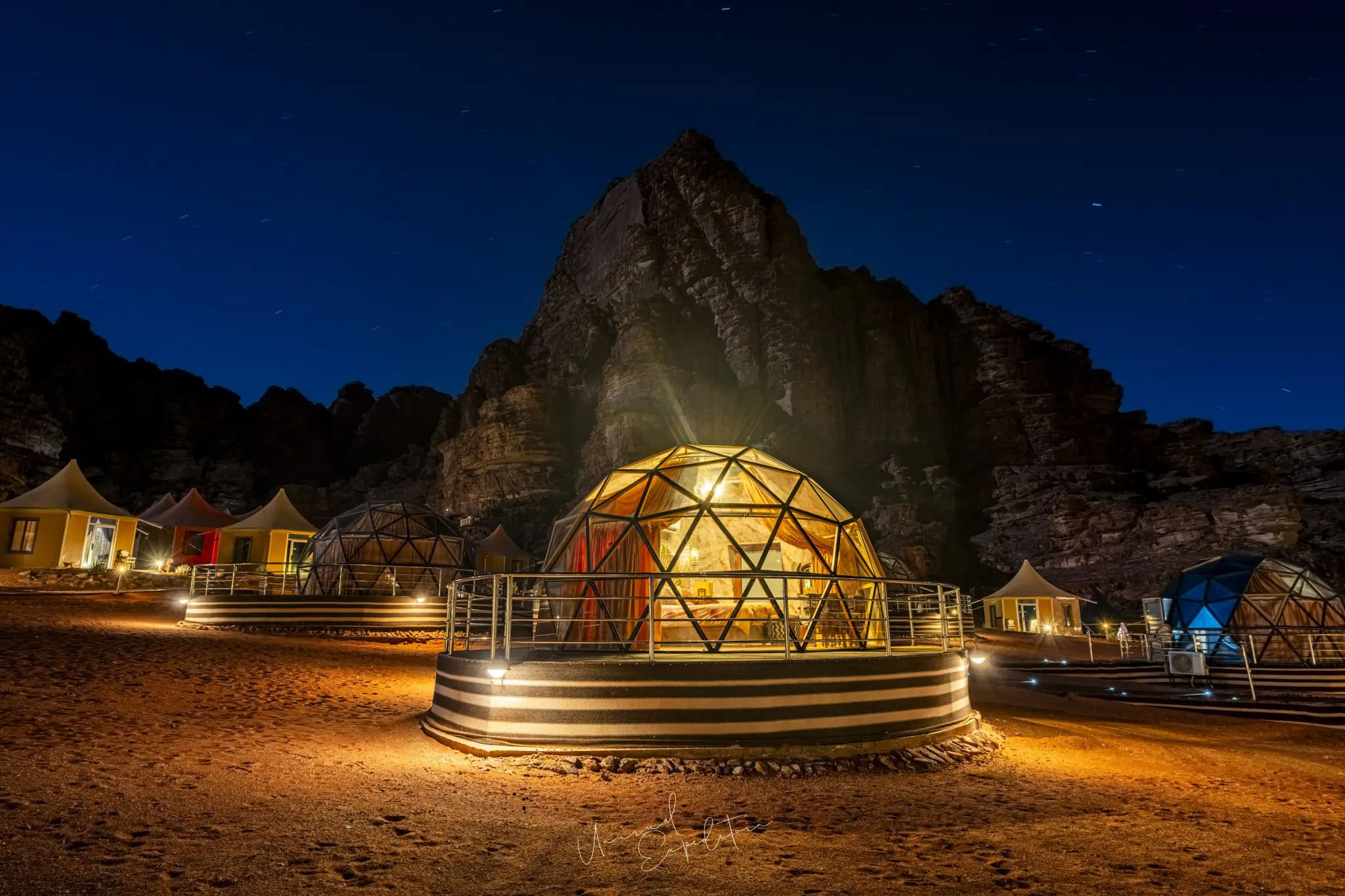
Wadi Rum at night is dark, silent and cold, and on a clear moonless night the sky above the cliffs fills with stars, which makes it one of the best places in Jordan for night photography. The finest frames combine the sky with the land: stars over a jebel, a lit tent or dome under a cliff at blue hour, or a campfire inside a Bedouin tent. Here is when to go, where to stand and which settings work, part of our Wadi Rum photography tour guide.
Wadi Rum at night: what you can photograph
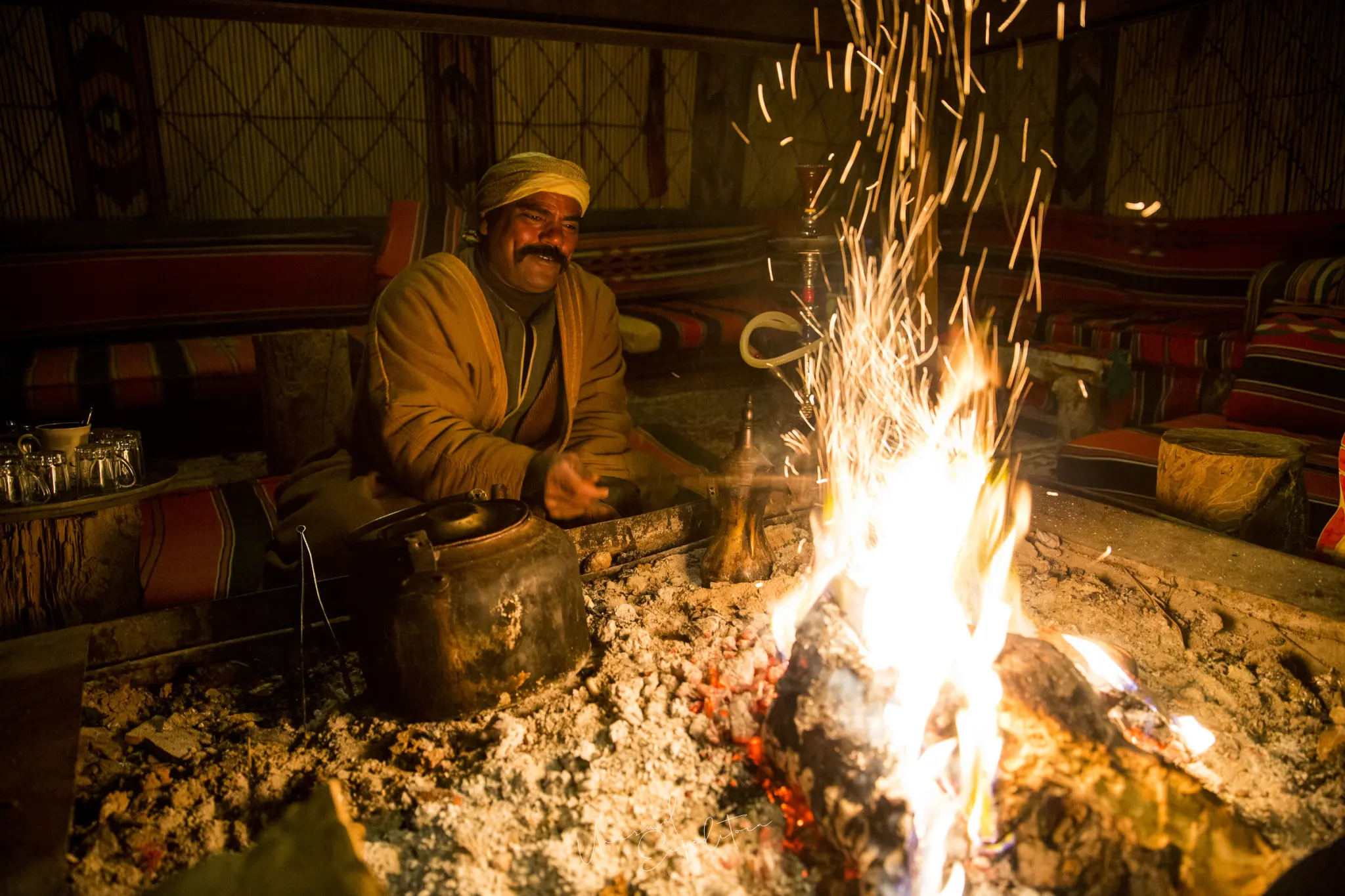
Wadi Rum at night offers three kinds of picture. The first is blue hour, the short spell after sunset when the sky is deep blue, the cliffs are still visible and the lights of a camp glow warm against them. The second is the full night sky: stars, and in the right season the Milky Way, over the dark shapes of the mountains. The third is the life of the camp, firelight on faces, the glow through the walls of a tent, tea poured by the fire. Each needs different settings and a different place to stand, so decide in daylight which you want and walk the ground before dark.
Wadi Rum night sky and stargazing
The Wadi Rum night sky is dark because there is so little around it: Rum Village and the camps have lights, but a short walk away from them the desert is black. Stargazing is best on the nights around the new moon; near full moon the desert is bright enough to walk without a torch, which is beautiful to see but washes out the fainter stars. Moonlight has its own use, though, lighting the cliffs softly for a landscape under a starry sky. Clear nights are most likely in the dry months, and winter nights, after rain has cleared the dust, can be the sharpest of all.
Wadi Rum Milky Way: when it is visible
The Wadi Rum Milky Way shot most people imagine, the bright core rising over the cliffs, is a seasonal subject. From southern Jordan the core is low in the south and appears before dawn in spring, through the evening in summer and early in the night in early autumn; in the winter months it is barely above the horizon after dark. Our own night frames from Wadi Rum are from winter trips, with stars over the camps but no Milky Way core. If the core is what you want, plan for the months between spring and early autumn, a moonless night, and a camp well away from the village, then check a planetarium app for its position over the cliffs.
Wadi Rum bubble camp and lit tents at blue hour
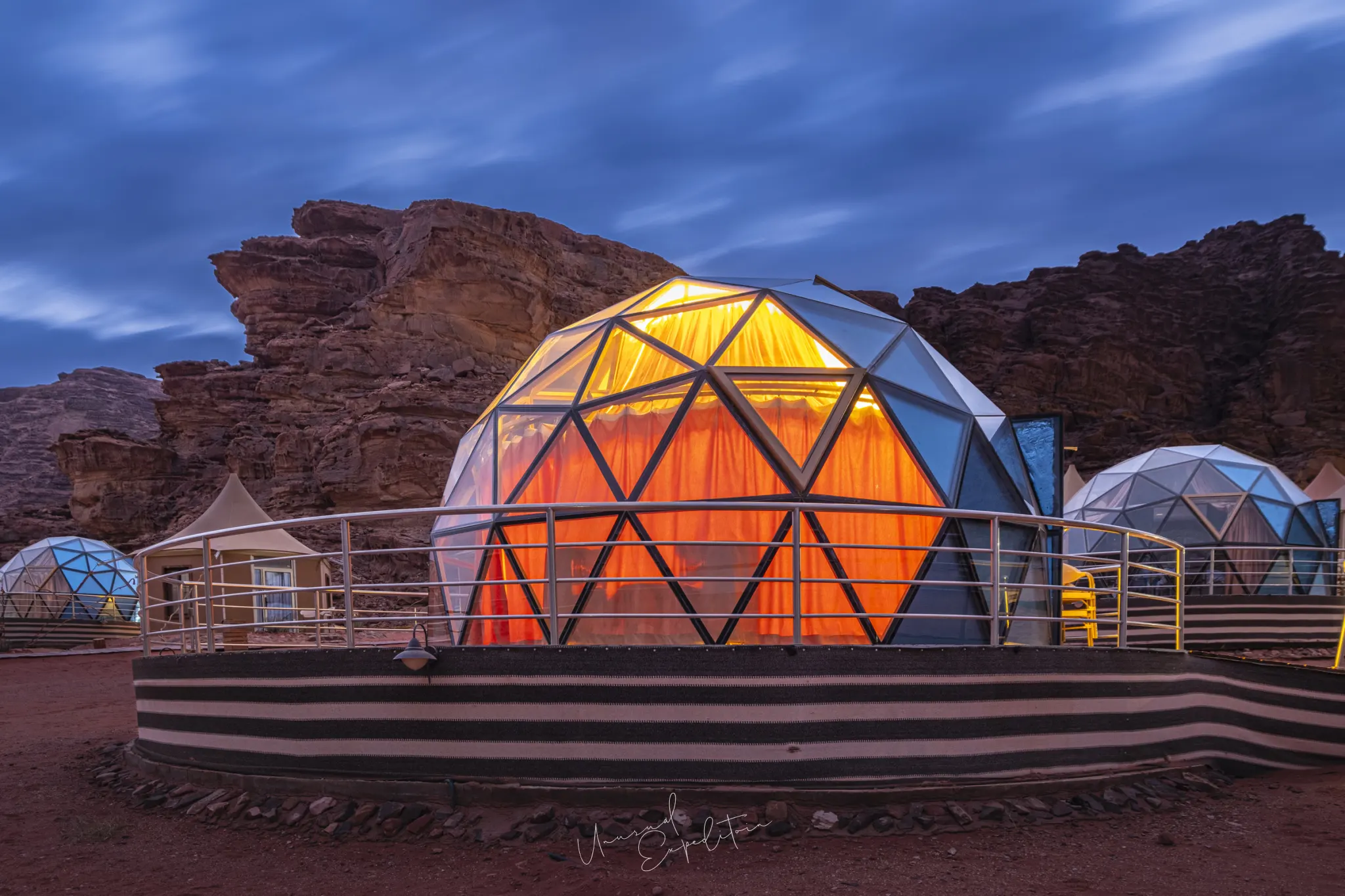
The Wadi Rum bubble camps, rows of transparent or lit domes set below the cliffs, are a subject in their own right at blue hour. A dome lit from inside glows orange against a deep blue sky, and the sandstone behind it still holds a little detail. The window is short: start when the lights come on and stop when the sky goes black and the cliff disappears. Stand back far enough to show the mountain above the dome, and use a tripod with a low ISO. Traditional black goat-hair tents with a fire burning inside work the same way. Ask the camp first if you are photographing other guests' domes.
Wadi Rum night temperature
Wadi Rum night temperature catches many visitors out. The desert loses its heat quickly once the sun goes, and Responsible Travel notes that from December to February nights can fall below freezing; even in spring and autumn a warm jacket is needed after dark. Standing still behind a tripod is colder than walking. Bring a hat, gloves that let you work the camera, a down jacket and spare batteries in an inside pocket, because cold drains them fast. A thermos of the camp's tea helps more than you would think. Summer nights are mild, but the days are hot, which is the trade-off of the Milky Way season.
"On our winter nights in Wadi Rum the coldest person in the group is always the one who stood still the longest waiting for the perfect frame. Dress for it, and the desert gives you a sky you will not forget."
Joseph Mak, tour leader, Unusual Expedition
Camera settings for night photography in Wadi Rum
| Subject | Starting point | Notes |
|---|---|---|
| Blue hour camp | ISO 100 to 400, f/8, several seconds | Bracket for the lit dome and the sky |
| Stars over the cliffs | ISO 3200 to 6400, widest aperture, under 20 seconds with a 16-35mm | Focus manually on a bright star |
| Milky Way core | As above, moonless night | Stack several frames to reduce noise |
| Campfire in a tent | ISO 1600 to 3200, wide aperture, handheld | Expose for the faces, let sparks streak |
| Moonlit landscape | ISO 800 to 1600, f/4, longer exposure | Looks like soft daylight with stars |
Use a red torch around other photographers, and turn off any light on the camera so it does not spoil their frames.
Safety and good manners after dark
The desert at night is safe to walk near your camp, but it is easy to lose your bearings once the camp lights are behind a dune. Tell your host where you are going, take a torch and a charged phone, and stay within sight of the camp unless your driver comes with you. Do not drive or wander out into the open desert alone. Keep noise down: other guests are there for the silence. For the evening light before night falls, see Wadi Rum sunset and sunrise, and for life in the camps, Wadi Rum Bedouin.
Night photography in Wadi Rum with us
For night work we choose camps away from the village lights and plan the trip around the moon. We run Wadi Rum as a private trip on request, with a photographer or coaching available at extra cost. See private tours and the Jordan photography tours page.
Wadi Rum photography tours
The next Wadi Rum departure is announced on the Wadi Rum photography tours page, with previous expeditions and all the planning guides.
Explore Wadi Rum in depth
- Wadi Rum Photography Tour Guide: Jordan's Desert of Red Sand and StoneJordan
- Wadi Rum Sunset and Sunrise: Where and When the Light Is BestJordan
- Wadi Rum Photos: What the Desert Looks Like Through the LensJordan
- Wadi Rum Jeep Tour: Rock Bridges, Canyons and Lawrence of ArabiaJordan
- Wadi Rum Camel Ride: Caravans, Herders and How to Photograph ThemJordan
- Wadi Rum Bedouin: Photographing the People of the DesertJordan
- How to Visit Wadi Rum: Entry, Weather by Month and How Many NightsJordan
Upcoming Photo Tours
- Egypt Photo Tour – EgyptEgypt 12 Dec 2026 To 20 Dec 2026
- Inner Mongolia Winter Owl Photo Tour – ChinaChina 01 Jan 2027 To 04 Jan 2027
- Inner Mongolia Winter Photo Tour – ChinaChina 05 Jan 2027 To 11 Jan 2027
- Mekong And Central Highland Vietnam Photo Tour - VietnamVietnam 16 Jan 2027 To 24 Jan 2027