
Wadi Rum Photos: What the Desert Looks Like Through the Lens
Wadi Rum photos: valleys, jebels, rock bridges, camels and camps, the scenes worth photographing and the lens for each.
Wadi Rum photos show a desert unlike the dune seas people expect: broad valleys of red and gold sand between lone sandstone mountains, natural rock bridges, wind-carved boulders, camels resting under cliffs and small camps dwarfed by the walls around them. The pictures that work best keep that sense of scale, with something living or built set against the rock. These are the scenes we photograph and how we approach each one, as part of our Wadi Rum photography tour guide.
The photographs here are our own, taken on our trips to Wadi Rum; we hold the rights to them, and the notes come from knowing these places first hand.
Wadi Rum pictures: what the desert actually looks like
Wadi Rum pictures often surprise people who have never been. The desert is not one sea of sand but a maze of flat valley floors, some sandy, some gravel and scrub, walled in by jebels that rise sheer from the ground. The rock is layered: dark granite at the base in places, then sandstone in bands of brown, orange and cream, eroded at the top into domes and melted-looking shapes. Between the mountains the sand changes colour from pale yellow to deep red, sometimes within a single valley. For a photographer this means every valley offers a background, and the work is finding the foreground: a line of tracks, a bush, a camel, a person walking.
Wadi Rum mountains and valleys from above
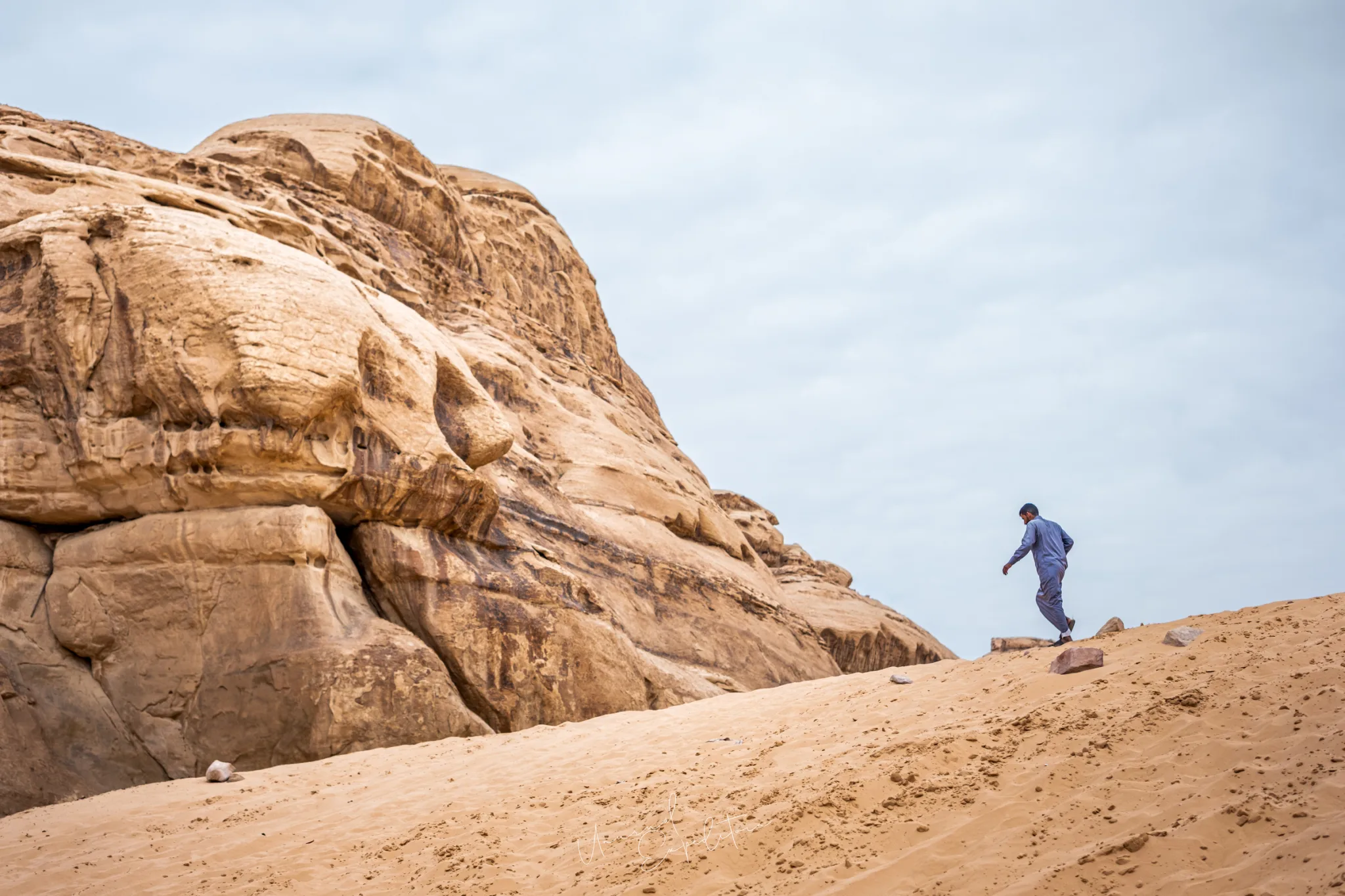
The easiest way to show the layout of the Wadi Rum mountains is to climb a little. Low ridges of slickrock sit along the edges of most valleys, and from twenty or thirty metres up you see the valley floor as a pattern: dunes, tracks fanning out from the camps, the shadows of the far cliffs. A 16-35mm or the wide end of a 24-70mm takes in the whole valley; a longer lens picks out a single jeep or a string of camels crossing it. Climb only where it is easy and dry, with your driver's advice: the sandstone crumbles, and sand on rock is slippery.
Camels in the frame
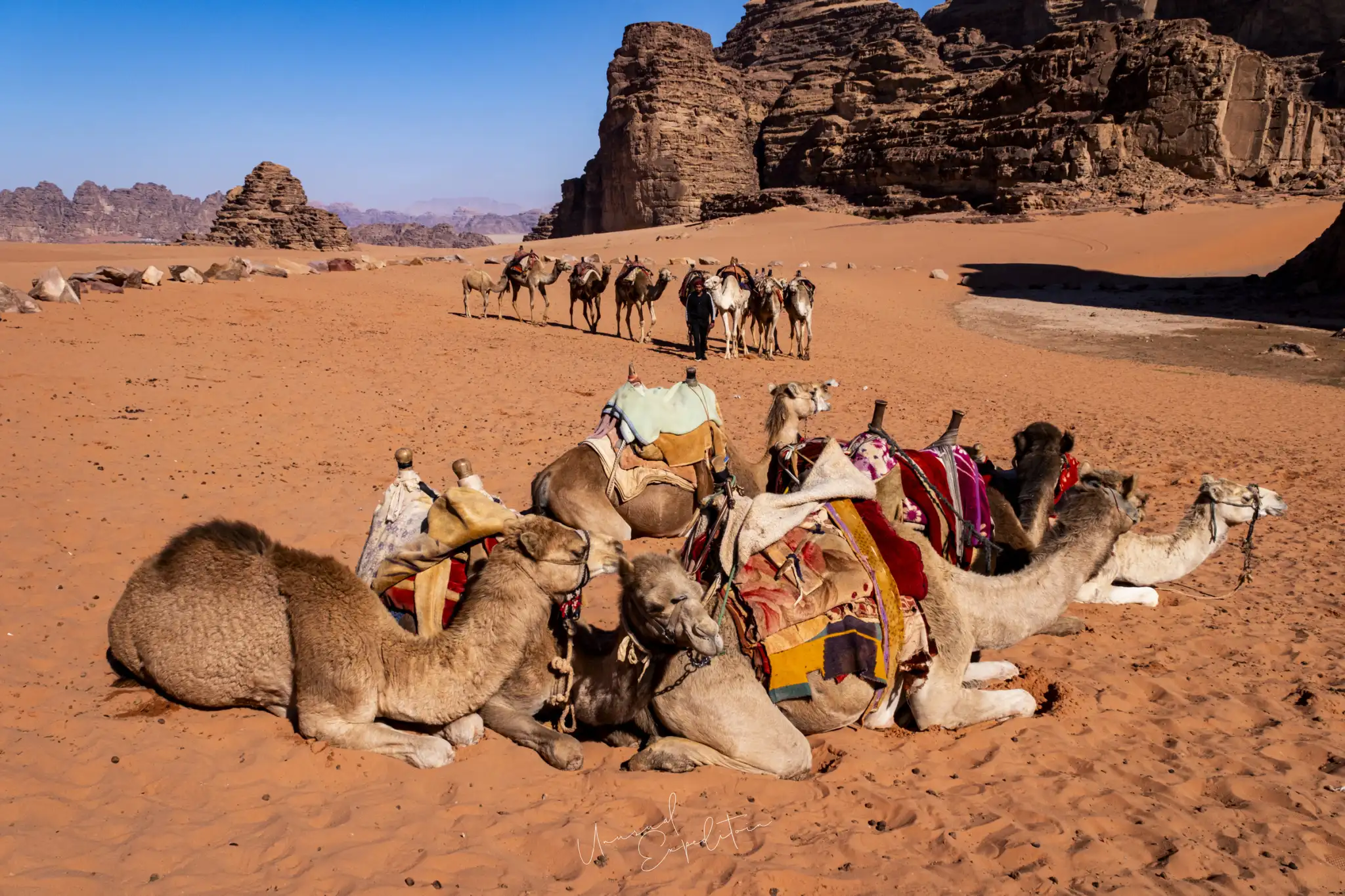
Camels are part of most Wadi Rum images, and they make the best scale bar the desert offers. Resting camels, folded down on the sand with their saddles on, are patient subjects: get low, put them in the foreground with a wide lens and let the jebel fill the top of the frame. Moving strings are better from further away with a 70-200mm, so the line of animals reads clearly against the sand. Ask the herder before you walk in among his animals, and keep out of kicking range behind them. More on this in our Wadi Rum camel ride article.
Wadi Rum arch: photographing the rock bridges
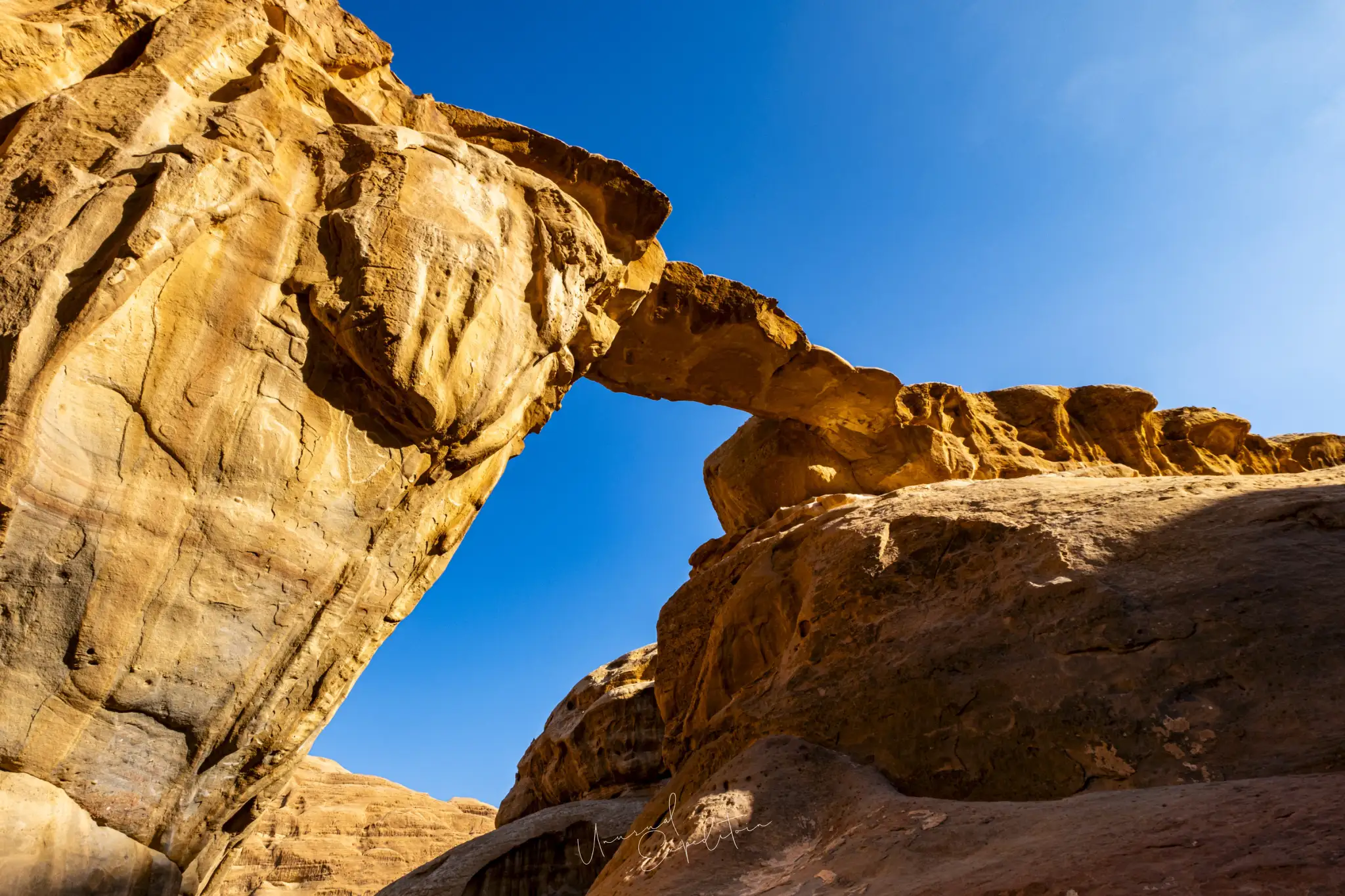
Search for a Wadi Rum arch and you will find two names: Burdah Rock Bridge, the largest, high on a ridge and reached by a steep scramble with a guide, and Umm Fruth, smaller and easy to climb, which Lonely Planet notes can be done without gear. There are smaller bridges too, and drivers stop at several. From below, a bridge against a deep blue sky makes a strong graphic frame: stand close, shoot upward with a wide lens and let the arch cut across the sky. From the side, with a person or a camel underneath, the bridge shows its size. Morning, with the sun behind you and the sky at its deepest blue, suits both.
Wadi Rum protected area photos: texture and detail
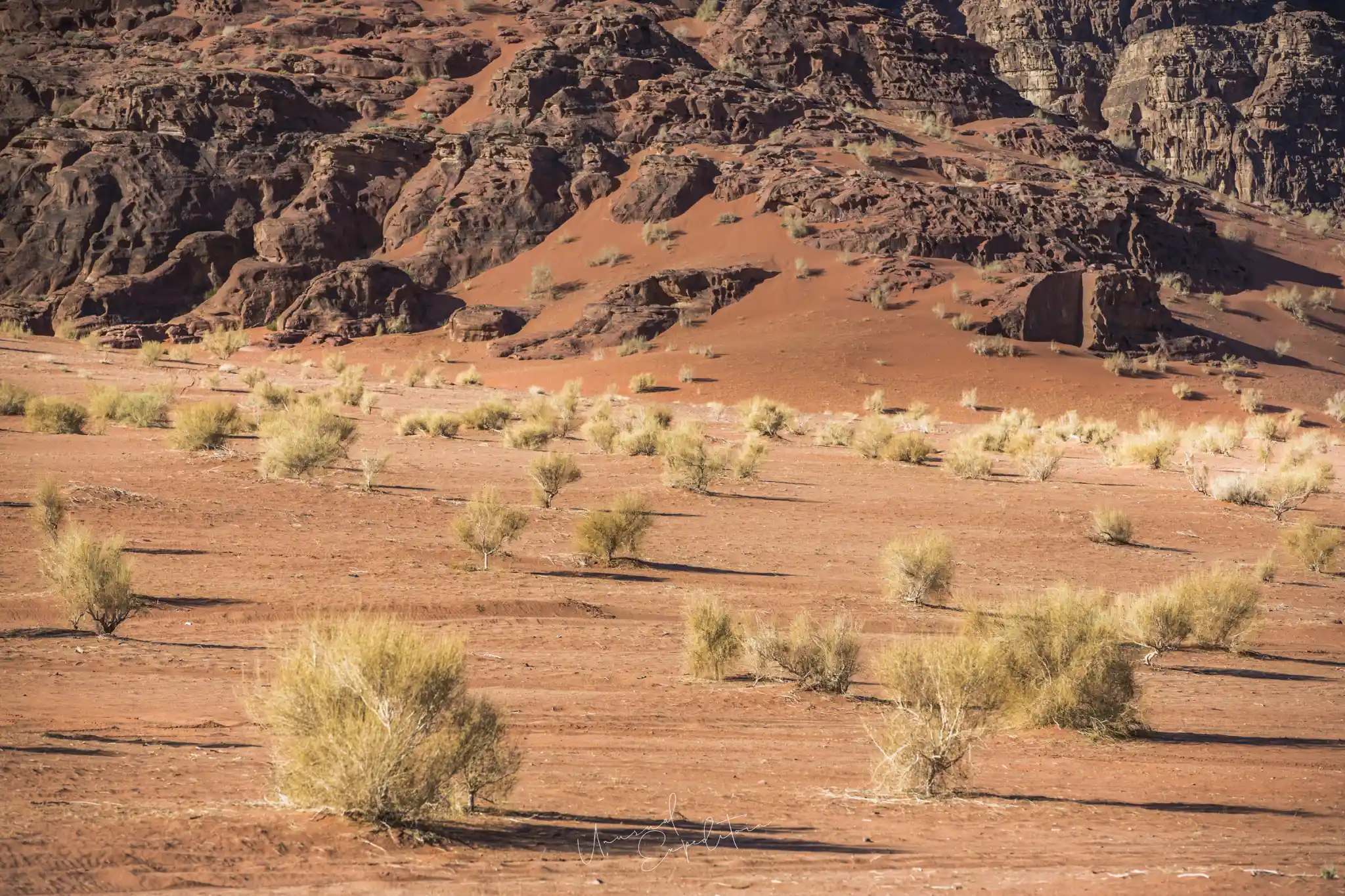
Wadi Rum protected area photos need not all be wide. The details are as rewarding: ripples in the sand after wind, the dark varnish streaked down a cliff, tufts of desert scrub in rows across a red valley, the curves of eroded sandstone close up, and the inscriptions and rock carvings that UNESCO counts in their tens of thousands. A 70-200mm isolates patterns in the cliffs; a macro or close-focusing lens finds texture in the rock. Side light is what brings texture out, so the first and last hours are the time for it, while the middle of the day is better spent in tents or canyons.
"People come for the big views and then fall for the small things: the patterns in the sand, the colour of the rock inside a canyon. I always tell the group to spend some time looking down as well as up."
Joseph Mak, tour leader, Unusual Expedition
Wadi Rum images through the day
| Time of day | What works | Lens |
|---|---|---|
| Dawn and early morning | Cold, clean light on east faces, long shadows across dunes | 16-35mm, 24-70mm |
| Mid morning | Rock bridges and Mushroom Rock against blue sky | 16-35mm |
| Middle of the day | Tents, tea, canyons, shaded detail | 24-70mm |
| Late afternoon | Camels and herders, red sand, west-facing cliffs | 70-200mm, 24-70mm |
| Dusk and night | Afterglow on the jebels, lit camps, stars | 16-35mm on a tripod |
The hard midday light is the one time to put the camera away for landscapes, and the best time for people inside the tents.
Camera care in the sand
Sand is the one real hazard to equipment in Wadi Rum. Fine dust gets into zoom barrels and onto sensors, and the wind in an open jeep blows it straight at the camera. Change lenses inside a tent or a closed vehicle, with your back to the wind, or carry two bodies and avoid changing at all. Keep a blower and a lens cloth in a sealed pocket, and put the camera in a bag on the drive, not on your lap. In winter the cold drains batteries quickly, so keep spares warm in an inside pocket.
Where these photos fit in a trip
Most of these scenes sit in the central part of the protected area, so two nights gives time to return to a valley when the light is right. The best evening and morning light is covered in Wadi Rum sunset and sunrise, and the rock bridges, canyons and Lawrence sites in our Wadi Rum jeep tour article.
Take your own Wadi Rum photos with us
We run Wadi Rum as a private trip on request, often together with Petra, at your own pace and with every arrangement made for you; a photographer or coaching can come along at extra cost. See private tours and our Jordan photography tours page.
Wadi Rum photography tours
The next Wadi Rum departure is announced on the Wadi Rum photography tours page, with previous expeditions and all the planning guides.
Explore Wadi Rum in depth
- Wadi Rum Photography Tour Guide: Jordan's Desert of Red Sand and StoneJordan
- Wadi Rum Sunset and Sunrise: Where and When the Light Is BestJordan
- Wadi Rum Jeep Tour: Rock Bridges, Canyons and Lawrence of ArabiaJordan
- Wadi Rum Camel Ride: Caravans, Herders and How to Photograph ThemJordan
- Wadi Rum Bedouin: Photographing the People of the DesertJordan
- Wadi Rum at Night: Stars, Camps and Night PhotographyJordan
- How to Visit Wadi Rum: Entry, Weather by Month and How Many NightsJordan
Upcoming Photo Tours
- Egypt Photo Tour – EgyptEgypt 12 Dec 2026 To 20 Dec 2026
- Inner Mongolia Winter Owl Photo Tour – ChinaChina 01 Jan 2027 To 04 Jan 2027
- Inner Mongolia Winter Photo Tour – ChinaChina 05 Jan 2027 To 11 Jan 2027
- Mekong And Central Highland Vietnam Photo Tour - VietnamVietnam 16 Jan 2027 To 24 Jan 2027