
Agra Fort Photos: What to Photograph Inside the Red Fort of Agra
Agra Fort photos: the Jahangir palace, Diwan-i-Am, Khas Mahal and the Taj view from Musamman Burj, with light, lenses and opening days.
The best Agra Fort photos come from four places inside the walls: the red sandstone Jahangir palace, the pillared Diwan-i-Am, the white marble Khas Mahal above its garden court, and the riverside pavilions of the Musamman Burj, where you look downstream across the Yamuna to the Taj Mahal. The fort is open every day, Fridays included, so it is the natural plan for the day the Taj is closed, and the afternoon light suits the river view.
This guide is part of our Agra photography tour guide. We photographed the fort on our Agra trips, and the notes below come from those visits and from the official sources named in each section.
Agra Fort photos: what the fort is
Agra Fort is a walled palace city on the right bank of the Yamuna, upstream of the Taj Mahal. The Agra district administration describes it as rebuilt in red sandstone by the emperor Akbar from 1565 and later embellished in white marble by Shah Jahan, which is exactly what you see as you walk through: massive red walls and gates outside, delicate marble pavilions near the river. UNESCO, in the World Heritage description that the official Taj Mahal site reproduces, calls it a powerful fortress of red sandstone whose 2.5 km of walls enclose the imperial city of the Mughal rulers, with palaces such as the Jahangir palace and the Khas Mahal, audience halls such as the Diwan-i-Khas, and two very beautiful mosques. Fort and Taj are separate World Heritage Sites and separate tickets.
Agra Fort inside: what you can and cannot see
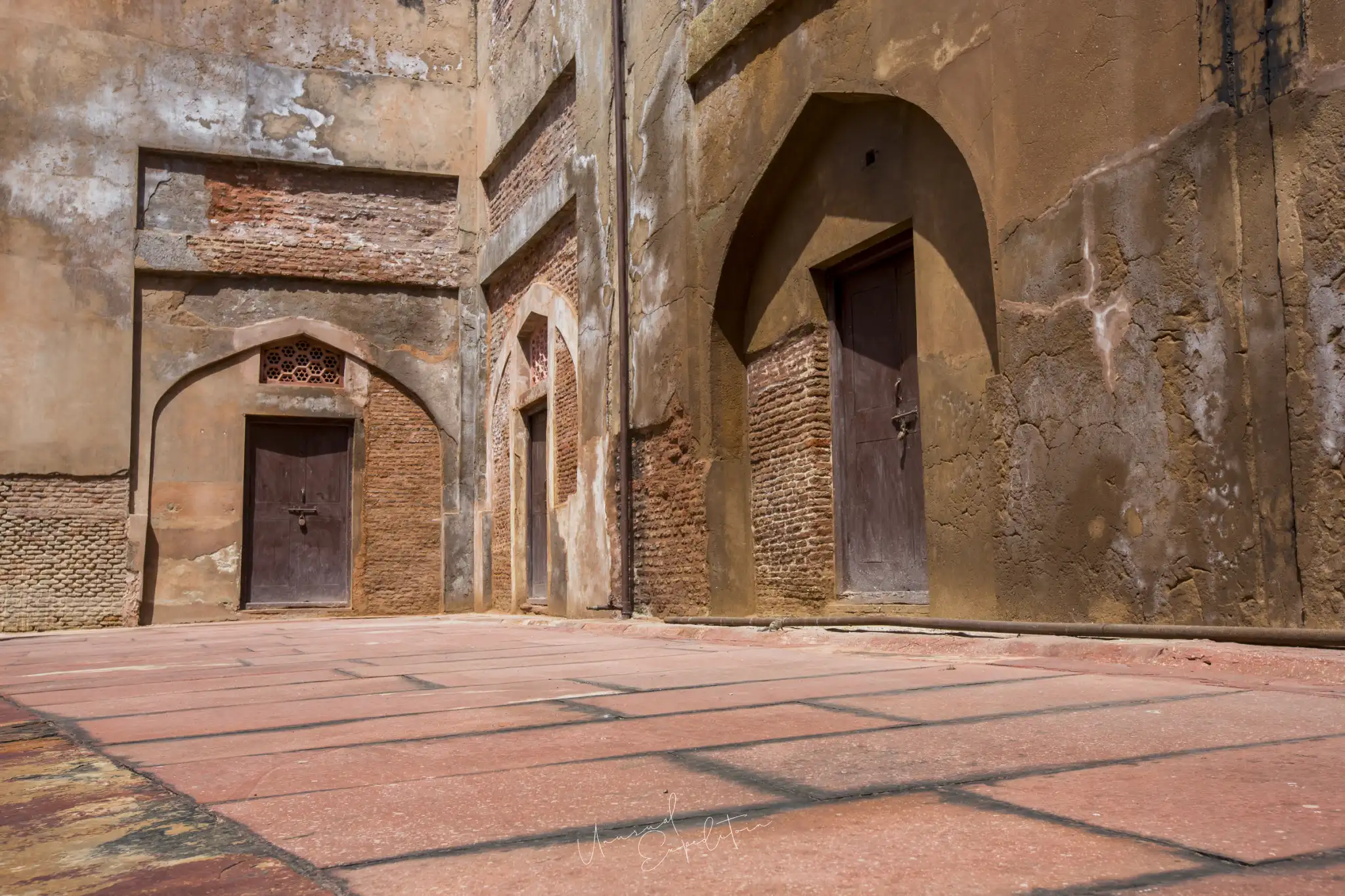
Inside Agra Fort, only part of the enclosure is open. The official Taj Mahal site notes that entry is through the Amar Singh Gate only, and that a portion of the fort is used by the Indian Army and closed to the public. What remains open is still large: the Jahangir palace, the Diwan-i-Am, the Diwan-i-Khas, the Khas Mahal, the Sheesh Mahal, the Musamman Burj and the Moti Masjid are all named on the Agra district site. Allow time to wander, because the best Agra Fort photos are often in the passages and courtyards between the famous buildings, where weathered sandstone walls, carved brackets and arched doorways give you texture and shade.
The Jahangir palace
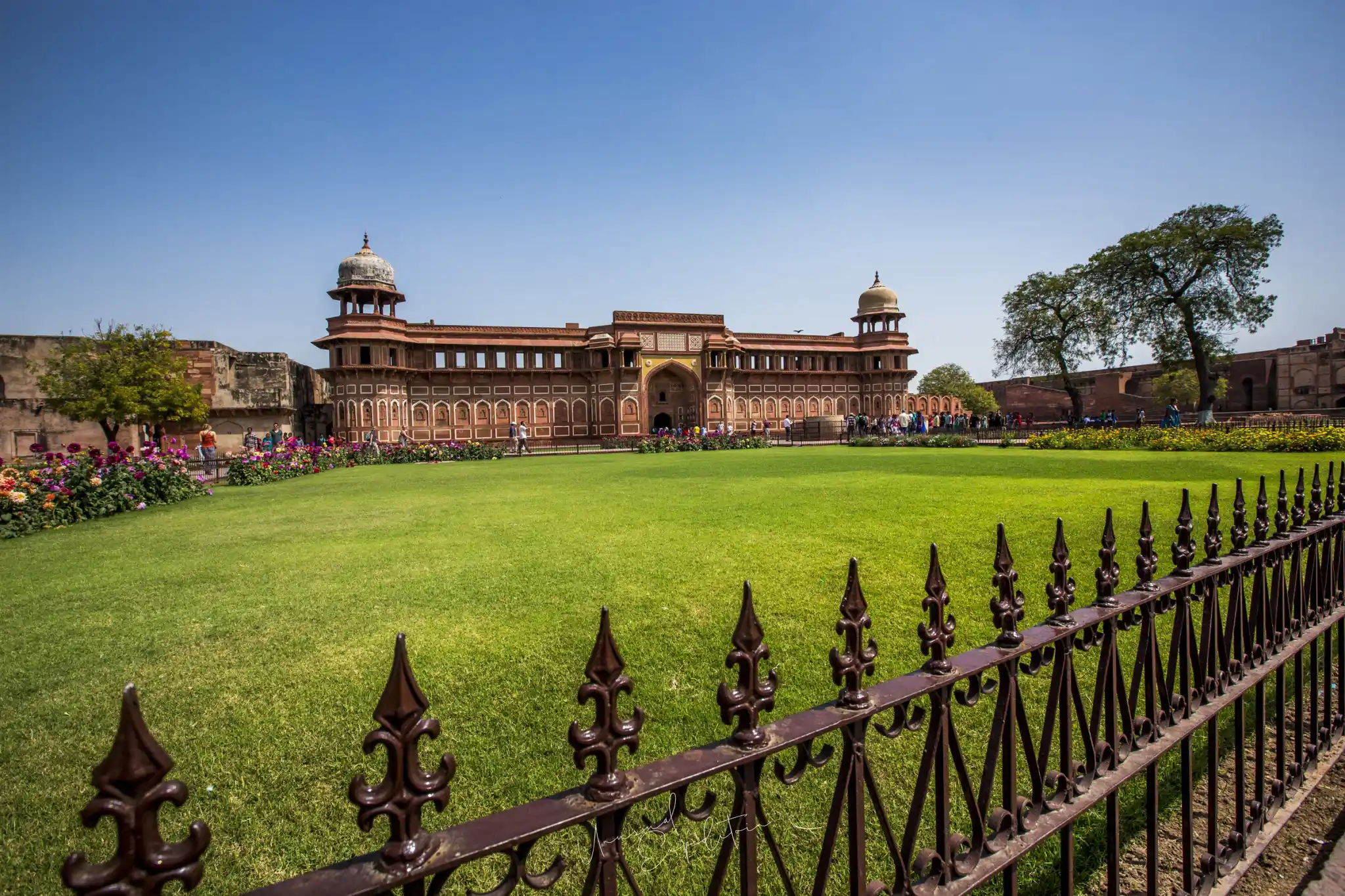
The Jahangir palace, the Jahangiri Mahal, is the large red sandstone building set behind a wide lawn, one of the first you reach from the Amar Singh Gate. Its long facade, with a chhatri at each end and carved panels around the central gateway, suits a wide lens from the edge of the lawn; the iron railing makes a good leading line low in the frame. Inside, its courtyards are a lesson in Akbar's sandstone architecture: deep brackets, carved pillars and shaded galleries. Expose for the stone and let the sky go pale, or come when there is some cloud to hold the highlights.
The Diwan-i-Am and its garden
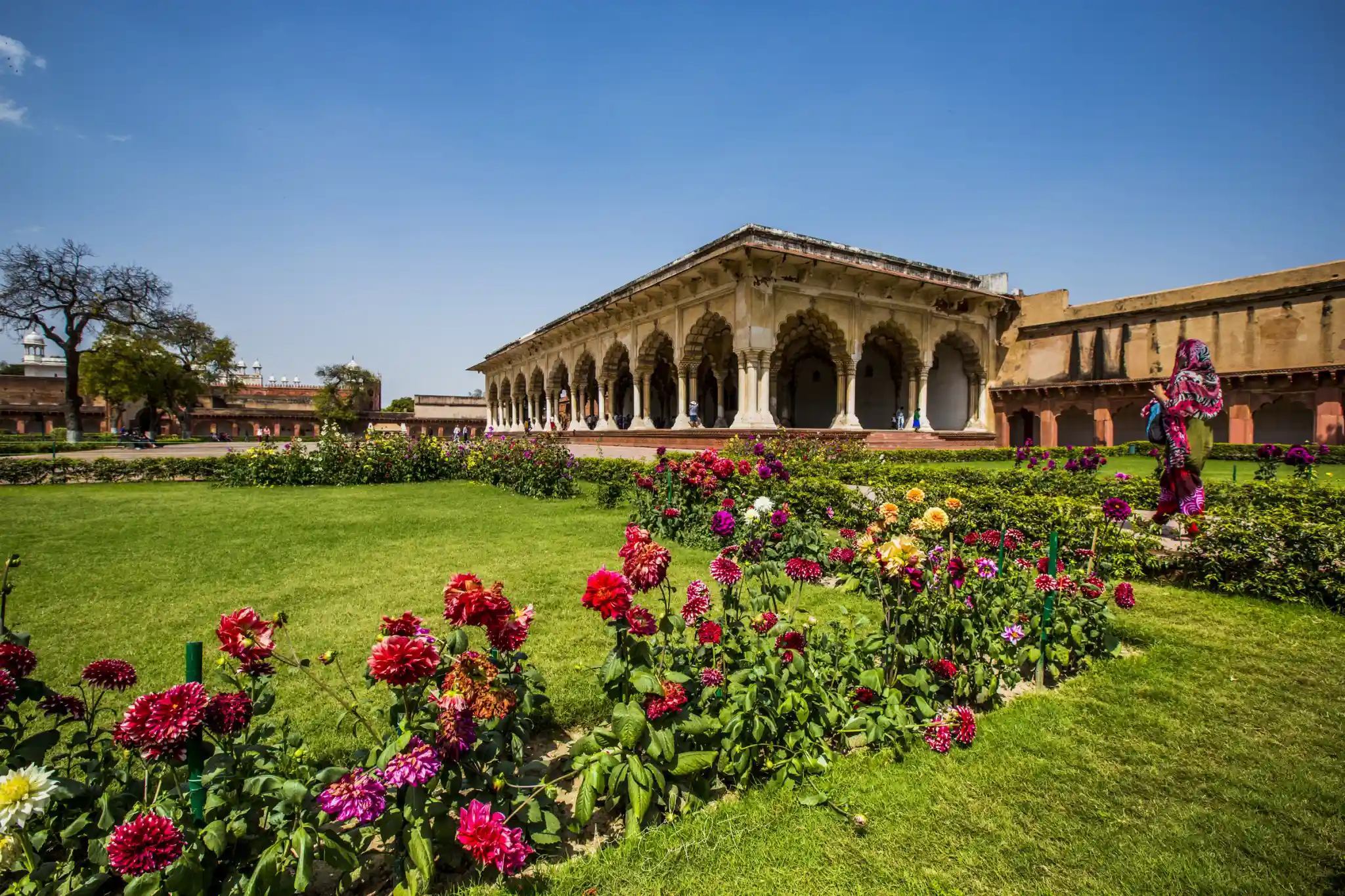
The Diwan-i-Am, the Hall of Public Audience, is a long, open hall of cusped arches on slender columns, facing a large courtyard where the emperor's subjects once gathered. Today the courtyard is a lawn with flower beds, and in the cool months flowers bloom in front of the hall. Shoot along the colonnade with a 16-35mm to stack the arches into a rhythm, or frame the whole hall behind the flowers with a 24-70mm. The hall is white and the garden bright, so midday is harsh here; late afternoon gives depth to the arches.
The Khas Mahal and the garden court
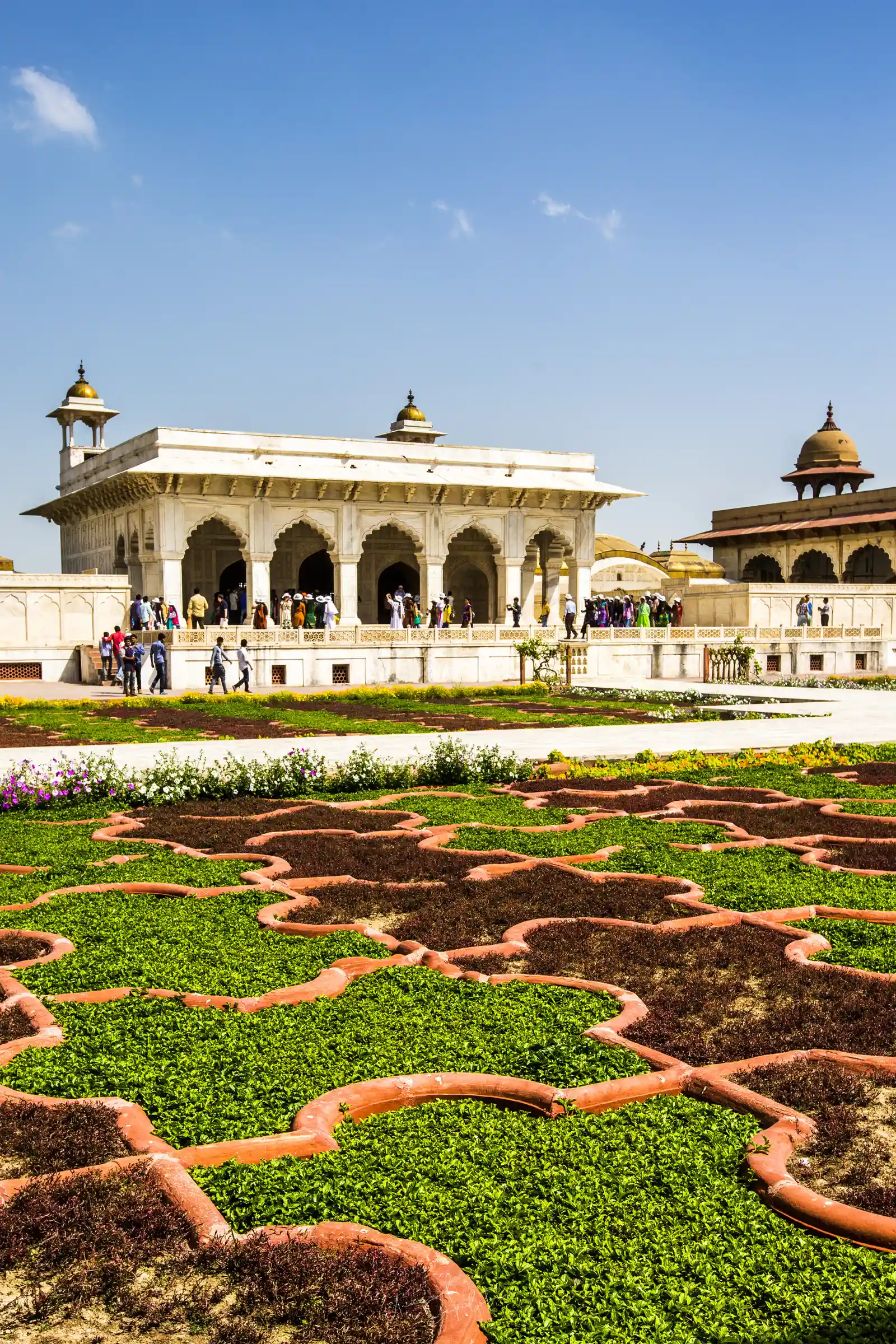
The Khas Mahal is Shah Jahan's white marble pavilion near the river, flanked by two smaller pavilions with curved roofs. In front of it lies a sunken garden court laid out in geometric beds, which from the terrace above becomes a pattern of red paths and green squares. A portrait frame from the terrace edge holds both the marble and the pattern. Nearby, the Sheesh Mahal is known for its mirrored interior, though access to it varies, so ask on site before you plan around it.
Taj Mahal view from Agra Fort
The Taj Mahal view from Agra Fort is the picture many visitors come for. The Agra district site says the Musamman Burj, the octagonal tower where Shah Jahan spent his last years, gives a memorable riverside view of the Taj. The fort lies upstream to the west of the Taj, so you look downstream across the bend of the Yamuna, and the carved marble screens and window frames of the riverside pavilions make natural frames. In the afternoon the sun is behind you and lights the side of the Taj facing the fort; in the early morning the sun rises beyond the Taj, which then reads as a silhouette in haze. A 70-200mm brings the dome close; a 24-70mm holds the window frame and the distant Taj together.
"At the fort I look for the Taj through the stone, not over it. Put a carved window or an archway between you and the dome and you tell the story of Shah Jahan looking out at his wife's tomb, without a word of caption."
Joseph Mak, tour leader, Unusual Expedition
Is Agra Fort open on Friday?
Yes. The Agra district site lists Agra Fort as open from sunrise to sunset on all seven days. That makes it the best use of a Friday in Agra, when the Taj Mahal is closed. A good Friday plan is the fort in the afternoon, when the light suits the river view, and Mehtab Bagh across the Yamuna for sunset, which the same district site lists as open on all days. Our Taj Mahal sunrise and sunset guide covers the far bank.
Where to stand and when
| Place in the fort | Subject | Best light | Lens |
|---|---|---|---|
| Lawn in front of the Jahangir palace | The sandstone facade | Morning or light cloud | 16-35mm |
| Diwan-i-Am | Colonnade, garden in bloom | Late afternoon | 16-35mm, 24-70mm |
| Khas Mahal terrace | Marble pavilions, geometric garden | Soft light, either end of the day | 24-70mm |
| Musamman Burj and riverside pavilions | The Taj across the Yamuna | Afternoon, sun behind you | 70-200mm, 24-70mm |
| Courtyards and passages | Doorways, carving, texture | Any time, open shade | 24-70mm |
If you have only one visit, make it the afternoon and end at the riverside pavilions.
Practical notes for photographers
Agra Fort has fewer restrictions than the Taj in practice, but treat it as the protected monument it is: no climbing on walls or railings, no touching the inlay, and respect any area that is roped off or guarded. Drones are not an option at Agra's monuments; see Taj Mahal rules for photographers. Carry water and wear shoes with grip, because the sandstone ramps are worn smooth. The fort pairs well with a slower look at the city in our is Agra worth visiting article.
Photograph Agra Fort and the Taj with us
We run Agra as a private trip on request, with the fort, the Taj and the far bank of the Yamuna planned around the light and the Friday closure. We arrange all the logistics, and coaching can be added at extra cost. See private tours and our India photography tours page.
Agra photography tours
The next Agra departure is announced on the Agra photography tours page, with previous expeditions and all the planning guides.
Explore Agra in depth
- Agra Photography Tour Guide: the Taj Mahal, Agra Fort and the YamunaIndia
- Taj Mahal Sunrise and Sunset: Where to Be and Which Way the Light FallsIndia
- Taj Mahal Rules for Photographers: Tripods, Drones and the MausoleumIndia
- Taj Mahal Photography: Where to Stand, the Light and Photo IdeasIndia
- Is Agra Worth Visiting? What to See Beyond the Taj MahalIndia
- Best Time to Visit Taj Mahal: the Month, the Day and the HourIndia
Upcoming Photo Tours
- Egypt Photo Tour – EgyptEgypt 12 Dec 2026 To 20 Dec 2026
- Inner Mongolia Winter Owl Photo Tour – ChinaChina 01 Jan 2027 To 04 Jan 2027
- Inner Mongolia Winter Photo Tour – ChinaChina 05 Jan 2027 To 11 Jan 2027
- Mekong And Central Highland Vietnam Photo Tour - VietnamVietnam 16 Jan 2027 To 24 Jan 2027