
Taj Mahal Photography: Where to Stand, the Light and Photo Ideas
Taj Mahal photography: where to stand in the complex, which side the light falls on, lenses without a tripod and photo ideas.
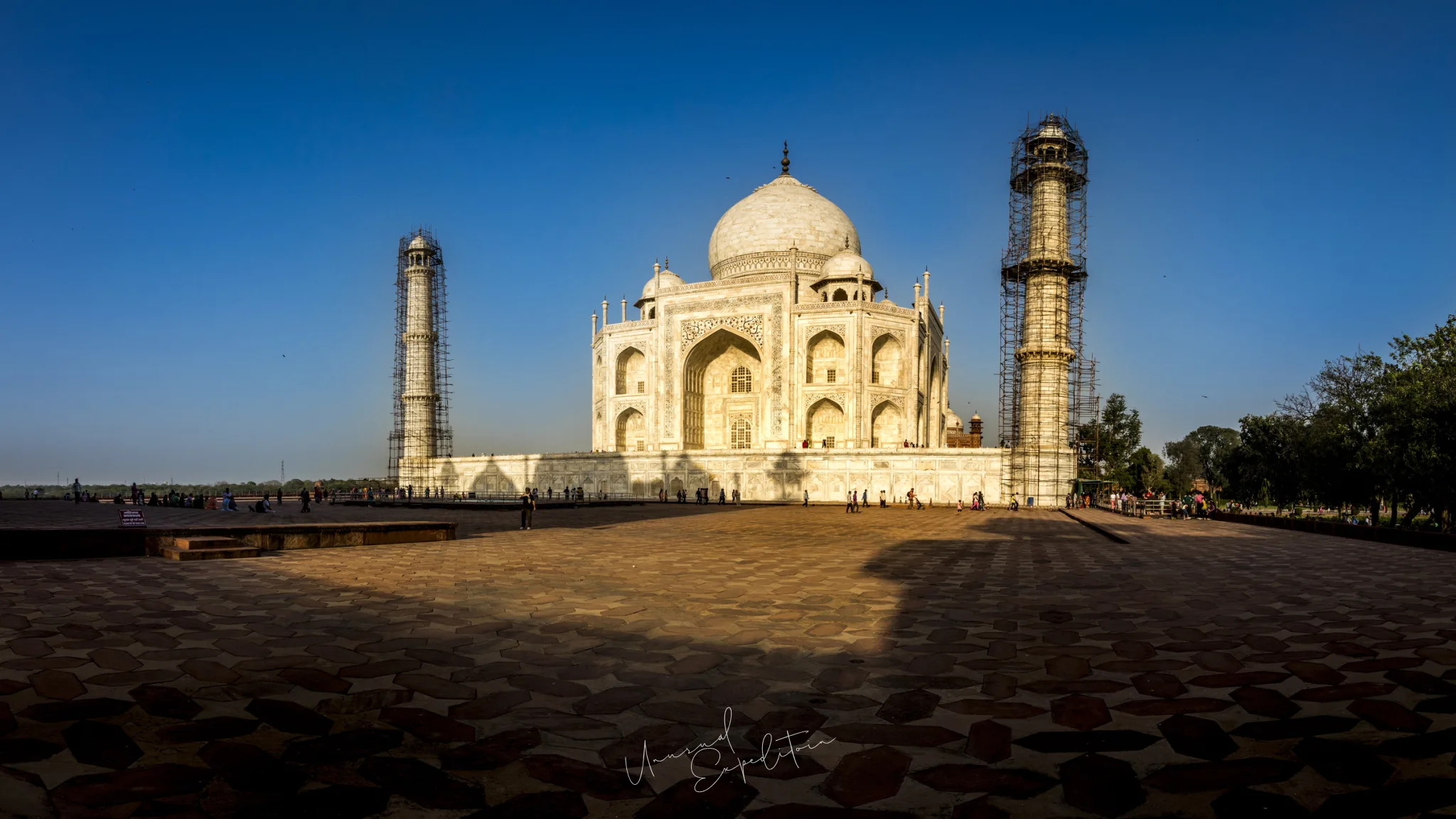
Taj Mahal photography works best when you know the plan of the complex before you arrive. The mausoleum stands at the north end of a long walled garden, facing south, with a red sandstone mosque on its west side and a matching guest hall on its east. That layout tells you where the light falls at each hour: the east face in the morning, the west face in the late afternoon, and the river face only from across the Yamuna. Stand in four or five places, not one.
This piece belongs to our Agra photography tour guide. The photographs in it are our own, taken on our trips to Agra; we hold the rights to them, and the notes come from knowing the complex first hand.
How the Taj Mahal complex is laid out
The official Taj Mahal site, published by the Department of Tourism of the Government of Uttar Pradesh, explains the plan in detail. Visitors enter through the east or west gate into a ceremonial forecourt. From there the great gate, set in the centre of the garden's southern wall, leads into a square Mughal garden divided into four quarters by raised walkways and water channels, with a marble platform and pool at the crossing. At the far end the mausoleum rises from its platform with a minaret at each corner, and beyond it a long red sandstone terrace drops to the river. The mosque sits on the west of that terrace, and the guest hall, built only to balance it, on the east. Every good viewpoint in the complex is one of these structures, or the space between two of them.
The great gate and the first view
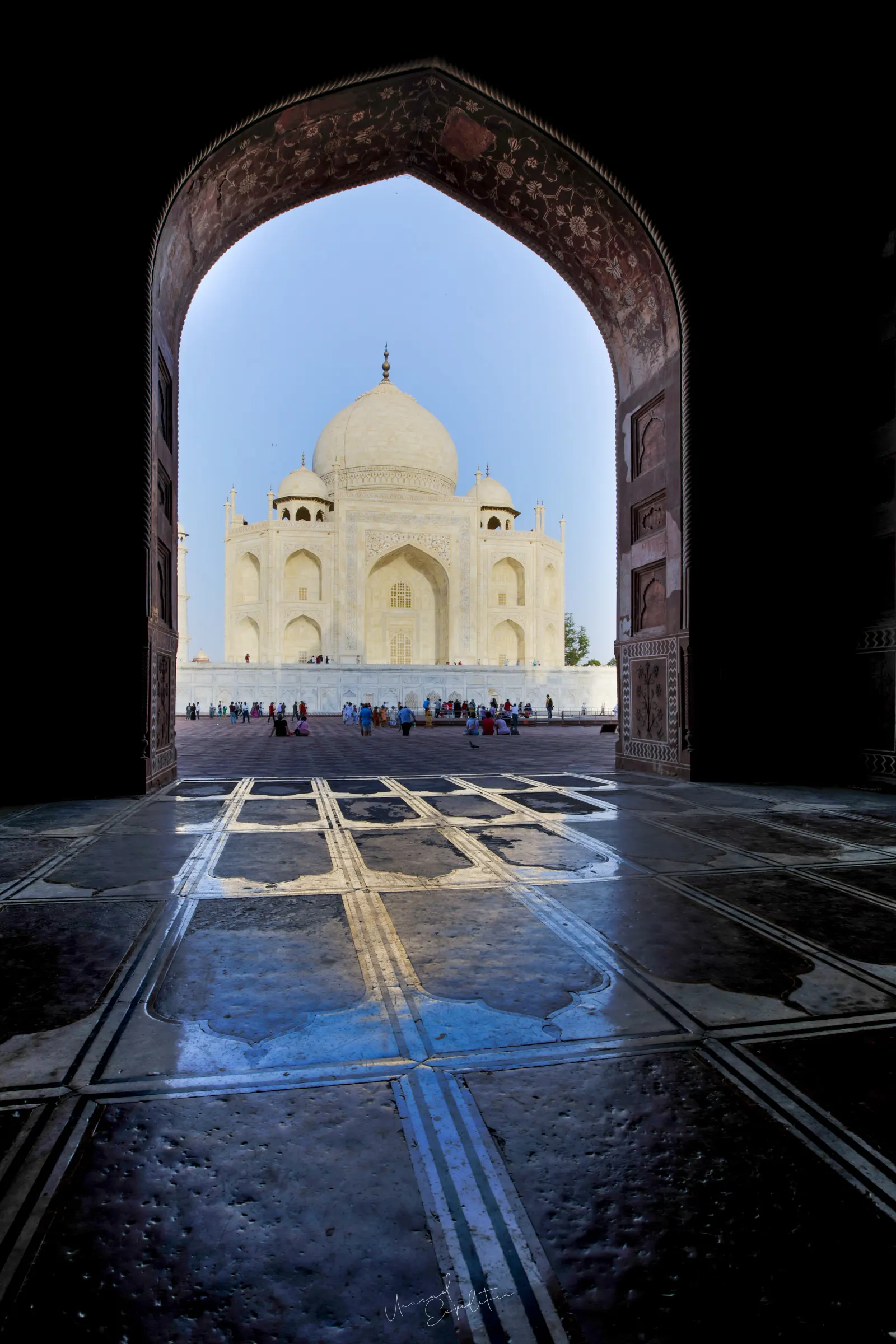
The first view of the Taj Mahal is through the great gate, and it is still one of the best. From the dark interior of the gate the mausoleum appears small and bright inside a pointed arch, and the arch does all the framing for you. Expose for the marble and let the gate go black. A 16-35mm or the wide end of a 24-70mm holds the whole arch; step back until the arch is symmetrical. The gate itself repays a look: the official site quotes the calligraphy above its arch, "O Soul, thou art at rest. Return to the Lord at peace with Him, and He at peace with you."
The central channel and the reflection
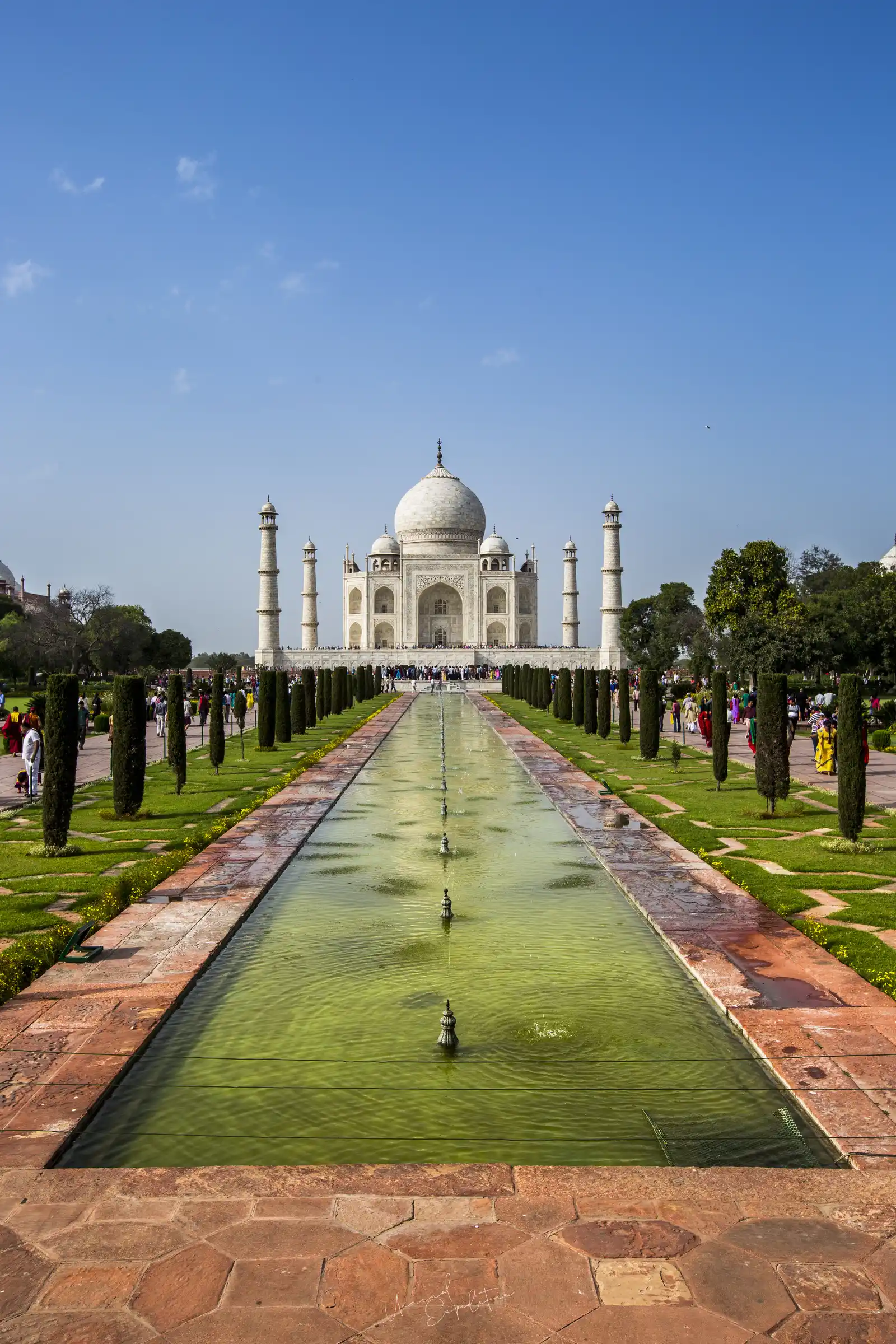
The classic Taj Mahal view runs straight down the central water channel, with rows of cypress on each side and the mausoleum closing the line. It is the picture everyone knows, and it is worth making properly: get low over the edge of the channel, keep the minarets vertical, and wait for still water between the fountains. A portrait frame suits the long perspective. The marble platform at the centre of the garden, with its benches, is where the crowd gathers, so arrive at opening time and walk straight there before anything else if this is the shot you want.
The mosque and guest hall platforms
The two red sandstone buildings beside the Taj Mahal give the views most visitors miss. From the platform of the mosque on the west side, the mausoleum stands at an angle with its minarets staggered, and in the late afternoon the sun behind you lights the west face and warms the sandstone underfoot. In the morning the guest hall on the east side does the same job, with the sun over your shoulder on the east face. Inside the arcades of both buildings, the pointed arches frame slices of white marble against red stone. Remember that the mosque is a place of worship; take your shoes off where asked and keep your voice down.
Where the light falls through the day
| Position | You face | Best light | Lens |
|---|---|---|---|
| Inside the great gate | North, along the axis | Opening time, soft side light from the east | 16-35mm, 24-70mm |
| Central channel | North | Early morning, before the crowd | 16-35mm, 24-70mm |
| Guest hall platform | West, towards the mausoleum | Morning, sun behind you | 24-70mm |
| Mosque platform | East, towards the mausoleum | Late afternoon, sun behind you | 24-70mm |
| Mehtab Bagh, across the river | South, the back of the Taj | Sunset | 70-200mm |
Read the table as a route: gate and channel first, guest hall while the morning light lasts, mosque at the end of the afternoon.
Taj Mahal photo ideas beyond the postcard
Once the classic frames are done, the Taj Mahal is a place for details and people. A few ideas that have worked for us:
- Visitors in bright saris walking beside the channel, with the Taj soft in the background at a wide aperture.
- Light from the carved stone screens, the jali, falling across sandstone floors and vaults.
- The inlaid flowers and calligraphy on the marble, with a 70-200mm from a respectful distance.
- The garden trees as a dark foreground, with the dome rising above them.
- A minaret alone against a blue sky, cut away from the rest of the building.
Photograph people as part of the place, not as props, and ask before you take a close portrait. Many Indian visitors will ask to photograph you as well.
"Without a tripod the Taj teaches you to look. I tell people to stop chasing the one perfect frame from the centre bench and to walk the side paths slowly. The building changes every few steps, and the light on the marble changes every few minutes."
Joseph Mak, tour leader, Unusual Expedition
Taj Mahal photos of the back side, from the river
The north face of the Taj Mahal, the side towards the Yamuna, cannot be photographed well from inside the complex. For that you cross the river to Mehtab Bagh, the Mughal garden aligned with the mausoleum on the far bank, or to the viewpoint beside it. The Agra district administration describes Mehtab Bagh as the finest vantage point for viewing and photographing the Taj, especially at sunset, and lists it as open from sunrise to sunset on all days. A 70-200mm is the lens there. Our Taj Mahal sunrise and sunset guide covers the far bank in detail.
Taj Mahal photography without a tripod: what to carry
The official rules for the Taj Mahal prohibit tripods and drones, and photography is not allowed inside the main mausoleum; our Taj Mahal rules for photographers lists them all. Plan for handheld work. A 24-70mm covers most of the complex, a 16-35mm handles the gate arch and the interiors of the side buildings, and a 70-200mm picks out details and visitors. A camera with good stabilisation and clean high ISO matters more than any single lens, especially in the dark gate and arcades. Bring a polarising filter: it tames the glare off white marble and deepens a hazy sky. Keep the bag small, because large bags slow the security check, and leave chargers and spare electrical items behind, since the official list bans them.
Timing your visit
The Taj Mahal opens 30 minutes before sunrise and closes 30 minutes before sunset, and it is closed on Fridays, according to the official visiting hours. The first hour is the most valuable: soft light, fewer people, still water in the channel. Midday light is flat and hard on the marble, a good time for the mosque arcades and the garden shade. See the best time to visit Taj Mahal article for months, fog and crowds.
Photograph the Taj Mahal with us
We run Agra as a private trip on request, so you can come back to the Taj on a second morning if the first one is grey. We arrange the logistics around what you want to photograph, and a photographer or photography coaching can be added at extra cost. See private tours and our India photography tours page.
Ask us about photographing the Taj Mahal
Agra photography tours
The next Agra departure is announced on the Agra photography tours page, with previous expeditions and all the planning guides.
Explore Agra in depth
- Agra Photography Tour Guide: the Taj Mahal, Agra Fort and the YamunaIndia
- Taj Mahal Sunrise and Sunset: Where to Be and Which Way the Light FallsIndia
- Taj Mahal Rules for Photographers: Tripods, Drones and the MausoleumIndia
- Is Agra Worth Visiting? What to See Beyond the Taj MahalIndia
- Best Time to Visit Taj Mahal: the Month, the Day and the HourIndia
- Agra Fort Photos: What to Photograph Inside the Red Fort of AgraIndia
Upcoming Photo Tours
- Egypt Photo Tour – EgyptEgypt 12 Dec 2026 To 20 Dec 2026
- Inner Mongolia Winter Owl Photo Tour – ChinaChina 01 Jan 2027 To 04 Jan 2027
- Inner Mongolia Winter Photo Tour – ChinaChina 05 Jan 2027 To 11 Jan 2027
- Mekong And Central Highland Vietnam Photo Tour - VietnamVietnam 16 Jan 2027 To 24 Jan 2027