
Amber Fort Jaipur and the Hawa Mahal: Where to Stand and When
Amber Fort Jaipur and the Hawa Mahal for photographers: the lake view, the elephant ramp, the Hawa Mahal front view and the best time.
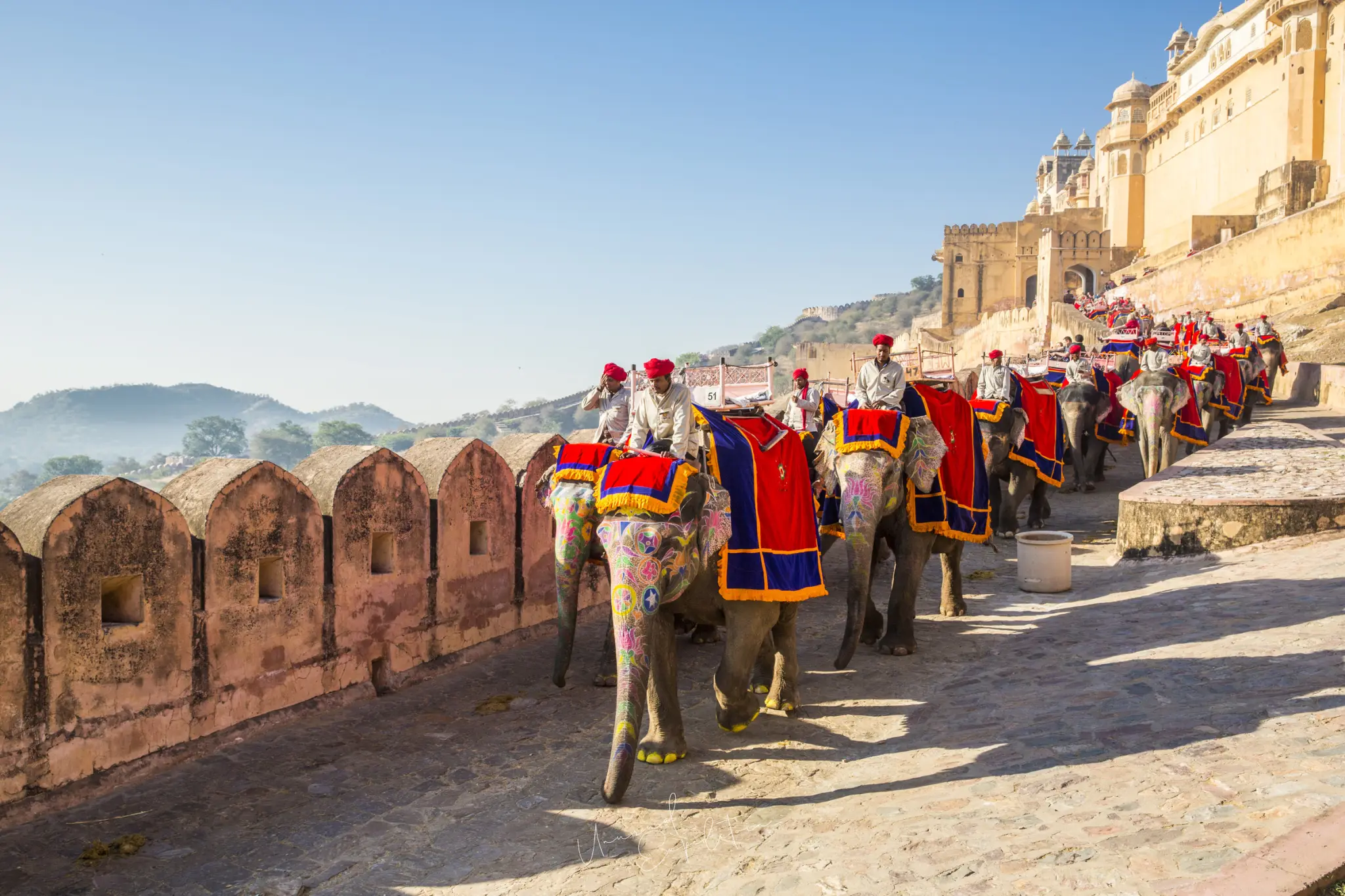
Amber Fort, Jaipur, is best photographed twice: first from the road across Maota Lake in the early morning, when the fort's long yellow walls and their reflection fill the frame, and then up close on the ramp and in the courtyards while the light is still low. The Hawa Mahal, the Palace of the Winds in Jaipur's old city, is a morning subject too: its pink latticed front takes the early sun and is best seen from across the street.
Both sit in the Jaipur part of our Rajasthan photography tour guide, which covers the state as a whole. Both are morning subjects, both draw crowds, and Amber has the elephants to think about.
Amber Fort or Amer Fort?
Amber Fort and Amer Fort are the same place: Amer is the name of the old town below it, and both spellings are in daily use, on signs and in tickets. The fort was the seat of the Kachhwaha rulers before they built Jaipur on the plain. Raja Man Singh began the present palace in the late sixteenth century in red sandstone and marble, and his successors added the courtyards and halls. In 2013 UNESCO inscribed Amber with five other forts as the World Heritage site "Hill Forts of Rajasthan". Wikipedia's account of the fort notes that Maota Lake below it was the palace's main water supply, which is why the fort and its reflection belong together in a picture.
Amber Fort Jaipur: where to stand
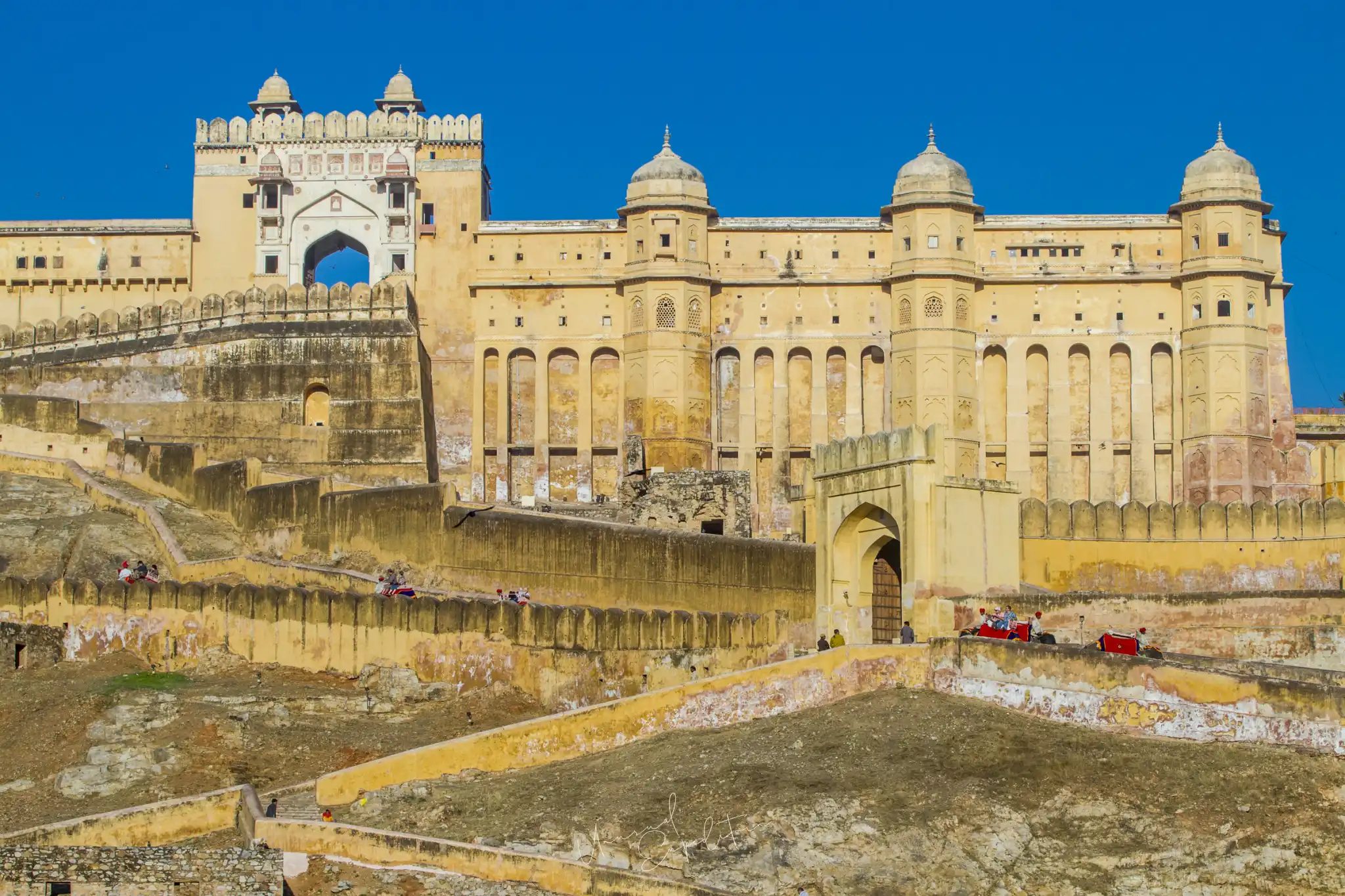
Amber Fort Jaipur rewards three positions. The first is the lakeside road below the fort, looking across Maota Lake. On a still morning the water is flat and the whole length of the fort is doubled in it; this is the classic view and the reason to arrive early. The second is the ramp that climbs from the lake to the Suraj Pol, the Sun Gate, where the crenellated wall gives you strong lines leading up to the fort. The third is inside: Jaleb Chowk, the first great courtyard, where the soldiers once paraded, and the palace courtyards above it, with their arches and mirrored rooms. Below the fort, the walls running up the hill make a good frame from the road on the way in.
Amber Fort photos: light and lenses
Amber is a morning subject. Our lake and facade frames were made in the early morning sun, and Wikipedia's account of the fort notes that its main entrance, the Sun Gate, faces east. The lake view needs the low early sun and no wind, so it is gone by mid morning, when the light turns hard on the yellow stone and the sky goes pale. A 24-70mm covers the lake view and the courtyards; a 70-200mm lets you pick out the elephants on the ramp or a single window from below. Inside the palace, the light is dim in the halls and bright in the courtyards, so expose for the stone and let the shadows go. Tripods may be questioned at monuments in India: carry a small one and ask before you set it up.
| Spot | Best light | Lens | What you get |
|---|---|---|---|
| Maota Lake road | Early morning, still air | 24-70mm | The fort reflected whole |
| The ramp to the Sun Gate | Early to mid morning | 70-200mm | Walls, elephants, mahouts |
| Jaleb Chowk and the palace | Morning, side light | 16-35mm or 24-70mm | Arches, courtyards, details |
| Hawa Mahal from the street | Early morning | 24-70mm | The facade, with or without traffic |
Everything on this list is a morning subject, so a single early start covers most of it.
Amber Fort elephant rides: photograph or ride?
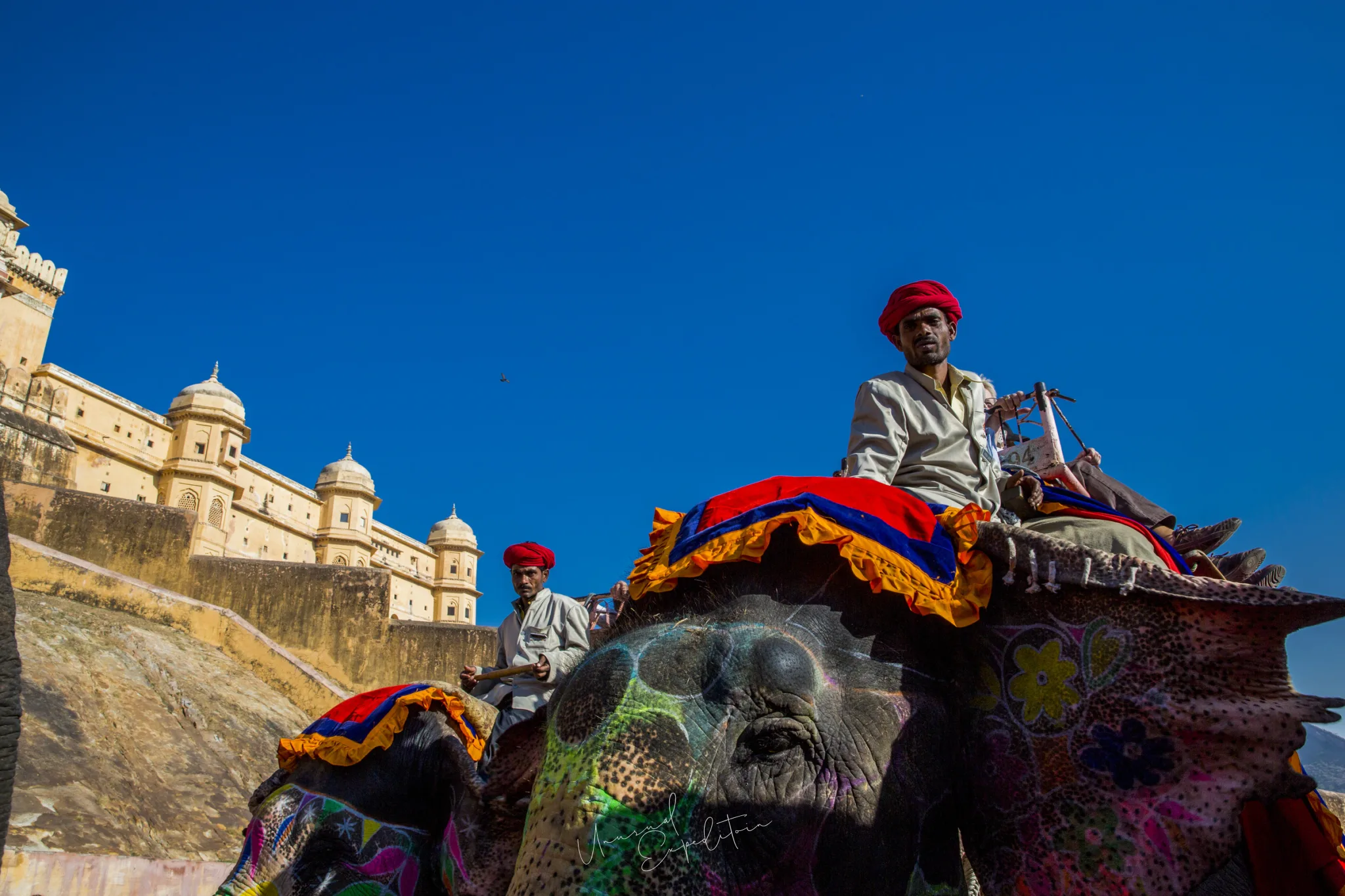
Painted elephants still carry visitors up the ramp to the Sun Gate, and on a busy morning they make one of the most colourful sights in Jaipur. The rides are also one of the most debated. Welfare groups, PETA India among them, have campaigned for years to end them, and Wikipedia's account of the fort records the criticism and the switch some operators have made to jeeps. ThePrint has reported that the number of riders has fallen sharply in recent years. We do not ride and do not book the rides. We photograph the elephants and their mahouts from the side of the ramp, where you can work without being in anyone's way, and the mahouts are mostly happy to be photographed once you have greeted them.
Hawa Mahal Jaipur: the front view
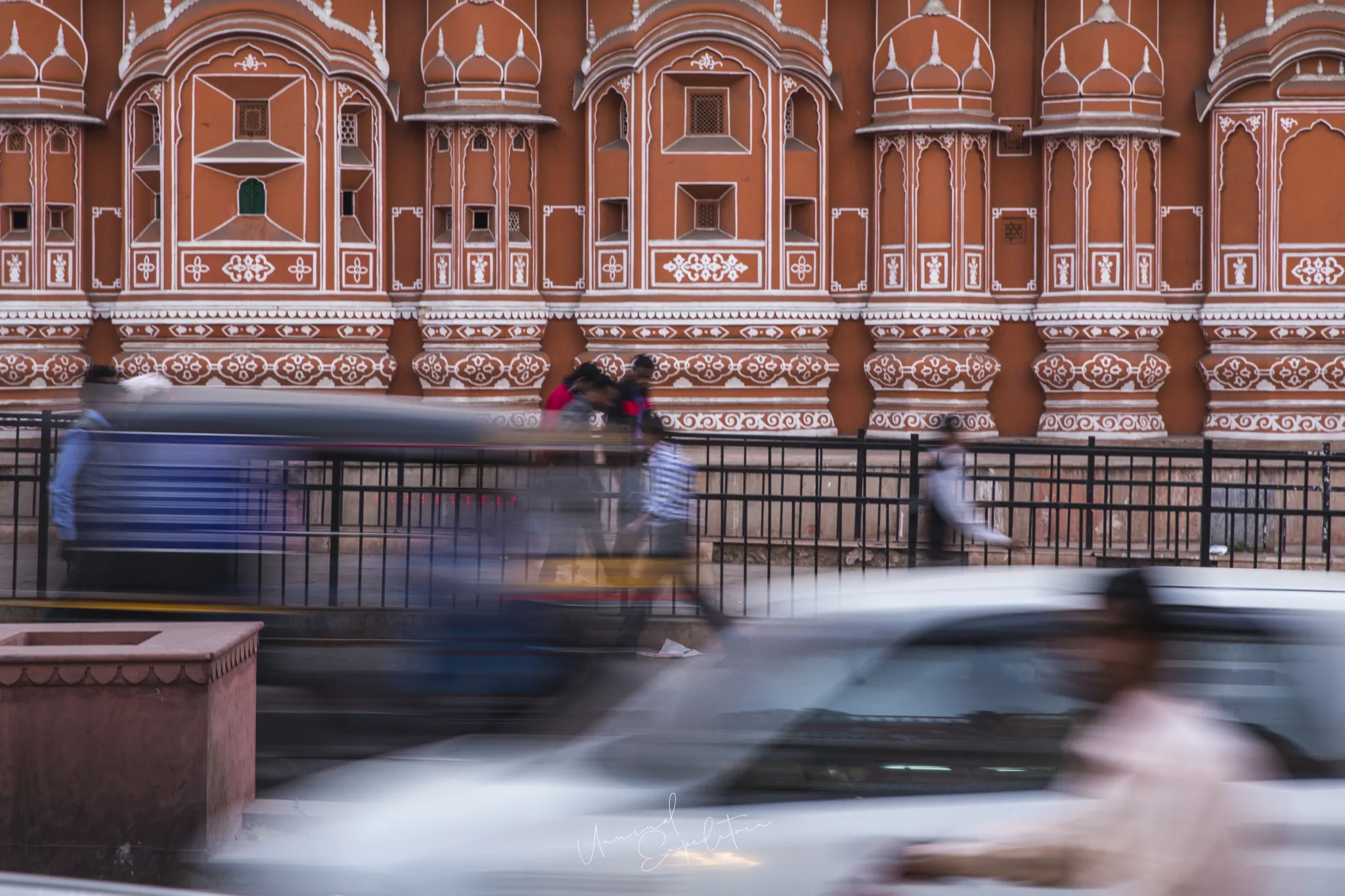
The Hawa Mahal, Jaipur's Palace of the Winds, is a screen more than a palace. Incredible India, the Government of India's tourism site, dates it to 1799 and to Maharaja Sawai Pratap Singh; it was built as an extension of the City Palace's women's quarters, and its 953 small latticed windows let the women of the court watch the street below without being seen. The building is only a few rooms deep behind that famous face, which is why the front view is the picture. Stand on the far side of the road, across the traffic, and use the pink and white pattern as a backdrop. A slow shutter turns the cars, rickshaws and buses into streaks of colour against the stillness of the facade, and a faster one catches a single figure walking under it.
Best time to visit Hawa Mahal
The best time to visit the Hawa Mahal is early morning. The facade takes the first sun, the street is still quiet enough to set up, and the pink stone glows before the light turns flat. By late morning the road is full and the facade is in harder light. If you want to go inside, check the official opening hours and ticket arrangements before you go; the view out of the latticed windows onto the street is worth seeing, though the outside is the picture. For the wider season, with the months to choose and the festivals, see our best time to visit Rajasthan guide.
"At Amber I tell people to be on the lake road before anything else. A short spell of flat water gives you the picture everyone wants, and after that you can spend the rest of the morning on the ramp with the mahouts, which is where the real pictures are."
Joseph Mak, tour leader, Unusual Expedition
Jaipur photography beyond the fort
Jaipur photography does not stop at these two. The walled city, inscribed by UNESCO as a World Heritage city, is laid out on a grid of bazaars, and its arcades of pink shops are a fine place for street pictures in the morning, before the crowds. The City Palace and the Jantar Mantar observatory sit inside the walls, and the hill forts of Jaigarh and Nahargarh look down on the city. Jaipur is a big, busy city, though, and the old towns of Jodhpur and Udaipur feel more intimate for street photography; our Jodhpur blue city guide shows the difference.
Practical notes for Amber Fort and the Hawa Mahal
Both monuments are ticketed; check the official source before you travel for current prices and hours, because they change. Arrive at Amber early to beat the tour buses, wear shoes you can climb in, and carry water. Guides at the gate will offer their services; agree a price first if you want one. Dress modestly for the palace, as you would for any Indian monument, and keep your camera bag small enough to carry through crowded doorways.
Photograph Jaipur with us
We include Jaipur and Amber in private Rajasthan trips on request, built around the mornings that matter, with all arrangements made for you; a photographer or photography coaching can be added at extra cost. See private tours and our India photography tours page.
Ask us about Jaipur and Amber Fort
Rajasthan photography tours
The next Rajasthan departure is announced on the Rajasthan photography tours page, with previous expeditions and all the planning guides.
Explore Rajasthan in depth
- Rajasthan Photography Tour Guide: Jaipur, Jodhpur, Udaipur and JaisalmerIndia
- Udaipur Photography: Lake Pichola, the City Palace and the Old TownIndia
- Ranakpur Jain Temple: Marble, Light and the Villages of the Aravalli HillsIndia
- Mehrangarh Fort, Jodhpur: Sunset from the Walls and Jaswant ThadaIndia
- Jodhpur Blue City: the Lanes, the People and Why the Houses Are BlueIndia
- Jaisalmer Photography: the Golden Fort, the Havelis and Bada BaghIndia
- Best Time to Visit Rajasthan: Months, Light and FestivalsIndia
Upcoming Photo Tours
- Egypt Photo Tour – EgyptEgypt 12 Dec 2026 To 20 Dec 2026
- Inner Mongolia Winter Owl Photo Tour – ChinaChina 01 Jan 2027 To 04 Jan 2027
- Inner Mongolia Winter Photo Tour – ChinaChina 05 Jan 2027 To 11 Jan 2027
- Mekong And Central Highland Vietnam Photo Tour - VietnamVietnam 16 Jan 2027 To 24 Jan 2027