
Belo sur Mer and the Dhow Builders of the Vezo Coast
Photographing Belo sur Mer: hand-built dhows, Vezo fishermen, the lagoon and salt pans, getting there and working with people.
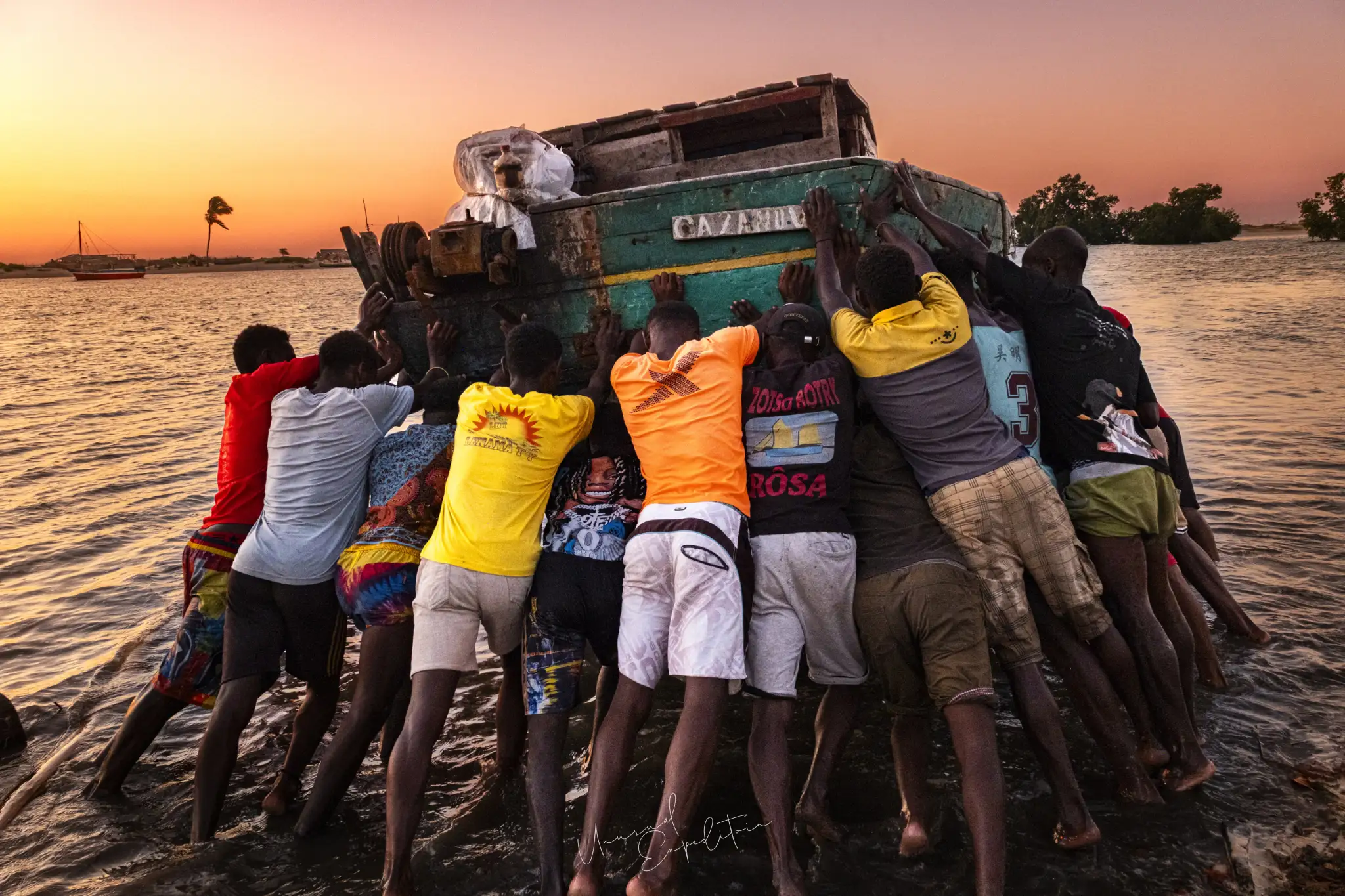
Belo sur Mer is a Vezo fishing village of a few thousand people on Madagascar's west coast, about 80 kilometres south of Morondava, where wooden sailing dhows are still built by hand on the beach the way they were a century ago. It is the people chapter of our April tour and, for many guests, the pictures they end up printing. Getting there, what the dhow yards and the beach give a photographer, how to work with the people who live there, and the Vezo village of Betania on the way back, in that order.
It belongs to the complete Madagascar photography tour guide.
Getting to Belo sur Mer
There is no paved road. From Morondava it is three to five hours in a 4x4 along sand tracks and, at low tide, the beach itself, through dry forest and past salt pans and the odd baobab. In the wet season the route closes; by April it is open, which is one of the reasons the tour runs then, as The best time for a Madagascar photography trip explains. The drive is part of the photography: zebu carts, villages of palm-thatch houses, children who run alongside. We stop. Day 2 of the itinerary is the flight from Tana to Morondava and this drive, arriving at Belo sur Mer mid afternoon.
Who the Vezo are
The Vezo are the fishing people of Madagascar's south-west coast, a few hundred kilometres of it from Morondava south to Toliara. The name means something like "those who paddle". They live from the sea in outrigger pirogues and sailing dhows, move with the fish along the coast, and build their own boats, which is the skill that makes Belo sur Mer what it is. Their villages are on the sand, their houses are palm and plank, and children learn to handle a pirogue before they can read. Photographing them well means understanding that the boats are not a craft display; they are the economy.
The dhow yards
The Vezo build boutres, wooden cargo and fishing dhows up to twenty metres long, on the sand above the tide line, from hand-sawn planks on a frame of local hardwood, with no plans and no power tools. A hull takes months. At any time there are several at different stages: a bare keel, a ribbed skeleton, a planked hull being caulked, a finished boat waiting for a spring tide. The yards are open and the builders are used to visitors from the handful of lodges in the village. Work starts early, pauses in the midday heat and resumes after 15:00, so the light and the activity line up at both ends of the day.

What to photograph there
The hulls themselves, from inside, where the ribs make a cathedral of curved wood. Hands on tools: adzes, hand drills, caulking irons. The builders working in pairs, one inside and one out. Children sitting in a half-built boat. The finished dhows at anchor in the lagoon with their lateen sails furled, and, if the tide and wind allow, under sail. The beach at the end of the day, when the pirogues come in and the whole village meets them. A 24-70mm does most of this; the wide zoom gets inside the hulls; the long zoom picks out faces from a respectful distance. The light is bright and bounces off sand and water, so faces are evenly lit even at noon, and a polariser deepens the lagoon.
"The dhow yard is the one place on the trip where I tell people to put the long lens away. Walk up, shake hands, show interest in the boat. The builders are proud of the work and they will show you. The pictures from a metre away are the ones that matter."
Joseph Mak, tour leader, Unusual Expedition
Photographing people in a Vezo village
Ask first, every time, with a gesture if nothing else; the local guide translates. Accept a no. Children will ask to be photographed and then to see the screen; show them. Do not pay for photographs, which sours it for the next group, but do buy fish, a drink or a carved model dhow in the village, which is how visitors are supposed to leave money. Take the time to be there without a camera for the first half hour. The pictures that come after that are different, because people have stopped performing.
The lagoon and the salt pans
Belo sur Mer sits on a lagoon behind a sand bar, with mangroves to the south and salt pans inland where sea water is evaporated in shallow rectangles. The pans are graphic from a low angle in late light, white and pink grids with workers in them. The lagoon at dawn is flat and still, with the dhows reflected. Both are within walking distance of the lodge.
Betania: the other Vezo village
On the morning of Day 4, after the dawn session at the Avenue of the Baobabs, we cross to Betania, the Vezo village on the spit opposite Morondava. It is busier and closer than Belo sur Mer: a beach full of pirogues, dugout canoes with outriggers, being launched and hauled through the shallows, women sorting the catch, children everywhere. The light is already high by the time we arrive, so this is a session for action and colour, not mood. The two villages together give the full picture of the coast, and the Avenue, which sits between them on the map, is covered in Photographing the Avenue of the Baobabs.
Practicalities
The lodge at Belo sur Mer has bungalows, a generator for part of the evening and good fish, and that is about it. Charge everything while the generator runs. The heat is dry and reaches the low thirties; carry water on the walks. Sand gets into everything, so a cloth and a blower before every lens change. The road out the next morning takes the same three to five hours. For the city at the other end of the flight, read Antananarivo street photography.
Come and meet the builders
Belo sur Mer is Day 2 and the morning of Day 3 of the Madagascar Photo Tour, 11 to 19 April 2027. If people are what you photograph, it is the reason to come.
Join the Madagascar photography tour
Madagascar Photo Tour – Madagascar departs 11 Apr 2027 To 19 Apr 2027, led by Joseph Mak. Small group, photography first. All Madagascar photography tours.
Explore Madagascar in depth
- The Complete Guide to a Madagascar Photography TourMadagascar
- What to Pack for a Madagascar Photo TourMadagascar
- The Milky Way over the Baobabs: Night Photography in MadagascarMadagascar
- Madagascar Tour from Singapore: Flights, Visa and What to ExpectMadagascar
- Is Madagascar Safe? Health, Roads and Drones for PhotographersMadagascar
- What a Madagascar Photo Tour Costs, Line by LineMadagascar
- Twelve Questions Before You Book a Madagascar Photo TourMadagascar
- Madagascar or an African Safari for Wildlife Photography?Madagascar
- Madagascar Light and Weather, Region by RegionMadagascar
- Is Madagascar Worth Visiting for a Photographer? A Straight AnswerMadagascar
- Lemur Photography at Andasibe and BeyondMadagascar
- The Best Time to Visit Madagascar for PhotographyMadagascar
Upcoming Photo Tours
- Egypt Photo Tour – EgyptEgypt 12 Dec 2026 To 20 Dec 2026
- Inner Mongolia Winter Owl Photo Tour – ChinaChina 01 Jan 2027 To 04 Jan 2027
- Inner Mongolia Winter Photo Tour – ChinaChina 05 Jan 2027 To 11 Jan 2027
- Mekong And Central Highland Vietnam Photo Tour - VietnamVietnam 16 Jan 2027 To 24 Jan 2027