
Camera Gear for Day of the Dead Photography in Mexico
Camera gear for Day of the Dead photography: lenses for the parade, candlelit cemeteries and butterfly fishermen, real settings, kit table.
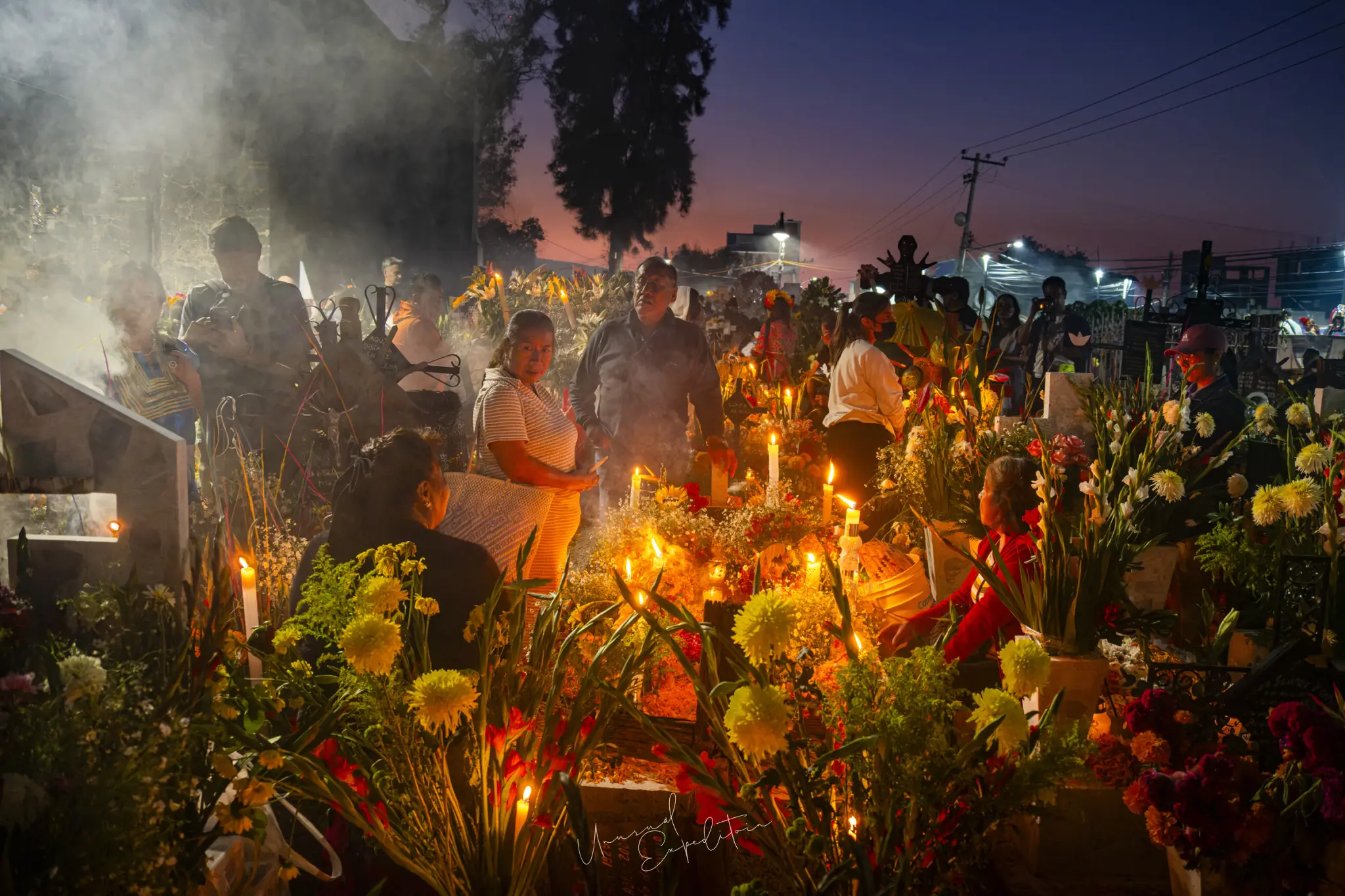
Camera gear for Day of the Dead photography in Mexico has to cover four very different situations in ten days: a four-hour parade behind barriers in hard sun, candlelit cemeteries after dark, fishermen on a lake from a moving boat, and the painted interiors and high facades of colonial churches. The kit that did it on our 2026 Mexico festival of the dead photography tour was two bodies, an 18-135mm or 24-70mm plus 70-200mm, a 10-24mm, an 18mm f/1.4 and a travel tripod, and this article explains why, with the settings from the actual frames.
What lenses do you need for the Day of the Dead parade?
A 70-200mm, or a long travel zoom such as an 18-135mm, on one body and a 24-70mm on the other. The Catrinas on Reforma come to the barrier, so 70mm to 135mm fills the frame with a figure and 200mm isolates a face under a hat. Our parade frames ran 1/320 to 1/480 of a second, f/5.6 to f/8, ISO 400 to 800 over the three hours it took to pass. The 24-70mm handles the floats and the crowd. Nothing wider is needed at the barrier, and a 100-400mm is too much weight for a four-hour stand.
What do you need for candlelight in the cemetery?
A fast lens and a steady hand. At Mixquic on 2 November the light is candles, a few floodlights and the last of the dusk, and the settings on our frames from dusk into the night were ISO 1800 to 5000, f/4 to f/5.6, 1/25 to 1/125 of a second on the 18-135mm, and ISO 1800, f/1.4, 1/80 to 1/200 on an 18mm prime at the night market. No flash, ever: it is forbidden by courtesy and it kills the picture. In-body stabilisation gets you to 1/25 of a second hand-held at wide angles. A monopod is useful, a tripod among the graves is not.

Which lens for the butterfly fishermen on Lake Pátzcuaro?
The long end. From the boat the fishermen are 20 to 60 metres away and the nets rise for a second or two, so 100mm to 135mm on a crop body, or 200mm to 400mm on full frame, at 1/400 of a second or faster. Our frames are all 1/400 at f/8, ISO 180 to 400, under a hard early-afternoon sky. Shoot in bursts as the net goes up and keep the horizon level, which is harder than it sounds on a moving boat.
What wide lens for churches and the Zócalo?
A 10-24mm on a crop body or a 16-35mm on full frame. The Capilla del Rosario in Puebla, the Morelia cloister and the Cholula stairway all need 10mm to 16mm, and the rooftop view of the Zócalo mega-ofrenda was 10mm at 1/20 of a second, ISO 1000, f/4, on a tripod. Keep the camera level and correct verticals later; tilting a 10mm lens at a facade produces a church falling backwards.
Do you need a tripod?
For three pictures, yes: Calle Aldama at blue hour in San Miguel de Allende (6.5 seconds at ISO 400), the Zócalo rooftop, and the Cholula fairground at dusk. A travel tripod under 1.5 kilograms is enough. Everywhere else, including the cemetery, it stays in the bag or the room.
"Mexico is not a long-lens trip. Of the frames I kept, nine in ten were between 18mm and 135mm. Bring the fast prime, bring the wide zoom, and leave the 600mm at home."
Joseph Mak, tour leader, Unusual Expedition
Bodies, batteries and cards
Two bodies, because changing lenses at the parade barrier or in a dark cemetery is where cards get dropped and sensors get dust. Cool nights do little to batteries, but twelve-hour days do; three per body, charged every night. Cards of 128 GB or more: the parade alone produced over a thousand frames per person. A small blower and a microfibre cloth for the dust of the archaeological sites.
Bags, straps and security
A bag that closes, worn in front in crowds. One camera on a cross-body strap, the other in the bag. Nothing branded that announces itself. On the Reforma barrier for four hours you cannot put a bag down, so pack light that day: two bodies, two lenses, water, a hat.
Clothing and the small things
A fleece and a windproof shell for the highland nights, a hat and sunscreen for the parade and the pyramids, shoes with grip for Guanajuato's lanes and Mixquic's uneven ground, a head torch with a red mode for the cemetery, and light cotton for the Yucatán. A printed copy of your passport, the hotel list and the tour leader's number. Mexican plugs are the flat two-pin North American type at 127 volts.
The kit list
| Item | For | Priority |
|---|---|---|
| Two camera bodies | No lens changes at the barrier or in the dark | Essential |
| 24-70mm or 18-135mm | Streets, markets, parade floats, most of the trip | Essential |
| 70-200mm | Parade Catrinas, fishermen, details on facades | Essential |
| Fast wide prime, 18mm to 35mm f/1.4 to f/2 | Night market, cemetery, church interiors | Essential |
| 10-24mm or 16-35mm | Zócalo rooftop, chapels, cloisters, cenote | Strongly recommended |
| Travel tripod | Blue hour streets, Zócalo, Cholula at dusk | Recommended |
| Three batteries per body, 128 GB cards | Twelve-hour days, a thousand frames at the parade | Essential |
| Head torch with red mode | Mixquic cemetery paths | Recommended |
| Fleece, shell, hat, grip shoes | Highland nights, parade sun, cobbles | Essential |
Everything on the list fits in one carry-on camera bag and one small duffel.
What not to bring
A drone, which INAH sites and the festival crowds prohibit in practice; a flash, which you will not use; a 600mm, which you will carry for nothing; and a laptop larger than you need, because the hotel rooms in Guanajuato and Taxco are small and the days are long. The conditions behind this list are in The best time for Day of the Dead photography and the cemetery technique in Mixquic at night.
Bring it with us
The next departure is listed on the Mexico photography tours page. Send us your kit list before you book and we will tell you what to leave behind.
Mexico photography tours
The next Mexico departure is announced on the Mexico photography tours page, with previous expeditions and all the planning guides.
Explore Mexico in depth
- Mexico Festival of the Dead Photography Tour: The Complete GuideMexico
- Mexico Tour from Singapore: Flights, Visa and What to ExpectMexico
- Puebla, Cholula and Taxco for PhotographersMexico
- Guanajuato and San Miguel de Allende at Day of the DeadMexico
- Mexico Day of the Dead Photo Tour: Your Questions AnsweredMexico
- Photographing the Day of the Dead Parade in Mexico CityMexico
- Mexico's Pyramids: Tula, Teotihuacán, Chichén Itzá, Ek Balam and TulumMexico
- Mixquic: Photographing the Day of the Dead Cemetery at NightMexico
- Janitzio and the Butterfly Fishermen of Lake PátzcuaroMexico
- The Best Time for Day of the Dead Photography in MexicoMexico
Upcoming Photo Tours
- Egypt Photo Tour – EgyptEgypt 12 Dec 2026 To 20 Dec 2026
- Inner Mongolia Winter Owl Photo Tour – ChinaChina 01 Jan 2027 To 04 Jan 2027
- Inner Mongolia Winter Photo Tour – ChinaChina 05 Jan 2027 To 11 Jan 2027
- Mekong And Central Highland Vietnam Photo Tour - VietnamVietnam 16 Jan 2027 To 24 Jan 2027