
Mixquic: Photographing the Day of the Dead Cemetery at Night
Mixquic Day of the Dead: La Alumbrada on 2 November, the 1 November night market, candlelight settings without flash, and how to behave.
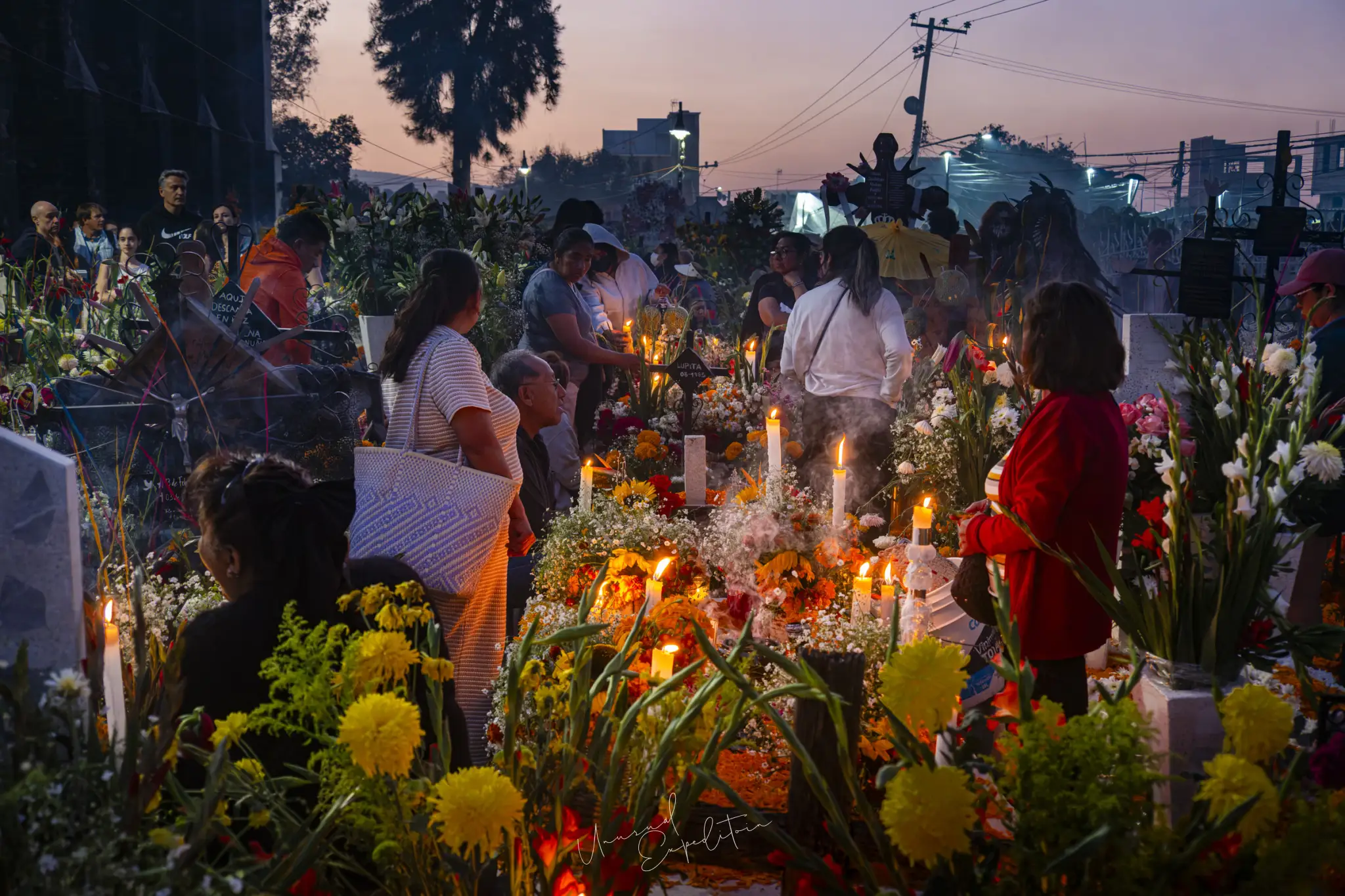
San Andrés Mixquic is a village on the southern edge of Mexico City where, on the night of 2 November, families fill the churchyard cemetery with candles, marigolds and copal smoke and keep vigil beside the graves until morning. It is called La Alumbrada, the lighting, and it is the most intimate Día de Muertos photography within reach of the capital. Our Mexico festival of the dead photography tour spends two nights there: the street night market on 1 November and the cemetery from dusk on 2 November. This is what happens, how we photograph it and how we behave.
Where is Mixquic and why go there instead of Janitzio?
Mixquic sits in the Tláhuac borough, about 35 kilometres and 90 minutes south-east of the Zócalo, beside the canals of Xochimilco. It became famous for its vigil in the 1960s and still receives tens of thousands of visitors over the two nights, but the cemetery is on flat ground around the church of San Andrés, the village streets are closed to cars and turned into a market, and a group can arrive, work and leave without a boat or a mountain path. Janitzio, the island in Lake Pátzcuaro, is the more famous name and now the more crowded one, with a single steep lane and managed access; we photograph it by day, in Janitzio and the butterfly fishermen, and give the nights to Mixquic.
1 November: the Mixquic night market
On the first night the village is a fair. Stalls sell masks, costumes, sweets and food along the streets to the church, families walk the children round in fancy dress, teenagers in skull paint pose for each other and motorbikes thread the crowd. We worked it late in the evening with an 18mm f/1.4 prime at ISO 1800, f/1.4, 1/80 to 1/200 of a second: a boy and his father in matching skeleton jackets, two children in papier-mâché pumpkin heads, a clown mask on a stick in front of a stall. It is loud, lit by bulbs and screens, and it is the night the camera can be playful.
2 November: La Alumbrada, from dusk to candlelight
The second night is the one the photographs are for. Families arrive in the afternoon to clean the graves, cover them with cempasúchil petals, set out candles, flowers, bread and the dead person's favourite things, and light copal in clay burners. At dusk the candles are lit, the smoke rises into the last light, the church bells ring, and the cemetery becomes a field of small fires with a family at each one. We entered just before sunset and worked for an hour and a half: the sky went from blue to black in about forty minutes, and the frames moved from 1/125 of a second at ISO 1800 to 1/25 at ISO 5000 on an 18-135mm at f/4 to f/5.6, hand-held, with no flash.

How do you photograph a candlelit cemetery?
Arrive before dark, so you have seen the ground and the families have seen you. Work the first forty minutes hardest: the dusk sky behind the crosses and the smoke is the richest light of the night, and once it is black the pictures become pools of candlelight. Expose for the candle-lit faces and let the background go; the camera meter wants to brighten the whole scene and will burn out the flames. Shoot wide for the field of candles, 18mm to 35mm, and tighter, 50mm to 90mm, for one grave and one family, from the path. Stabilisation and a steady stance get you to 1/25 of a second; above ISO 5000 the smoke turns to noise. White balance on daylight keeps the candles orange and the dusk blue, which is what the eye saw.
How do you behave in the cemetery?
You are a guest at a family occasion. We walk on the paths and never across or between graves. We ask before photographing anyone at close range, with a nod and the camera half raised, and accept a no without a second try. No flash, no head torch in anyone's face, no tripod legs among the offerings. If a family is praying or weeping we move on. We buy flowers and candles from the stalls at the gate and leave them at an untended grave, which is a local custom and a fair exchange. The village has welcomed cameras for sixty years and the welcome depends on each visitor.
"At Mixquic I tell the group to put the camera down for the first ten minutes and walk the paths. Say good evening, look at the photographs on the graves, let the families see your face. Then the pictures come to you, and they are better for it."
Joseph Mak, tour leader, Unusual Expedition
Xochimilco the same morning
Mixquic is on the far side of Xochimilco, so the morning of 2 November goes to the canals: the painted trajineras moored in their hundreds at the embarcadero, a single boat drifting under the trees, the chinampa gardens where the cempasúchil was grown. We photographed for a quarter of an hour, a 24-70mm, the boats' red, green and yellow at full saturation in flat late-morning light. It is a short, bright counterweight to the night that follows.
What to wear and bring
The cemetery is at 2,240 metres and the temperature falls below 10 degrees Celsius soon after dark. A fleece, a shell, shoes with grip for uneven earth and petals, a head torch with a red mode for the walk out, and a bag that closes. One body on a strap, the fast prime on it, the second body with the zoom in the bag. Water and nothing to eat among the graves.
Two nights at Mixquic
| Night | When | What it is | Lens and settings |
|---|---|---|---|
| 1 November | Late evening | Street market, costumes, children, stalls | 18mm f/1.4, ISO 1800, 1/80 to 1/200 |
| 2 November | Dusk | Dusk, candles being lit, smoke against the sky | 18-135mm f/4 to f/5.6, ISO 1800 to 3200, 1/60 to 1/125 |
| 2 November | After dark | Full dark, families at the graves | 18-135mm or fast prime, ISO 3200 to 5000, 1/25 to 1/60 |
The first forty minutes of the second night produce most of the keepers.
Come and photograph it with us
Every departure of the Mexico Festival of the Dead tour ends its festival week at Mixquic on 2 November. The settings above are explained in Camera gear for Day of the Dead photography, and the parade the day before in Photographing the Day of the Dead parade in Mexico City.
Mexico photography tours
The next Mexico departure is announced on the Mexico photography tours page, with previous expeditions and all the planning guides.
Explore Mexico in depth
- Mexico Festival of the Dead Photography Tour: The Complete GuideMexico
- Mexico Tour from Singapore: Flights, Visa and What to ExpectMexico
- Puebla, Cholula and Taxco for PhotographersMexico
- Guanajuato and San Miguel de Allende at Day of the DeadMexico
- Camera Gear for Day of the Dead Photography in MexicoMexico
- Mexico Day of the Dead Photo Tour: Your Questions AnsweredMexico
- Photographing the Day of the Dead Parade in Mexico CityMexico
- Mexico's Pyramids: Tula, Teotihuacán, Chichén Itzá, Ek Balam and TulumMexico
- Janitzio and the Butterfly Fishermen of Lake PátzcuaroMexico
- The Best Time for Day of the Dead Photography in MexicoMexico
Upcoming Photo Tours
- Egypt Photo Tour – EgyptEgypt 12 Dec 2026 To 20 Dec 2026
- Inner Mongolia Winter Owl Photo Tour – ChinaChina 01 Jan 2027 To 04 Jan 2027
- Inner Mongolia Winter Photo Tour – ChinaChina 05 Jan 2027 To 11 Jan 2027
- Mekong And Central Highland Vietnam Photo Tour - VietnamVietnam 16 Jan 2027 To 24 Jan 2027