
Ganga Aarti in Varanasi: Where to Watch and How to Photograph It
Ganga aarti Varanasi: the evening ceremony at Dashashwamedh, the morning aarti at Assi, steps or boat, camera settings and respect.
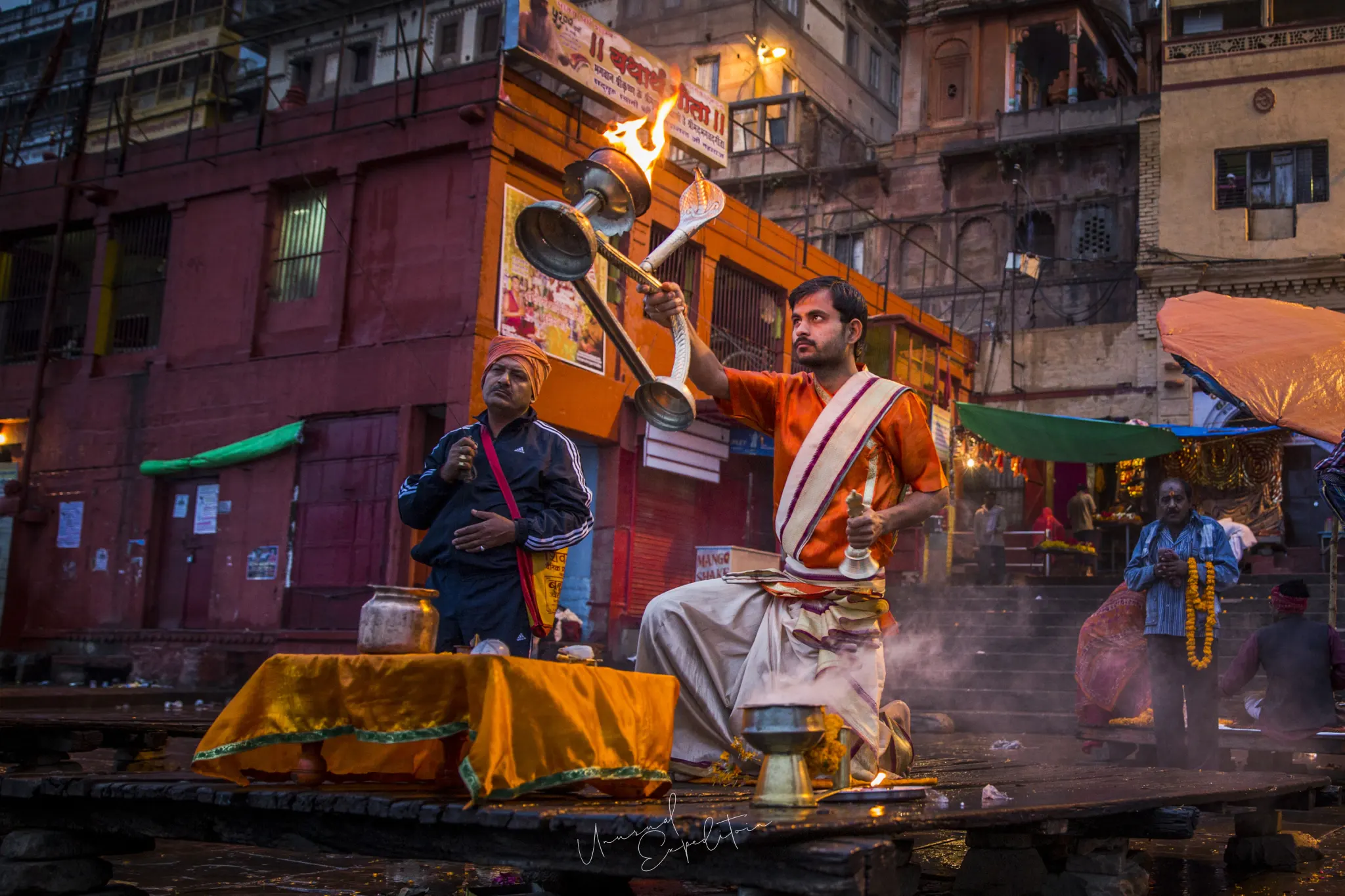
The Ganga aarti in Varanasi is the evening offering of fire to the river, held every night after sunset on Dashashwamedh Ghat and on several neighbouring ghats. Priests in saffron stand on raised platforms and swing tiered brass lamps, incense burners and yak-tail whisks in unison while conch shells sound and bells ring. You can watch it from the steps, where you are in the crowd, or from a boat on the river, where you see the whole line of priests against the lit ghat.
This article is part of our Varanasi photography tour guide. We photographed the aarti on each of our Varanasi visits, from the steps and from the water.
What happens at the evening Ganga aarti in Varanasi
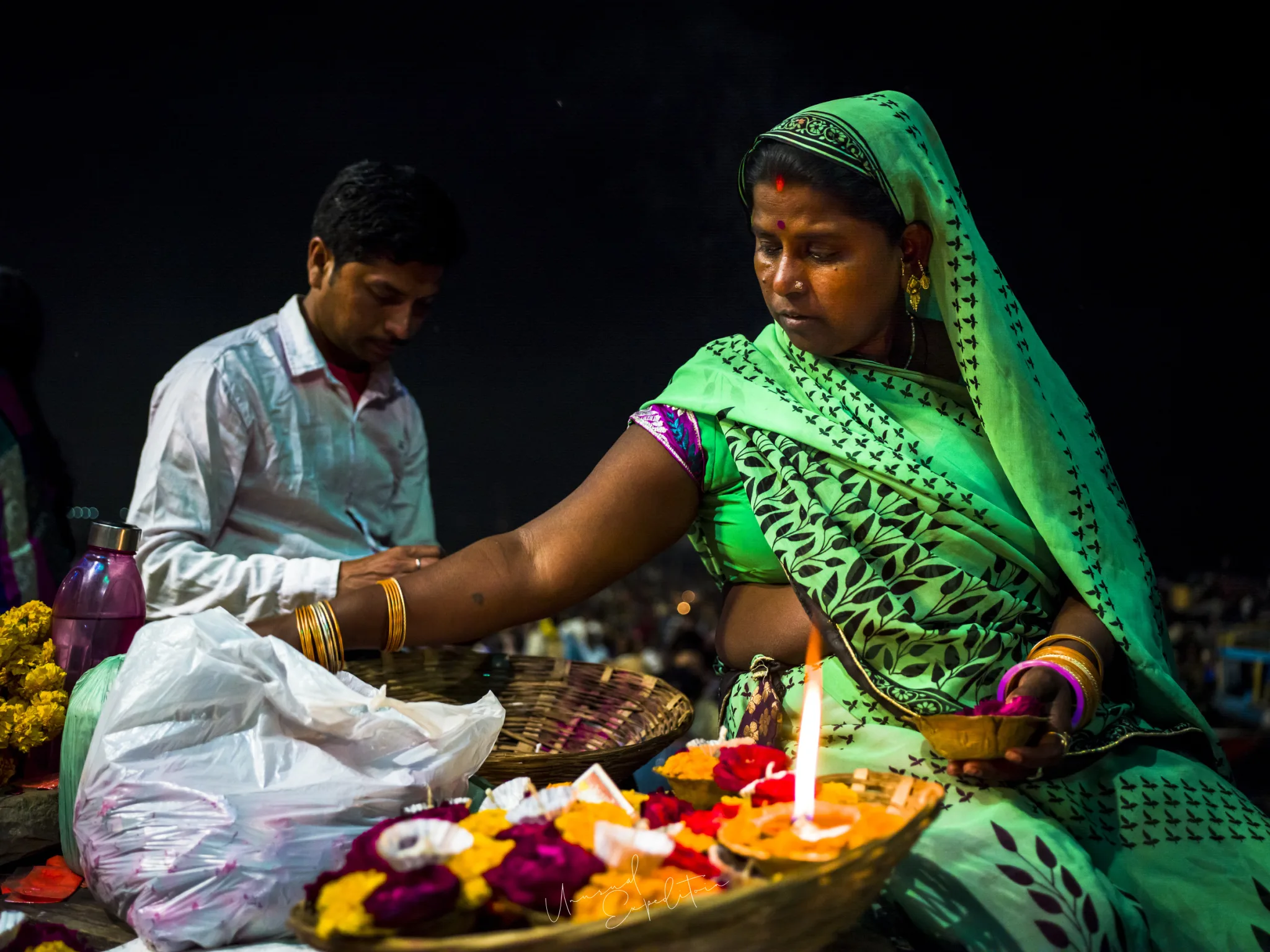
The evening Ganga aarti in Varanasi follows the same order every night. The priests take their places on the platforms facing the river, blow conch shells, and then work through a sequence of offerings: incense, tiered brass lamps of fire, flowers and fans. Each offering is raised to the river, then turned to the four directions, all in time with the chanting and the bells. Incredible India, the Government of India's tourism site, describes the ceremony at Dashashwamedh as lasting about forty-five minutes, with brass lamps that rise several tiers and a crowd of thousands. At the end, people float small leaf boats with a candle and marigolds on the river. Standing on the steps to watch costs nothing.
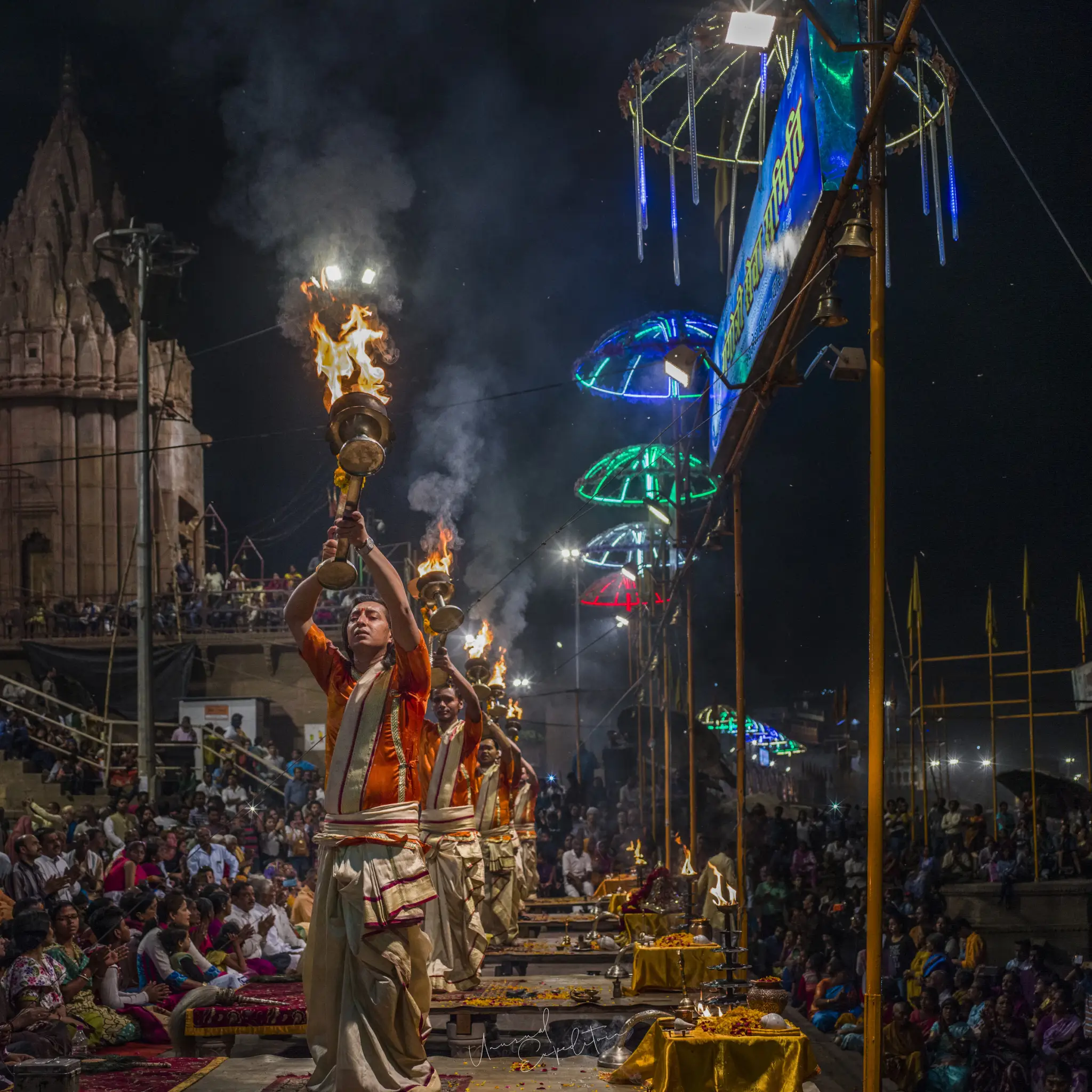
Best Ganga aarti in Varanasi: Dashashwamedh or Assi
| Ceremony | Where | When | Character | For photographers |
|---|---|---|---|---|
| Evening Ganga aarti | Dashashwamedh Ghat | Every evening after sunset | Large, choreographed, crowded | Fire, smoke and a long line of priests; the classic picture |
| Subah-e-Banaras | Assi Ghat | Every morning around sunrise | Smaller, with music and yoga | Softer light, fewer people, room to move |
| Smaller evening aartis | Several other ghats | After sunset | Local, a priest or two | Intimate portraits, but check before you shoot |
If you only have one evening, go to Dashashwamedh; if you have a second morning, Assi is the gentler companion.
Ganga aarti Varanasi photos from the steps
From the ghat steps at Dashashwamedh you are close to the priests and inside the atmosphere, and the best Ganga aarti Varanasi photos usually come from here: a single priest with a lamp of fire held above his head, smoke drifting across the lights, faces in the crowd lit by flame. Arrive well before sunset, because the steps facing the platforms fill early and nobody moves once the ceremony starts. Take your shoes off if you are told to, sit where the volunteers ask you to, and do not stand in front of people who have come to pray. A 24-70mm covers most of what you can reach from the steps; a fast 35mm or 50mm prime helps once the sky goes dark.
Ganga aarti Varanasi boat booking
From the river, the aarti becomes a stage: the line of platforms, the lit temples behind and the smoke rising into the blue sky in the minutes after sunset. Boats moor side by side in front of Dashashwamedh, so arrive early for a place at the front of the raft of boats, not three rows back. For Ganga aarti Varanasi boat booking, the boatmen wait at the ghats in the late afternoon, and your hotel or guide can arrange one for you; agree the price, the route and where you will be moored before you step in. A rocking boat rules out a tripod, so use a higher ISO and a 70-200mm to reach the priests, and remember that people on the boats in front will be in your frame. Our Varanasi sunrise and sunset article covers the river at both ends of the day.
Camera settings for the aarti
The light at the aarti is mostly fire against darkness, which fools a camera's meter into overexposing. Expose for the flames, not the shadows: spot or centre-weighted metering on the lamp, or a negative exposure compensation of a stop or more, keeps the fire golden instead of burnt-out white. Keep the shutter fast enough to freeze the lamps when the priests hold them still, around 1/125s, and accept a high ISO to get there; noise in a dark sky is easier to live with than blur. For a sense of motion, try a slower shutter while a priest circles his lamp and let the flames trace an arc. Blue hour, in the first minutes after sunset, gives the best balance between the sky and the fire. Do not use flash: it flattens the scene and disturbs the people praying around you.
"At the aarti I tell people to stop shooting for the first few minutes and just listen to the bells. When you know the rhythm, you know when the lamps will rise, and you are ready for it instead of chasing it."
Joseph Mak, tour leader, Unusual Expedition
Respect at the aarti
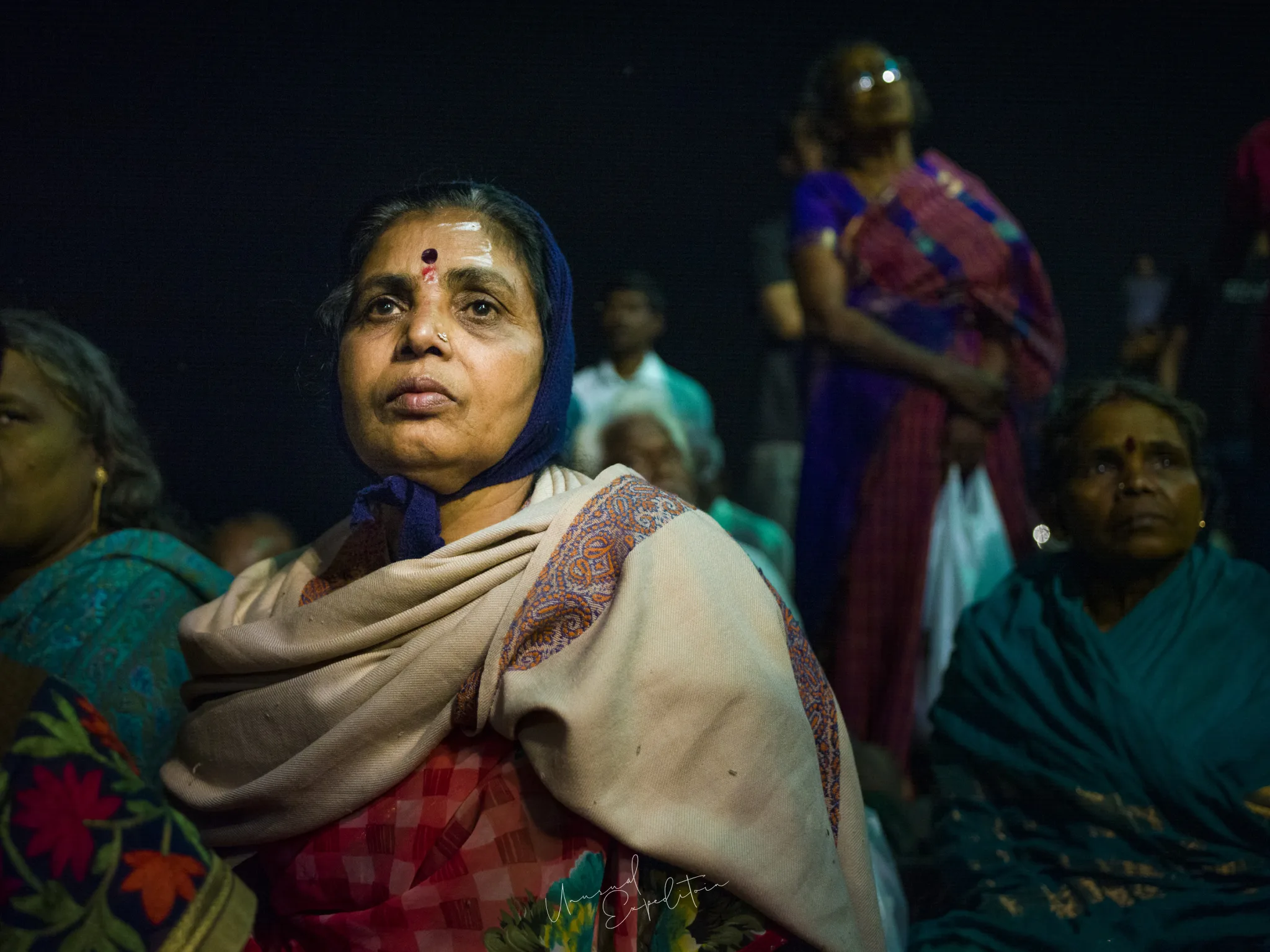
For the people on the steps, the aarti is worship, not a show, even if the crowd of cameras can make it feel like one. Keep your voice down, keep your elbows in, and lower the camera when someone near you is praying with folded hands. Portraits of pilgrims in the crowd are often possible if you ask with a smile first; take a refusal gracefully. The priests are performing a rite, so do not climb onto the platforms or walk between them and the river. Leaf-boat lamps sold by vendors are a lovely offering, but choose the ones made of leaves and flowers, not plastic.
The aarti through the year
The aarti is held every evening of the year, but the setting changes with the seasons. In the cool months the smoke hangs in still air and the crowd wraps itself in shawls. In the monsoon the river can rise over the lower ghats; in recent floods, Indian newspapers reported, the Dashashwamedh aarti moved up to higher ground and rooftops and boats were stopped by the district. On Dev Deepawali, the full moon of Kartik fifteen days after Diwali, the aarti is at its grandest and the ghats are lined with earthen lamps. Our best time to visit Varanasi article sets out the months, and best ghats in Varanasi covers Dashashwamedh and Assi by daylight.
See the aarti with us
We run Varanasi as a private trip on request, so the evenings can be planned around the aarti: one night on the steps, one on the water, and a morning at Assi if you want the quieter version. We arrange the boats and the logistics; a photographer or photography coaching can be added at extra cost. See private tours and our India photography tours page.
Varanasi photography tours
The next Varanasi departure is announced on the Varanasi photography tours page, with previous expeditions and all the planning guides.
Explore Varanasi in depth
- Varanasi Photography Tour Guide: the Ghats, the Aarti and the Old CityIndia
- Varanasi Sunrise and Sunset: Boats on the Ganges at Both Ends of the DayIndia
- Varanasi Street Photography: the Old City Lanes and Their PeopleIndia
- Varanasi Photos: the River, the Lanes and the PeopleIndia
- Is Varanasi Worth Visiting? Getting There and What to KnowIndia
- Best Time to Visit Varanasi: Weather, Festivals and Light by MonthIndia
- Best Ghats in Varanasi for Photography, Ghat by GhatIndia
Upcoming Photo Tours
- Egypt Photo Tour – EgyptEgypt 12 Dec 2026 To 20 Dec 2026
- Inner Mongolia Winter Owl Photo Tour – ChinaChina 01 Jan 2027 To 04 Jan 2027
- Inner Mongolia Winter Photo Tour – ChinaChina 05 Jan 2027 To 11 Jan 2027
- Mekong And Central Highland Vietnam Photo Tour - VietnamVietnam 16 Jan 2027 To 24 Jan 2027