
Iceberg Photography Tips: Shooting the Icebergs of Scoresby Sund, Greenland
Iceberg photography tips from Scoresby Sund: shoot from the Zodiac, use grey light, why some icebergs are blue, sizes, detail and safety.
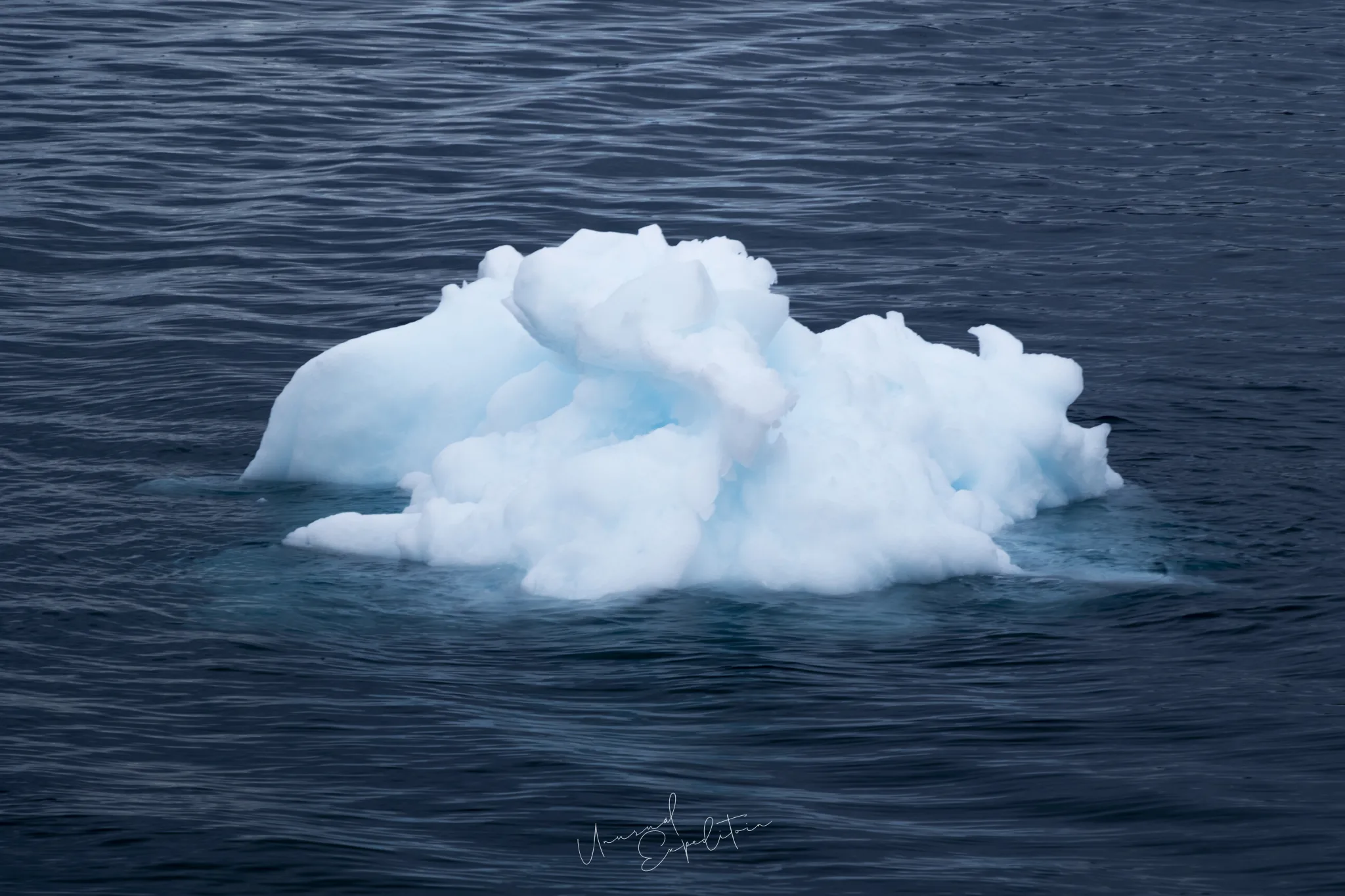
The best iceberg photography tips for Greenland come down to four things: shoot from a Zodiac at water level, welcome the grey days because flat light brings out the blue, look for detail inside the ice as well as the whole berg, and expose for the white so nothing burns out. These are the lessons from our own frames of the icebergs of Scoresby Sund, East Greenland, the fjord system covered in full in photographing Scoresby Sund.
Every picture on this page was made inside the Scoresbysund fjord system on one voyage, most of them on a single morning of sleet and brash ice. If you want the wider picture of the country first, our Greenland photography tour guide sets out the whole trip.
Iceberg photography tips: start at water level
The single biggest change you can make to iceberg photography in Scoresby Sund is to get low. From the deck of an expedition ship you look down on the ice, and a berg the height of a house flattens into a white shape on grey water. From a Zodiac your lens sits a metre above the sea, the berg towers over the frame, and the brash ice in front becomes a foreground that leads the eye in. A 24-70mm covers the whole berg when the driver brings you close; a 70-200mm picks out faces and ridges from a safe distance. Keep the horizon level; tilted water is the first thing a viewer notices. Where the boats usually go is set out in our Greenland photo spots guide.
Greenland photos: icebergs in grey light
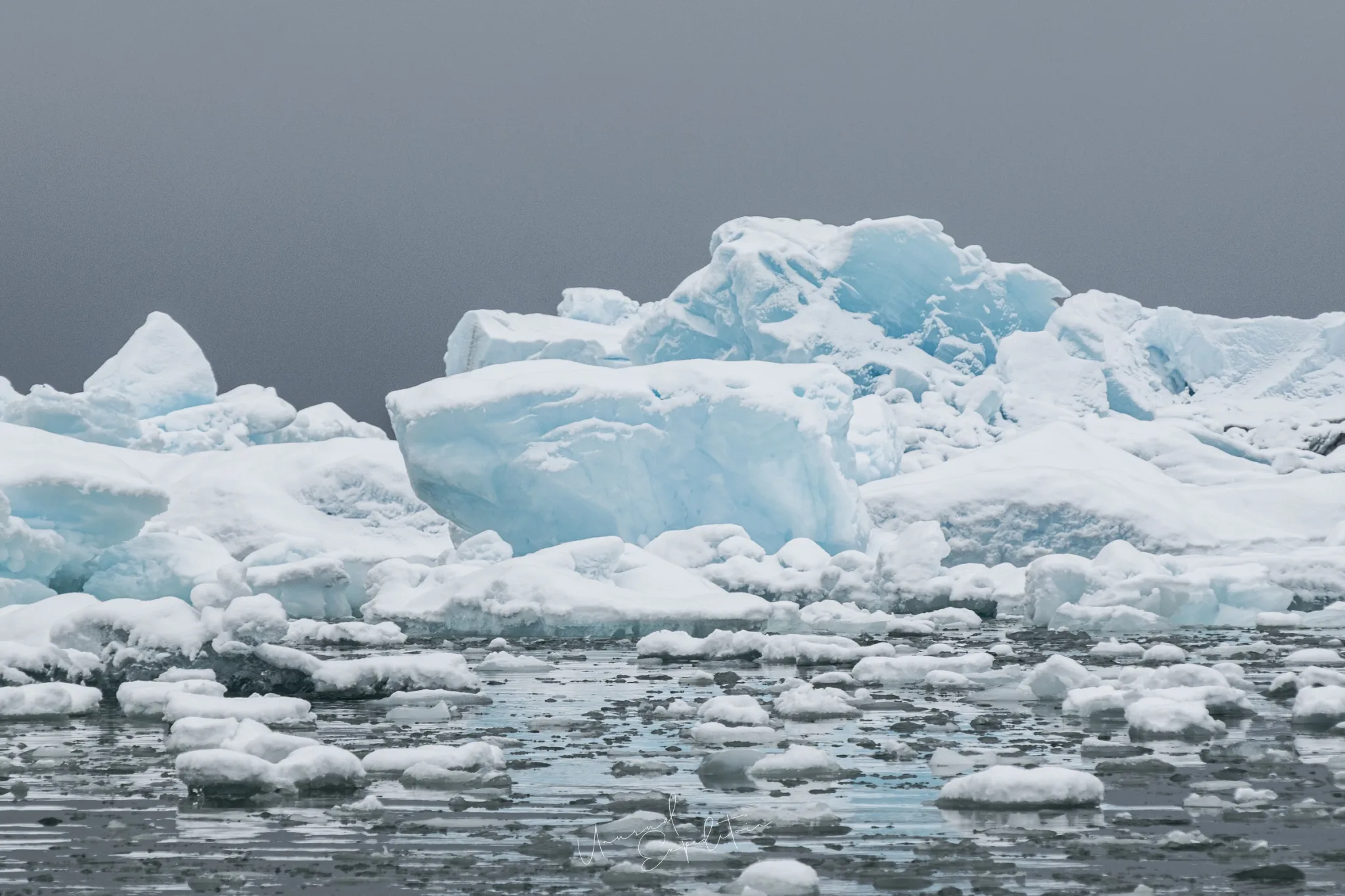
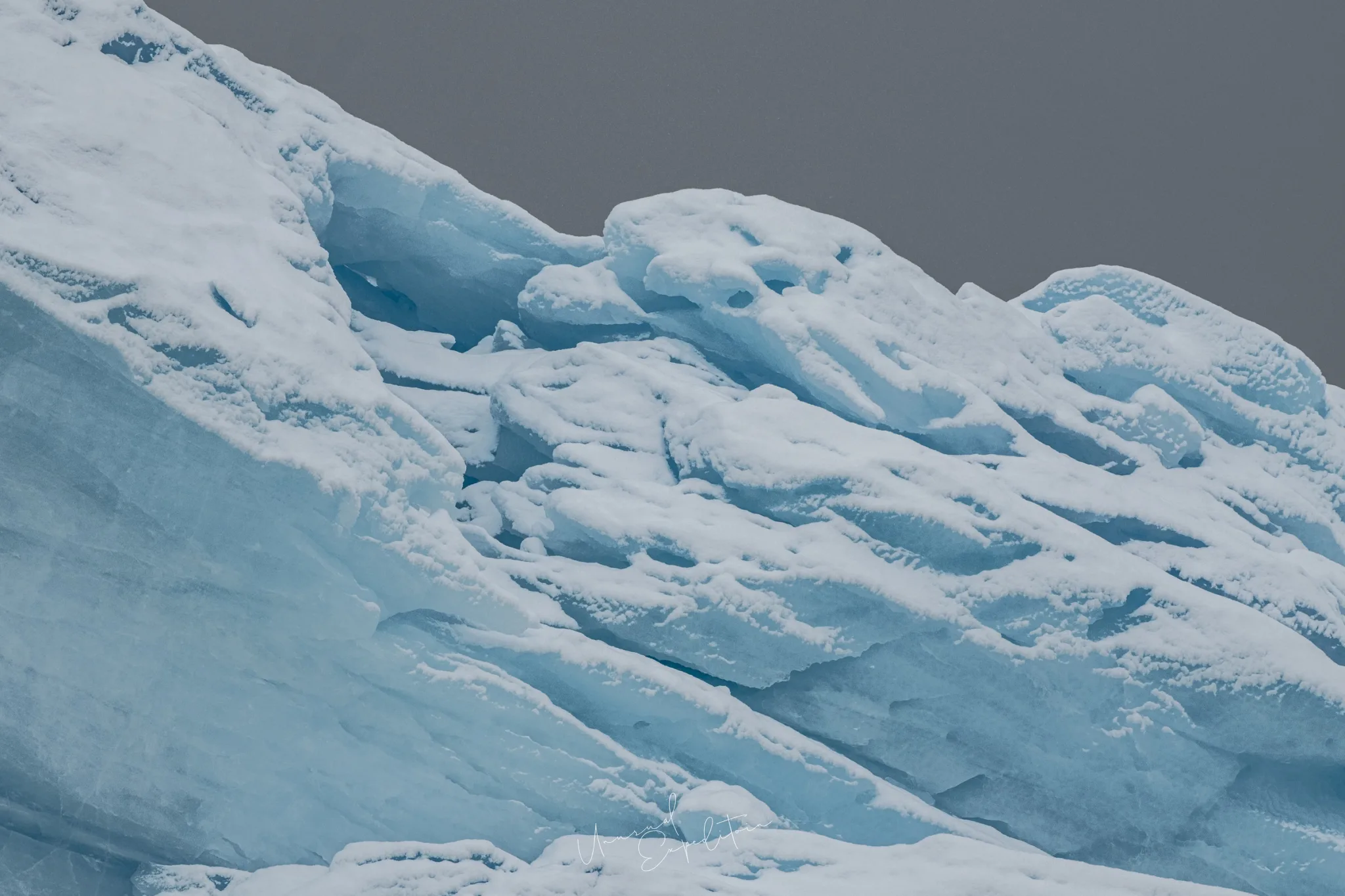
Grey weather is when Greenland photos of icebergs look their most blue. Under a clear sky the sun turns the surface of a berg brilliant white and the shadows go dark, so the camera has to choose between the two. Under cloud the light is soft and even, the contrast drops, and the blue inside the ice shows through. Our sleet morning in the inner part of Scoresby Sund produced the strongest colour of the whole voyage, while the clear days gave white sculpture against dark water, a different picture altogether. On a grey day, fill the frame with ice and keep the sky small, because a flat sky reads as empty. Either way, the camera meter will try to turn white ice grey; add between two thirds and one and a third stops of exposure compensation, then check the histogram and stop while the right edge is still just short of the wall, so the brightest ice keeps its texture.
Why are some icebergs blue?
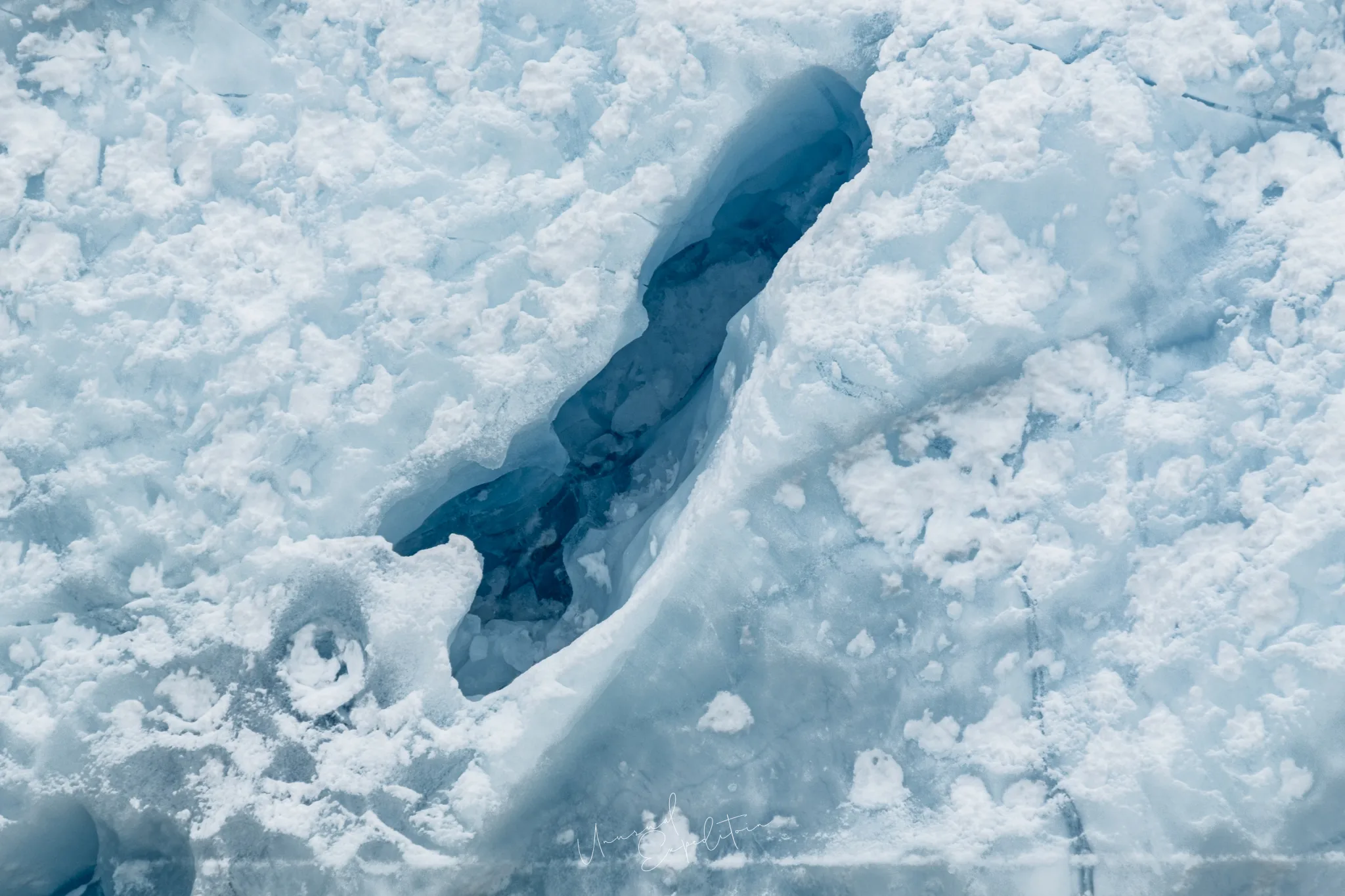
Why are some icebergs blue while others look white? The United States Geological Survey explains it this way: ice absorbs the red end of white light and lets the blue pass through and scatter, so the longer the path light travels through ice, the bluer it looks. Snow and new ice are white because their air bubbles scatter every colour equally. Glacier ice in Greenland has been squeezed under its own weight for centuries, the bubbles have been pressed out and the crystals have grown large, and that dense ice glows blue in the cracks and the undersides. In practice the bluest parts of a berg are the freshly broken faces and the areas that have rolled up from under the water, where the surface has not yet weathered white. Leave white balance on daylight; auto white balance will try to neutralise the very colour you came for.
Where the icebergs of Scoresby Sund come from
The icebergs of Scoresby Sund are calved by the glaciers at the heads of its long inner fjords. The most productive is Daugaard-Jensen Glacier at the head of Nordvestfjord, the northern arm of the system; glaciologists writing in the Annals of Glaciology describe its floating front moving forward by about the size of a typical calved iceberg, roughly a kilometre, before pieces break away. The bergs then drift slowly down the fjords on the current and the wind, and many ground in the shallower water nearer the open coast, where they sit for weeks while sun and sea reshape them. The same bay can look completely different from one season to the next. For the geography of the fjord system as a whole, see photographing Scoresby Sund.
Iceberg sizes: from growlers to giants
Iceberg names follow size, and the names help you plan the shot. NOAA describes a growler as a fragment roughly the size of a truck or a grand piano, standing less than about a metre above the sea, and a bergy bit as the next size up, a few metres high. Above that come small, medium and large icebergs. Growlers are the easiest to isolate: on dark water a single piece becomes a clean, almost abstract subject, and a longer focal length keeps the background empty. Medium bergs are where a person, a Zodiac or a ship earns its place in the frame, because without one nothing tells the viewer how big the ice is. The giants are best shown in part, a wall or a ridge.
| Subject | What makes the picture | Lens | Watch for |
|---|---|---|---|
| Growler or bergy bit | Isolation on dark water | 70-200mm | Clutter at the frame edge |
| Medium berg | A Zodiac or person for scale | 24-70mm | Horizon tilt from the boat |
| Large berg | A wall, ridge or arch in part | 70-200mm | Burnt-out white on clear days |
| Brash ice field | Foreground leading to a berg | 24-70mm | Too much flat sky |
| Ice detail | Texture, cracks, blue layers | 70-200mm | Spray on the front element |
Most of the strongest frames from the voyage came from the last two rows, which cost nothing but attention.
Iceberg detail: the pictures inside the ice
Iceberg detail is where Scoresby Sund rewards patience. Once you have the whole berg, stay with it and look closer: the ridges where meltwater has carved channels, the layered bands where old snow was compressed, the scalloped surface left by waves, and the cracks where blue ice shows through. A 70-200mm from the Zodiac turns any of these into a picture that could be a mountain range or a painting. Fill the frame so there is no horizon to anchor it, and the viewer will look at the ice itself. A shutter speed around 1/500 second freezes the movement of the boat, and two bodies, one with each lens, save changing lenses over salt water; the rest of the kit is in camera gear for Greenland photography.
Climbing icebergs in Greenland: why you should not
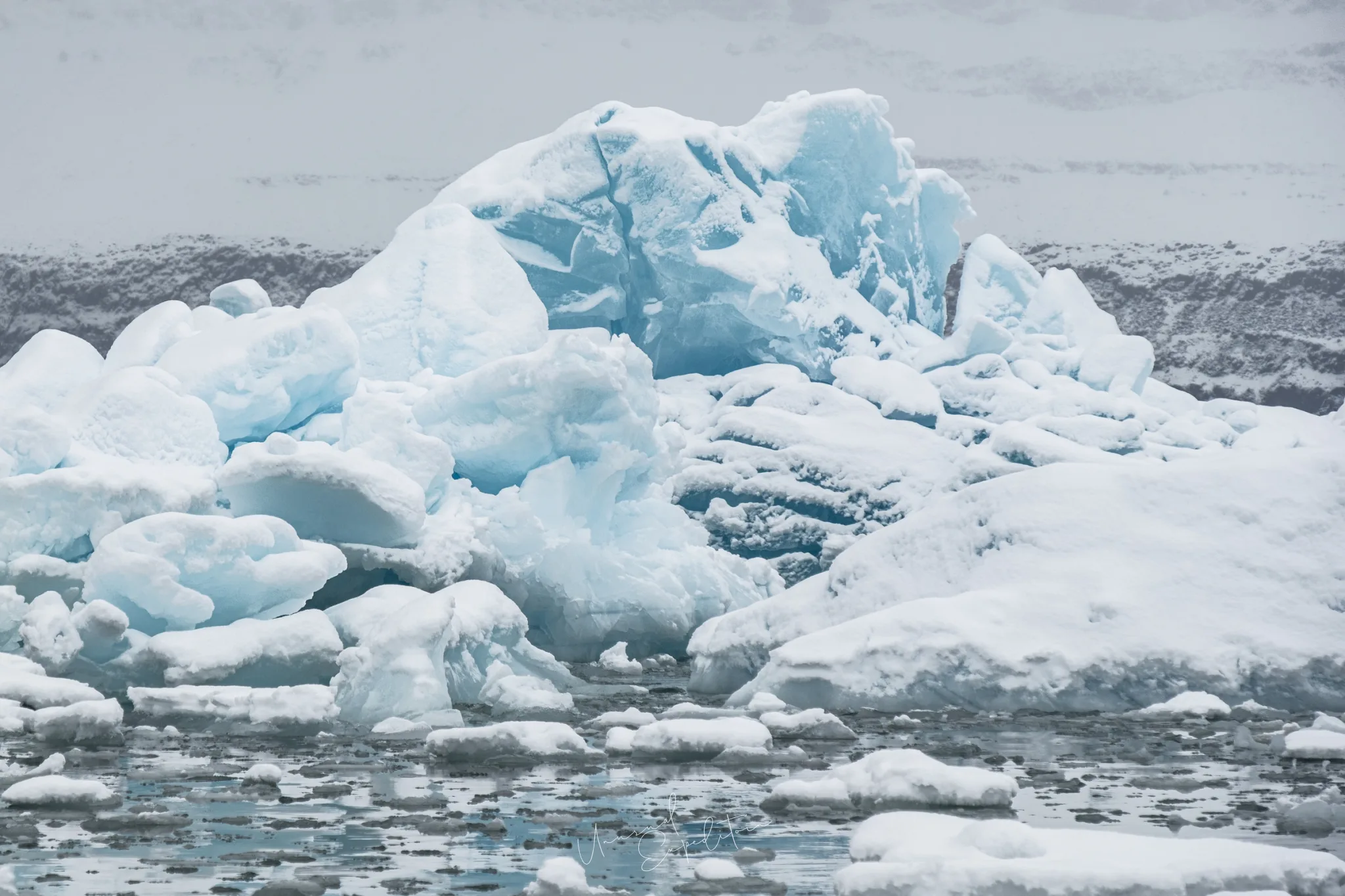
Climbing icebergs in Greenland turns up in search suggestions, and on our voyages nobody climbs, and nobody lands on the ice. Bergs are unstable. As the underwater part melts faster than the top, the balance shifts and a berg can roll without warning, which is also why the expedition team keeps the Zodiacs a sensible distance off any berg and away from glacier fronts. Most of an iceberg's mass sits below the waterline, out of sight, and it can reach well beyond the visible edge. The guidelines that member operators of AECO, the Association of Arctic Expedition Cruise Operators, follow for small-boat cruising near ice exist for the same reason. For a photographer the distance is no handicap: it is exactly what a longer lens is for.
Iceberg flips in Greenland: be ready, stay back
Iceberg flips in Greenland are rare to witness and impossible to predict. If a berg near you starts to crack loudly or shed pieces, the driver will move away first and you photograph second. Keep the camera on continuous drive and a fast shutter speed whenever you are near large ice, so that if something does calve or roll at a distance, you are ready. On every voyage the expedition team's call is final.
"Guests always want the sunny day for icebergs. Then they see the grey-day pictures on the laptop and realise the ice was at its bluest in the sleet. Stay low, look closely and let the weather do what it does."
Unusual Expedition tour leaders
Our September frames of the same fjords, ice and tundra are collected in Greenland photos from East Greenland in September.
Photograph the ice of Scoresby Sund with us
We sail into Scoresby Sund in early September on our Greenland Arctic Sights and Northern Lights photography tour, with Zodiac cruising among the bergs whenever the conditions allow. Fares are indicatively US$9,000 to US$15,000 per person depending on the suite. The current departure and rate are on the Greenland photography tour page.
Join the Scoresby Sund photography tour
Greenland Arctic Sights and Northern Lights 5 Sep 2027 departs 05 Sep 2027 To 15 Sep 2027. Small group, photography first. All Scoresby Sund photography tours.
Explore Scoresby Sund in depth
- Photos of Greenland People and Villages: Ittoqqortoormiit as It Is LivedGreenland
- Sunrise and Sunset in Greenland: Daylight by Month at Scoresby SundGreenland
- Greenland Photo Spots: Where to Shoot in Scoresby Sund and IttoqqortoormiitGreenland
- Greenland Photos: What East Greenland Looks Like in SeptemberGreenland
- Greenland Arctic Wildlife Photography: What You Will Really SeeGreenland
- Photographing Ittoqqortoormiit, East Greenland's Loneliest TownGreenland
- Scoresby Sund Photography Tour Guide: Photographing East Greenland's Great FjordGreenland
Upcoming Photo Tours
- Egypt Photo Tour – EgyptEgypt 12 Dec 2026 To 20 Dec 2026
- Inner Mongolia Winter Owl Photo Tour – ChinaChina 01 Jan 2027 To 04 Jan 2027
- Inner Mongolia Winter Photo Tour – ChinaChina 05 Jan 2027 To 11 Jan 2027
- Mekong And Central Highland Vietnam Photo Tour - VietnamVietnam 16 Jan 2027 To 24 Jan 2027