
Kamchatka Volcanoes: How Many, Which Are Active, and How to Photograph Them
How many volcanoes in Kamchatka, the tallest, which are active, Tolbachik lava, craters, ice caves and Kuril Lake, with settings.
How many volcanoes in Kamchatka? About 300, of which around 30 are active, which makes the peninsula one of the most volcanic places on earth and the reason UNESCO lists the "Volcanoes of Kamchatka" as a World Heritage Site. For a photographer that means snow cones above tundra, black lava fields, steaming craters, ice caves and, in some years, an eruption you can watch at night. Here is which volcanoes matter, which are active, and how to photograph them well and safely.
Volcanoes are one part of a Kamchatka trip; the bears, the coast and the logistics are in our Kamchatka photography tour guide.
Does Kamchatka have volcanoes, and how many?
Kamchatka sits where the Pacific plate dives under the Okhotsk plate, and that subduction feeds a long chain of volcanoes down the length of the peninsula. Counts depend on what you include, but about 300 volcanoes is the usual figure, with around 30 counted as active. They range from symmetrical cones such as Koryaksky and Avachinsky above Petropavlovsk-Kamchatsky, to the sprawling Tolbachik massif, to calderas so large they hold lakes, Kuril Lake among them. The Kamchatka Volcanic Eruption Response Team, KVERT, publishes warnings and activity reports, mainly for aviation, and it is the place to check before a trip.
Kamchatka tallest volcano: Klyuchevskaya Sopka
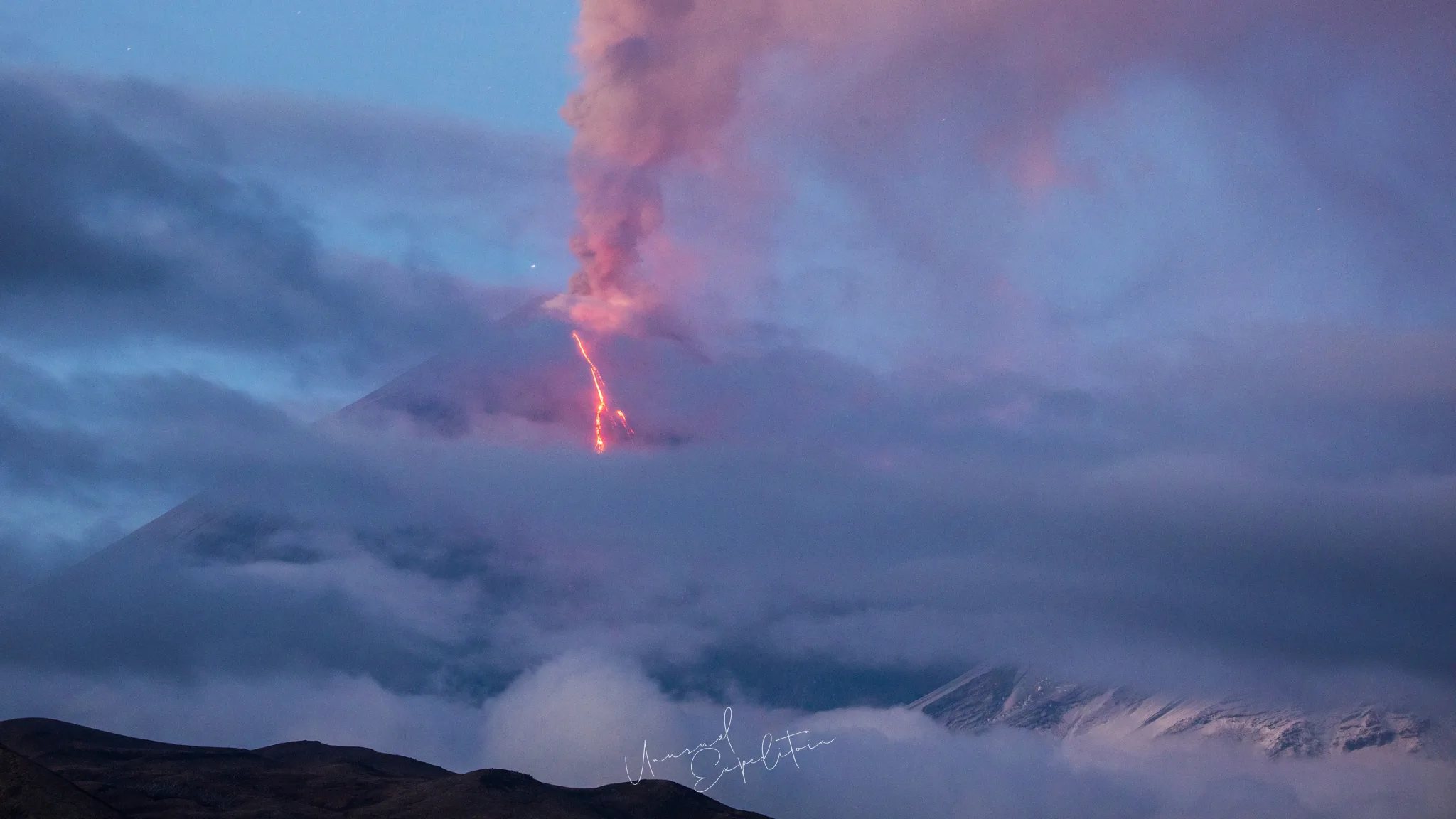
The highest is Klyuchevskaya Sopka, at about 4,750 metres the tallest active volcano in Eurasia, standing in the Klyuchevskaya group with Kamen, Bezymianny, Ushkovsky and Tolbachik around it. It erupts frequently, and its height shifts a little with each eruption. On one of our trips the group put on a night show: lava running down the flank of the cone and an ash column lit pink at dusk. You watch from tens of kilometres away, which is how it should be, with a long lens and a tripod.
Is Kamchatka volcano active right now?
Several always are. Shiveluch and Klyuchevskaya erupt often, Bezymianny and Karymsky have regular phases, and Ebeko on the Kuril Islands puffs ash most years. Which one is active during your trip is a matter of luck and timing. KVERT's colour codes tell you the current state of each volcano, and the local operators know which viewpoints are open. Never approach an active vent without a guide and a reason; ballistic rocks, gas and sudden ash are the dangers, and they are real.
The lava fields of Tolbachik
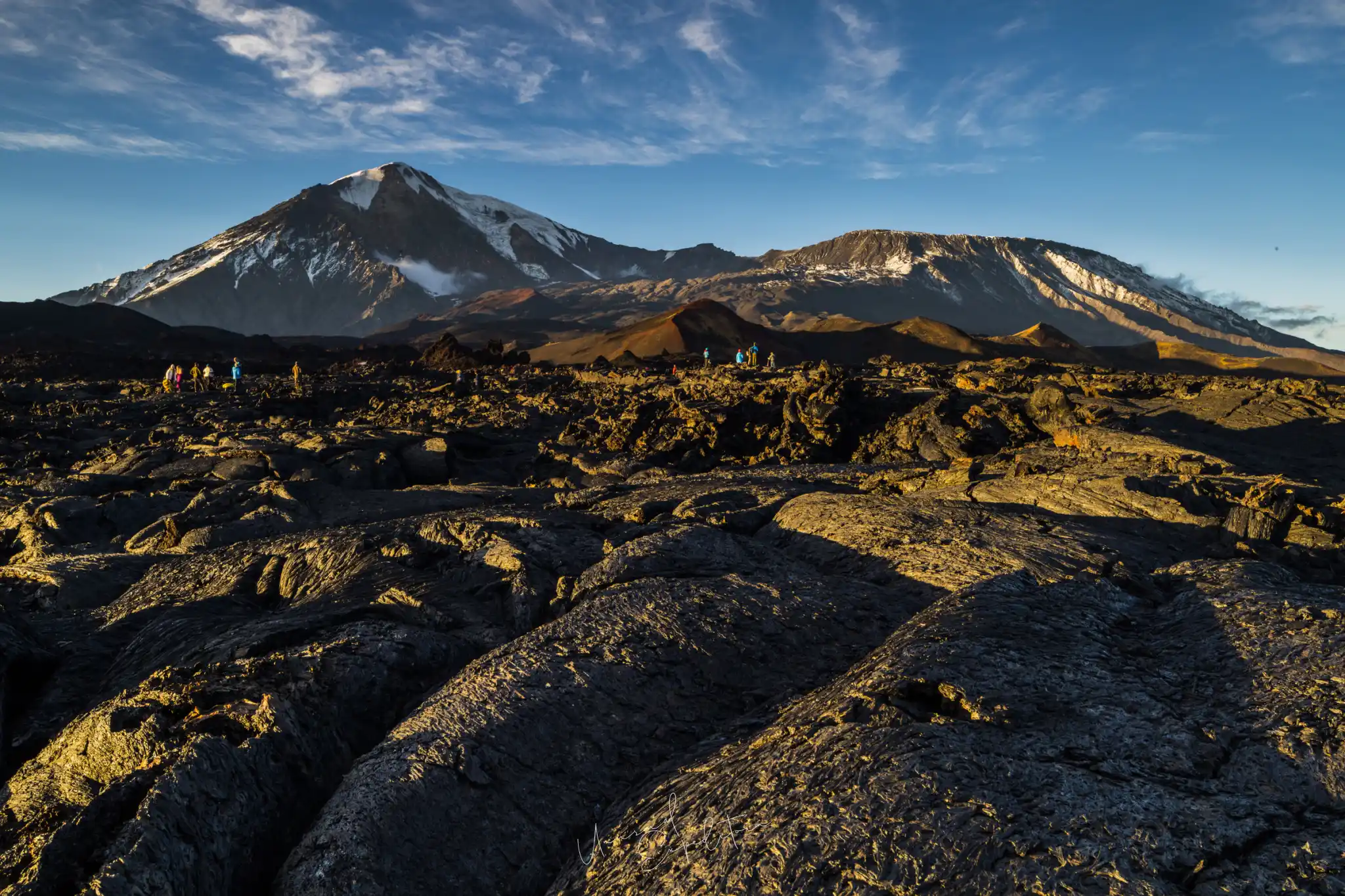
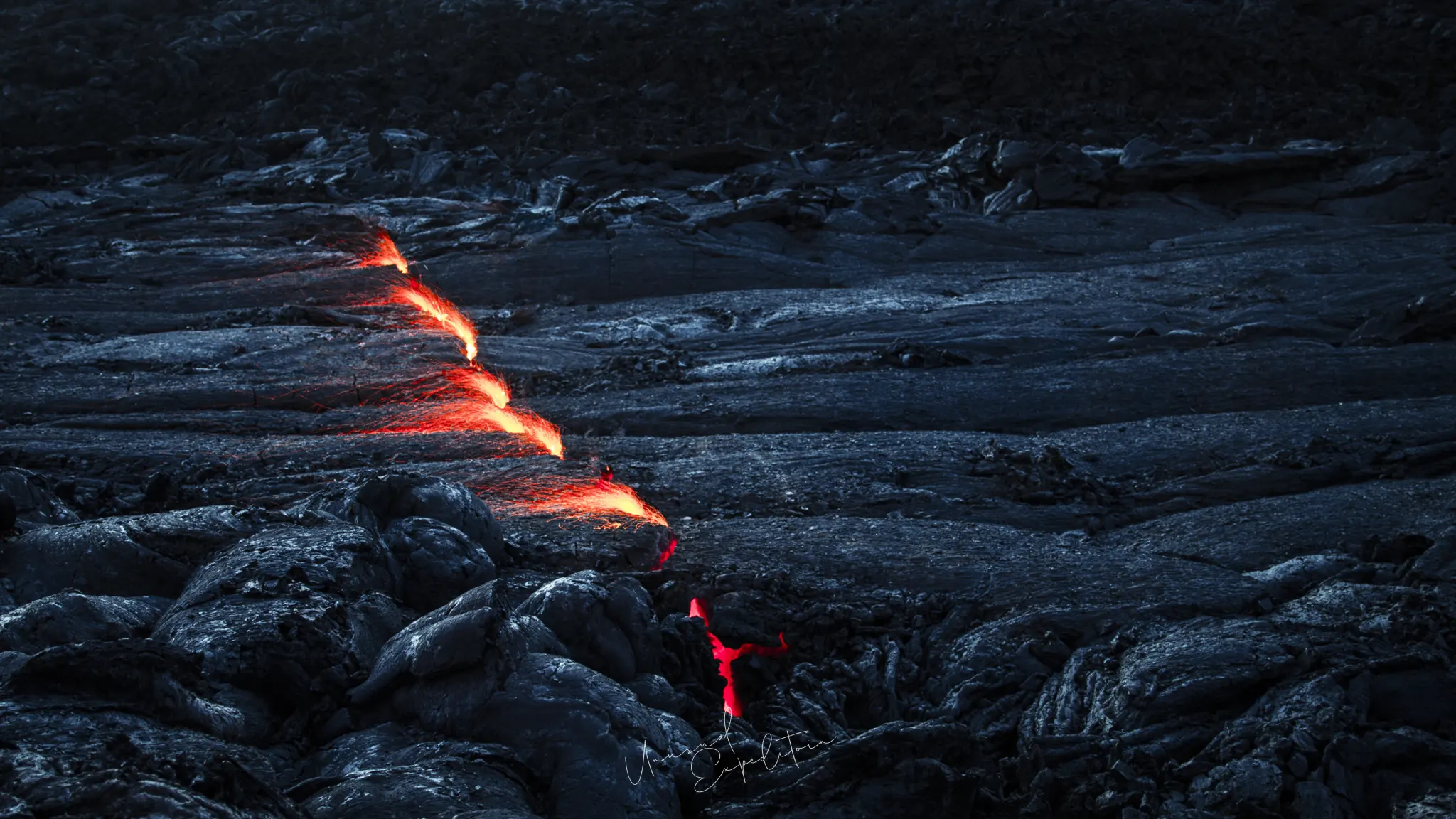
Tolbachik is the easiest place to stand on fresh volcanic ground. The 1975 Great Tolbachik eruption buried forest under ash and left the famous dead forest, grey trunks standing in black sand. The 2012 to 2013 fissure eruption laid down new lava fields, black and ropy, with the twin peaks of Plosky and Ostry Tolbachik behind. In the first years after that eruption, cracks in the lava still glowed at night, and on our trip we photographed red light inside a fissure under a full moon. Today the fields are cooler, but the shapes and textures are the subject: low side light at dawn or dusk turns black rock into sculpture.
Craters, fumaroles and ice caves
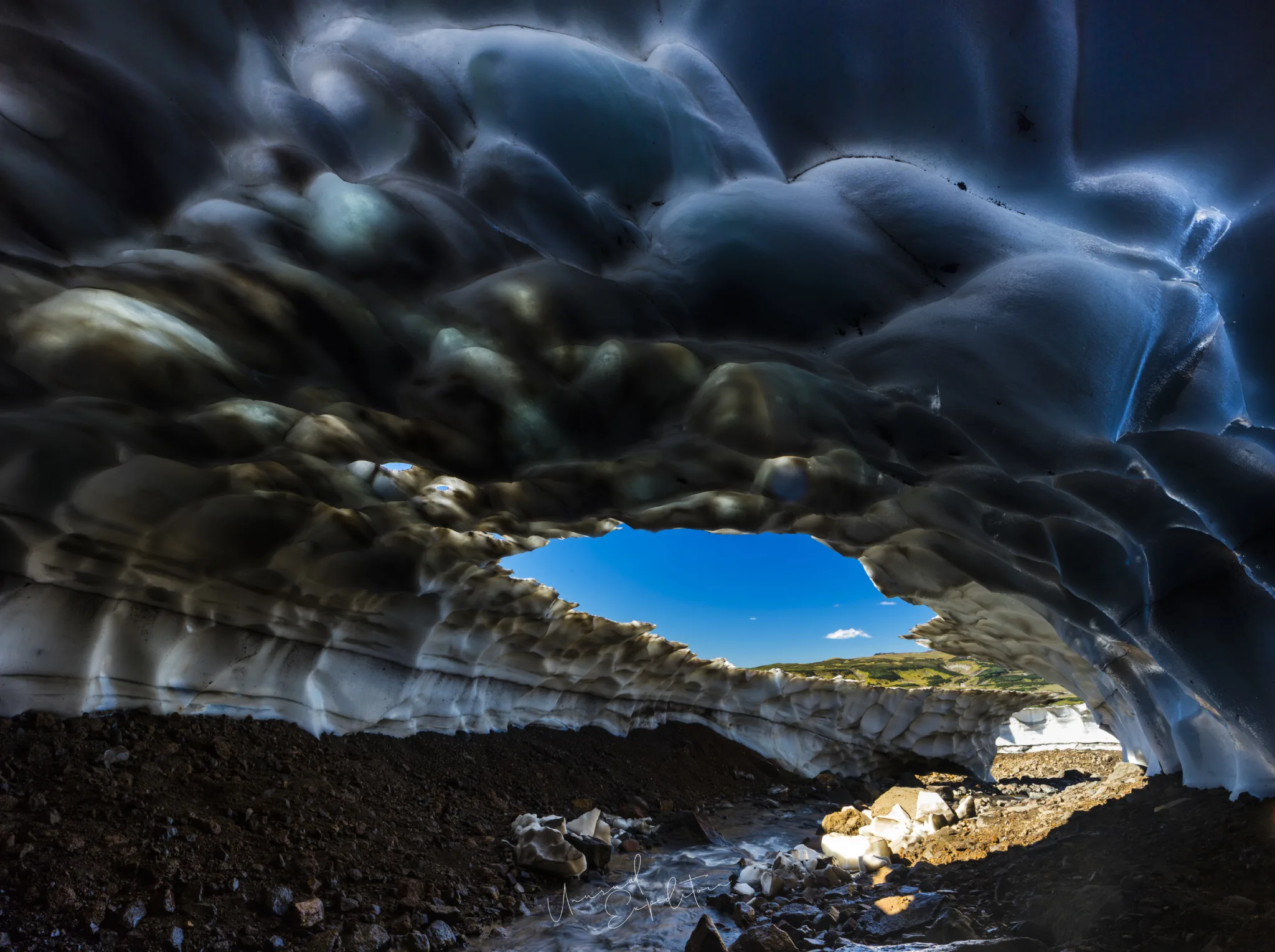
Mutnovsky, south of the city, is the classic crater visit: a basin of fumaroles, boiling mud and sulphur yellow, with a glacier spilling into it. A drone with permission shows its scale best; from the rim, a wide lens and a strong polariser cut through the steam. Near Mutnovsky and Vilyuchinsky, meltwater carves tunnels under snowfields and glaciers, and inside them the light comes through ice of different thickness in blues and, at the right angle, reds and purples. They are beautiful and unstable: only with a guide, never on a warm afternoon, and never under an overhang that has started to drip.
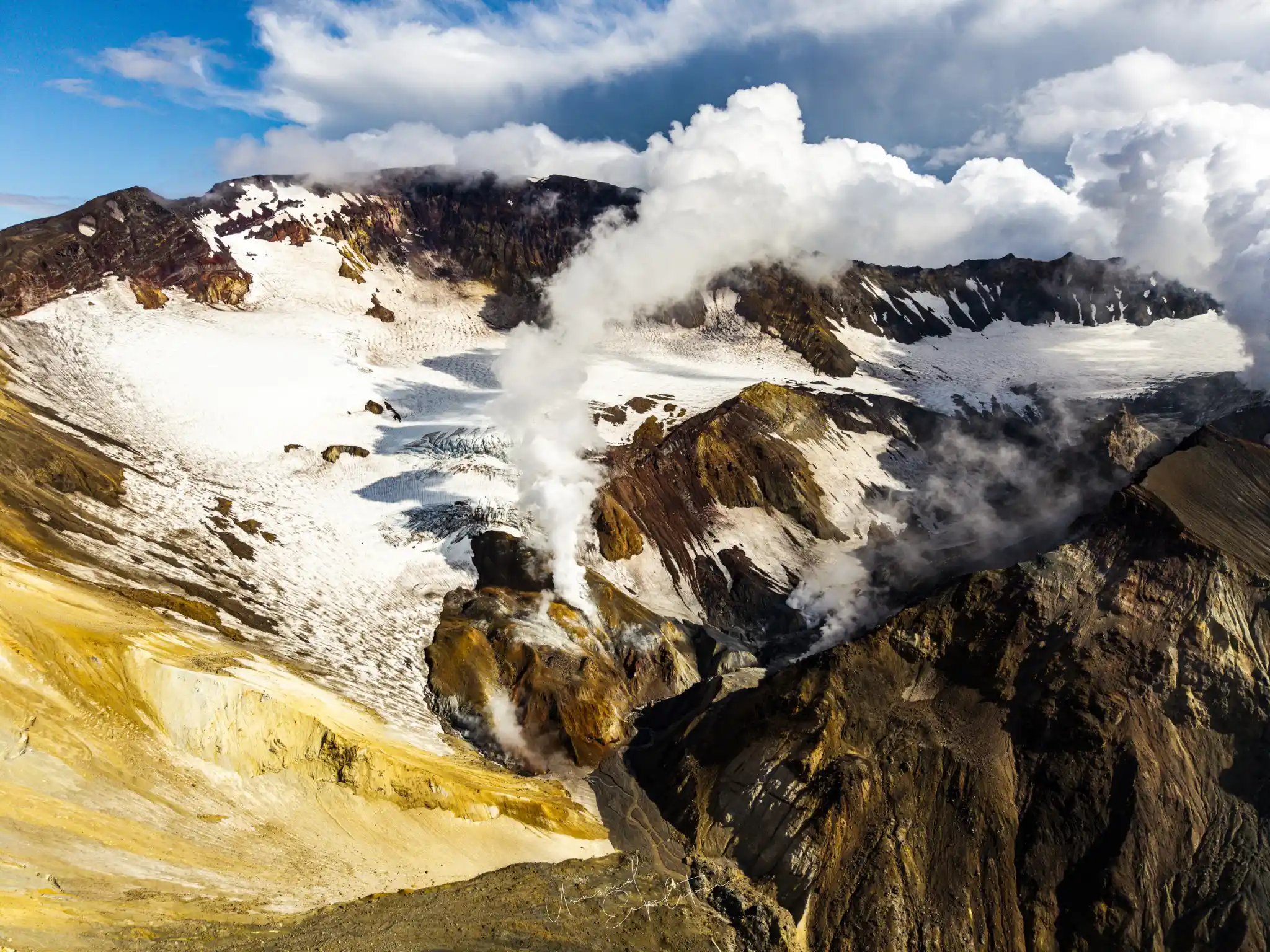
"The eruption was the loudest silence I have photographed. We stood on a ridge far away, the cone glowed and the ash rose into the dusk, and nobody spoke for a long time. I had a tripod, a long lens and a cable release, and I barely needed anything else."
Joseph Mak, tour leader, Unusual Expedition
Kurile lake volcano: Ilyinsky and the caldera
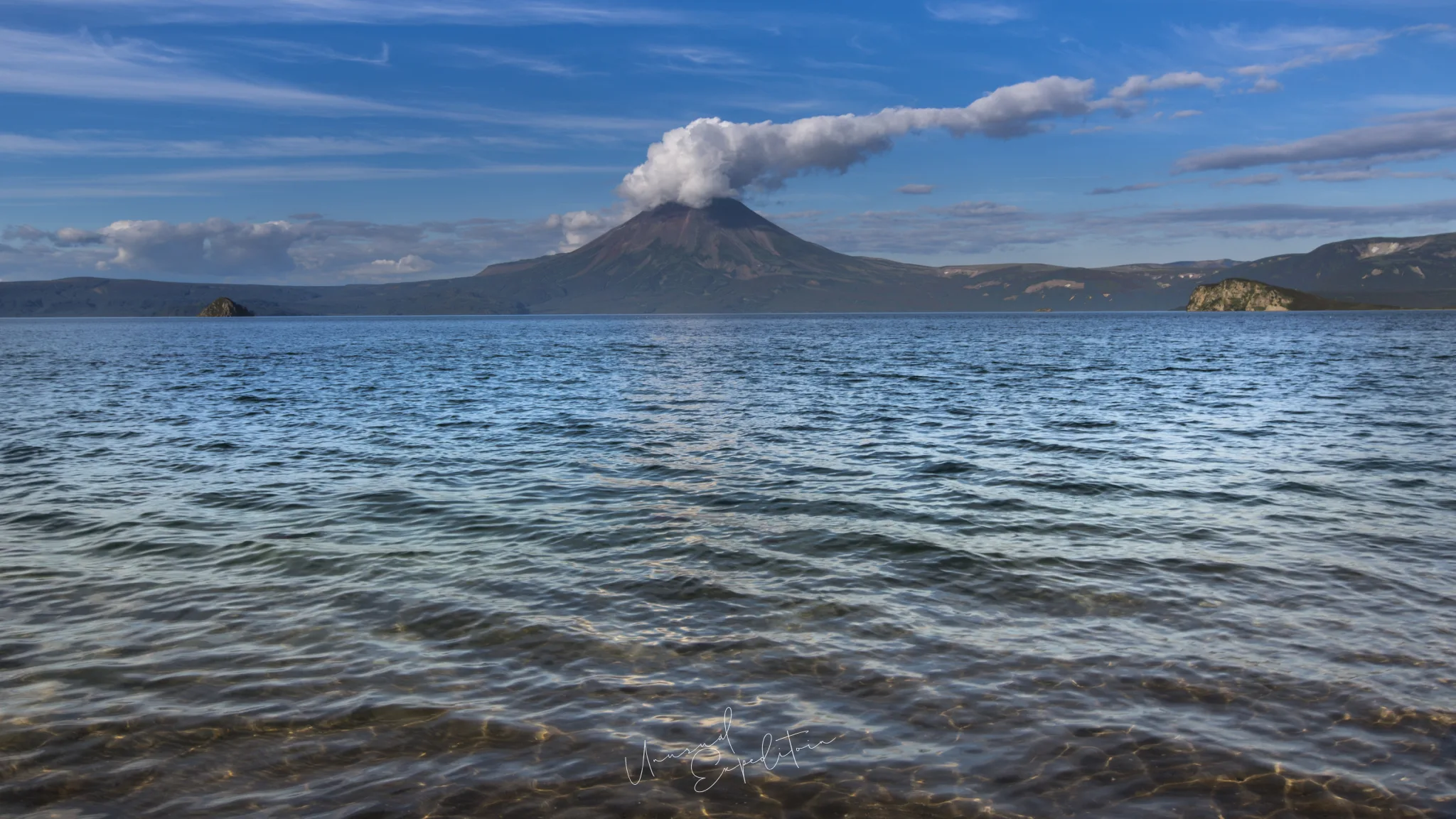
Kuril Lake is itself a volcano: a caldera formed about 8,400 years ago and then flooded. Ilyinsky volcano rises from its northern shore, a near-perfect cone that sometimes trails a plume of steam, and it is the backdrop to many of the bear pictures from the lake. Is Kurile Lake volcano active? The caldera is not erupting; Ilyinsky last erupted in the early twentieth century and still steams. For the bears that make the lake famous, see Kuril Lake bears photography.
How to photograph Kamchatka volcanoes
| Subject | Light | Lens | Settings to start |
|---|---|---|---|
| Cone reflected in a pool | Dawn or dusk, no wind | 16-35mm | f/11, tripod, graduated filter |
| Eruption at night | Blue hour into dark | 100-400mm | ISO 800 to 3200, 1 to 8 s on a tripod |
| Lava field texture | Low side light | 24-70mm | f/8, polariser off |
| Crater and fumaroles | Midday is fine | 16-35mm | Polariser to cut the steam glare |
| Ice cave | Bright overcast outside | 14mm to 24mm | Expose for the ice, not the opening |
The common thread is patience with the weather: cloud sits on the cones for days, then clears for an hour, and that hour is the picture.
Kamchatka volcano tour: getting close
Most volcano areas are reached by Kamaz truck or helicopter, since roads run only a short way from the city. The helicopter is the fastest way to the Klyuchevskaya group and the geothermal valleys, and we cover the flying in Kamchatka helicopter tour photography. For when the light, the snow and the access work together, see the best time to visit Kamchatka for photography.
See the volcanoes with us
Our Kamchatka trips combine the volcanoes with Kuril Lake and the coast. Future departures and private dates are on the Russia photography tours page.
Kamchatka photography tours
The next Kamchatka departure is announced on the Kamchatka photography tours page, with previous expeditions and all the planning guides.
Explore Kamchatka in depth
- Kamchatka Photography Tour: The Complete GuideRussia
- Kuril Lake Bears: Photographing Kamchatka's Brown Bears and SalmonRussia
- Kamchatka Wildlife Beyond the Bears: Orcas, Sea Lions and SalmonRussia
- Kamchatka Tour from Singapore: How to Get ThereRussia
- Kamchatka Photos: What the Peninsula Really Looks LikeRussia
- Kamchatka Photography Trip FAQRussia
- Kamchatka Helicopter Tour: Photographing from the Mi-8Russia
- How Big Are Kamchatka Bears, and Are They Dangerous?Russia
- The Best Time to Visit Kamchatka for PhotographyRussia
Upcoming Photo Tours
- Egypt Photo Tour – EgyptEgypt 12 Dec 2026 To 20 Dec 2026
- Inner Mongolia Winter Owl Photo Tour – ChinaChina 01 Jan 2027 To 04 Jan 2027
- Inner Mongolia Winter Photo Tour – ChinaChina 05 Jan 2027 To 11 Jan 2027
- Mekong And Central Highland Vietnam Photo Tour - VietnamVietnam 16 Jan 2027 To 24 Jan 2027