
Luxor Photo Spots: Where to Stand and When at Karnak, Luxor Temple and the West Bank
Luxor photo spots: Karnak hypostyle hall and pylon, Luxor Temple, Medinet Habu, Deir el-Bahari and a balloon over the West Bank.
The Luxor photo spots that repay a photographer are the Great Hypostyle Hall at Karnak, the first pylon of Karnak at sunset, Luxor Temple in its morning shadows, the painted courts of Medinet Habu, the terraces of Hatshepsut's temple at Deir el-Bahari and the sky above the West Bank from a hot air balloon. The East Bank temples suit the low sun at either end of the day, and the West Bank wants an early start. These notes belong to our Luxor photography tour guide.
The photographs are our own, from our Egypt trips, and we hold the rights to them. We have no frames of the tombs in the Valley of the Kings or of Luxor Temple at night, so those appear in general terms only.
Luxor photo spots at a glance
| Spot | Best light | Lens | Notes |
|---|---|---|---|
| Karnak hypostyle hall | Late afternoon | 16-35mm, 24-70mm | Shafts of sun between columns |
| Karnak first pylon | Sunset and dusk | 24-70mm | Silhouette from the forecourt |
| Luxor Temple | Early morning | 24-70mm | Raking light on reliefs |
| Medinet Habu | Morning | 16-35mm, 24-70mm | Original colour in the inner courts |
| Deir el-Bahari | Morning | 24-70mm | The temple faces east |
| Balloon over the West Bank | Sunrise | 24-70mm | Flights depend on the wind |
Medinet Habu is often the quietest of the big temples, which is why we give it more time than its fame suggests.
The Great Hypostyle Hall at Karnak
The Great Hypostyle Hall is the heart of Karnak. The University of Memphis Hypostyle Hall Project counts 134 sandstone columns in 16 rows; the twelve central columns, about 20 metres high, carry open papyrus capitals, and the hall was built mainly under Sety I and finished under Ramesses II. In late afternoon the sun drops low enough to slip between the rows and light single columns, while the rest of the hall stays in shade. That contrast is the photograph. Point a 16-35mm up the shaft of a lit column against the blue, or use a 24-70mm to isolate a band of carved cartouches. Expose for the highlights and let the shadows go dark.
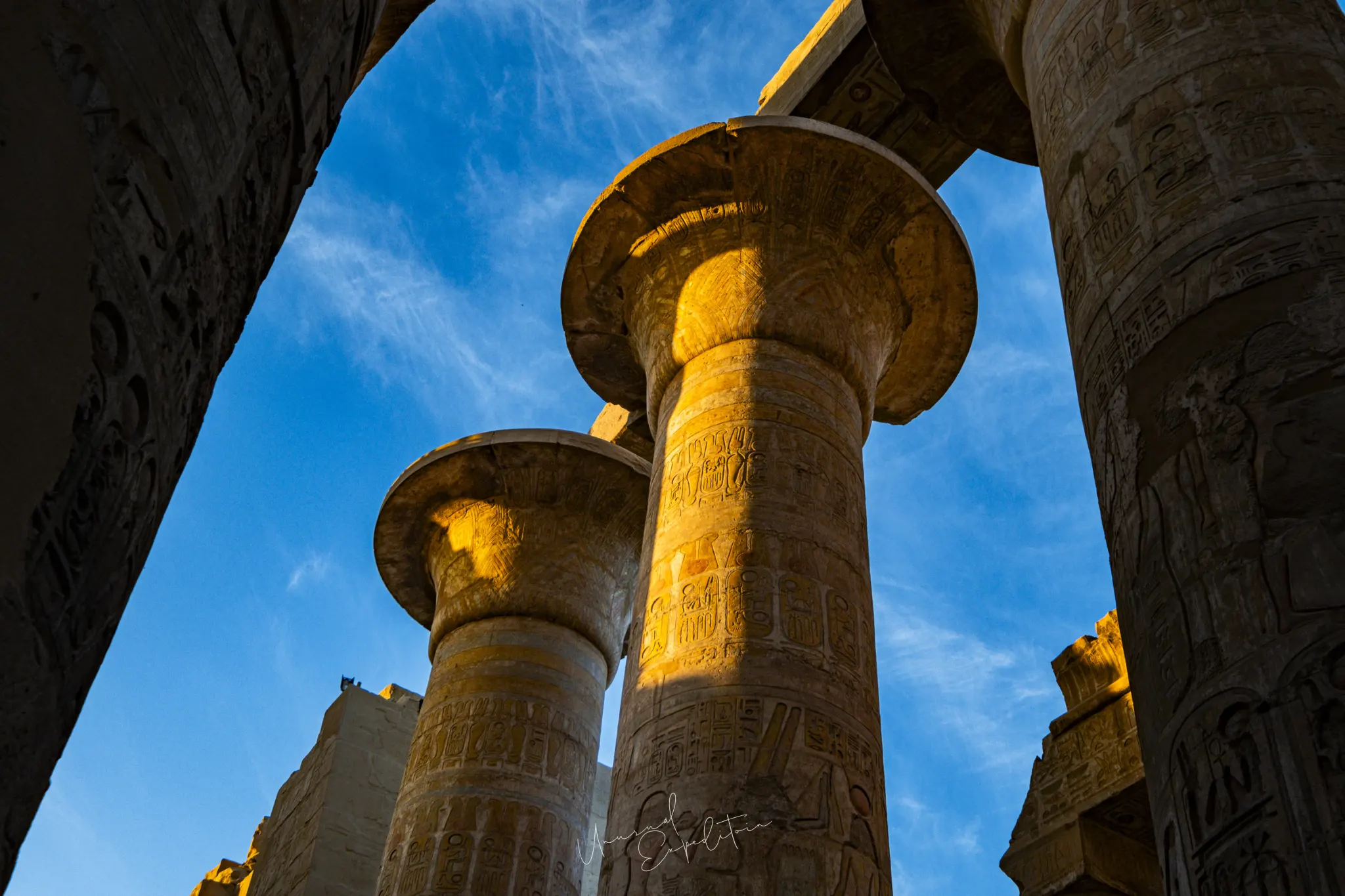
Our Karnak temple hypostyle hall article goes deeper into this one hall.
The first pylon of Karnak at sunset
The first pylon of Karnak faces west towards the Nile, so it takes the sunset behind it from the forecourt and the processional avenue of ram headed sphinxes. As the sun goes the pylon turns into a silhouette against an orange sky, and after it has set the sky can go pink above the stone. A 24-70mm from the avenue keeps the rams in the foreground. Stay through the dusk if the site is still open; the colour often comes late.
Luxor Temple in the morning
Luxor Temple sits in the middle of the town on the East Bank. Its colonnade of papyrus columns, the court of Ramesses II with the mosque of Abu al-Haggag built into it, and the single obelisk at the gate (its twin stands in the Place de la Concorde in Paris) are the main subjects. Early morning is our choice: the sun comes in low from the east and lays diagonal bars of shadow across the carved walls, so the hieroglyphs stand out in relief. Look for those bands of light with a 24-70mm and fill the frame with carving. The temple is reported to stay open after dark, floodlit, so check current hours if you want a night frame.
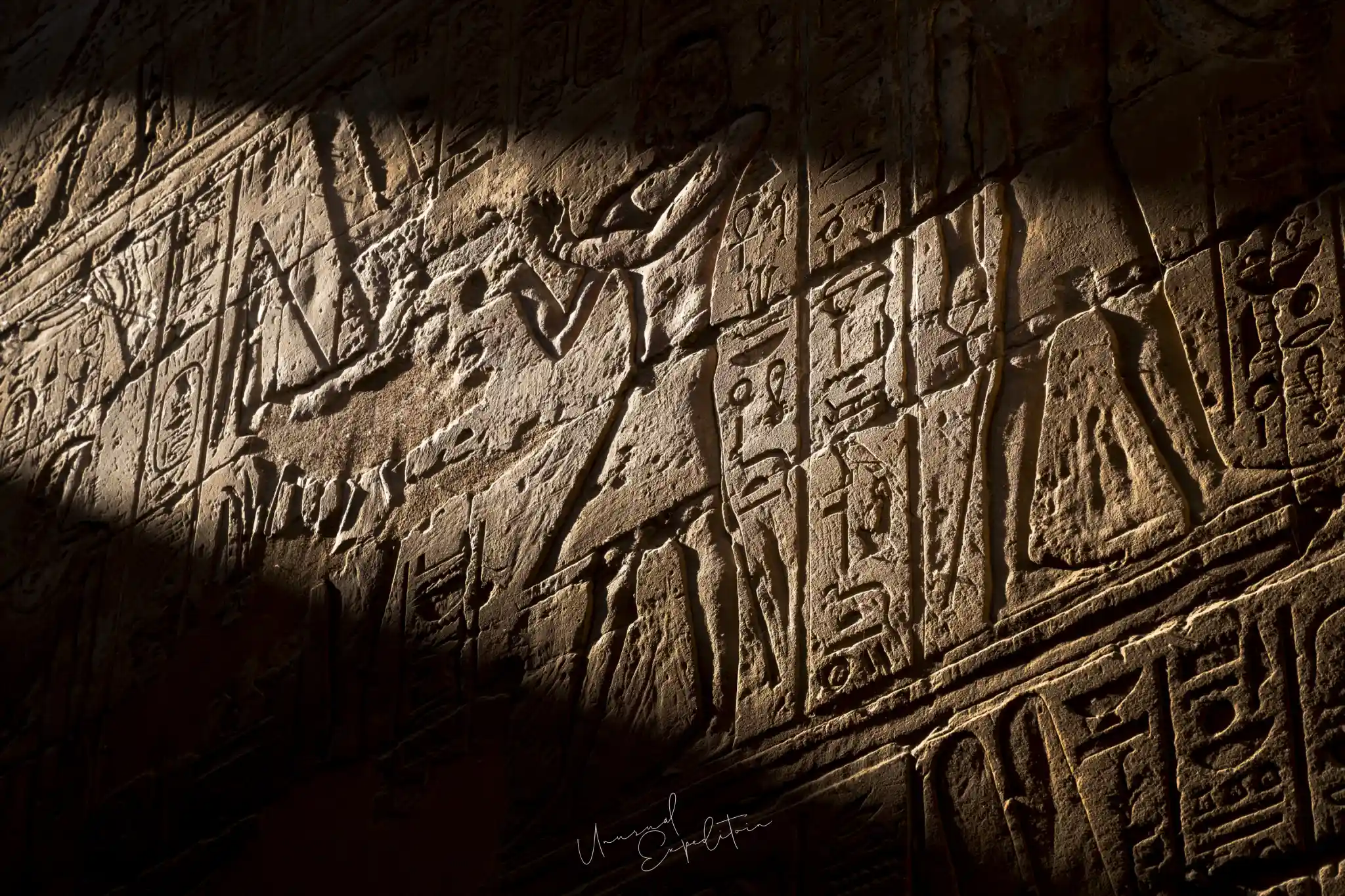
The temple has its own guide in Luxor Temple photos.
Medinet Habu on the West Bank
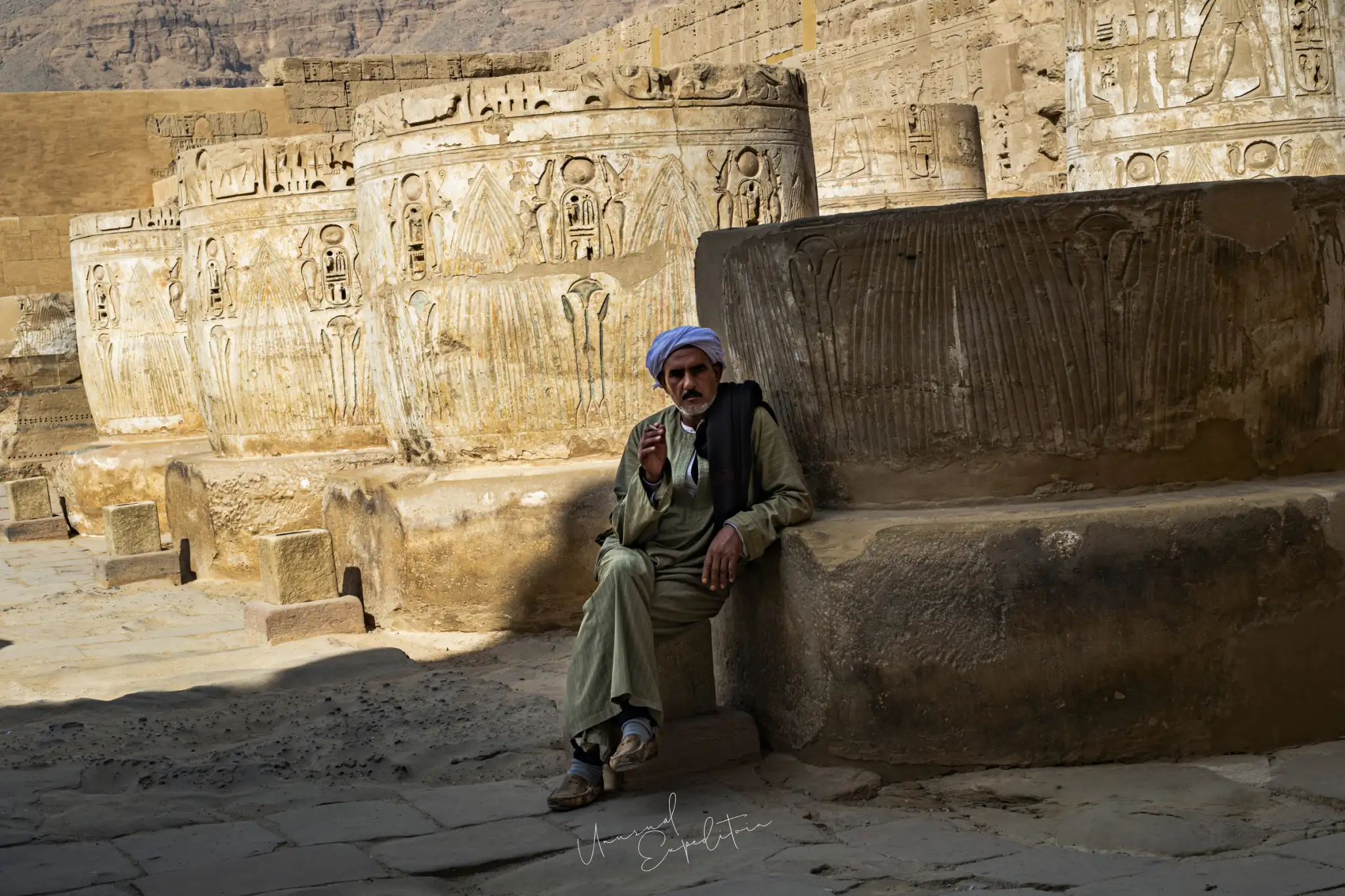
Medinet Habu is the mortuary temple of Ramesses III, recorded over decades by the University of Chicago's Epigraphic Survey. The fortified gate leads into courts where the reliefs are cut deep, and in the inner courts some of the original colour survives: blues, reds and ochres on the pillars and ceilings. Morning light reaches into the courts and lifts the paint without burning it out. A 16-35mm suits the courts, a 24-70mm the painted figures. The custodians here are patient people and often sit in the shade of the walls, which gives a sense of scale if you ask first.
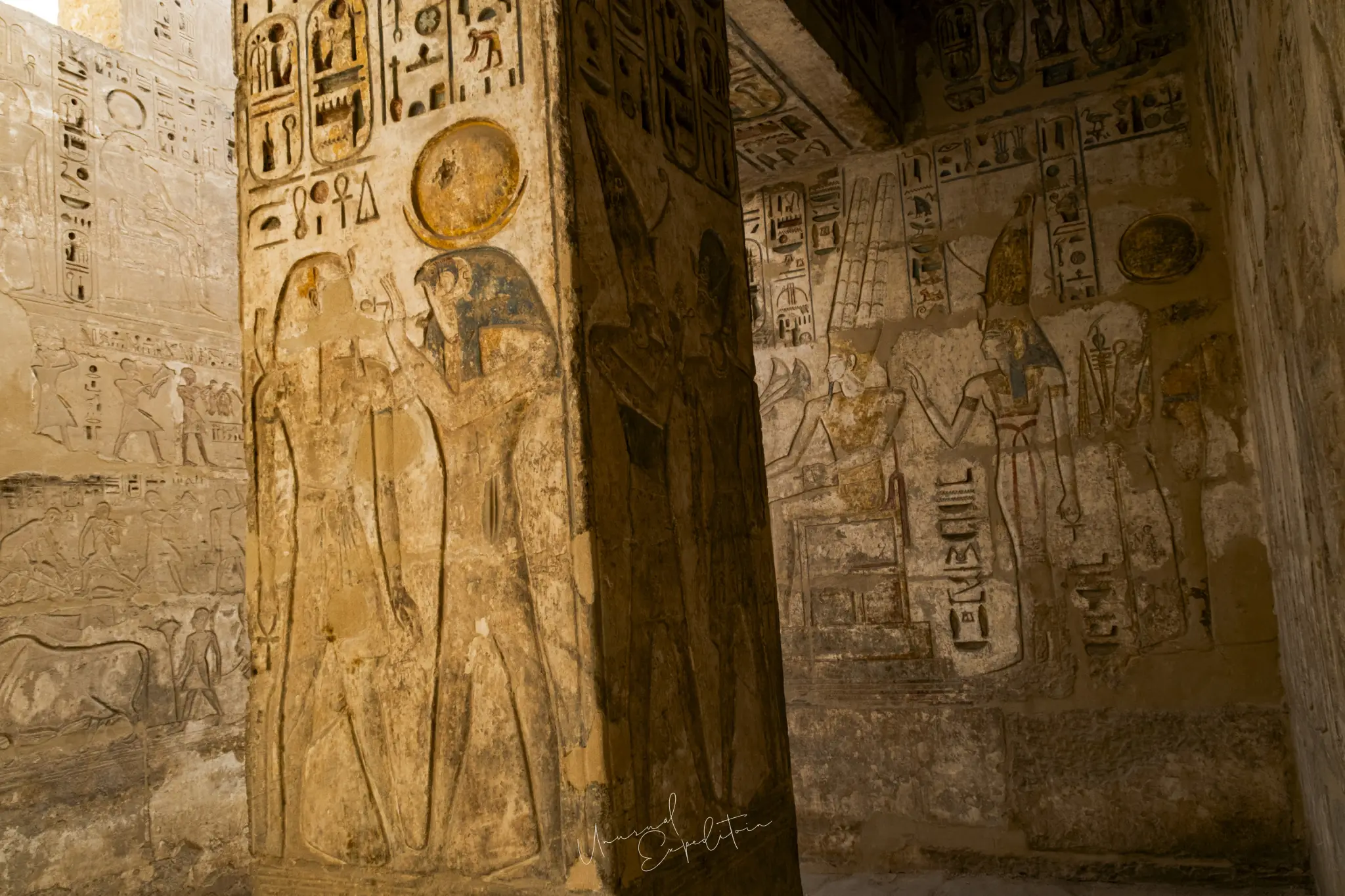
See Medinet Habu for the full walk through the temple.
Deir el-Bahari and the West Bank
Hatshepsut's temple at Deir el-Bahari is built in terraces against the limestone cliffs, and it faces east, so the morning sun lights the colonnades and the cliff behind them together. Stand back on the approach with a 24-70mm to keep the whole stack of terraces and the cliff in one frame. The Valley of the Kings lies behind the same cliffs; the Theban Mapping Project lists more than sixty tombs there, with a rotating handful open, and rules inside individual tombs can differ from the general permission, so check at the gate. Our Luxor West Bank article covers the whole side of the river.
A hot air balloon over the West Bank
A sunrise balloon flight over the West Bank is the one aerial photo spot open to visitors in Luxor. From the basket the green fields, the desert edge and the temples lie below, with dozens of other balloons drifting at different heights in the warm light. A 24-70mm covers it; keep the shutter fast because the basket moves. Flights are cancelled by the Egyptian Civil Aviation Authority for wind and weather, and since a 2018 incident the rules limit how many balloons fly and keep them west of the Nile, so treat the flight as a bonus.
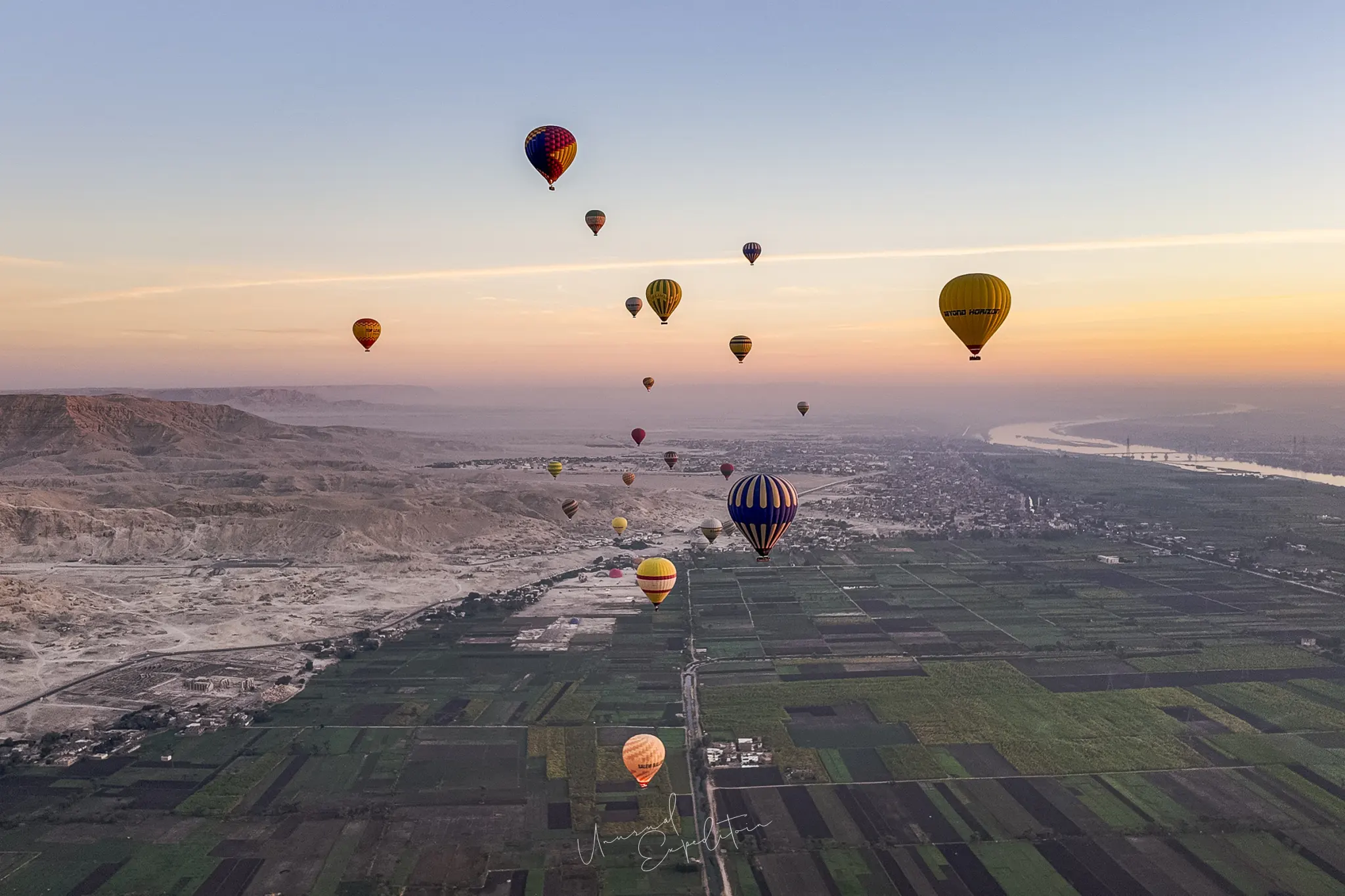
Booking, safety and what to expect are in Luxor hot air balloon.
"Karnak is a different temple at each end of the day. In the late sun the columns light up one at a time, and I tell people to stop walking and wait for the light to come to them."
Joseph Mak, tour leader, Unusual Expedition
Camera rules and crowds in Luxor
Personal photography without flash is allowed at sites of Egypt's Ministry of Tourism and Antiquities, which covers the temples here; drones need permission from the Egyptian Civil Aviation Authority. Ancient Thebes with its Necropolis is a UNESCO World Heritage Site and draws cruise groups in the middle of the morning, so be at the West Bank temples early and keep Karnak for the late afternoon, when many groups have gone back to their boats.
Photograph Luxor with us
Luxor is part of our Egypt Photo Tour with Cairo, Giza, Aswan and Abu Simbel, with Karnak, the West Bank temples and an optional balloon flight. The current departure is on the Egypt photography tours page.
Join the Luxor photography tour
Egypt Photo Tour – Egypt departs 12 Dec 2026 To 20 Dec 2026, led by Joseph Mak. Small group, photography first. All Luxor photography tours.
Explore Luxor in depth
- Luxor Photography Tour Guide: Karnak, the West Bank and the BalloonsEgypt
- Medinet Habu Temple: Colour, Reliefs and Quiet on the West BankEgypt
- West Bank of Luxor: Hatshepsut, the Valley of the Kings and Medinet HabuEgypt
- Luxor Temple Photos: Columns, Reliefs and the LightEgypt
- Luxor Hot Air Balloon at Sunrise: A Photographer's GuideEgypt
- Karnak Temple Hypostyle Hall: Photographing the ColumnsEgypt
- Best Time to Visit Luxor for Photography: Weather and LightEgypt
Upcoming Photo Tours
- Egypt Photo Tour – EgyptEgypt 12 Dec 2026 To 20 Dec 2026
- Inner Mongolia Winter Owl Photo Tour – ChinaChina 01 Jan 2027 To 04 Jan 2027
- Inner Mongolia Winter Photo Tour – ChinaChina 05 Jan 2027 To 11 Jan 2027
- Mekong And Central Highland Vietnam Photo Tour - VietnamVietnam 16 Jan 2027 To 24 Jan 2027