
Maasai Village Ngorongoro: Visiting and Photographing with Respect
Maasai village Ngorongoro: who lives in the conservation area, what a visit involves, fees, portraits with consent and the lenses to use.
A Maasai village in Ngorongoro is a boma, a ring of low mud and dung houses inside a thorn fence, home to an extended family and its cattle, goats and donkeys in the highlands around the crater. Several families along the crater roads welcome visitors for a fee paid to the community: you are greeted with song, watch the jumping dance, see inside a house and meet the women who make the beadwork. Done with time and good manners, it is some of the best people photography in Tanzania.
This guide belongs to our Ngorongoro photography tour guide. For the Kenyan side of Maasai country, read our Maasai village visit guide from the Masai Mara.
Maasai village Ngorongoro: who lives in the conservation area
The Maasai have grazed the Ngorongoro highlands for generations, and the Ngorongoro Conservation Area was set up in 1959 as a multiple land use area so that they could stay. UNESCO's World Heritage listing describes it in those terms: wildlife living alongside semi-nomadic Maasai pastoralists. Life has changed a great deal since. Herders no longer take their cattle down to the crater floor, which National Geographic reported was restricted from about 2015, and the government has encouraged families to move out of the area to new land at Msomera since 2022. Human Rights Watch has described that relocation as forced in practice, while the government presents it as voluntary and necessary for the ecosystem. It is a live issue, and it is worth reading about before you go.
Maasai village visit Tanzania: what happens
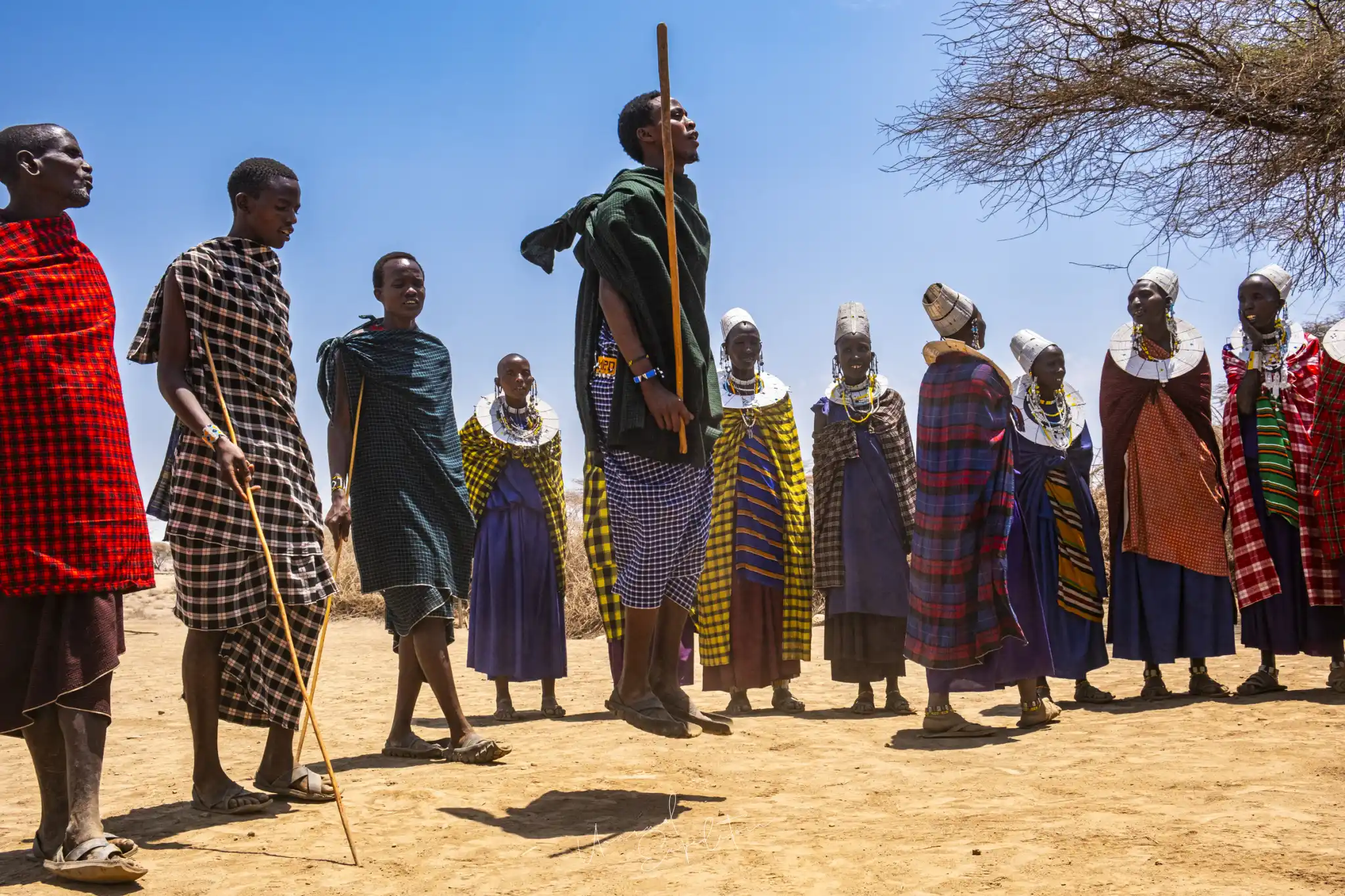
A Maasai village visit in Tanzania usually starts at the boma gate, where the women sing a welcome in a line and the men answer with their own song. The men then perform the adumu, the jumping dance, which the National Museums of Kenya describe as the climax of the Eunoto ceremony that marks young warriors coming of age; at a visitors' boma it is a demonstration, with the young men taking turns to jump straight up from a standing start while the others sing. You may be invited inside a house to see the cooking fire and sleeping places, and the women lay out beadwork for sale. Fire-making with sticks is another common demonstration. Nobody minds questions, and the conversation is often the best part.
Ngorongoro crater Maasai: photographing people with respect
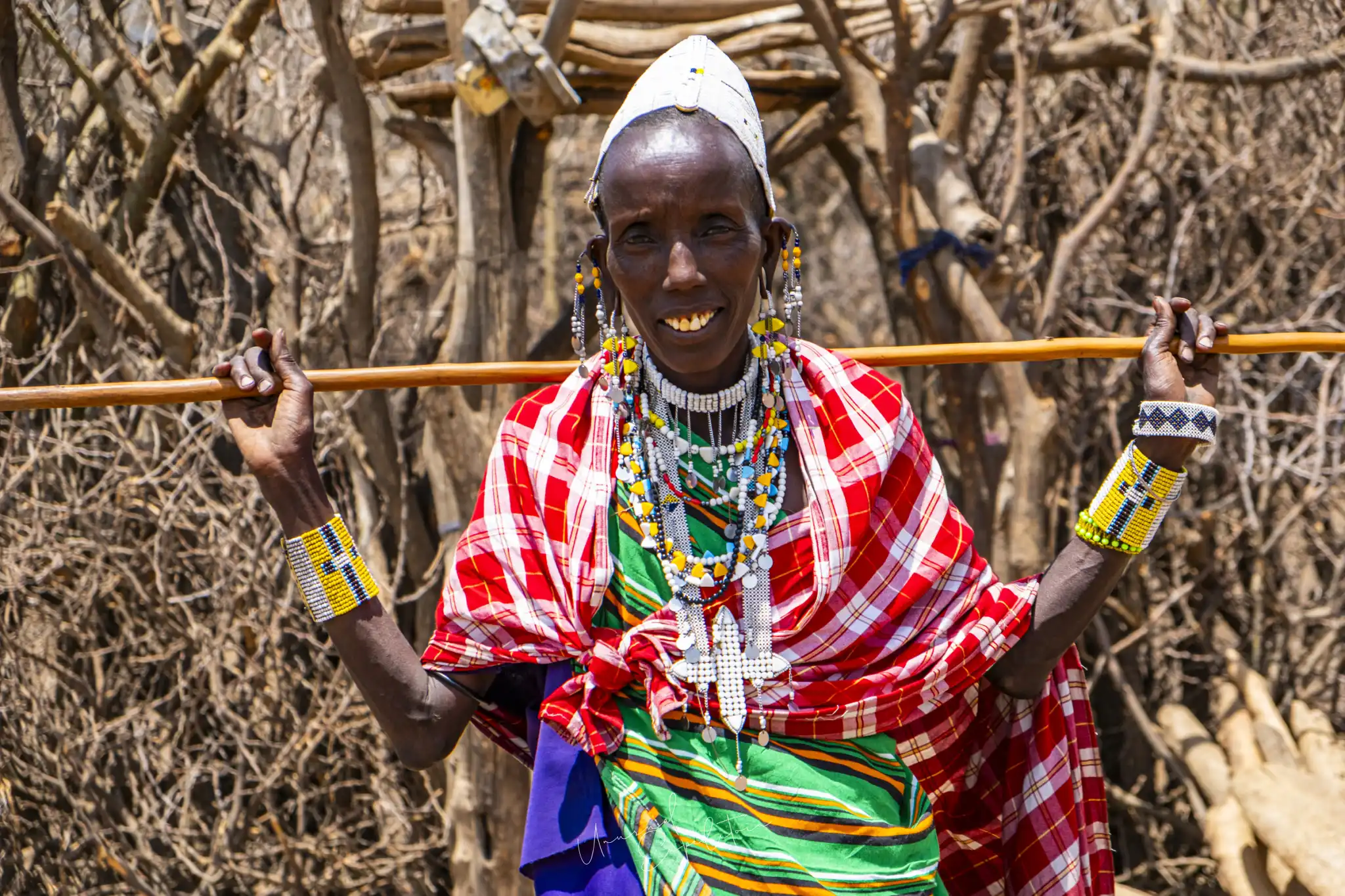
Ngorongoro crater Maasai families see many visitors, and the photographs that work are the ones made with permission and a little patience. Ask before every close portrait, through your guide if needed, and show the person the picture on the back of the camera; it is often what turns a polite pose into a smile. Photograph the dance and the welcome freely once you are inside, because that is what it is for, but do not walk into houses or pick up a lens at someone who has turned away. We do not photograph or publish children, and we suggest you take the same line. The woman on the card of this page posed for us by the thorn fence, her walking stick across her shoulders, smiling straight into the lens.
Maasai village tour Tanzania: paying and choosing a village
A Maasai village tour in Tanzania is arranged through your safari guide, who knows which bomas receive visitors and how they work. Most charge an entry fee per person, paid to the community, and the beadwork is sold separately at prices the women set. We do not quote amounts here because they differ by village and change; your guide will tell you before you go in. Choose a boma that is used to visitors and has an agreed fee: everyone knows what to expect, and the money reaches the families. A visit fits easily between the crater and the road west to Oldupai Gorge and the Serengeti, and it suits the middle of the day, when the light on the crater floor is at its flattest.
Light and lenses for a Maasai boma
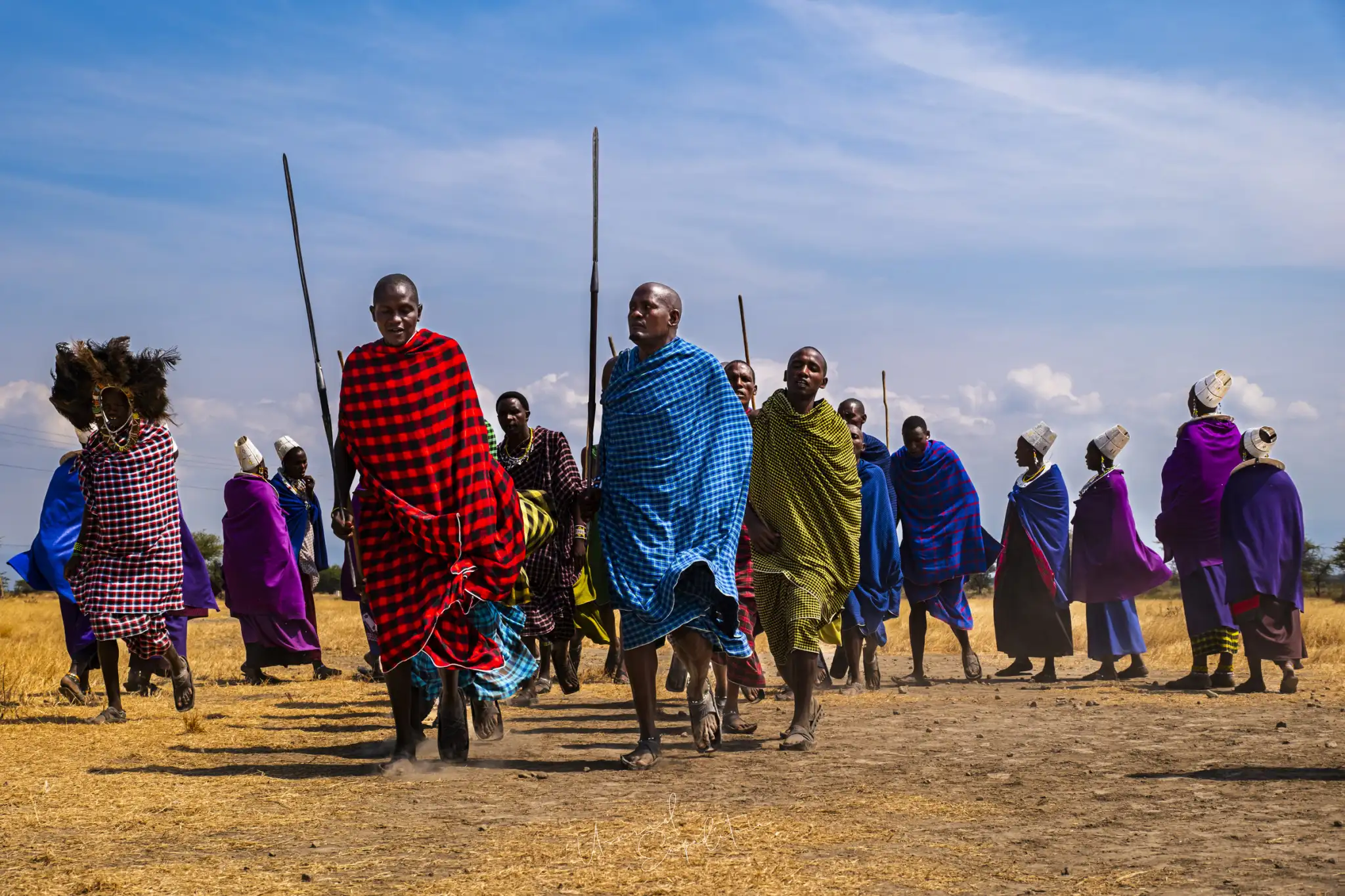
Maasai bomas are bright, dusty and full of colour, and the light is usually hard, because visits tend to fall in the middle of the day. Hard light suits the red, blue and checked shukas and the beadwork, which hold their colour in full sun; it is less kind to faces, so look for open shade by a house wall or the thorn fence for portraits. These are the lenses we use.
| Subject in the boma | Lens | Note |
|---|---|---|
| Welcome song and the line of women | 24-70mm | Low angle, sky behind, include the collars |
| The jumping dance | 24-70mm or 70-200mm | Fast shutter, time it at the top of the jump |
| Portraits by a house or fence | 70-200mm | Open shade, ask first, show the frame |
| Beadwork and hands | 24-70mm close | Details tell the story without faces |
Leave the 100-400mm in the vehicle; a long lens from a distance reads as intrusion in a place where people have invited you in.
"The best Maasai pictures I have came after the dance, not during it. Once the performance is over people relax, the jokes start, and you are just a visitor with a camera they have already met."
Joseph Mak, tour leader, Unusual Expedition
How a village visit fits a Ngorongoro trip
A Maasai village fits naturally on the same day as the crater, before or after the game drive, and pairs well with Oldupai Gorge on the road west. If you are deciding how to split your days between the crater and the plains, our Ngorongoro Crater vs Serengeti comparison helps, and the practical questions about gates, fees and guides are in the Ngorongoro photography FAQ. Further north-east, beyond the conservation area, Maasai families also live around Lake Natron under the volcano Ol Doinyo Lengai, a quieter place for portraits with a landscape behind.
Visit a Maasai village with us
Our Tanzania departures are listed on the Tanzania photography tours page. If you want time with a Maasai family at your own pace, with the crater on the same trip, we arrange it as a private trip for individuals, couples and families, and a photographer can join you for coaching at extra cost.
Ask us about a Maasai village visit
Join the Ngorongoro photography tour
Serengeti Photo Tour – Tanzania 2027 departs 21 Aug 2027 To 01 Sep 2027. Small group, photography first. All Ngorongoro photography tours.
Explore Ngorongoro in depth
- Ngorongoro Crater Photography: The Complete GuideTanzania
- Ngorongoro Photography FAQ: Fees, Opening Hours and Crater RulesTanzania
- Ngorongoro Crater vs Serengeti: Which to Photograph, and Is the Crater Worth ItTanzania
- Ngorongoro Crater Photos: What the Crater Really Looks LikeTanzania
- Ngorongoro Crater Animals: Black Rhino, Buffalo, Hyena and the RestTanzania
- Lake Natron Photos: The Soda Lake and Ol Doinyo LengaiTanzania
- Best Time to Visit Ngorongoro Crater for PhotographyTanzania
Upcoming Photo Tours
- Egypt Photo Tour – EgyptEgypt 12 Dec 2026 To 20 Dec 2026
- Inner Mongolia Winter Owl Photo Tour – ChinaChina 01 Jan 2027 To 04 Jan 2027
- Inner Mongolia Winter Photo Tour – ChinaChina 05 Jan 2027 To 11 Jan 2027
- Mekong And Central Highland Vietnam Photo Tour - VietnamVietnam 16 Jan 2027 To 24 Jan 2027