
Sichuan Opera Face Changing in Chengdu: How to Photograph the Show
Sichuan opera face changing in Chengdu: backstage make-up, masks and costumes, teahouse stages, camera settings and etiquette.
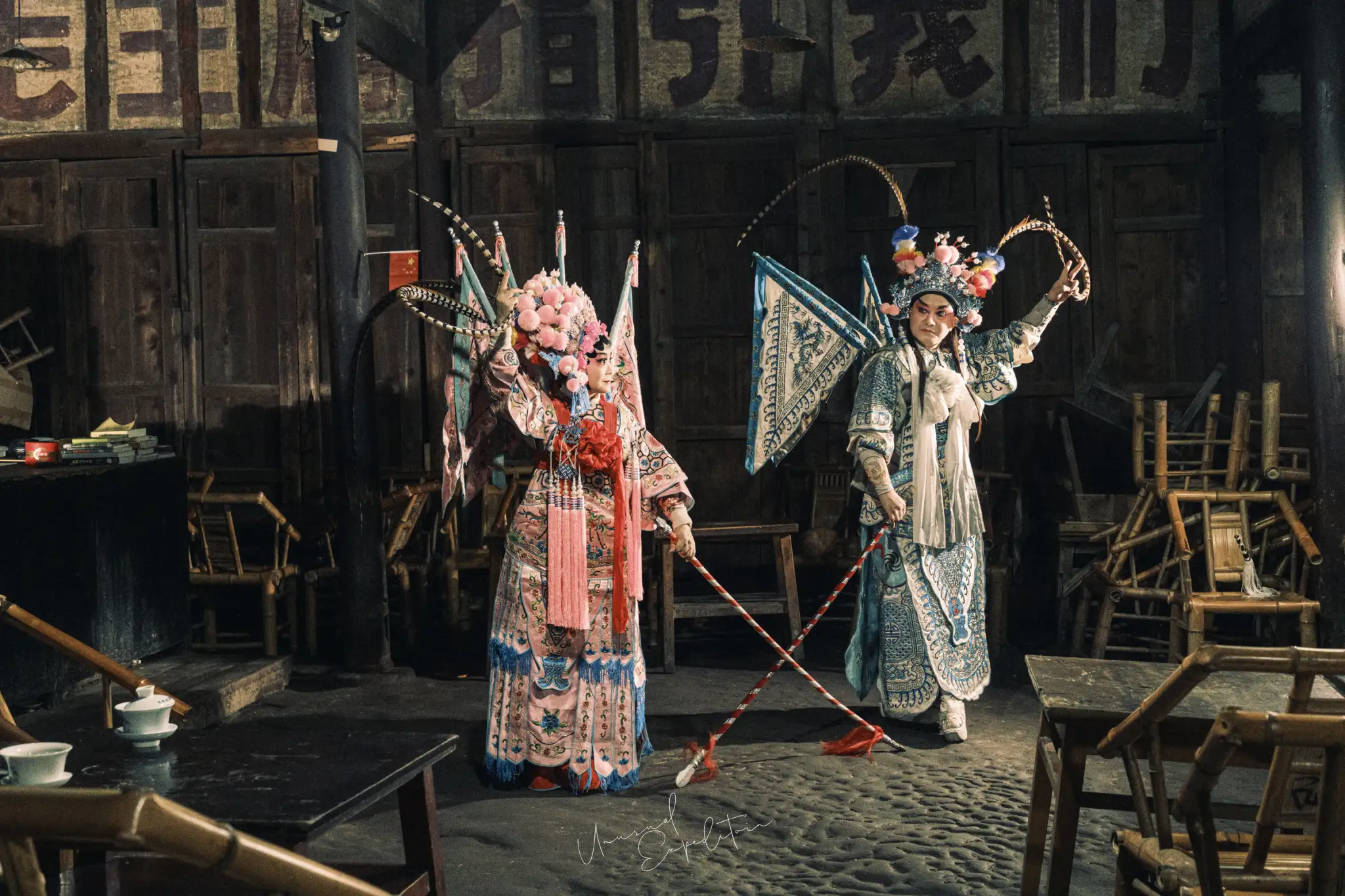
Sichuan opera face changing, bian lian in Chinese, is the trick every visitor to Chengdu wants to see: a performer sweeps a hand or a fan past the face and the painted mask changes colour in an instant. For photographers, the richer pictures are often around the show rather than the trick itself: make-up in small mirrors, embroidered costumes, headdresses and performers on an old teahouse stage. This guide explains how we photograph Sichuan opera in Chengdu.
Chengdu is where our western Sichuan trips begin and end, and the city's teahouse culture is covered in our western Sichuan photography tour guide. This article looks at one subject in depth: the opera.
What Sichuan opera is
Sichuan opera, chuanju, is the regional opera of Sichuan and Chongqing, with high-pitched singing, percussion, comic roles, acrobatics and, in the shows staged for visitors, puppetry, fire spitting and face changing. The South China Morning Post describes face changing as a centuries-old art that has been listed among China's intangible cultural heritage, and the Smithsonian notes that only a few hundred people are said to have mastered it. The technique is famously guarded and was traditionally passed down within families, from master to disciple. What visitors see in Chengdu ranges from short variety shows in theatres and teahouses, with a face-changing finale, to longer traditional pieces performed for local audiences who know every line.
Sichuan opera face changing: can you photograph it?
You can try, but the change itself is built to beat the eye, and it beats most cameras too. Each change lasts a fraction of a second and happens behind a sweep of a sleeve or a fan, under stage lights that are rarely bright. A fast shutter of at least a two hundred and fiftieth of a second, a high ISO and burst mode give you a chance of catching the fan mid-sweep, but expect most frames to show a mask before or after the change. Many photographers do better by treating face changing as a story in two frames, one mask and then the next, or by filming it. Always check the house rules: some theatres ban flash and some ban photography during the show altogether.
Backstage: the make-up
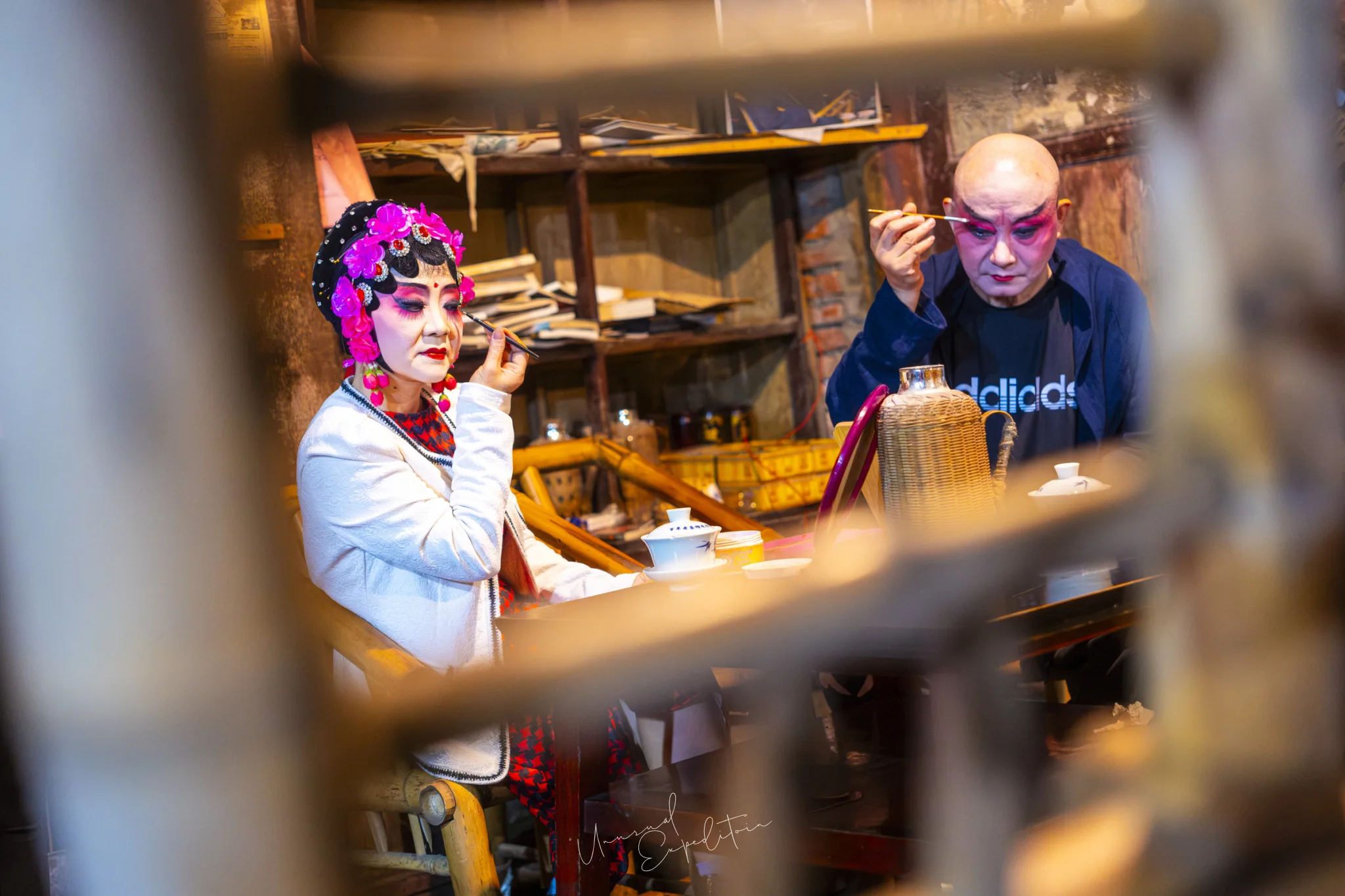
The make-up is where Sichuan opera gives photographers the most. Performers paint their own faces, often in a cramped corner beside the stage, using small mirrors, pots of colour and brushes laid out on a table. The bold lines of white, red and black that mark each role build up layer by layer, and the mirror lets you show the painted face and the working hands in one frame. A fast prime such as a 33mm at a wide aperture handles the low light and lets you blur the clutter around the mirror. We arrange backstage access in advance through the venue; turning up and walking in is not acceptable, and the performers are working to a deadline.
Costumes, headdresses and masks
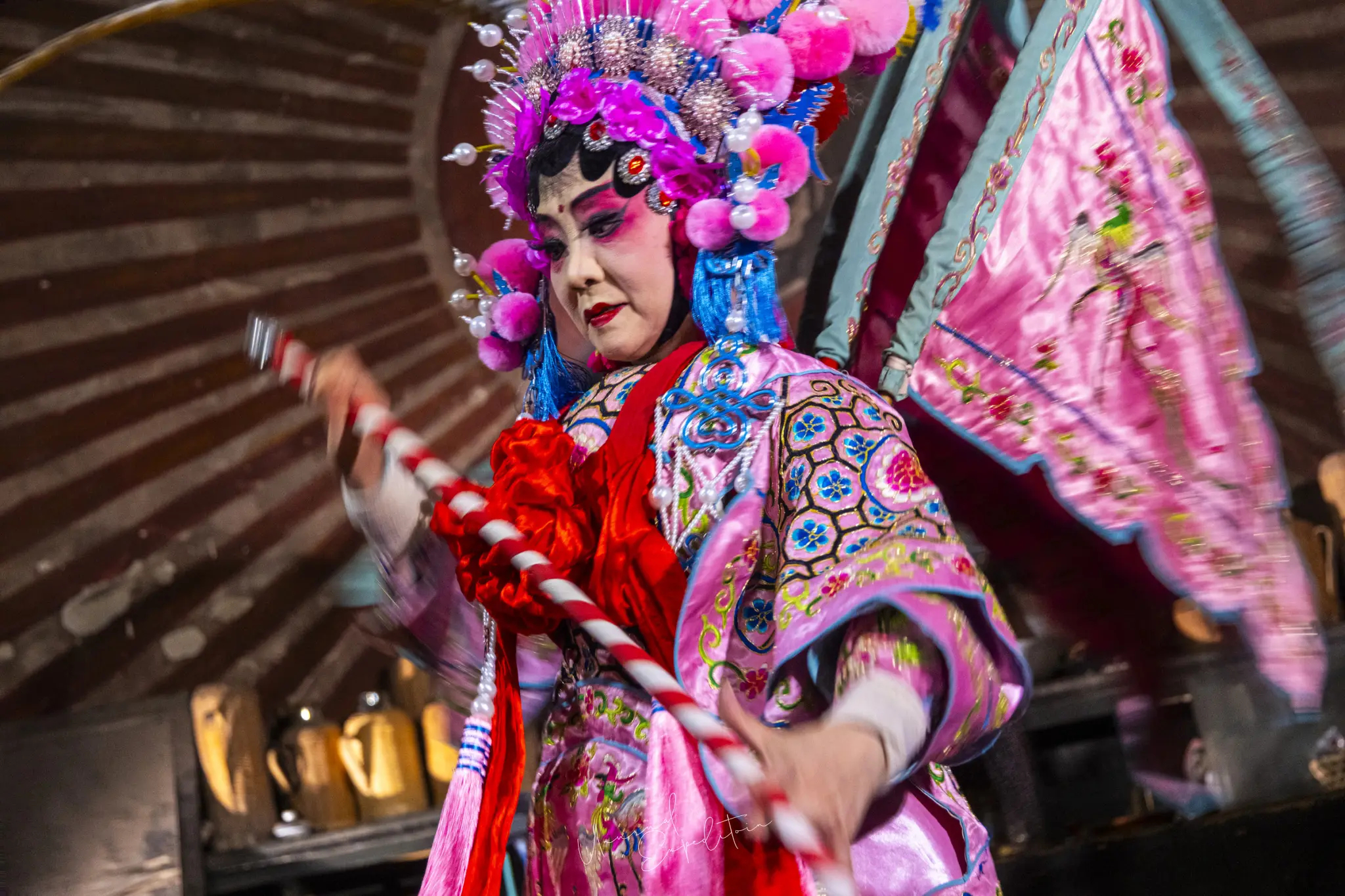
Sichuan opera masks and costumes are as photogenic as the faces: embroidered robes, pom-pom headdresses, long pheasant feathers and banners strapped to the back of military roles. They read best against a dark background, which an old teahouse provides naturally. Get close and fill the frame with fabric, beads and painted face together, and use a slightly slower shutter, around a fiftieth of a second, when a performer twirls a prop so that it blurs while the face stays sharp. Ask before photographing a performer in costume off stage: most are generous, but some are getting ready and do not want to be disturbed.
On the teahouse stage
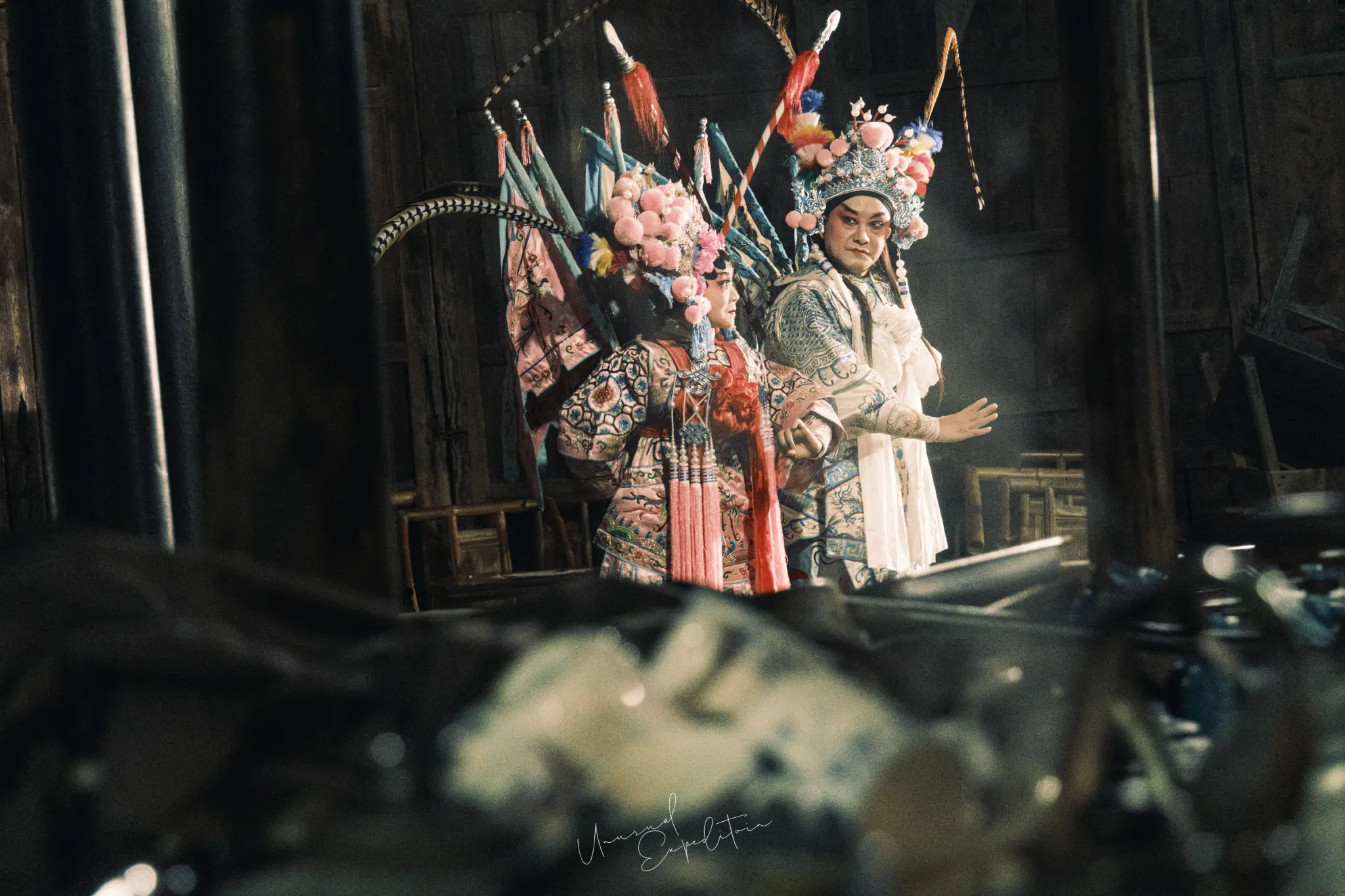
The best Sichuan opera show in Chengdu for photography is often not the biggest. In an old teahouse the stage is small, the audience sits at bamboo tables with tea, and the performers move a few metres from you. That intimacy lets you include the setting: wooden chairs, kettles, posters on dark walls and the people watching. Steam from the kettles drifting through the stage lights adds atmosphere. Work from the side of the room so you do not block anyone's view, and keep the lens hood on, because stage lights are often pointed straight back at the audience.
Camera settings for Sichuan opera
| Situation | Shutter | ISO | Lens |
|---|---|---|---|
| Make-up at the mirror | About 1/60 s | High, 3200 is normal | Fast prime, wide open |
| Performers on stage | 1/80 to 1/250 s | High | 24-70mm or 70-200mm |
| Face changing | 1/250 s or faster, burst | As high as needed | 70-200mm from the side |
| Twirling props, motion | About 1/50 s | Medium | 24-70mm |
| Fire spitting | 1/250 s | Lower, the flame is bright | 24-70mm |
Shoot raw: stage lighting mixes colours, and you will want to set the white balance afterwards. Turn off the focus-assist lamp and the shutter sound.
The first time I photographed the opera I spent the whole show trying to catch the face change and got almost nothing. The next time I went backstage early, sat quietly in the corner, and watched one performer paint the face for the role. Those are the pictures I still look at.
Joseph Mak, tour leader, Unusual Expedition
Where to see Sichuan opera in Chengdu
Chengdu has theatres that stage nightly Sichuan opera shows for visitors, with face changing, fire spitting, puppetry and short scenes from classic plays, and teahouses where a stage is part of the room. The Yuelai Teahouse is long known for opera, and the People's Park teahouses and the old teahouses on the edge of the city are worth asking about. Programmes and venues change, so check current listings with your hotel or guide rather than relying on old reviews. For the life of the teahouses themselves, read our Chengdu teahouse photography guide.
Etiquette at the show
Buy a ticket or a tea, sit where you are placed, and never use flash during a performance. Phone screens and camera screens are bright in a dark teahouse, so dim them. If the venue allows photography but the audience is local and attentive, shoot less and from the edges. Backstage, keep out of narrow passages, do not touch costumes or props, and leave the moment you are asked. Performers often welcome a print or a copy of the best picture; offer one through the venue.
Sichuan opera on a western Sichuan trip
A night at the opera fits the first or last evening of a trip to the high country, when everyone is in Chengdu and needs a gentle start or a soft landing after the altitude. It is a useful contrast in a portfolio from the region, too: warm lamp light, colour and faces after days of open grassland and snow peaks. For the mountain side of the trip, read our western Sichuan photo spots.
Photograph Sichuan opera with us
We arrange Sichuan opera and teahouse evenings in Chengdu on our western Sichuan trips and on private trips on request. Current departures and all our China guides are on the China photography tours page.
Join the Sichuan photography tour
Inner Mongolia Winter Owl Photo Tour – China departs 01 Jan 2027 To 04 Jan 2027, led by Joseph Mak. Small group, photography first. All Sichuan photography tours.
Explore Sichuan in depth
- Western Sichuan Tour: A Photography Guide to Tibetan SichuanChina
- Tagong Grassland Photos: Zhara Lhatse, Tagong Monastery and YaksChina
- Litang Monastery Photos: Gold Roofs, Monks and Yaks at 4,000 MetresChina
- Western Sichuan Photo Spots: Litang, Tagong, the Passes and DanbaChina
- Larung Gar Photos: The Buddhist Academy at Seda, and Whether You Can Go NowChina
- Chengdu Teahouse Photos: Old Teahouses and Sichuan OperaChina
- Best Time to Visit Western Sichuan for PhotographyChina
Upcoming Photo Tours
- Egypt Photo Tour – EgyptEgypt 12 Dec 2026 To 20 Dec 2026
- Inner Mongolia Winter Owl Photo Tour – ChinaChina 01 Jan 2027 To 04 Jan 2027
- Inner Mongolia Winter Photo Tour – ChinaChina 05 Jan 2027 To 11 Jan 2027
- Mekong And Central Highland Vietnam Photo Tour - VietnamVietnam 16 Jan 2027 To 24 Jan 2027