
Papua New Guinea Traditional Dress: Bilas, Face Paint and Headdresses of the Highlands
Papua New Guinea traditional dress in the Highlands: bilas, women's and men's dress, headdress and face paint meaning, kina shells.
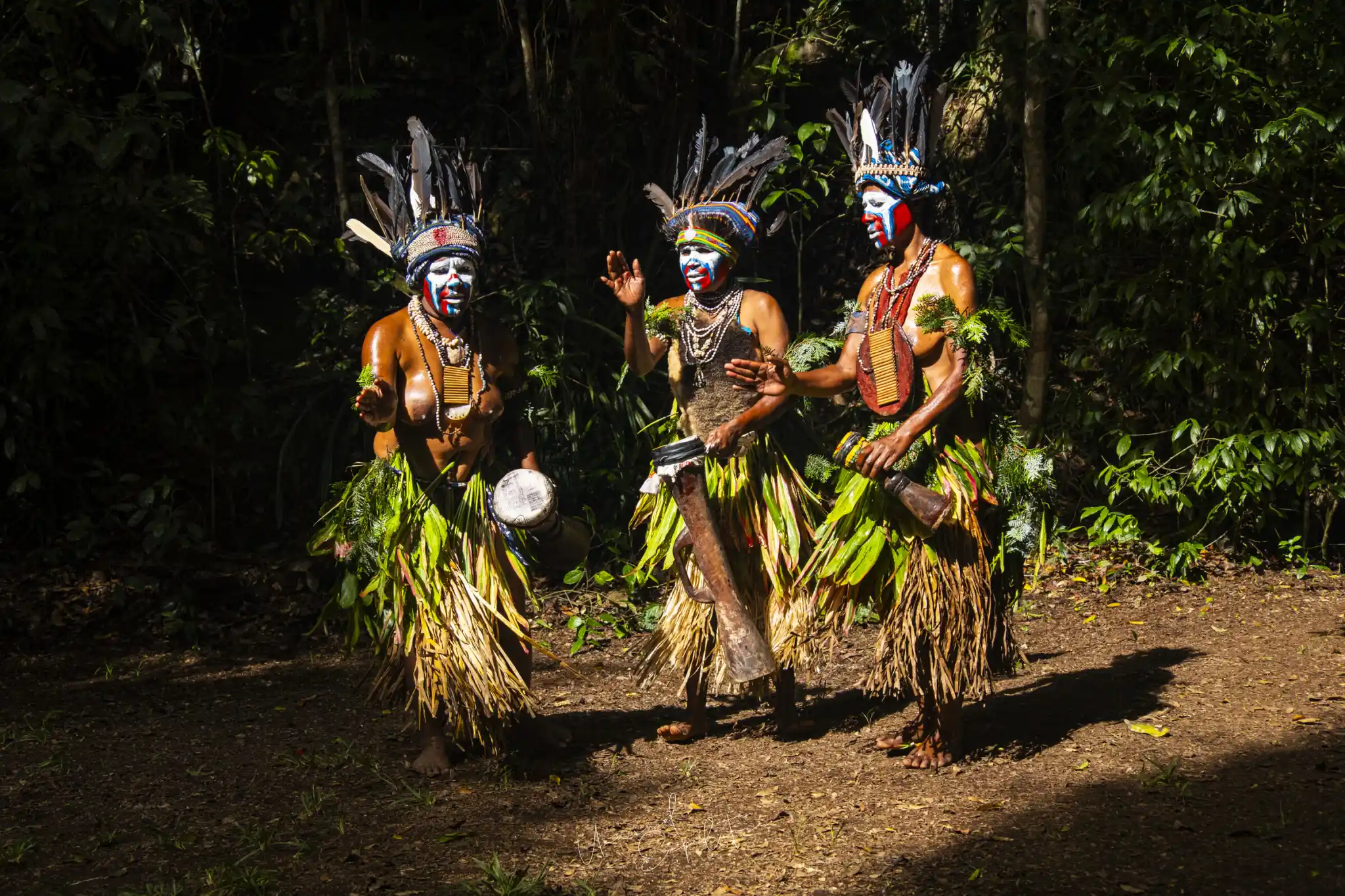
Papua New Guinea traditional dress in the Highlands is called bilas, the Tok Pisin word for body adornment: feather headdresses, face paint, shell necklaces, kina-shell breastplates, grass skirts and leaf aprons, worn for sing-sings, bride-price exchanges and other ceremonies. Every clan and valley has its own style, so the dress tells you who someone is and where they come from. Everyday clothes are ordinary shirts and skirts; bilas is ceremonial finery.
This is the dress behind almost every famous portrait from the country, and it is what our village sessions are built around. It belongs to our Papua New Guinea Highlands photography guide, with separate pieces on the Huli wigmen, the Asaro mudmen and the Chimbu skeleton dancers.
Papua New Guinea traditional clothing name: bilas
The Papua New Guinea traditional clothing name you will hear most is bilas, which covers everything worn to look one's best for a ceremony: paint, feathers, shells, leaves, fur, beads and woven pieces. The Australian Museum, which held a major exhibition called Bilas, describes adornment in Papua New Guinea as a form of language, signalling clan, status and occasion. A few other Tok Pisin words come up in the Highlands. A pulpul is a grass skirt. A laplap is a wrapped cloth. Tanget are the cordyline leaves many highland men tuck into a belt at the back. A bilum is the looped string bag carried by almost everyone, often with feathers or patterns worked in. Most of what you photograph at a sing-sing is owned by the family and kept carefully between ceremonies.
Papua New Guinea traditional dress female
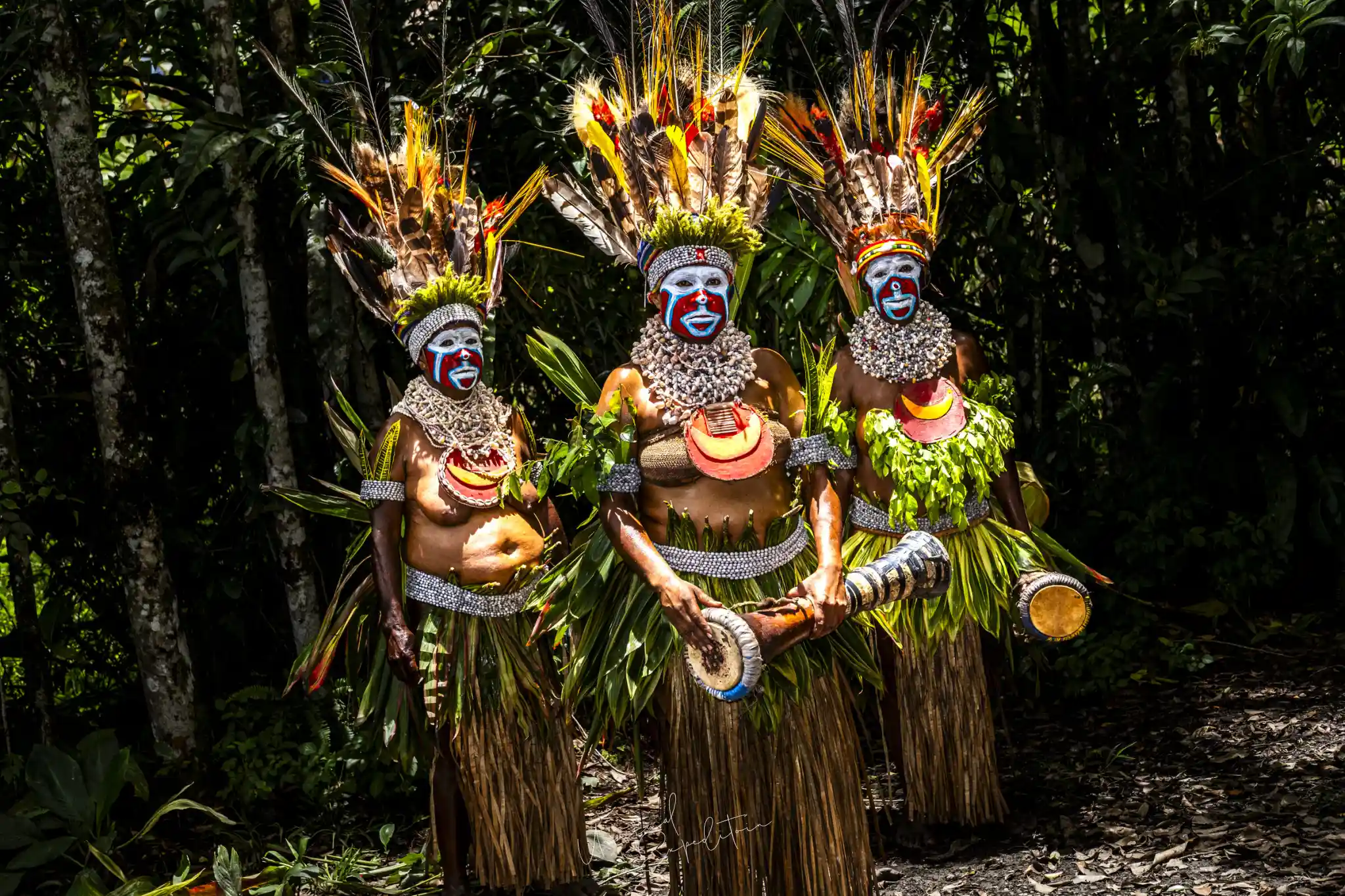
Papua New Guinea traditional dress for women in the Highlands usually starts with a pulpul of grass or fibre, layered to the knee, with strings of shell and seed beads across the chest and a kina-shell crescent hanging at the throat or breast. Many groups add a tall headdress of feathers, sometimes as tall as the dancer's own body, and paint the face in bold red, white and black patterns. Women dance in lines, often with a kundu drum, and their bilas is as elaborate as the men's. Bare breasts are part of traditional dress in many highland groups; photograph them with the same respect you would give any portrait, and never single someone out for it.
Papua New Guinea traditional dress male
Papua New Guinea traditional dress for men varies more from group to group. Huli men in Hela Province wear wigs made from their own hair, decorated with feathers and everlasting flowers, with yellow and red face paint. Men in other valleys wear a woven or bark belt with a front apron and tanget leaves behind, armbands, pig-tusk or shell ornaments in the nose, and headdresses of cassowary, parrot and bird-of-paradise feathers. Some groups, like the Asaro mudmen and the Chimbu skeleton dancers, go further and change the whole body with clay or paint. A man in full bilas may also carry a stone axe, a bow and arrows or a spear, which is where the many searches for Papua New Guinea warrior photos come from.
Papua New Guinea headdress meaning
The Papua New Guinea headdress meaning is about wealth, identity and connection to the birds and spirits of the forest. Feathers are the most valuable part of bilas: bird-of-paradise plumes, the red feathers of Pesquet's parrot and the black plumes of the cassowary. The Wildlife Conservation Society in Papua New Guinea reports that headdresses are treated as heirlooms and passed down, and that so many Pesquet's parrot feathers are in use that there may be more of the birds in headdresses than alive in the wild. A large headdress shows that a family has the wealth and the connections to assemble it.
Papua New Guinea face paint meaning
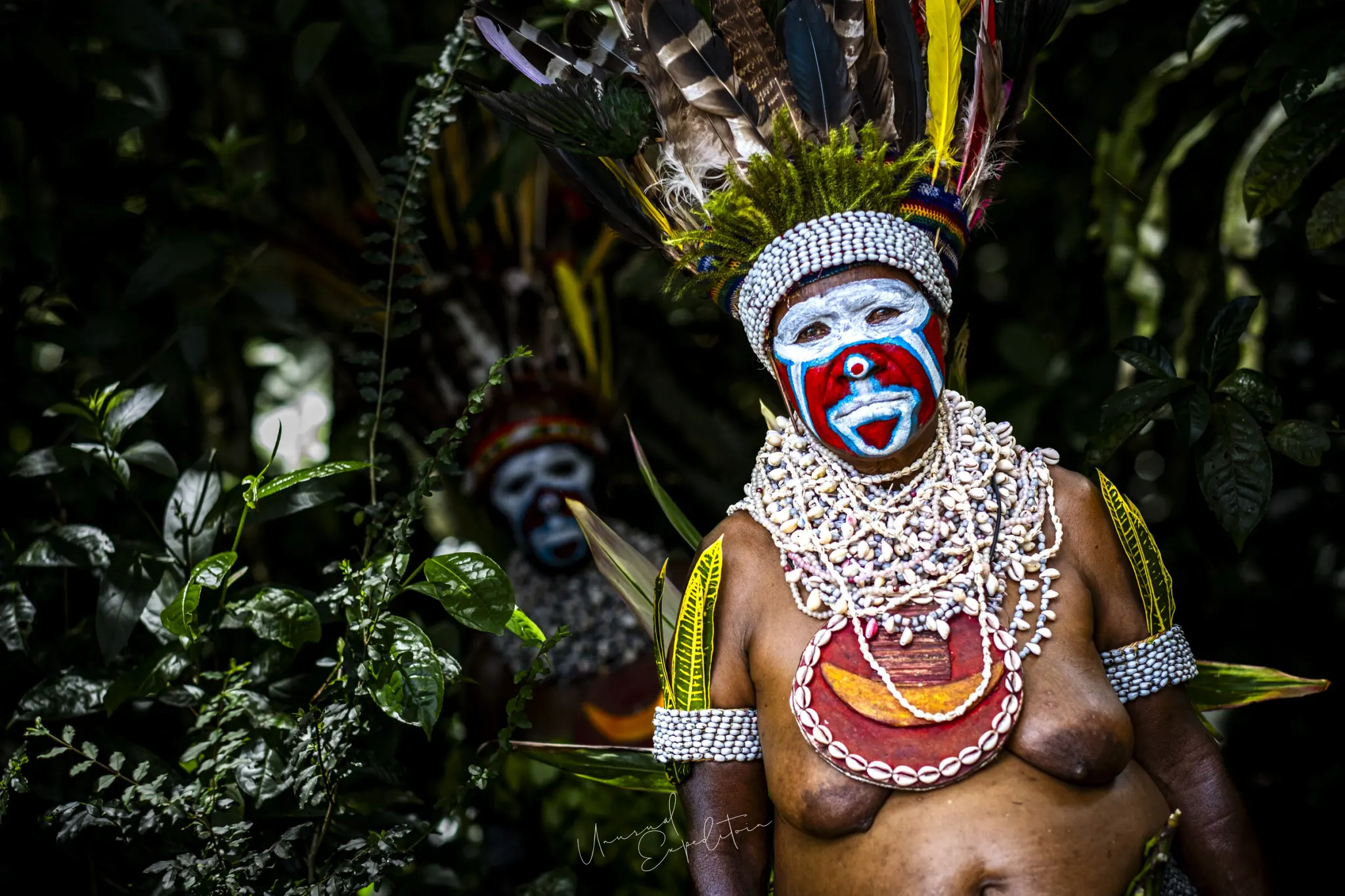
The Papua New Guinea face paint meaning depends on the group. For the Huli, yellow ochre with red and white lines is the colour of ceremony. For other highland groups, red and white patterns around the eyes and mouth, or a face split into blocks of blue, red and white, mark a clan's own style, and a dancer from a neighbouring valley would recognise it at once. Paint was traditionally made from clays, ochres, charcoal and plant oils, mixed and applied by hand. Painting takes time and is done in groups, one person painting another with a stick, a leaf or a finger, often with a small mirror. It is one of the best moments of a session to photograph, because faces are relaxed and the light is usually soft in the shade.
Kina shells and the national currency
The kina is a crescent cut from gold-lip pearl shell, traded inland from the coast and worn on the chest as a sign of wealth. Shells were part of bride-price and other exchanges in the Highlands, and when Papua New Guinea created its own currency it named it the kina, with the smaller unit, the toea, named after another valued shell ornament, as the Bank of Papua New Guinea explains in its history of the currency. In a portrait the kina catches light beautifully: angle the dancer slightly towards the brightest part of the sky and it glows.
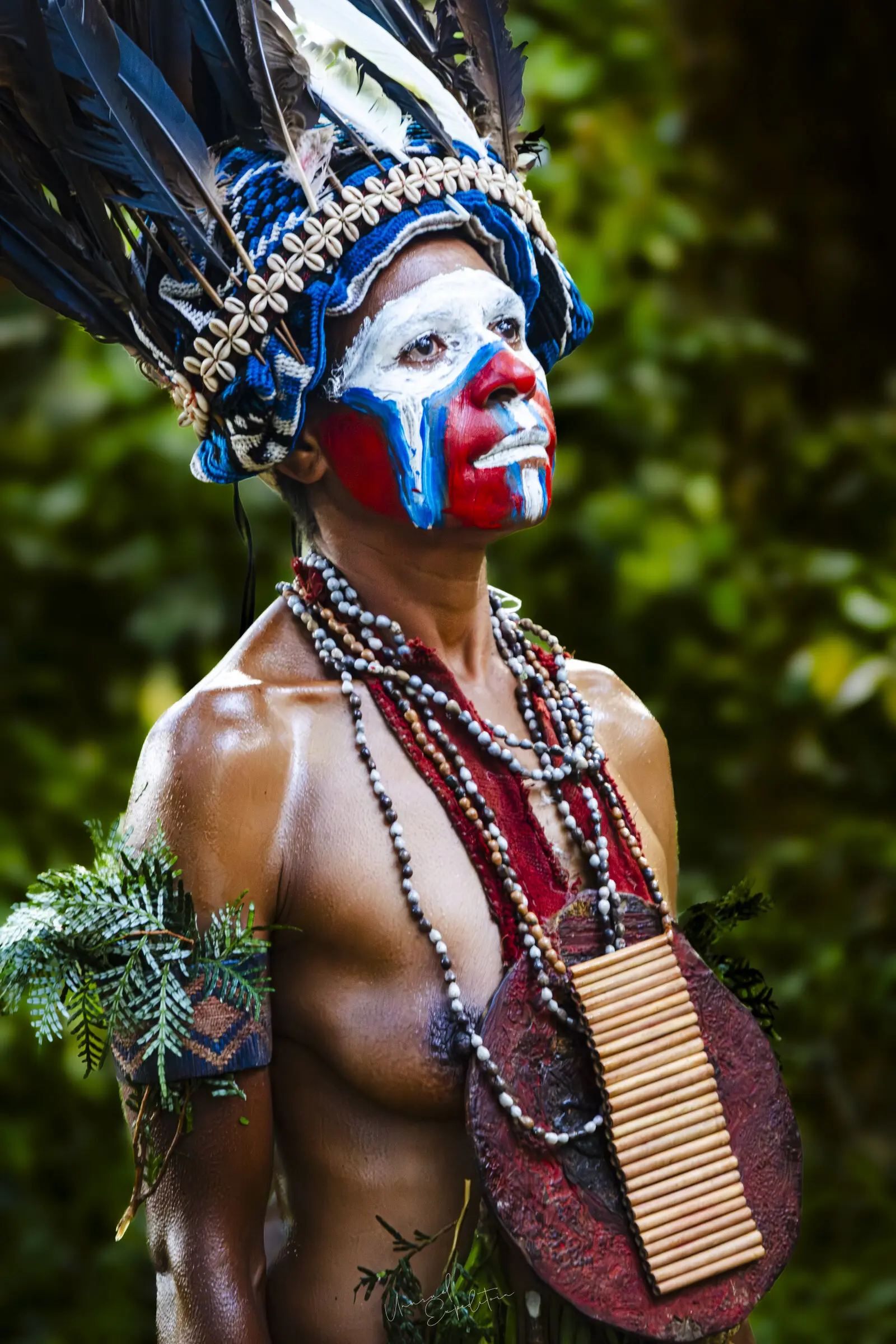
"I tell every group the same thing: the bilas is not a costume, it is somebody's grandfather's feathers. Ask what each piece is, who made it and who wore it before. People light up when you ask, and the portraits get better because of it."
Joseph Mak, tour leader, Unusual Expedition
Papua New Guinea sing sing: where the dress is worn
A Papua New Guinea sing sing is a gathering of song and dance, held for a celebration, a payment, a funeral feast or a show, where groups dress in full bilas and dance for hours. The best known are the big shows, the Mount Hagen Show in August and the Goroka Show in September, where dozens of groups perform on one ground. On our trips we photograph smaller sing-sings arranged with a village, which means fewer people, more time with each group and natural backgrounds instead of crowds. Timing for the shows is in best time to visit Papua New Guinea.
Sing sing dance Papua New Guinea: photographing it
| Moment | Lens | Approach |
|---|---|---|
| Painting and dressing | 24-70mm | Stay close and quiet, shoot in the shade |
| Portraits in full bilas | 24-70mm, 70-200mm | Dark forest behind, light from one side |
| Group dance | 24-70mm, 16-35mm | Shoot from the edge, 1/500 s for feathers in motion |
| Details: kina, shells, feathers | 70-200mm or macro | Ask first, frame tight |
The dance is fast and the feathers never stop moving, so the quiet moments before it are where most of the strongest portraits come from.
Photograph highland dress with us
Our Papua New Guinea trips are small private journeys built around village sing-sings arranged with each community. Planned departures and how to join are on the Papua New Guinea photography tours page.
Papua New Guinea Highlands photography tours
The next Papua New Guinea Highlands departure is announced on the Papua New Guinea Highlands photography tours page, with previous expeditions and all the planning guides.
Explore Papua New Guinea Highlands in depth
- Papua New Guinea Highlands Photography Guide: Tribes, Markets and BirdsPapua New Guinea
- Papua New Guinea Highlands Photography FAQ: Fees, Consent, Weather and GearPapua New Guinea
- Papua New Guinea Bird Watching: Parrots, Kingfishers and Honeyeaters of the HighlandsPapua New Guinea
- Birds of Paradise Papua New Guinea: A Photographer's GuidePapua New Guinea
- Skeleton Tribe Papua New Guinea: Photographing the Chimbu Skeleton DancersPapua New Guinea
- Asaro Mudmen Photos: the Mud Masks of the Eastern HighlandsPapua New Guinea
- Huli Wigmen Photos: Photographing the Huli of Papua New GuineaPapua New Guinea
Upcoming Photo Tours
- Egypt Photo Tour – EgyptEgypt 12 Dec 2026 To 20 Dec 2026
- Inner Mongolia Winter Owl Photo Tour – ChinaChina 01 Jan 2027 To 04 Jan 2027
- Inner Mongolia Winter Photo Tour – ChinaChina 05 Jan 2027 To 11 Jan 2027
- Mekong And Central Highland Vietnam Photo Tour - VietnamVietnam 16 Jan 2027 To 24 Jan 2027