
Pushkar Fair Market: Pots, Tools and Camel Finery at the Camel Mela
The Pushkar camel mela market: clay pots, tools, harness, camel finery, feather fans and fodder trucks, and how to photograph the sellers.
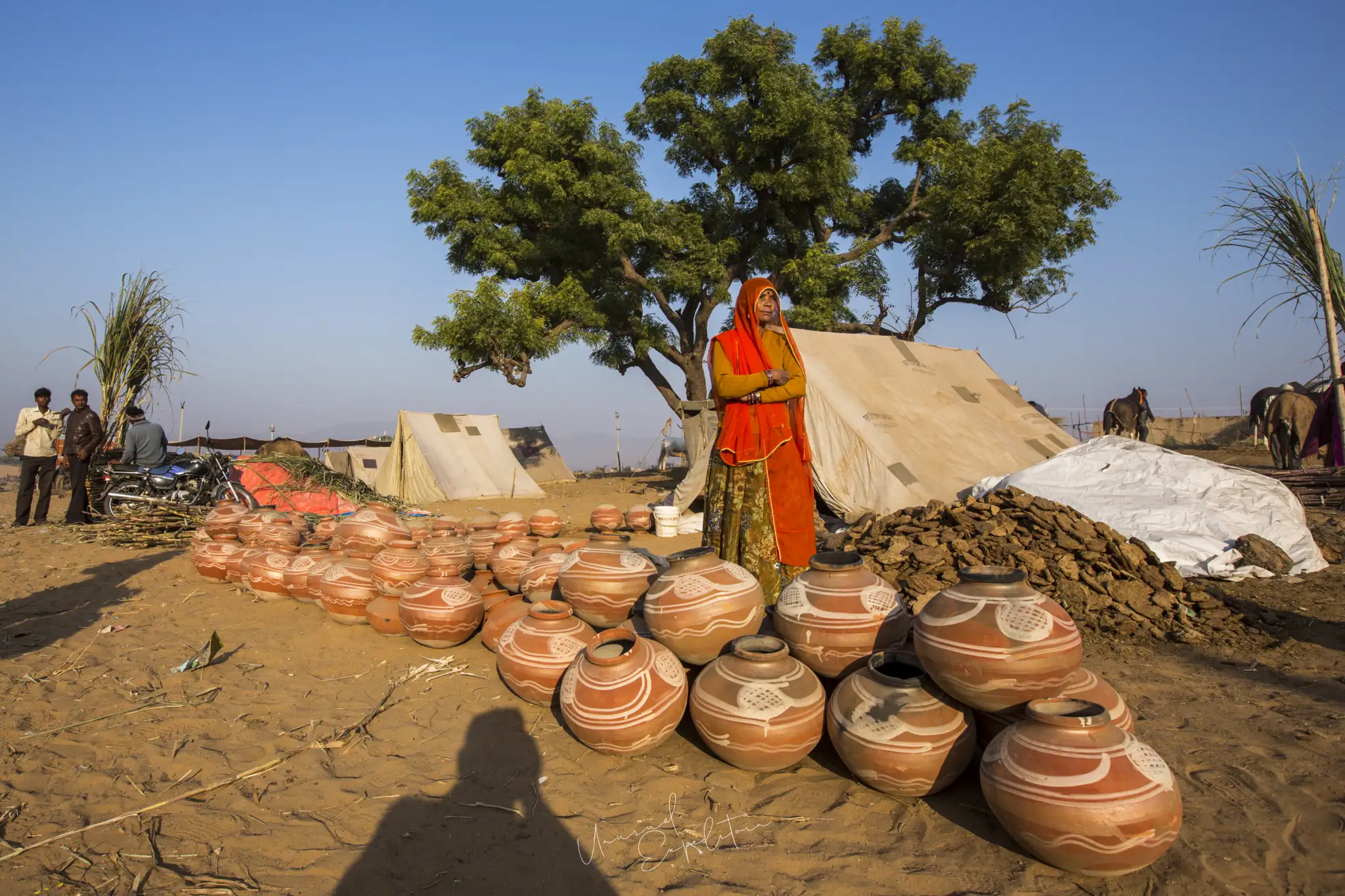
The market at the Pushkar camel mela is a working bazaar for herders, not a souvenir street: clay water pots laid out in rows on the sand, wooden pitchforks and tool handles, leather straps and shoes, bead halters and pompoms for dressing a camel, peacock feather fans, and trucks of green fodder for the animals. For a photographer it is the fair's colour and its quieter portraits, and it carries the middle of the day, when the light is too hard for the trading ground.
The market grows up around the trading ground for the length of the fair. For the fair as a whole, see the Pushkar photography tour guide; for the animals, the Pushkar camel fair article.
Shopping at the Pushkar camel mela
The Pushkar camel mela market sells what herders need. Herders and their families buy pots, tools, rope and harness while they are at the fair, and traders set up under canvas and tarpaulin on the sand to meet them. Visitors are welcome to browse and buy, but the stalls are not laid out for them, which is exactly why they photograph well: nothing is arranged, and every stall is a still life of things made by hand. Walk it slowly in the morning, when the low light reaches under the awnings, and come back at midday for the shade-side portraits of the sellers.
Clay pots on the sand
Water pots are one of the fair market's most photogenic subjects. Sellers bring round clay pots, painted with white lines and patterns, and stack them on the open sand in rows and pyramids, the seller standing or sitting among them. Shot wide and low, with a 16-35mm or the wide end of a 24-70mm, the pots fill the foreground and the seller, the tents and the trees sit behind. Morning side light brings out their curves. Ask the seller before you frame her in, and let her choose where to stand. Buying a small pot is a good way to say thank you.
Tools, harness and leather
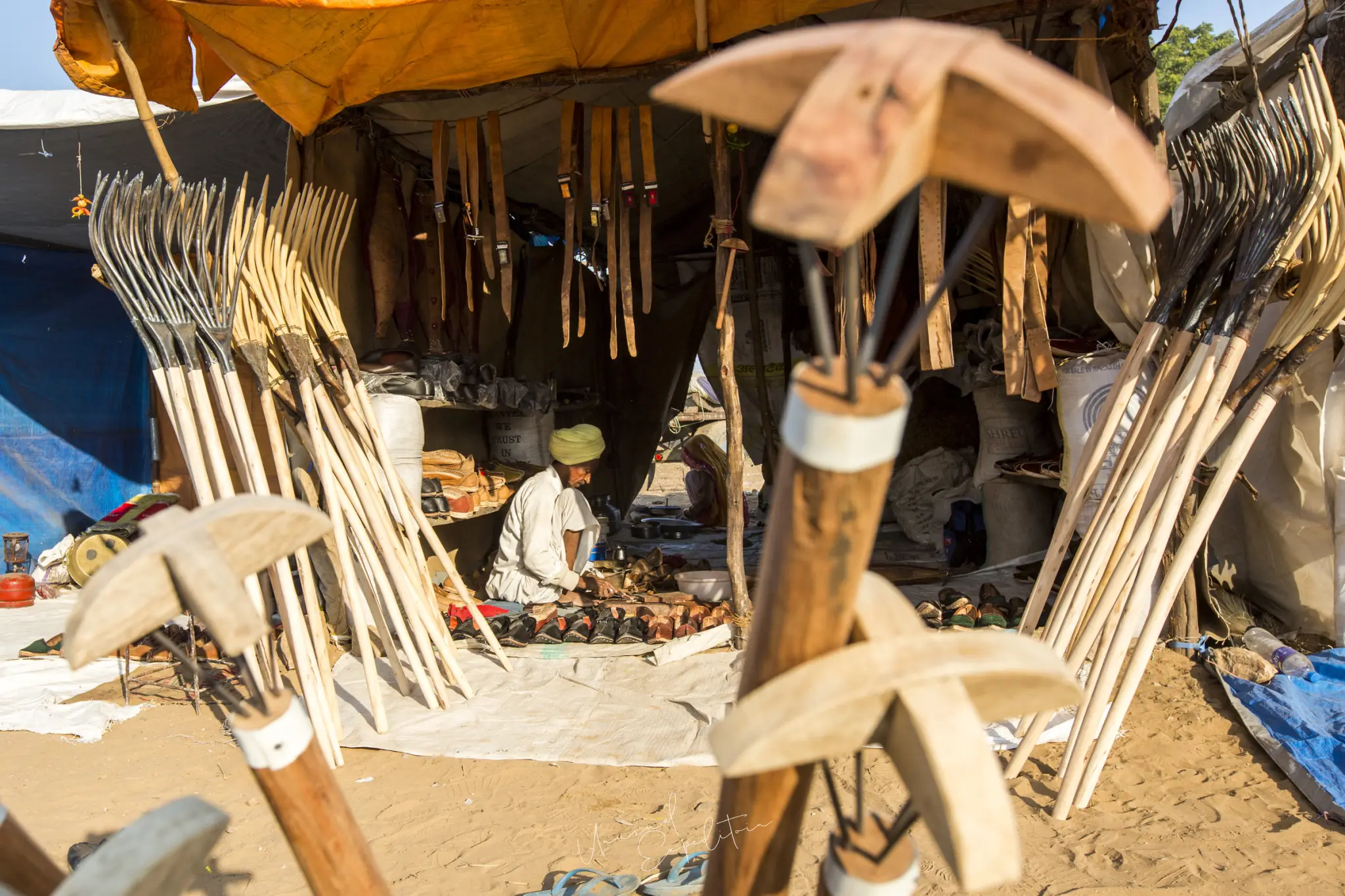
Under the larger canvas shelters, craftsmen sell what a farm and a herd need: wooden pitchforks with long pale handles, tool handles, leather straps, sandals and shoes, ropes and bells. The stalls are dark inside and bright outside, so meter for the seller in the shade and let the sand burn out, or step back and frame the whole stall with its owner small inside it. A wooden handle or a pitchfork in the foreground gives the frame depth.
Camel finery and walking vendors
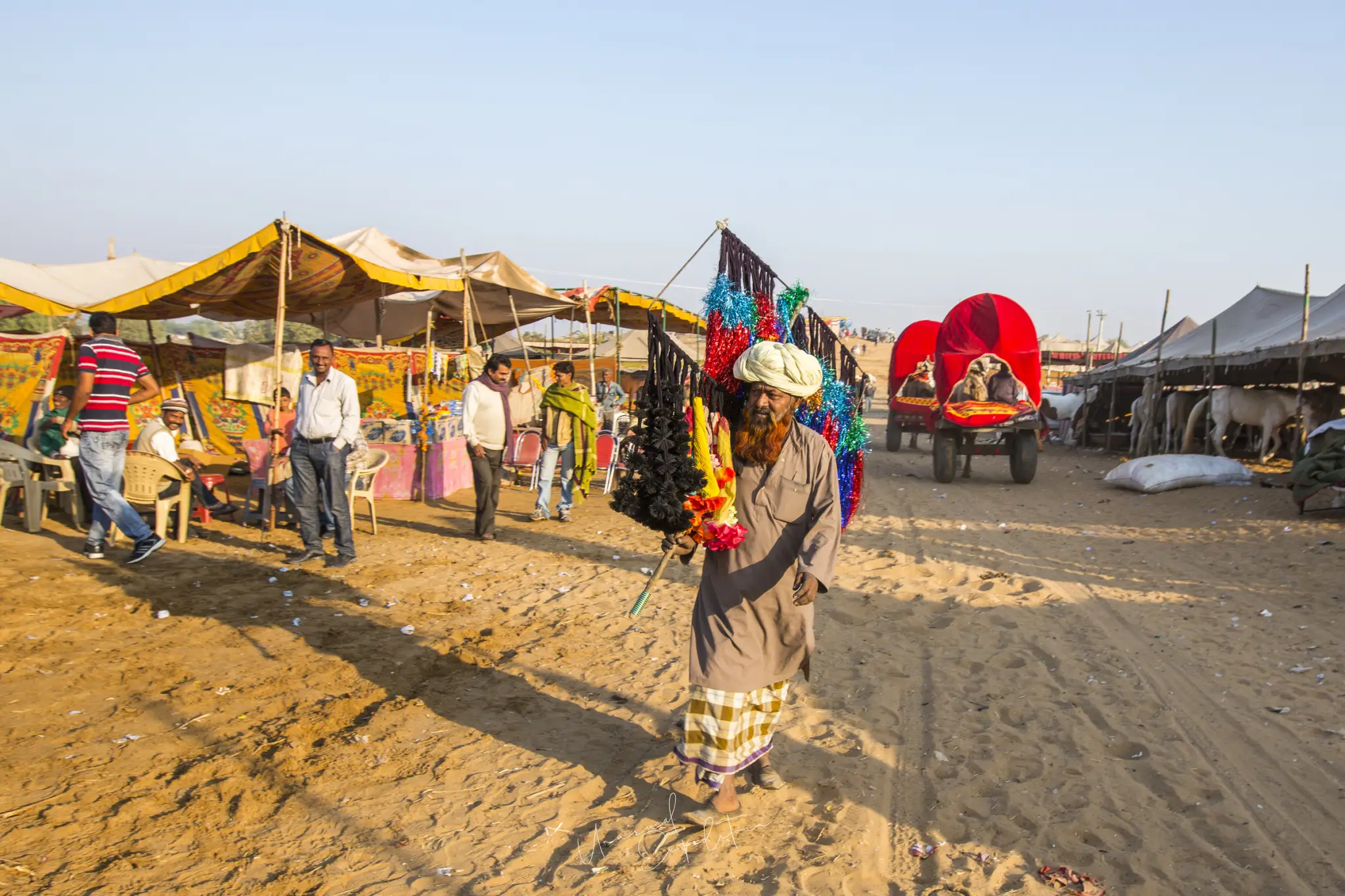
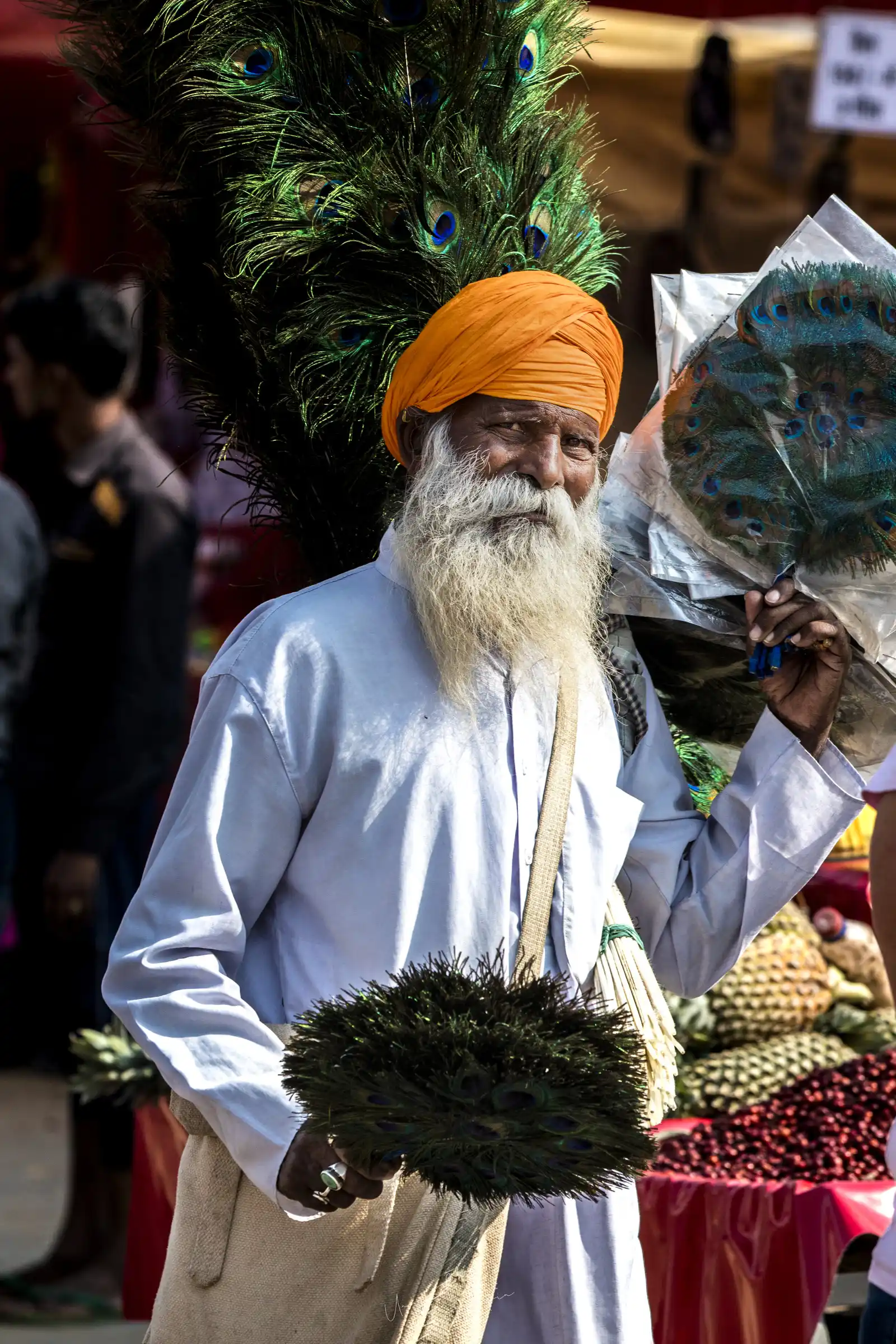
A camel for sale is dressed for it, and the fair sells everything needed: bead halters, pompoms, tassels, embroidered saddle cloths and bells. Some sellers have stalls; others walk the lanes between the tents with poles hung with tassels and strings of beads over their shoulders, calling out as they go. The walking vendors make good environmental portraits: let one walk into a clean patch of sand with the tents behind, and shoot as he passes. Other sellers carry peacock feather fans, which catch the light like nothing else in the market.
What you will find in the fair market
| Stall | What is sold | How to photograph it |
|---|---|---|
| Pot sellers | Painted clay water pots | Wide and low, seller among the pots |
| Tool and harness stalls | Pitchforks, handles, straps, shoes | Expose for the shade, foreground tool |
| Camel finery | Halters, pompoms, tassels, bells | Close detail, or a vendor walking |
| Feather fan sellers | Peacock feather fans | Portrait with the fans as background |
| Fodder trucks | Green fodder and straw for the animals | Wide, with the unloading in action |
The market and the trading ground sit side by side on the sand, so you can move between them as the light changes.
"I like the market at the hottest part of the day. The sellers sit in the shade and have time to talk, and a man selling feather fans will give you a better portrait than half the posed herders on the dunes."
Joseph Mak, tour leader, Unusual Expedition
Fodder for the animals
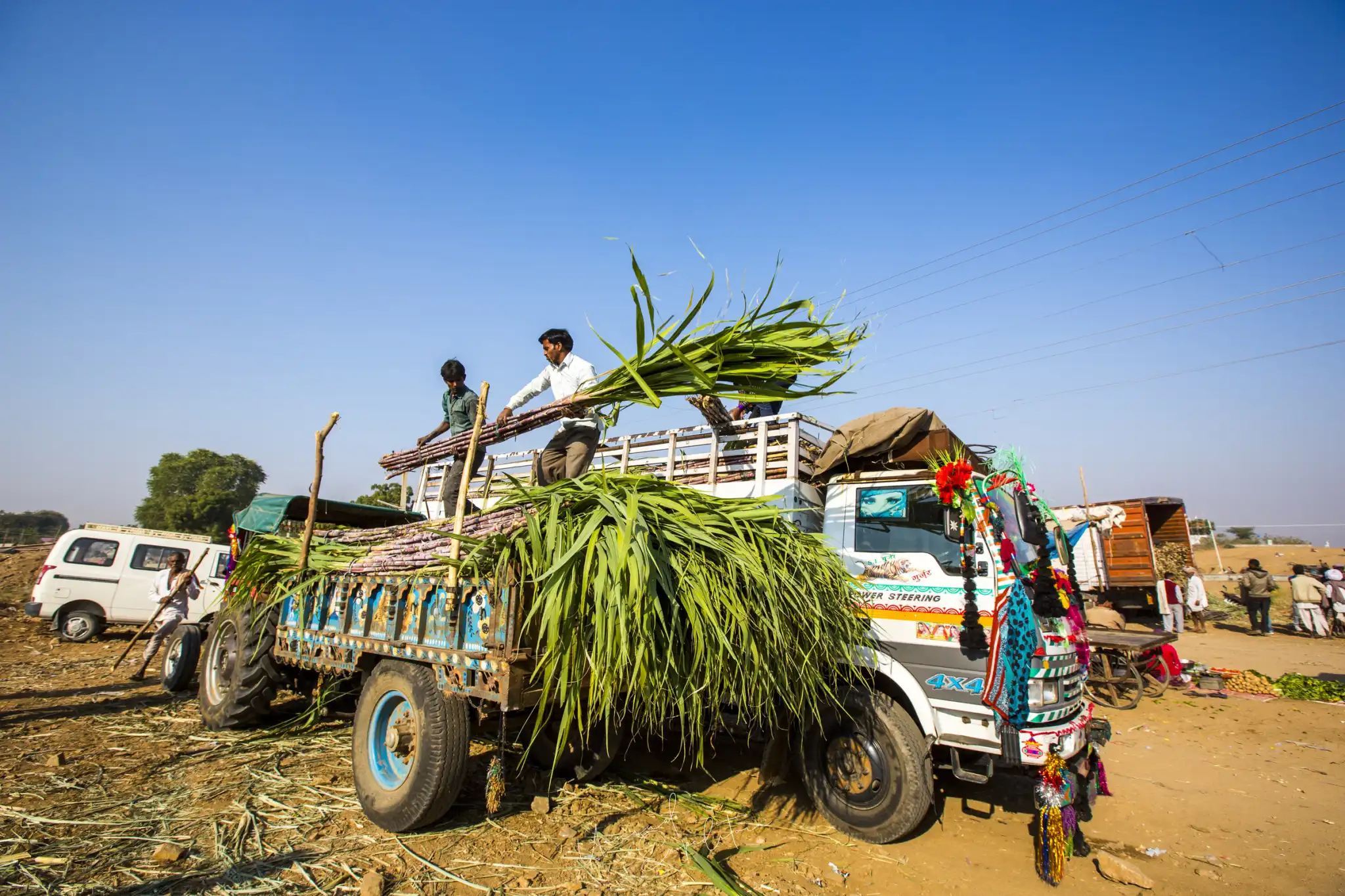
Every camel and horse on the ground needs feeding, and the fodder trade is a busy corner of the fair in itself. Trucks and tractors arrive piled high with green fodder and straw, men climb on top to throw it down, and herders carry it away in bundles. It is a working scene with movement and colour, painted trucks, the green load against a blue sky, and it shows what the fair really is: a livestock market that has to run every day. Stand clear of the trucks while they unload.
Light and settings in the market
The fair market is the one part of Pushkar that works in the middle of the day. Under canvas the light is soft and coloured by the awning, a gift for portraits; outside it is hard and white. Stand the seller just inside the shade, facing out, and expose for the face. A 24-70mm covers nearly everything, with an aperture around f/4 to separate a seller from a busy stall. Keep the ISO up rather than the shutter down, because people move. For detail shots of beads, bells and tassels, get close and fill the frame with colour.
Buying, bargaining and photographing sellers
Prices are set by bargaining, as they are for the camels. Be friendly, be fair, and do not photograph a seller you have just argued with. A purchase, however small, is the easiest way into a portrait. Ask first, and accept a no. In the town bazaar the shops are aimed at visitors, and our is Pushkar worth visiting article covers the town. More camel and herder pictures are in Pushkar fair photos.
Walk the market with us
We run Pushkar as a private trip on request, at your pace, with the logistics arranged around the fair; photography coaching can be added at extra cost. See private tours and our India photography tours page.
Pushkar photography tours
The next Pushkar departure is announced on the Pushkar photography tours page, with previous expeditions and all the planning guides.
Explore Pushkar in depth
- Pushkar Photography Tour Guide: the Camel Fair, the Lake and the TownIndia
- Pushkar Sunrise and Sunset: the Dunes, the Lake and the HillIndia
- Pushkar Photography FAQ: the Fair, the Ghats, Gear and SafetyIndia
- Pushkar Camel Fair: What Happens at the Pushkar MelaIndia
- Pushkar Fair Photos: Camels, Herders and the Trading GroundIndia
- Is Pushkar Worth Visiting? The Lake, the Ghats and How to Reach PushkarIndia
- Best Time to Visit Pushkar for the Camel Fair and the TownIndia
Upcoming Photo Tours
- Egypt Photo Tour – EgyptEgypt 12 Dec 2026 To 20 Dec 2026
- Inner Mongolia Winter Owl Photo Tour – ChinaChina 01 Jan 2027 To 04 Jan 2027
- Inner Mongolia Winter Photo Tour – ChinaChina 05 Jan 2027 To 11 Jan 2027
- Mekong And Central Highland Vietnam Photo Tour - VietnamVietnam 16 Jan 2027 To 24 Jan 2027