
Day of the Dead Photos from Mexico: What the Real Celebration Looks Like
Day of the Dead photos from Mexico: the Reforma parade, the Zócalo ofrenda, sugar skulls, altars going up, marigold graves, Mixquic.
Day of the Dead photos from Mexico usually show a painted face under a flowered hat, or a cemetery full of candles. The real celebration is wider: a parade on a six-lane avenue, a plaza turned into an altar, sugar skulls on a market table, marigolds stacked on a pavement, a family sitting up all night beside a grave. These photographs come from our Mexico festival of the dead photography tour; this is what each part of the week looks like from where you stand.
What do Day of the Dead photos in Mexico actually show?
Día de Muertos is a family festival first and a spectacle second. The core of it is the ofrenda, an altar built at home or at the grave with photographs of the dead, candles, cempasúchil marigolds, pan de muerto, salt, water and whatever the person liked to eat and drink. Around that core the cities have added the parade in Mexico City, the giant Catrinas, the face paint and the market stalls. A photographer who only shoots the painted faces comes home with a costume party. The pictures that hold up are the ones with the altars and the families in them, and they are easier to make than the parade pictures, because nobody is moving.
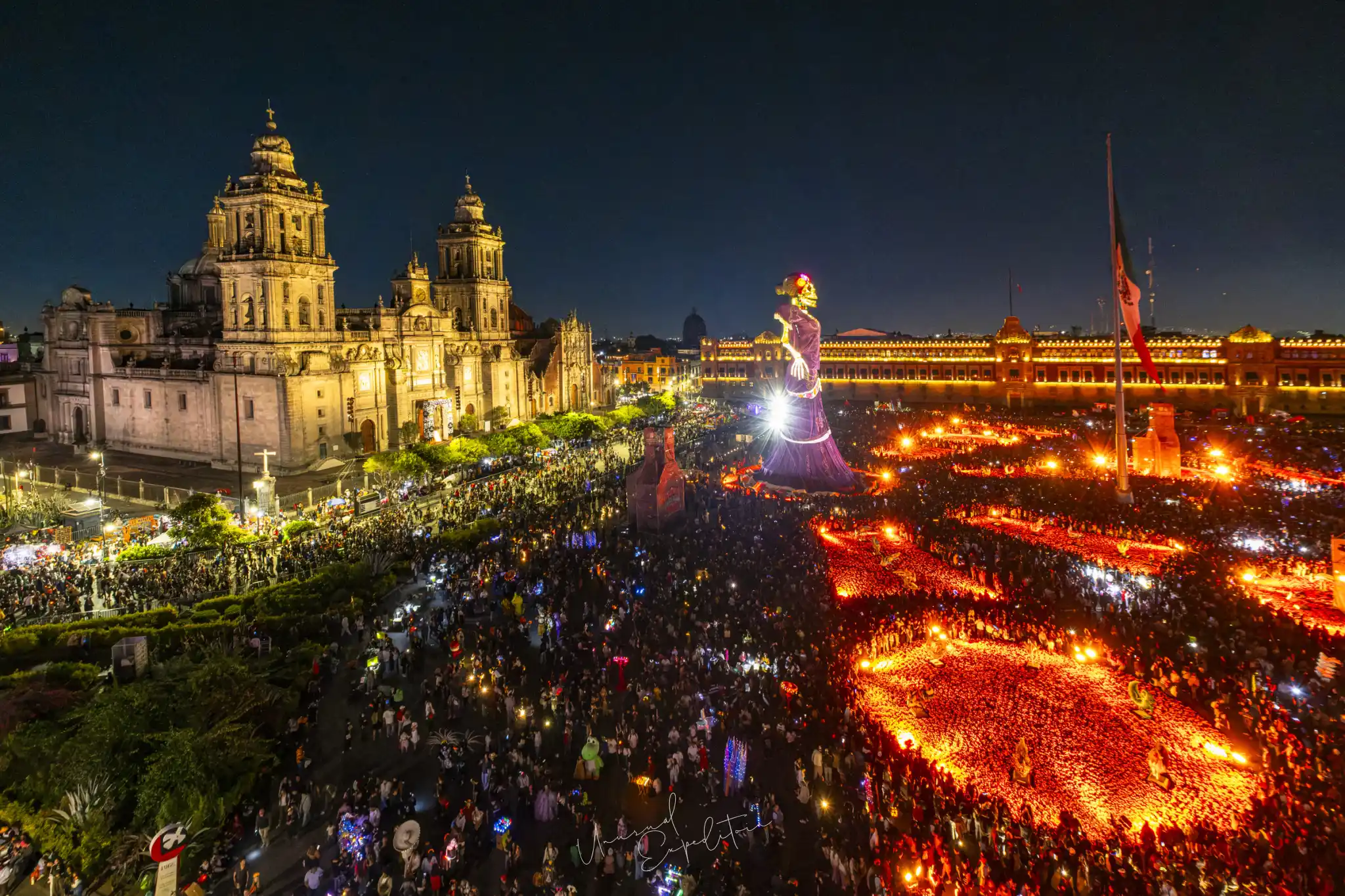
The Zócalo mega-ofrenda from above
Mexico City's main square carries a public ofrenda through the festival week, a different design every year, built from marigolds, papel picado, giant skeletons and lit figures across the whole plaza. From street level it is a crowd. From a rooftop on the west side of the square, with the cathedral lit on the left and the figures glowing in the middle, it becomes the one wide picture that says where you are. We photographed it after dark with a 10-24mm, the whole square in the frame and the cathedral facade as the anchor. The rooftop cafés and hotel terraces around the Zócalo fill early on festival nights; arrive before the light goes and keep the table.
Day of the Dead parade photos: the Gran Desfile on Reforma
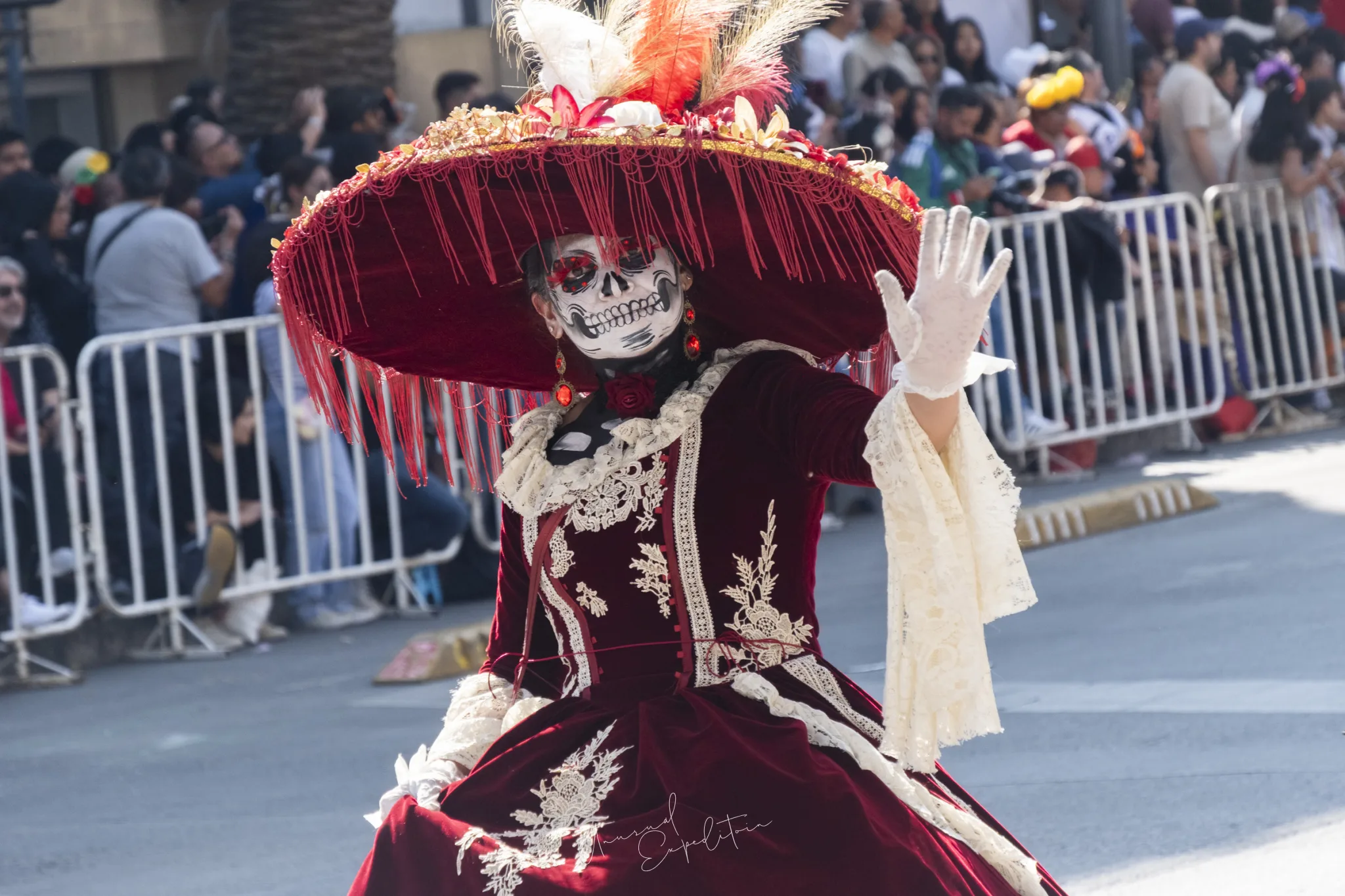
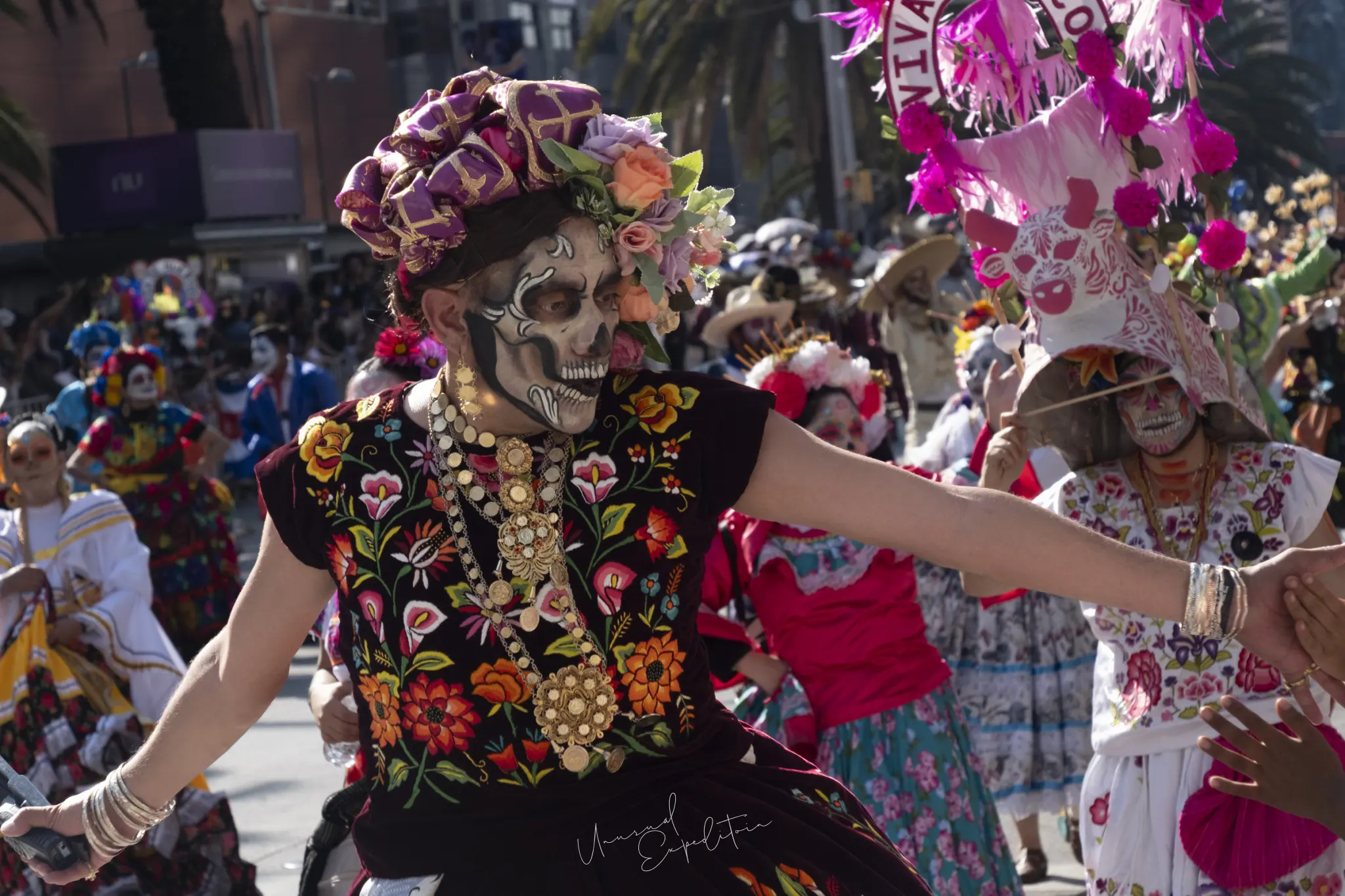
The Gran Desfile de Día de Muertos runs along Paseo de la Reforma to the Zócalo on the Saturday of the festival, with floats, dance troupes, regional Catrinas and marching bands, and it is the part of the week that looks most like the opening of a Bond film, because that is where the idea came from. The photographs are made from the kerb, between the barriers, with a long lens pointed up the avenue: a 70-200mm picks one face out of a troupe, and a 24-70mm gets a whole line of dancers as they pass. The light is hard afternoon sun down the avenue, so put it behind you and expose for the painted faces, which are two stops brighter than the dark costumes. We cover where to stand and how long it runs in photographing the Day of the Dead parade in Mexico City.
Sugar skulls, bread and the market tables
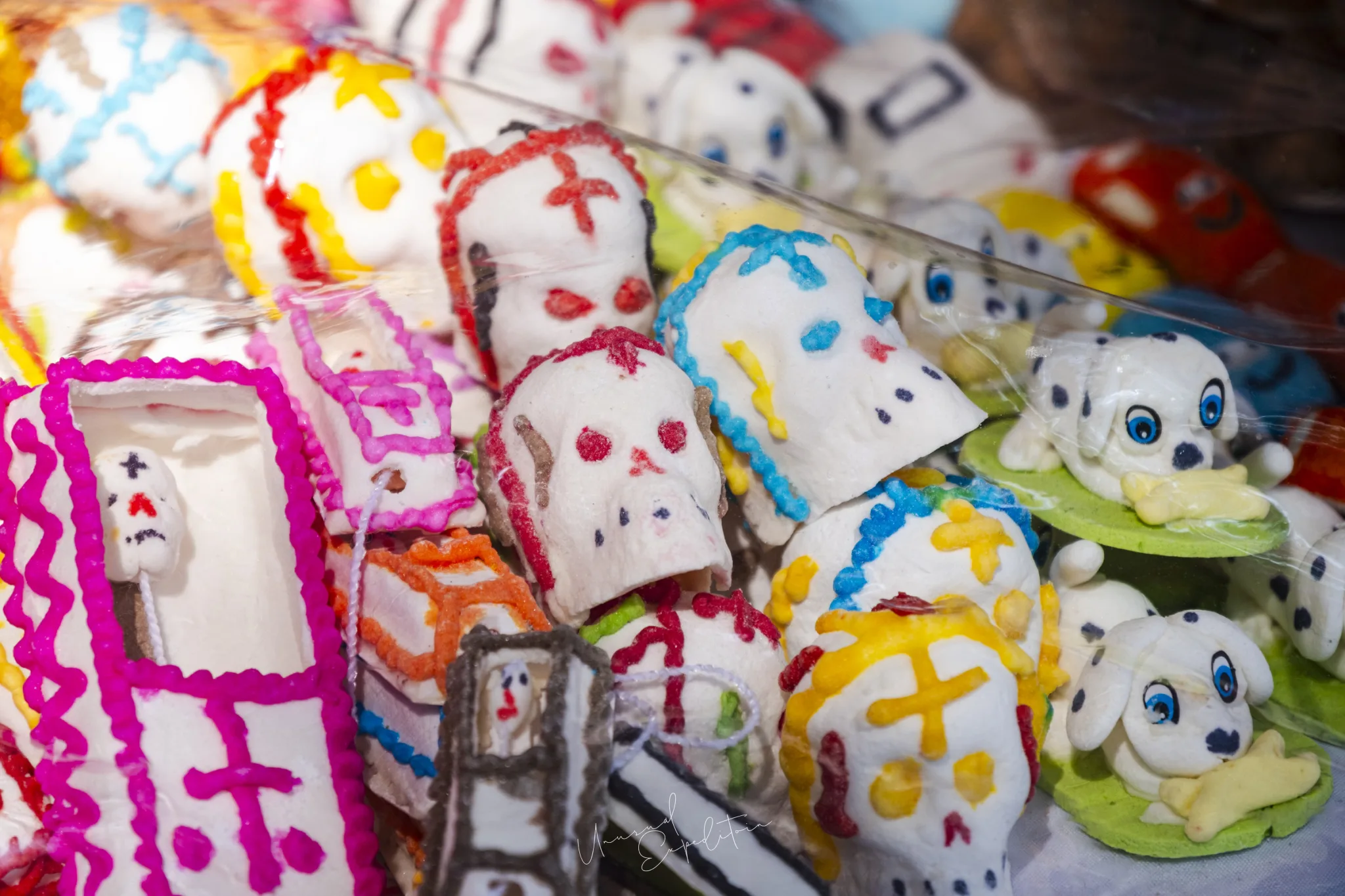
Before the altars go up the markets fill with the things that go on them. Sugar skulls with coloured icing and foil eyes, chocolate skulls, pan de muerto with its bone-shaped crust, candied pumpkin, candles by the kilo and marigolds by the armful. The market in Dolores Hidalgo had a table of sugar skulls the size of a hand, white with pink, blue and green icing, and the photograph is a still life: fill the frame, a 24-70mm at its long end, f/4 so the back rows soften, and the stallholder's hand if she will let you. Ask, buy something, and the table is yours for two minutes.
Day of the Dead altar photos: an ofrenda being built
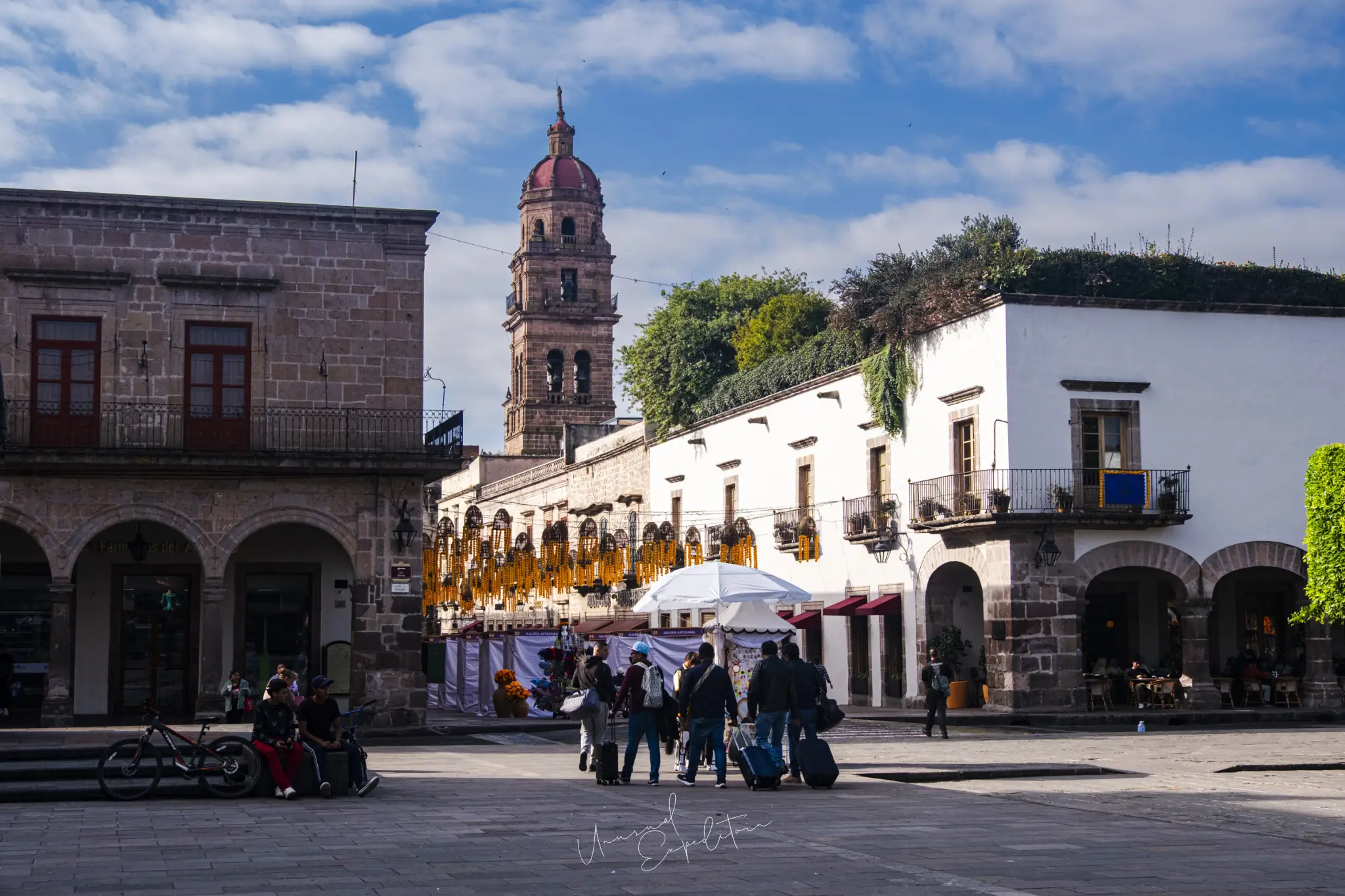
The public ofrendas in the city squares take days to build, and the building is better to photograph than the finished thing. In Morelia the marigolds arrived on the plaza as a mountain of orange heads on the pavement with a man setting candles into them, and by the same morning strings of marigold heads were hung across the craft stalls under the cathedral tower. Two frames: the orange filling the bottom two-thirds with one working figure for scale, and the garlands strung against the stone with the tower behind. Finished altars photograph best at dusk when the candles are lit and the sky still holds colour; by full dark they are pools of light with nothing around them.
Marigolds on the graves in Michoacán
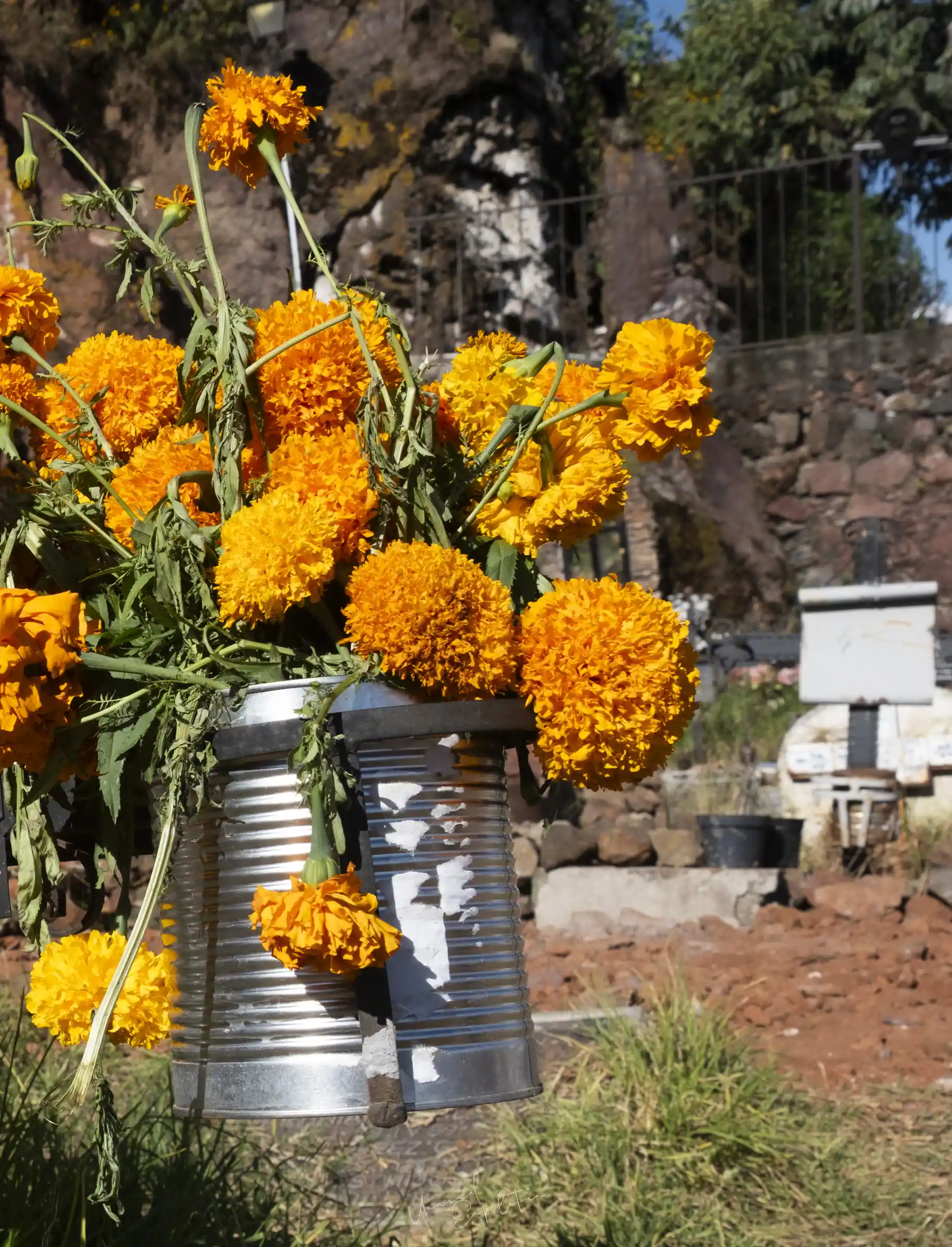
In the towns around Lake Pátzcuaro the cemeteries are dressed in daylight on the first days of November: graves covered in cempasúchil, arches of flowers over the headstones, tins of marigolds standing in the grass. By day the colour is the picture. A single grave with its flowers against brown earth and a name board, shot low with a wide lens, says more than the whole cemetery. We photograph the Michoacán chapter by day and cover the lake in Janitzio and the butterfly fishermen.
The candlelit cemetery at Mixquic
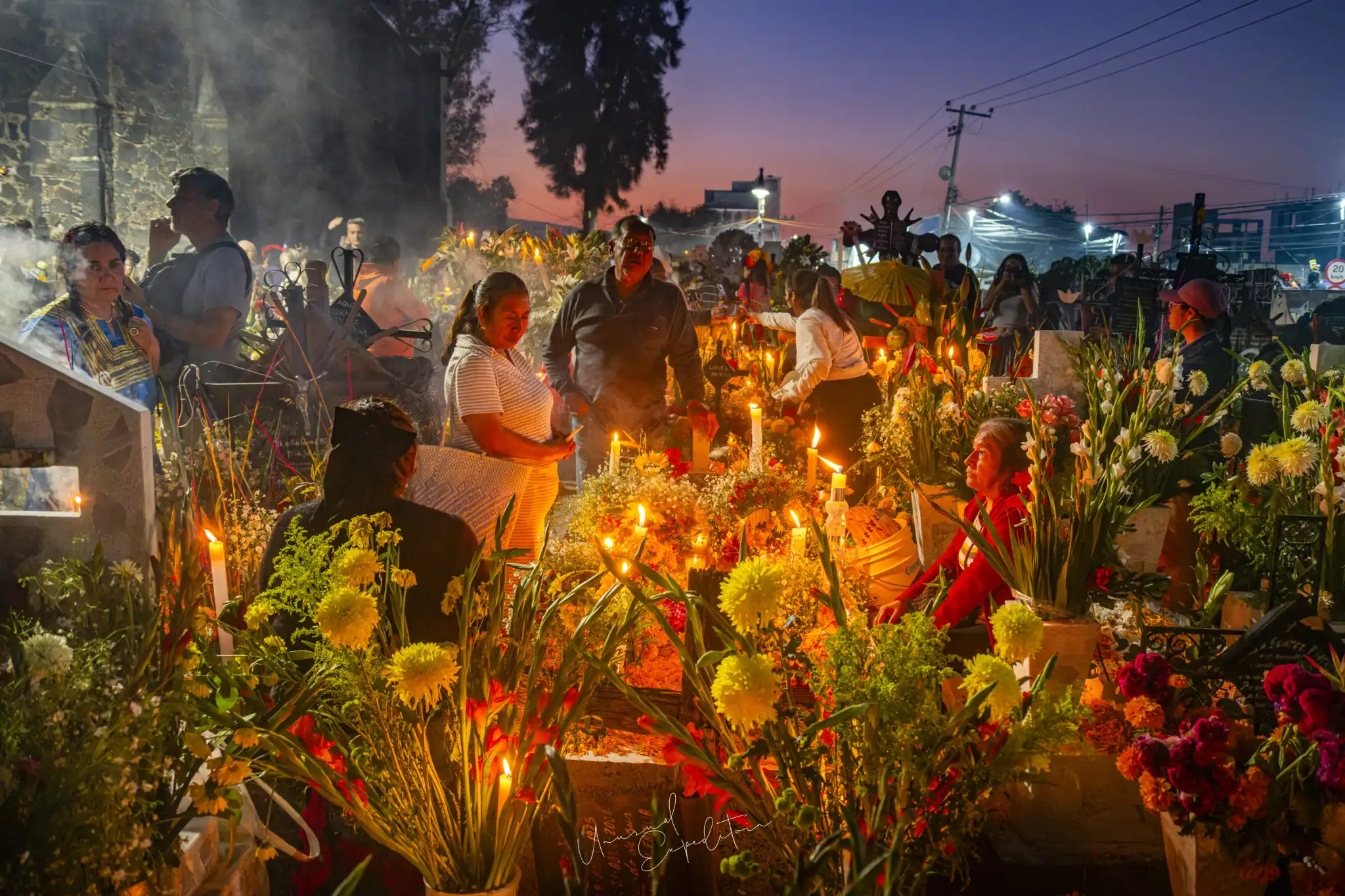
The last night is the one most people picture. At San Andrés Mixquic, on the southern edge of Mexico City, families fill the churchyard with candles and copal smoke on the evening of 2 November and keep vigil until morning. The best photographs are made in the forty minutes after sunset, when the sky behind the crosses is still blue and the candles are already lit; by full dark the frames are pools of orange with black around them. Hand-held, no flash, a fast prime or a zoom at f/4, ISO climbing as the light goes. The conduct matters more than the settings and we set it out in Mixquic: photographing the cemetery at night.
"People ask me for the one Day of the Dead picture and I never have one. The week is a parade, a market, an altar and a cemetery, and the pictures that mean something to me are the quiet ones: a man setting candles in marigolds, a grave with tins of flowers on it. The Catrinas are the postcard. The families are the festival."
Joseph Mak, tour leader, Unusual Expedition
Where each kind of Day of the Dead photo is made
| Subject | Where | Light | Lens |
|---|---|---|---|
| Parade Catrinas and troupes | Paseo de la Reforma, Mexico City | Hard afternoon sun down the avenue | 70-200mm, 24-70mm |
| The public mega-ofrenda | Zócalo, Mexico City, from a rooftop | Dusk into night, floodlit | 10-24mm or 16-35mm |
| Sugar skulls and market tables | Town markets, Dolores Hidalgo | Shade under the stalls | 24-70mm at the long end |
| Altars being built | Plaza arcades, Morelia | Open shade by day | 24-70mm |
| Marigold graves by day | Cemeteries around Lake Pátzcuaro | Full sun or bright overcast | 16-35mm, low |
| Candlelit vigil | San Andrés Mixquic | Forty minutes of dusk, then candles | Fast prime, 24-70mm at f/4 |
The parade and the vigil are the two that depend on being in the right place at the right hour; everything else can be photographed across the week.
Is it all right to photograph people at Day of the Dead?
At the parade and in the markets, yes, and most people in costume expect it and pose. At the altars and in the cemeteries the answer is yes with permission. A nod with the camera half raised, a thank-you, and a no accepted the first time. The families at Mixquic have had cameras in the cemetery for two generations and the welcome depends on each visitor. Children in face paint at the night markets are photographed with a parent's nod, and we do not publish identifiable children's faces from the cemeteries at all.
Photograph the whole week with us
Every departure of the Mexico Festival of the Dead photography tour covers the parade, the colonial towns, the lake and the cemetery in one festival week, with Joseph Mak on the kerb and in the churchyard with you. The week's shape is in the best time for Day of the Dead photography in Mexico.
Mexico photography tours
The next Mexico departure is announced on the Mexico photography tours page, with previous expeditions and all the planning guides.
Explore Mexico in depth
- Mexico Festival of the Dead Photography Tour: The Complete GuideMexico
- Janitzio Photos: The Island, the Cemetery and the Boat from PátzcuaroMexico
- San Miguel de Allende Photo Spots: Where to Stand and WhenMexico
- Mexico City Photo Spots: The Best Places to Take PicturesMexico
- Mexico Tour from Singapore: Flights, Visa and What to ExpectMexico
- Puebla, Cholula and Taxco for PhotographersMexico
- Guanajuato and San Miguel de Allende at Day of the DeadMexico
- Camera Gear for Day of the Dead Photography in MexicoMexico
- Mexico Day of the Dead Photo Tour: Your Questions AnsweredMexico
- Photographing the Day of the Dead Parade in Mexico CityMexico
- Mexico's Pyramids: Tula, Teotihuacán, Chichén Itzá, Ek Balam and TulumMexico
- Mixquic: Photographing the Day of the Dead Cemetery at NightMexico
Upcoming Photo Tours
- Egypt Photo Tour – EgyptEgypt 12 Dec 2026 To 20 Dec 2026
- Inner Mongolia Winter Owl Photo Tour – ChinaChina 01 Jan 2027 To 04 Jan 2027
- Inner Mongolia Winter Photo Tour – ChinaChina 05 Jan 2027 To 11 Jan 2027
- Mekong And Central Highland Vietnam Photo Tour - VietnamVietnam 16 Jan 2027 To 24 Jan 2027