
Timket Photos: Where to Stand and How to Shoot the Feast
Timket photos in Lalibela: high banks over the procession, lenses, light on white cloth, the pool, and what not to photograph.
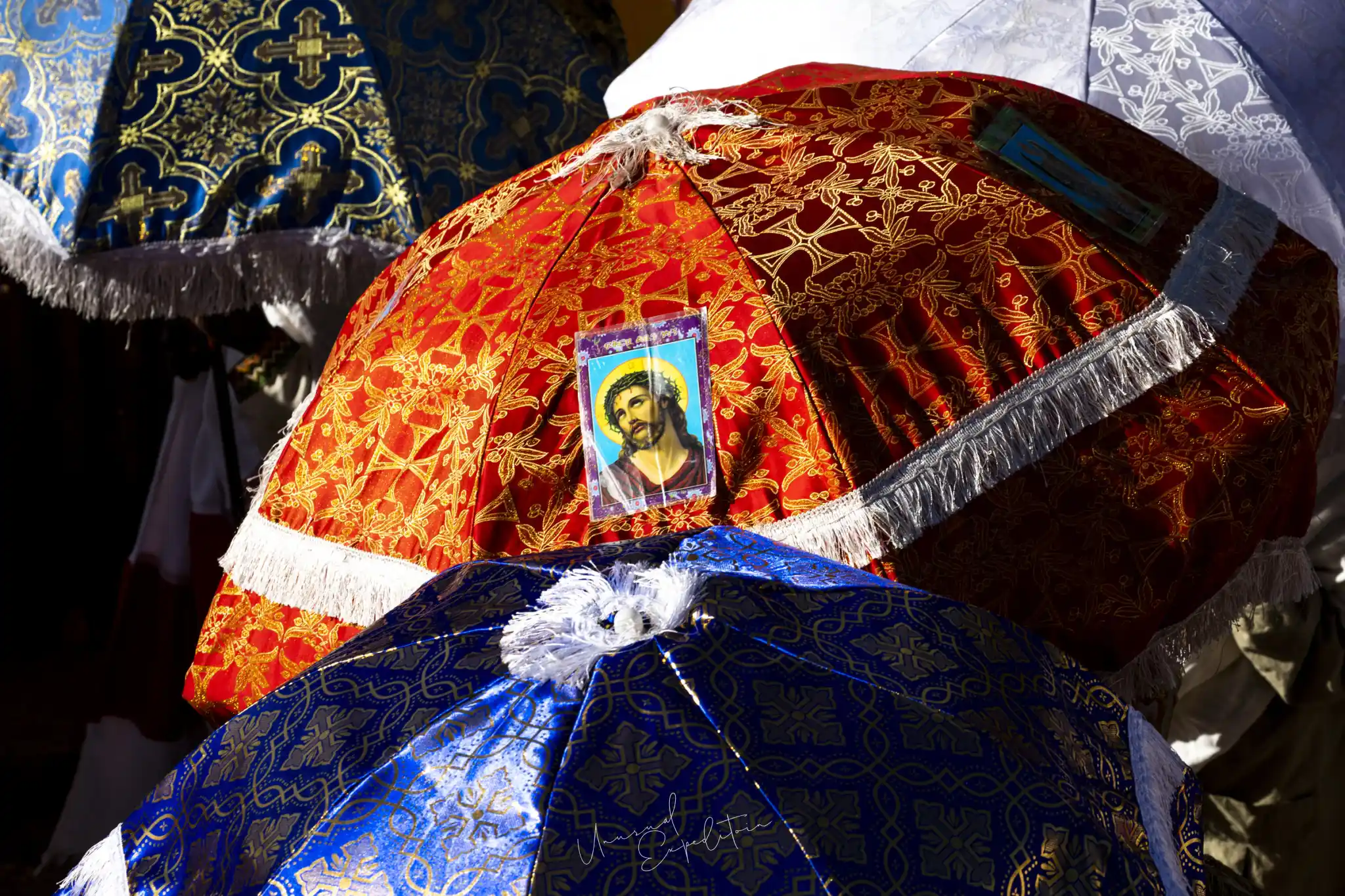
Timket photos are made from three things: colour, height and patience. The colour comes from velvet umbrellas, gold vestments and a sea of white shawls; the height comes from finding a bank, a wall or a terrace above the procession so the umbrellas read as a pattern; and the patience comes from staying in one good place while the tabots come to you. In Lalibela that means working the processions on the eve and the pool and the return on the main day.
These notes come from photographing Timket in Lalibela, covered in our Lalibela photography tour guide. The photographs in this guide are our own, taken on our trips here; we hold the rights to them, and the notes come from knowing the place first hand. For what the feast means and when it falls, read Timkat festival in Ethiopia first.
Timket photos: what the feast looks like through a lens
Timket photos fall into a few families, and it helps to know which one you are after at any moment. From above, the processions are abstract: discs of red, blue, gold and white umbrellas with an icon or a tabot moving underneath. At eye level they become portraits: a priest under a fringed canopy, an elder resting on a prayer staff, a deacon swinging a censer. At the pool on the main day the pictures are about water and movement, splash and spray and hands reaching out. And in between there are quieter frames, women in white netela shawls praying with their hands together, a pennant line over the Timket ground, the reflection of all that colour in the water. UNESCO calls Ethiopian Epiphany a colourful festival, and Lalibela gives you every one of those kinds of picture within a few streets.
Where to stand for Timket photos in Lalibela
Lalibela is built on slopes, and the slopes are your best friend at Timket. The streets that lead from the churches down to the Timket ground run below banks, walls and terraces where local families gather to watch, and a place there, taken early and kept, gives you the umbrellas from above with the crowd filling the frame. At the Timket ground the higher ground around the field looks down on the cross-shaped pool and the ring of clergy. On the return, the cobbled streets near the churches put you at eye level with the clergy as they dance and sing.
| Moment | Where to stand | Lens | Watch for |
|---|---|---|---|
| Ketera processions | A bank or terrace above the route | 70-200mm, then 24-70mm | Umbrellas as pattern, icons of the baptism |
| Clergy at the Timket ground | Higher ground around the field | 24-70mm | The ring of clergy around the pool |
| Blessing and splashing | Behind the front rows, a little above | 24-70mm, weather cover on | Spray against the light, faces of the faithful |
| Return procession | Street level along the route | 24-70mm, 85mm | Censers, sistrums, dancing clergy |
Arrive before the procession does: once the route fills, nobody moves, and you should not push.
Lenses and settings for Timket
A 24-70mm covers most of Timket in Lalibela, because you are close to everything. A 70-200mm is worth carrying for the eve, when you photograph from a bank and want to isolate one umbrella, one face or one icon in the river of people. Light is the challenge. The sun is high and hard by mid-morning, the white cloth is very bright, and the faces under the umbrellas are in deep shade; expose for the white and lift the shadows later, or wait for an umbrella to light a face from within. In the dim streets and church doorways, open up and raise the ISO. Use a fast shutter for dancing clergy and for the water, and a slow one only if you want the umbrellas to blur against sharp faces. Carry a rain cover or a plastic bag for the camera on the main day.
Photographing the umbrellas and vestments
Lalibela's processional umbrellas are embroidered velvet in red, blue, green and gold, many with crosses or small icons sewn on, and they are held over every tabot, icon and senior priest. From a high place they make the strongest single image of the feast. Under them the clergy wear brocade capes, crowns and stoles that change from church to church. Close-ups of fabric and a single painted icon work well as a counterpoint to the wide frames, and you can make them without pointing a lens into anyone's face. The Ethiopian Orthodox priests page explains what the vestments, crosses and staffs are.
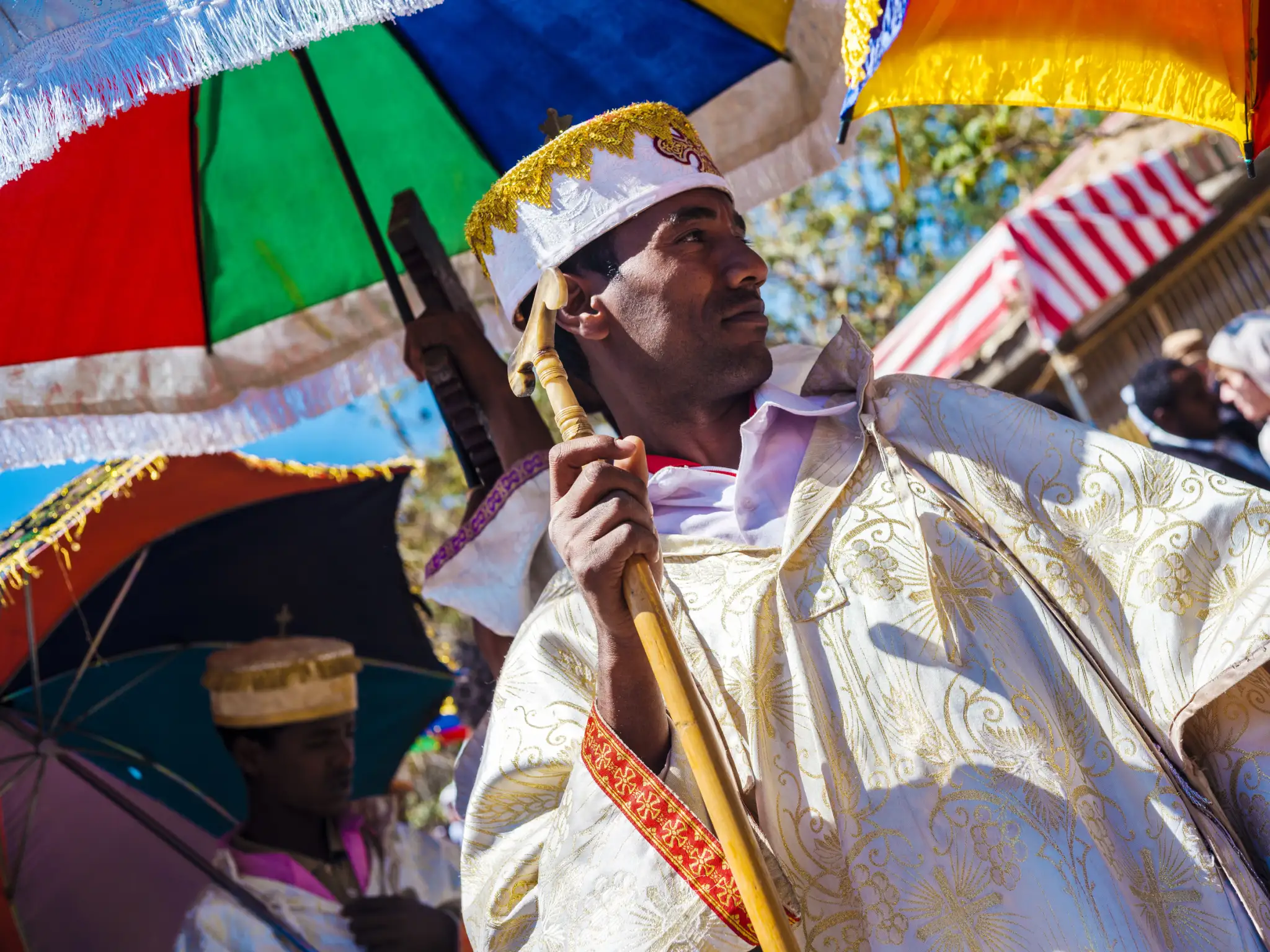
At Timket I pick one spot above the route and stay there. Chasing the procession gets you the backs of heads. If you stand still, the umbrellas, the icons and the singing all come past you.
Joseph Mak, tour leader, Unusual Expedition
Working in the Timket crowd
Timket crowds in Lalibela are large, friendly and devout. Singapore's Ministry of Foreign Affairs notes that pickpocketing and snatch theft do occur in Ethiopia, so keep your bag in front of you, carry little, and leave the tripod behind, because there is no room for it and it blocks other people. Move with the crowd, not against it. If someone asks you to step aside for an elder, a priest or a mother with a child, do it at once. Children are everywhere at Timket, and we do not photograph them; framing a wider scene so nobody young is the subject, or waiting until they pass, is easy once you decide to do it. For portraits of adults, ask, wait, and show the picture afterwards; people often ask to see it.
Photographing the water on the main day
The pool on Timket morning is a different kind of picture. Before the blessing, the clergy stand around the cross-shaped pool in a ring, and a high, wide frame shows the whole ceremony. Once the water is opened, the young men at the edge splash and are splashed, and the spray catches the low sun beautifully if you stand where it is backlit. Keep a little distance from the rim; the crowd surges forward and you will get wet. Look down as well as out: the reflections of robes and umbrellas in the rippled pool make a fine abstract. The best time to visit Lalibela page explains when the light is kindest in the dry season.

What not to photograph at Timket
A few things are not ours to photograph. The tabot is never uncovered in public, so there is nothing to look for under the cloth. During the night liturgy keep the camera down; flash in the dark is an intrusion. People immersing themselves in the water are at a very private moment in a public place, and we leave them alone. And we never ask anyone to stop, pose or repeat something for the camera; the feast goes on whether we are there or not.
Photograph Timket with us
We run Timket in Lalibela as a private trip on request when travel advice allows, with time on the eve and the main day and a quieter day among the churches. Photography coaching can be added at extra cost, and we arrange all the logistics to your needs. Any scheduled departure appears on our Ethiopia photography tours page.
Ask us about photographing Timket
Lalibela photography tours
The next Lalibela departure is announced on the Lalibela photography tours page, with previous expeditions and all the planning guides.
Explore Lalibela in depth
- Lalibela Photography Tour Guide: Rock-Hewn Churches and TimketEthiopia
- Timkat Festival in Ethiopia: Ketera, the Water and the TabotsEthiopia
- Lalibela Photography FAQ: Airport, Tickets, Dress and SafetyEthiopia
- Lalibela Church Photos: Inside the Rock-Hewn ChurchesEthiopia
- Ethiopian Orthodox Priests in Lalibela: Vestments, Crosses, PortraitsEthiopia
- Church of St George, Lalibela: Photographing Bete GiyorgisEthiopia
- Lalibela Weather and the Best Time to Visit LalibelaEthiopia
Upcoming Photo Tours
- Egypt Photo Tour – EgyptEgypt 12 Dec 2026 To 20 Dec 2026
- Inner Mongolia Winter Owl Photo Tour – ChinaChina 01 Jan 2027 To 04 Jan 2027
- Inner Mongolia Winter Photo Tour – ChinaChina 05 Jan 2027 To 11 Jan 2027
- Mekong And Central Highland Vietnam Photo Tour - VietnamVietnam 16 Jan 2027 To 24 Jan 2027