
Biei in Winter: The Christmas Tree, the Blue Pond and the Snow Fields of Hokkaido
Biei in winter: the Christmas tree, the Shirogane Blue Pond lit at night, lone trees and foxes, and the farmland rules to follow.
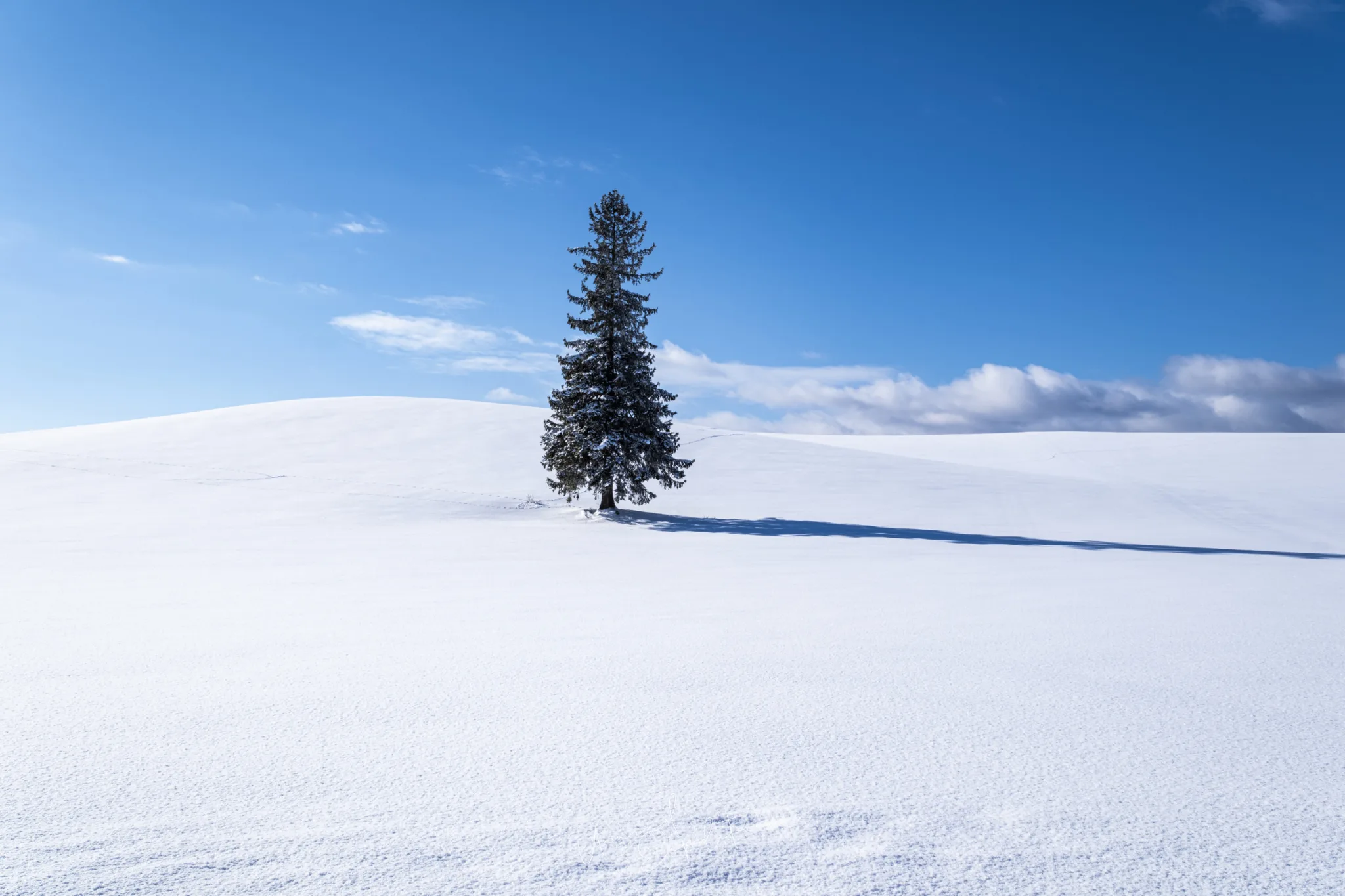
Biei in winter is a town of rolling snow fields in central Hokkaido, where single trees, farm windbreaks and gentle hills turn into some of the simplest and cleanest landscapes in Japan. The two best known subjects are the lone spruce called the Christmas tree and the Shirogane Blue Pond, whose dead larches stand in frozen water and are lit blue at night through the winter. Add red foxes crossing the fields and you have a full day of photography.
Biei sits in the centre of the island, away from the crane and eagle country of the east covered in our Hokkaido photography tour guide. Here we cover the Christmas tree, the Blue Pond by day and night, the single trees of the snow fields, the light to aim for, and the farmland rules that every visitor needs to respect.
Biei winter: why the snow fields work for photography
Biei winter landscapes work because there is so little in them. In summer the hills are a patchwork of crops and flowers; in winter the snow covers everything, so a single tree, a line of birches or a farmhouse becomes the whole picture. The hills are gentle, the snow is often fresh and smooth, and the sky changes quickly from heavy cloud to deep blue. The town is also an easy base for the Tokachi mountains and the Shirogane hot spring area. Most of the famous trees stand in private fields beside public roads, which is why the rules below matter so much.
Biei Christmas tree: the lone spruce on the hill
The Biei Christmas tree is a single conical spruce standing alone on a rounded snow field, and its shape on a clean white slope is what gives it the name. It is best on a day with blue sky and broken cloud, when the low winter sun throws the tree's shadow across the snow, or after fresh snowfall when the field is unmarked. A 70-200mm lens from the road lets you compress the tree against the sky and the rise of the hill; a 24-70mm lens shows it small in a big field. Do not walk into the field to get closer. The tree stands on farmland, and the unmarked snow is the picture for everyone who comes after you.
Biei Blue Pond winter: the Shirogane Blue Pond by day and night
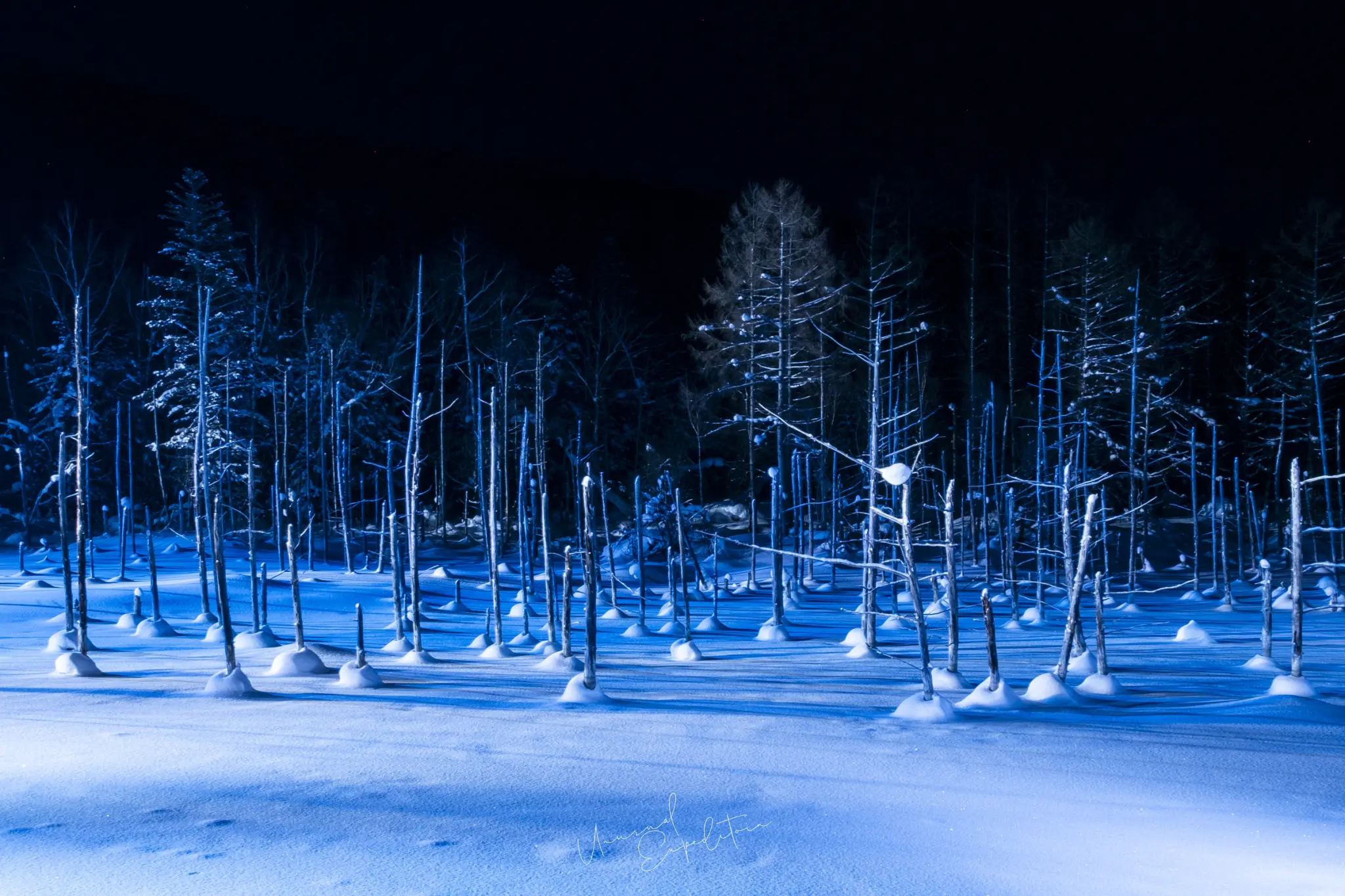
The Biei Blue Pond winter scene is very different from its famous summer colour. The Shirogane Blue Pond is a man-made pond near the Shirogane hot spring area, listed by Visit Hokkaido among the island's sights, where dead larches stand in water that turns blue from minerals in the summer months. In winter the pond freezes and the snow covers it, so by day you photograph rows of bare trunks rising out of white, with long shadows when the sun is out. At night the pond is lit up through the winter season; Japan's national tourism site, run by the Japan National Tourism Organization, describes the illumination as running each year from about November to April, and the official dates change each year, so check them before you go. The blue light on the snow and trees makes an unreal, quiet picture, and a tripod is essential.
Blue Pond Hokkaido winter: settings for the night light-up
For the Blue Pond Hokkaido winter illumination, set up on a tripod at the viewing area, frame the lit trees and some of the dark forest behind, and use a low ISO with an exposure of several seconds. Check the white balance: the light is already blue, and an automatic setting may try to neutralise it. Snow on the ground reflects the light, so take care not to overexpose the foreground. It is very cold at night here, and the viewing path is icy, so take microspikes and keep spare batteries warm. The viewing area is busy early in the evening; later it is usually quieter.
Biei is the place where we put away the long lenses and think about shape. One tree, one hill, one line of shadow. The snow does the editing for you.
Joseph Mak, tour leader, Unusual Expedition
Biei tree photography beyond the Christmas tree
The Christmas tree is only one of many single trees in Biei. Others stand on the crests of the fields, bare deciduous trees with a delicate crown against the sky, and rows of birches or poplars mark the edges of farms as windbreaks. Drive the farm roads slowly after fresh snow and look for a tree that stands clear of the background. The best frames often come from simple choices: the tree placed low in the frame with a lot of sky, or high in the frame with the curve of the field below. Afternoon sun from the side shows the texture of the snow better than a flat midday light.
Biei in winter: what to photograph and when
| Subject | Best light | Lens | Note |
|---|---|---|---|
| Christmas tree | Blue sky, low sun, fresh snow | 70-200mm | Photograph from the road only |
| Shirogane Blue Pond by day | Sun for shadows, or soft overcast | 24-70mm, 70-200mm | Trunks in snow, graphic lines |
| Blue Pond at night | Winter illumination | 24-70mm on a tripod | Check the season's dates |
| Lone trees and windbreaks | Side light, afternoon | 24-70mm, 70-200mm | Look for clean backgrounds |
| Red foxes in the fields | Any, best low sun | 100-400mm | Stay in the car or on the road |
The fields change after every snowfall, so a place that looked messy one day can be perfect the next.
Biei Hokkaido winter manners: stay on the road
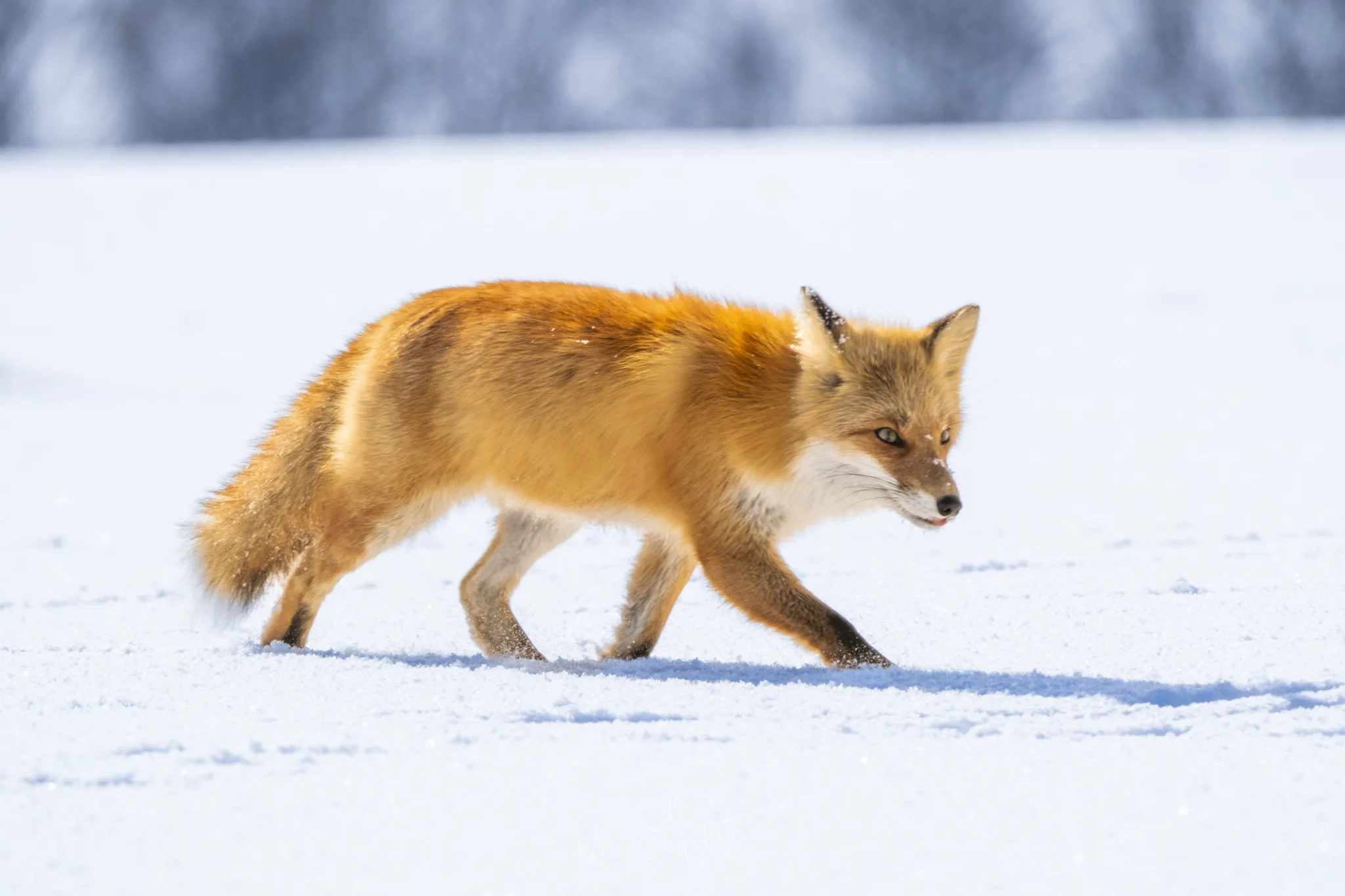
The fields of Biei are working farms, and the town asks visitors not to enter them, because trampling damages the soil and can carry disease into the crops, and cars stopped on narrow farm roads get in the way of the people who work there. Photograph from public roads and designated viewpoints, park only where it is allowed, never climb fences, and never fly a drone over private land without permission. Red foxes often hunt across the fields; watch them from the road and do not feed them, since wild foxes in Hokkaido can carry a parasite that infects people. Our Hokkaido wildlife guide covers fox photography in more detail.
Biei with the rest of a Hokkaido winter
Biei is a separate region from the cranes and eagles of the east, so many photographers make it a trip of its own or the start of a longer winter route. For the eastern subjects, see the red crowned crane Hokkaido guide and the best time to visit Hokkaido in winter for the month to choose.
Photograph Biei with us
We run Biei as a private trip on request, alone or combined with eastern Hokkaido, with every arrangement made around your pace; a photographer or coaching can be added at extra cost. See our private tours and the Japan photography tours page.
Join the Hokkaido photography tour
Kyushu, Shikoku And Setouchi Photography Journey departs 25 Sep 2027 To 05 Oct 2027, led by Joseph Mak. Small group, photography first. All Hokkaido photography tours.
Explore Hokkaido in depth
- Hokkaido Photography Tour Guide: Cranes, Eagles, Owls and Snow in Eastern HokkaidoJapan
- Steller's Sea Eagle Photography in Rausu: Size, Wingspan and the Winter BoatsJapan
- Red Crowned Crane Hokkaido: Photographing the Cranes of Tsurui, Akan and the Setsuri RiverJapan
- Whooper Swans at Lake Kussharo, Hokkaido: Photographing the Swans of the Hot Spring ShoreJapan
- Hokkaido Wildlife Photography: Red Foxes, Sika Deer, Owls and Forest Birds in WinterJapan
- Blakiston Fish Owl: How to Photograph the World's Largest Owl in HokkaidoJapan
- Best Time to Visit Hokkaido in Winter for Photography: Month by Month in the EastJapan
Upcoming Photo Tours
- Egypt Photo Tour – EgyptEgypt 12 Dec 2026 To 20 Dec 2026
- Inner Mongolia Winter Owl Photo Tour – ChinaChina 01 Jan 2027 To 04 Jan 2027
- Inner Mongolia Winter Photo Tour – ChinaChina 05 Jan 2027 To 11 Jan 2027
- Mekong And Central Highland Vietnam Photo Tour - VietnamVietnam 16 Jan 2027 To 24 Jan 2027