
Red Crowned Crane Hokkaido: Photographing the Cranes of Tsurui, Akan and the Setsuri River
Red crowned crane Hokkaido guide: the Tsurui-Ito sanctuary, Akan crane centre, the Setsuri River dawn roost, the dance and lenses.
Red crowned crane Hokkaido photography happens in winter in the east of the island, around Kushiro, where the cranes leave the frozen marshes for a few fields where they are fed. The two classic places are the Tsurui-Ito Tancho Sanctuary and the Akan International Crane Center, both open to visitors through the cold months, and at dawn the birds roost standing in the Setsuri River. Come for the dance, the snowfall and the frosted river mornings, and bring a long lens and patience.
The cranes are the first reason most photographers travel to eastern Hokkaido, and they sit at the centre of our Hokkaido photography tour guide, which places them alongside the eagles, owls and swans of the region. A crane day is long and cold, and most of the good pictures come to the people who wait at the right place.
Red-crowned cranes in Kushiro, Hokkaido, Japan: where they spend the winter
Red-crowned cranes in Kushiro, Hokkaido, Japan live year round in the wetlands of the east, nesting in the Kushiro marshes in spring and summer. When the marshes freeze, food becomes scarce and the birds gather at a small number of winter feeding grounds in Tsurui and Akan, on the northern edge of the Kushiro wetlands. That concentration is what makes photography possible: dozens or more birds on an open snow field, against dark woodland, within reach of a 100-400mm lens. The cranes are wild, and they come and go as they please, so some afternoons are busy and others quiet. Arrive early to find a spot along the fence, keep the tripod tight to the line of photographers, and stay put; moving around rarely helps.
Tsurui-Ito Tancho Sanctuary and the Akan International Crane Center
The Tsurui-Ito Tancho Sanctuary began with a dairy farmer, Yoshitaka Ito, who started feeding a pair of cranes on his pasture in the winter of 1966. The Wild Bird Society of Japan set up the sanctuary on his land in 1987, and, according to the society, feeding there runs from mid to late November to late March. The Akan International Crane Center, known as GRUS, is a separate site with an observatory over a snow field where cranes come to feed from November to March, as Visit Hokkaido describes it. Both work in a similar way: you stand behind a fence or a viewing area at a respectful distance and the cranes arrive on their own. The light differs, so it is worth seeing both; one may give you the birds against dark trees, the other against open snow and sky.
The Setsuri River roost at dawn
At night the cranes stand in shallow, slow water, where foxes cannot reach them without being heard. The best known roost is the Setsuri River below the Otowa Bridge in Tsurui. On the coldest mornings the river is warmer than the air, so it steams, frost forms on the trees along the bank, and the first sun turns the whole scene gold and pink. The birds are small in the frame from the bridge, so this is a landscape with cranes rather than a portrait, and a 100-400mm lens or longer lets you pick out groups in the mist. The bridge fills with tripods well before sunrise in midwinter; arrive in the dark and dress for standing still for a long time. Our best time to visit Hokkaido in winter guide covers which months give the coldest mornings.
Photographing the crane dance
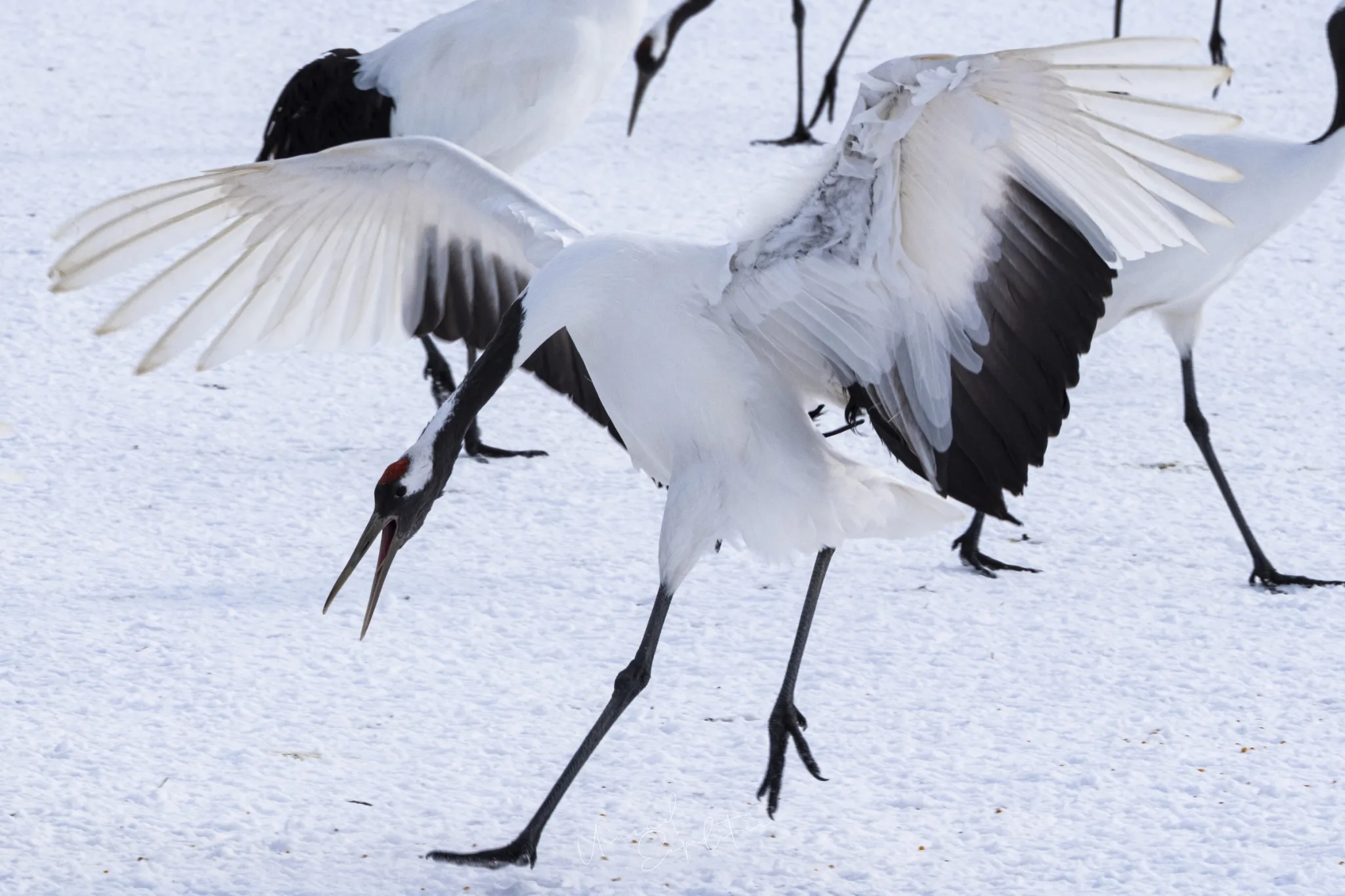
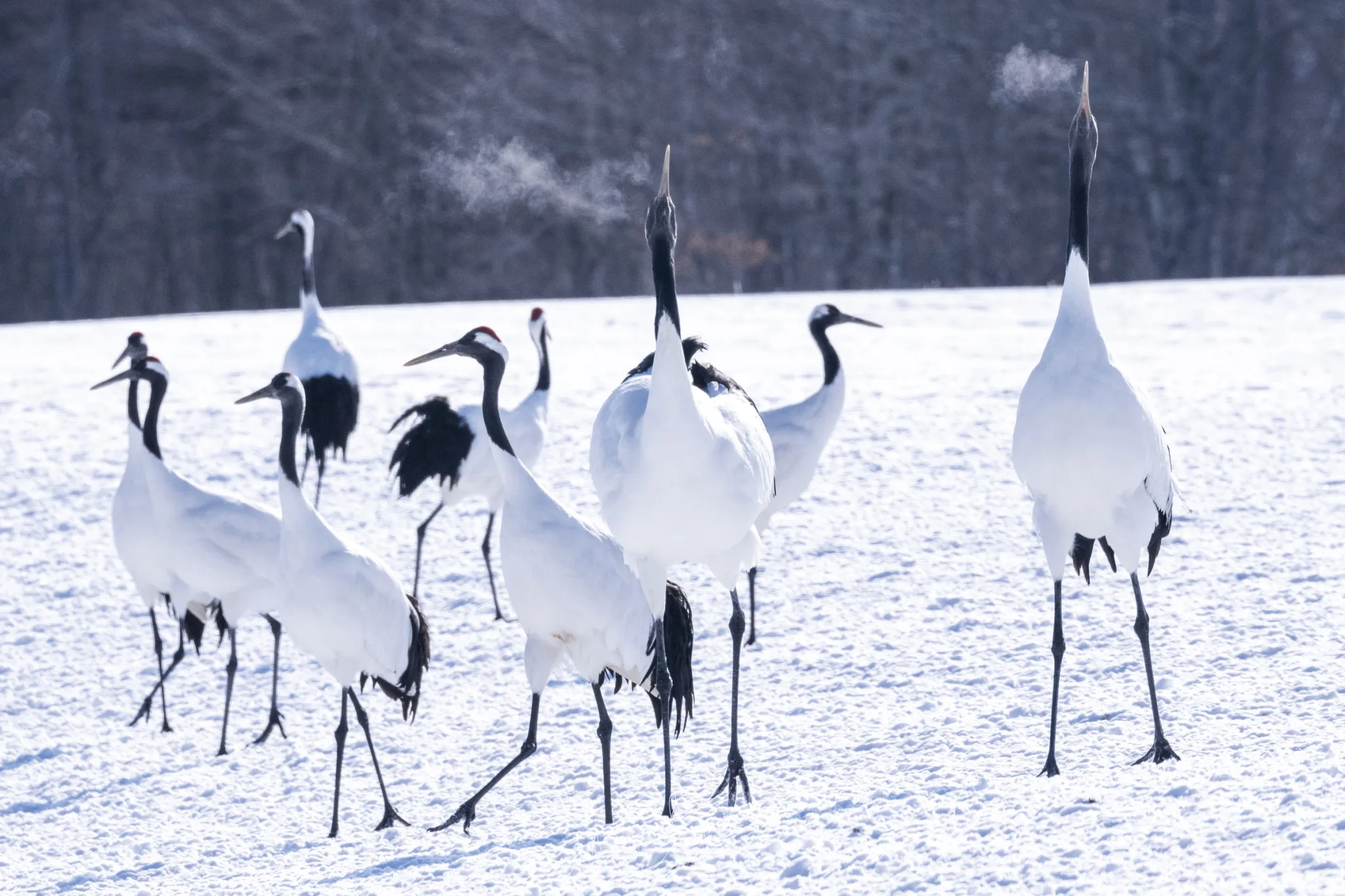
The dance is the behaviour everyone hopes to catch. Pairs bow, leap and open their wings, calling with heads raised, and the display often spreads through the group. It happens through the winter, and in our experience it picks up in the second half of the season as pairs prepare to breed. Watch for a bird stretching its neck and bowing: that is often the start. A fast shutter freezes the wings and the kicked-up snow, while a slow shutter with a gentle pan turns the dance into a blur of black and white that suggests the movement. Expose for the white plumage and the snow, adding exposure from what the meter suggests, and check the histogram so the white feathers keep detail.
The cranes reward the people who stay. The first hour at the fence is usually quiet, then a pair starts to call and suddenly the whole field is dancing. If you have packed up by then, you miss it.
Joseph Mak, tour leader, Unusual Expedition
Red crowned crane Japan population: a conservation story
The red crowned crane Japan population came close to disappearing in the early twentieth century, and the winter feeding in Tsurui and Akan is a large part of its recovery. According to figures reported by nippon.com, the January 2025 survey counted 1,927 cranes in Hokkaido, and the Ministry of the Environment has moved the bird from threatened to near threatened on its national list. More birds means more competition at the feeding grounds and more spread across the east, so you may also see cranes in fields beside the road. Stop only where it is safe and legal, stay in your car or at a distance, and never walk onto private farmland to get closer.
Red crowned crane Hokkaido: when and how to photograph
| Situation | Where | Light | Settings and lens |
|---|---|---|---|
| Dawn roost in river mist | Setsuri River, Otowa Bridge | Sunrise on the coldest mornings | 100-400mm, tripod |
| Dance and display | Tsurui and Akan feeding grounds | Through the day | Fast shutter, 100-400mm |
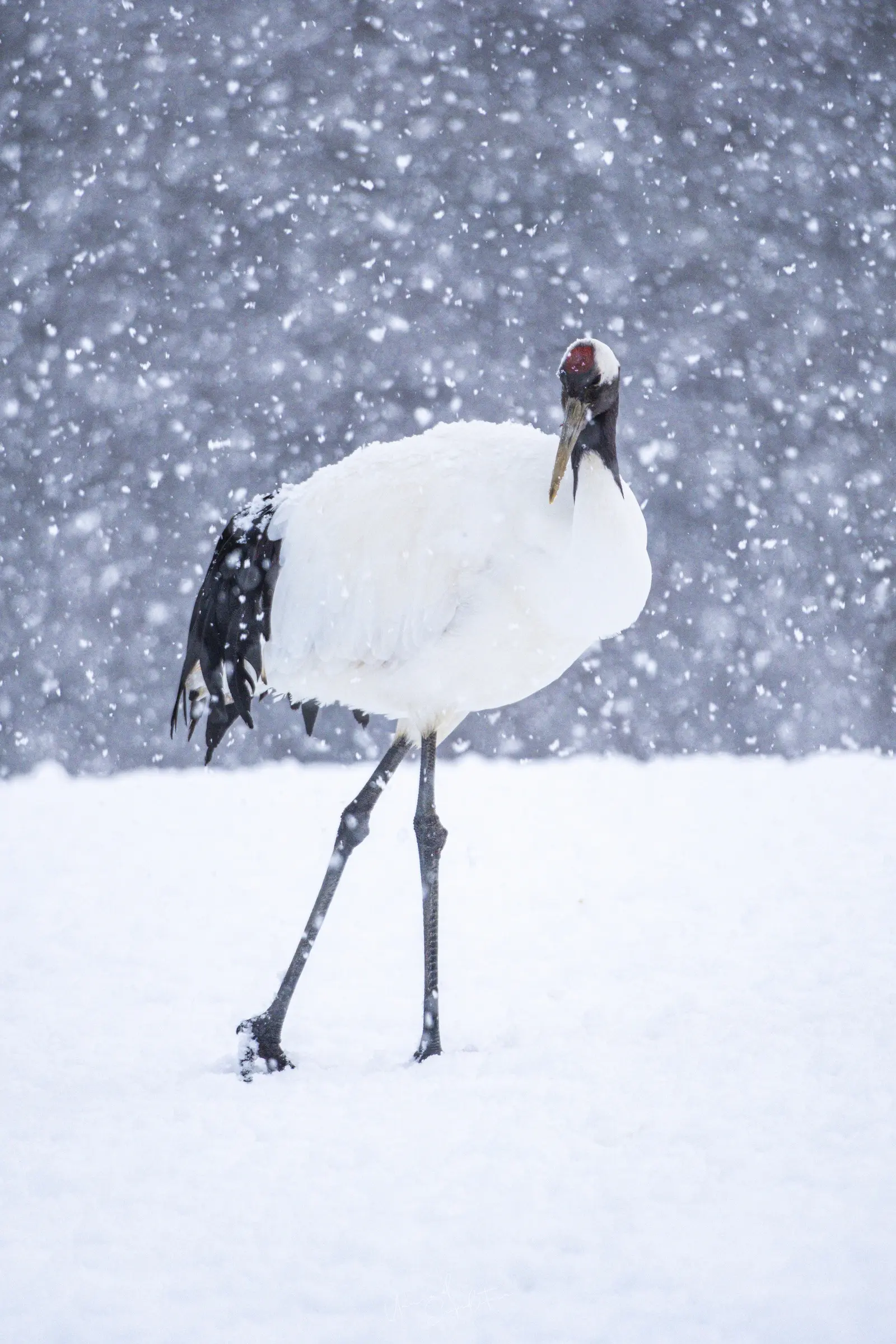
| Cranes in falling snow | Feeding grounds | Overcast, snowing | Add exposure, 70-200mm |
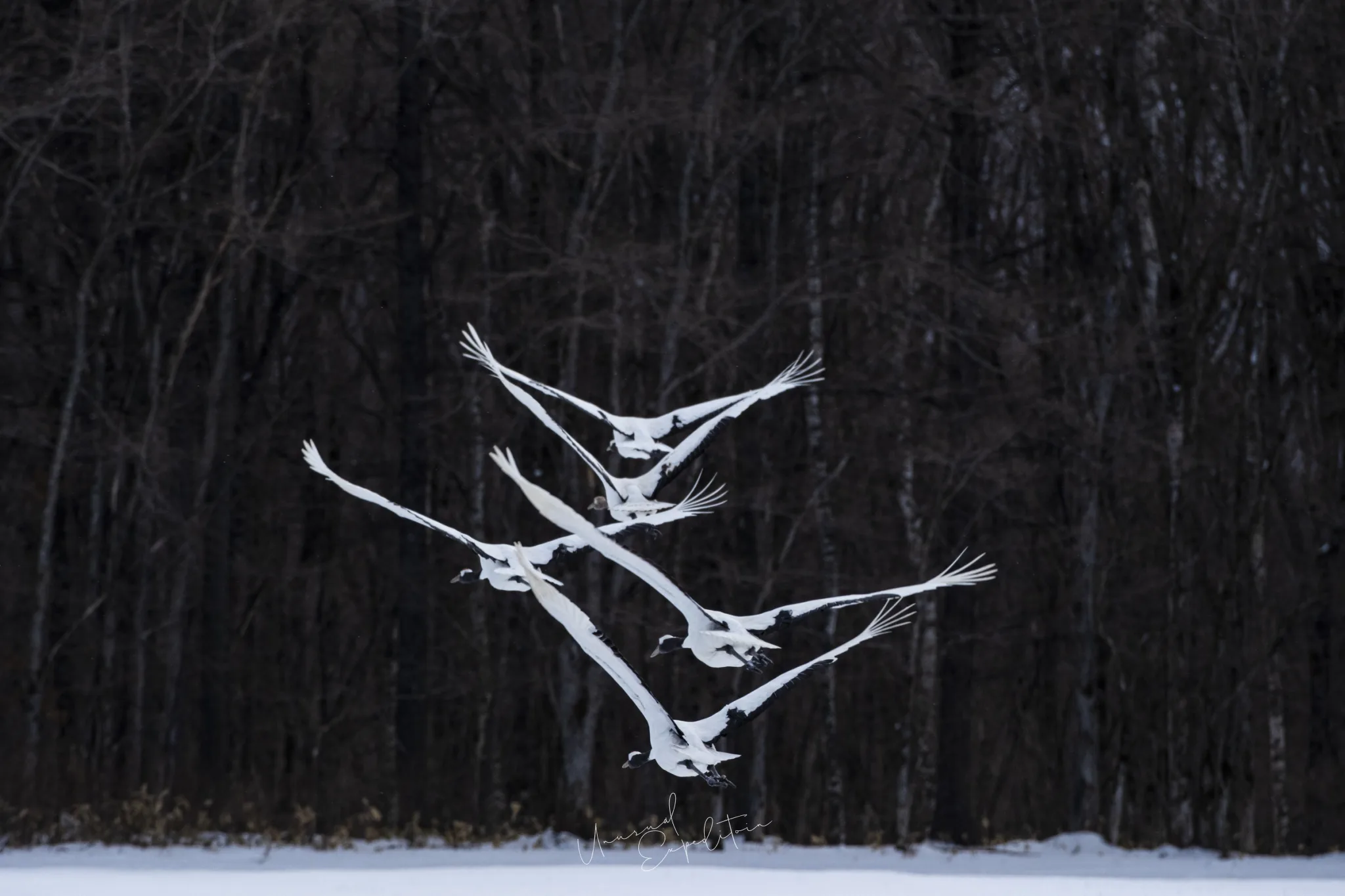
| Flight past dark trees | Fields by the woods | Afternoon | Continuous focus, 100-400mm |
Snowing days are worth staying out for, because the falling flakes soften the background and isolate each bird.
Kushiro cranes in the wider Hokkaido trip
Kushiro cranes fit naturally into a winter trip through the east. From the crane country it is a drive north and east to the Shiretoko Peninsula, where our Steller's sea eagle guide picks up the story at Rausu, and to Lake Kussharo, where the whooper swans at Lake Kussharo gather on the warm shore. On the way you may meet red foxes and sika deer, which our Hokkaido wildlife guide covers. Roads in winter are icy, so plan short legs with time in hand, and let someone else do the driving if you are not used to snow.
Practical notes for a crane day
Crane photography means standing still in the cold for hours. Wear insulated boots, layers and a windproof outer shell, and keep spare batteries warm in an inside pocket. A beanbag or a gimbal head on a sturdy tripod saves your arms. Keep voices low, never use flash, and do not throw food or step over fences: the cranes are wild birds, and the sanctuaries rely on visitors behaving well. If you bring a drone, leave it in the bag, since flying near the birds disturbs them; ask the site staff before you even think of it.
Photograph the cranes with us
We run eastern Hokkaido as a private trip on request, timed for the cranes and planned around your pace. We arrange all the logistics, and a photographer or coaching can be added at extra cost. See our private tours and the Japan photography tours page.
Ask us about the cranes of Hokkaido
Join the Hokkaido photography tour
Kyushu, Shikoku And Setouchi Photography Journey departs 25 Sep 2027 To 05 Oct 2027, led by Joseph Mak. Small group, photography first. All Hokkaido photography tours.
Explore Hokkaido in depth
- Hokkaido Photography Tour Guide: Cranes, Eagles, Owls and Snow in Eastern HokkaidoJapan
- Steller's Sea Eagle Photography in Rausu: Size, Wingspan and the Winter BoatsJapan
- Whooper Swans at Lake Kussharo, Hokkaido: Photographing the Swans of the Hot Spring ShoreJapan
- Hokkaido Wildlife Photography: Red Foxes, Sika Deer, Owls and Forest Birds in WinterJapan
- Blakiston Fish Owl: How to Photograph the World's Largest Owl in HokkaidoJapan
- Biei in Winter: The Christmas Tree, the Blue Pond and the Snow Fields of HokkaidoJapan
- Best Time to Visit Hokkaido in Winter for Photography: Month by Month in the EastJapan
Upcoming Photo Tours
- Egypt Photo Tour – EgyptEgypt 12 Dec 2026 To 20 Dec 2026
- Inner Mongolia Winter Owl Photo Tour – ChinaChina 01 Jan 2027 To 04 Jan 2027
- Inner Mongolia Winter Photo Tour – ChinaChina 05 Jan 2027 To 11 Jan 2027
- Mekong And Central Highland Vietnam Photo Tour - VietnamVietnam 16 Jan 2027 To 24 Jan 2027