
Blakiston Fish Owl: How to Photograph the World's Largest Owl in Hokkaido
Blakiston fish owl in Hokkaido: its size and wingspan, whether it migrates, how the night viewing at Rausu works, settings.
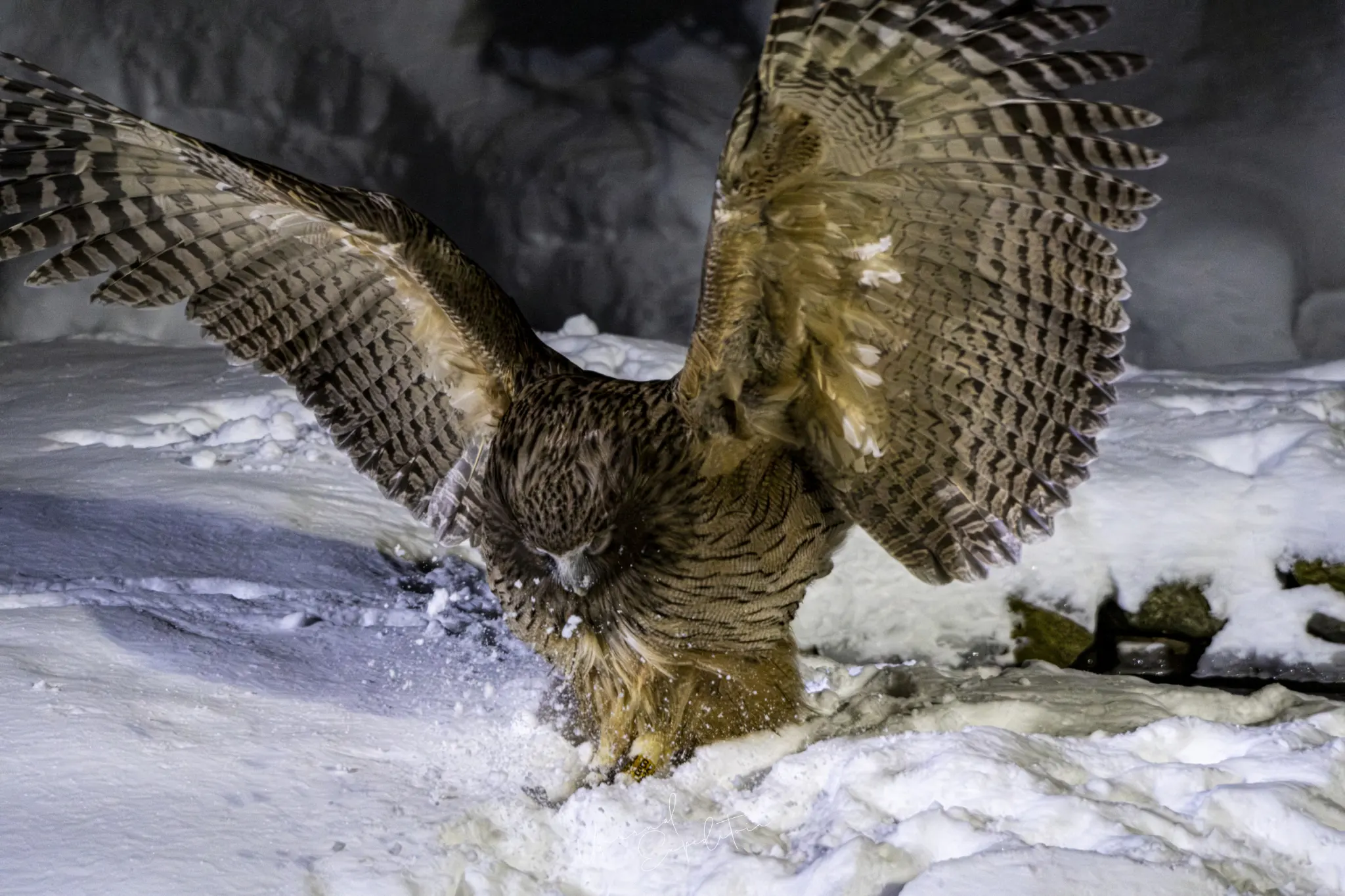
The Blakiston fish owl is the largest owl in the world and one of the rarest birds in Japan, and in Hokkaido the reliable way to photograph it is at night beside a stream in Rausu, on the Shiretoko Peninsula. The owls come down to shallow water to catch fish, lit by lamps the birds have grown used to, while photographers wait quietly indoors or under cover. It takes patience and warm clothes, but few winter subjects anywhere are as memorable.
The owl is the night chapter of our Hokkaido photography tour guide, which covers the cranes, eagles and swans of the same winter trip. It is a subject where knowing the bird and the place matters as much as the camera, so we start with the owl itself.
Blakiston fish owl: a giant of the northern rivers
The Blakiston fish owl lives in old riverside forests in the Russian Far East, north-east China and Hokkaido, where it hunts fish in rivers that stay open through the winter. National Geographic describes it as the world's biggest owl and notes that it takes salmon, trout and lamprey in icy rivers. In Hokkaido the owls survive mainly in the east, and Japan's Ministry of the Environment puts the island's population at roughly 165 birds, about a quarter of them in the Shiretoko World Heritage area. The ministry's red list places the species in its highest category of extinction risk. Seeing one is a privilege; photographing one well is a matter of doing nothing that disturbs it.
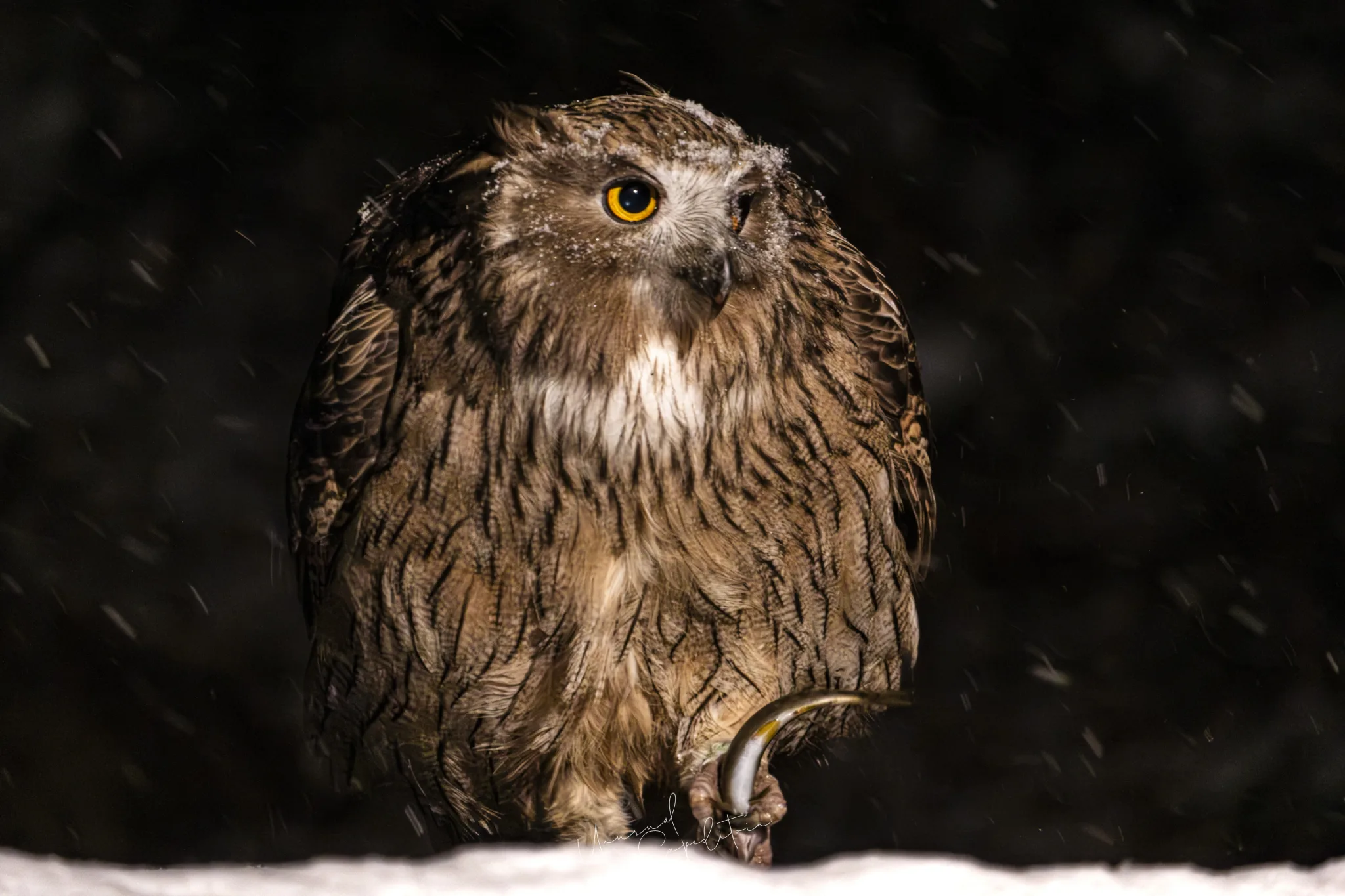
Blakiston's fish owl size and wingspan
Blakiston's fish owl size surprises everyone the first time the bird lands. It is a heavy, broad owl with tufted ears, a pale throat and finely barred brown plumage that blends into bark and snow, and its wingspan is around 1.8 metres, according to National Geographic. When it opens its wings to balance on the snow bank, the bird fills a 70-200mm frame from much further away than you expect, so frame wider than you think and leave room for the wings. The eyes are bright yellow, and they are what you focus on. At the same time, the owl's size makes it look slow, and it is not: the strike into the water is over in a moment.
Does the Blakiston's fish owl migrate?
Does the Blakiston's fish owl migrate? Not in Hokkaido. Unlike the Steller's sea eagles and whooper swans that arrive for the winter, the fish owl lives on the island all year, in pairs that keep to their stretch of river and nest in the hollows of old trees. That is why winter is the best time to photograph it: the rivers are narrowed by ice, the owls must come to the few places with open water and fish, and the snow gives a clean, bright background that summer cannot offer. It also means that disturbance at any time of year affects the same few birds, which is a good reason to watch only from established viewing places.
The first time the owl landed I forgot to press the shutter. It is that big. Now I tell people to set everything before dark, then sit still and wait, because the bird decides when it comes, not us.
Joseph Mak, tour leader, Unusual Expedition
How the night viewing in Rausu works
In Rausu a lodge beside a small stream has become known as a place to watch the owls. A pool in the stream holds fish, the area is lit softly through the night, and guests watch and photograph from inside or from a sheltered spot nearby, so nobody walks into the forest after the birds. Sources describe it as a managed site that keeps photographers out of the owls' habitat, which is the point. Expect to wait for hours, sometimes most of the night, and to see the owl once or a few times. Keep talking to a whisper, never use flash, and do not shine torches at the stream. Places are limited, so ask us early if the owl matters to you.
Camera settings for the fish owl at night
| Setting | Suggestion | Why |
|---|---|---|
| Lens | 70-200mm f2.8, or a fast 100-400mm | The owl comes close; light is low |
| Shutter | As fast as the light allows | The strike and the wings are quick |
| ISO | High, set before the bird arrives | There is no time to change it later |
| Focus | Single point, on the eye | Barred plumage confuses wide area focus |
| Support | Tripod or beanbag, pre-framed on the pool | You may wait for hours without moving |
Modern sensors handle high ISO well, and a sharp noisy frame always beats a clean blurred one.
Blakiston's fish owl wingspan in the frame: composition ideas
The classic frame is the owl standing on the snow bank with the dark stream behind, then the moment it opens its wings or rises from the water with a fish. On snowy nights the falling flakes catch the light and turn the black background into a field of stars around the bird, as in the frame above. Try both a tight portrait, which shows the ear tufts and the yellow eyes, and a wider frame that shows the snow and the water, which tells the story of how the owl lives. Expose for the face, not for the snow, and let the background go black.
Fitting the owl into a Shiretoko trip
An owl night pairs naturally with an eagle morning on the boats of Rausu, which our Steller's sea eagle guide covers. A short night's sleep is the price. The eastern forests also hold the smaller Ural owl, which roosts in tree hollows by day and appears in our Hokkaido wildlife guide. For the season and the weather, see the best time to visit Hokkaido in winter.
Photograph the fish owl with us
We arrange the owl as part of a private trip through eastern Hokkaido, on request and at your pace, with all the logistics in place. A photographer or photography coaching can be added at extra cost. See our private tours and the Japan photography tours page.
Ask us about the Blakiston fish owl
Join the Hokkaido photography tour
Kyushu, Shikoku And Setouchi Photography Journey departs 25 Sep 2027 To 05 Oct 2027, led by Joseph Mak. Small group, photography first. All Hokkaido photography tours.
Explore Hokkaido in depth
- Hokkaido Photography Tour Guide: Cranes, Eagles, Owls and Snow in Eastern HokkaidoJapan
- Steller's Sea Eagle Photography in Rausu: Size, Wingspan and the Winter BoatsJapan
- Red Crowned Crane Hokkaido: Photographing the Cranes of Tsurui, Akan and the Setsuri RiverJapan
- Whooper Swans at Lake Kussharo, Hokkaido: Photographing the Swans of the Hot Spring ShoreJapan
- Hokkaido Wildlife Photography: Red Foxes, Sika Deer, Owls and Forest Birds in WinterJapan
- Biei in Winter: The Christmas Tree, the Blue Pond and the Snow Fields of HokkaidoJapan
- Best Time to Visit Hokkaido in Winter for Photography: Month by Month in the EastJapan
Upcoming Photo Tours
- Egypt Photo Tour – EgyptEgypt 12 Dec 2026 To 20 Dec 2026
- Inner Mongolia Winter Owl Photo Tour – ChinaChina 01 Jan 2027 To 04 Jan 2027
- Inner Mongolia Winter Photo Tour – ChinaChina 05 Jan 2027 To 11 Jan 2027
- Mekong And Central Highland Vietnam Photo Tour - VietnamVietnam 16 Jan 2027 To 24 Jan 2027