
Sol de Mañana Geysers: Photographing Bolivia's Highest Geothermal Field
Sol de Mañana geysers: altitude, the steam at sunrise, mud pools, safety on the geyser field and how it fits the Uyuni route.
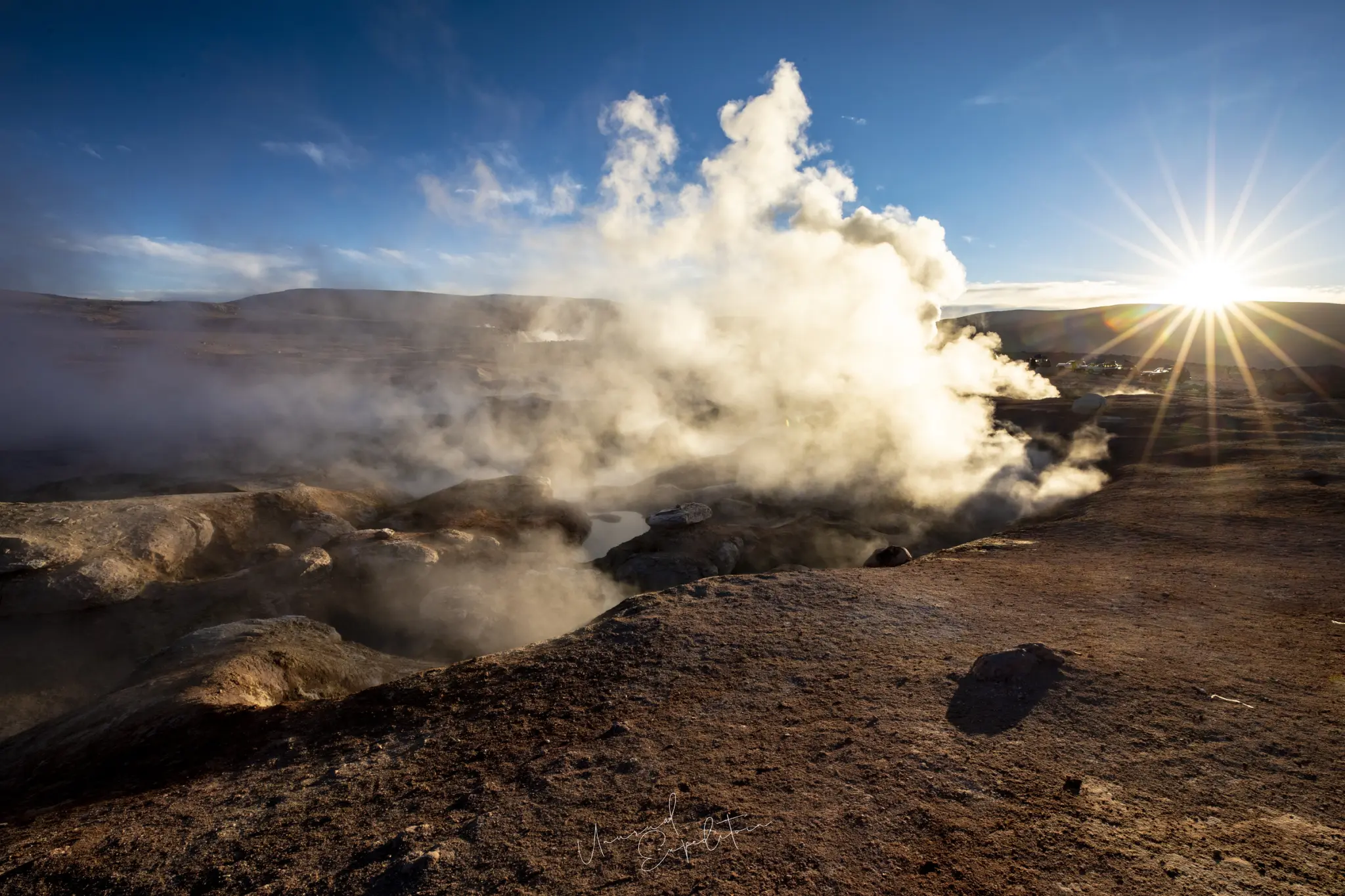
The Sol de Mañana geysers are a geothermal field of steaming vents and boiling mud pools at about 4,900 metres in the far southwest of Bolivia, south of Laguna Colorada on the route between the Salar de Uyuni and the Chilean border. The name means "morning sun", and morning is when to photograph it: the cold air makes the steam columns tall and dense, and a low sun behind them lights them up. Most of the activity is fumaroles and mud pots rather than erupting geysers.
Sol de Mañana is one stop on the loop described in our Uyuni photography tour guide. Our frames here come from a cold, clear morning on the field.
Sol de Mañana geysers: what the field looks like
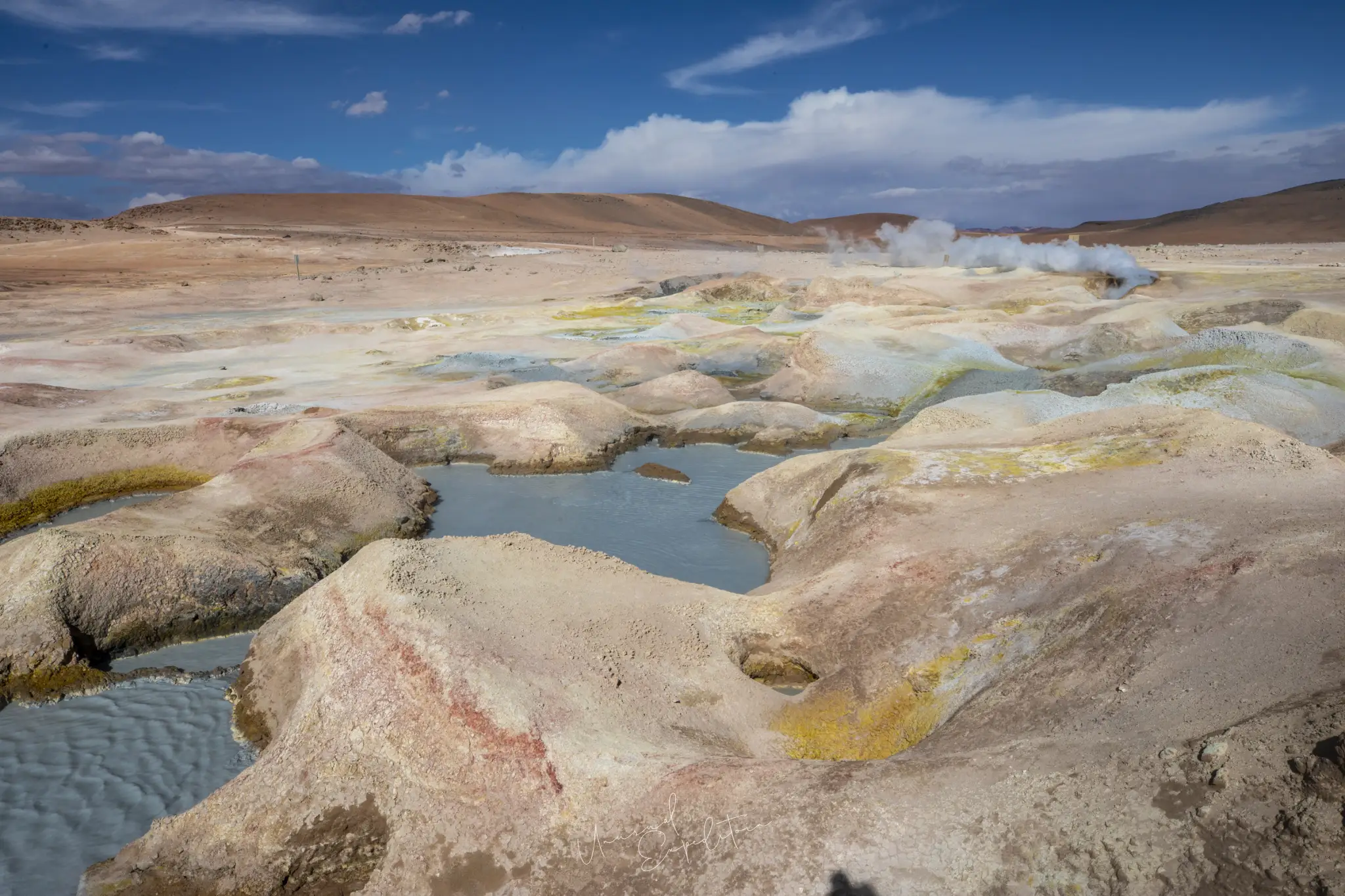
The Sol de Mañana geyser field spreads across a broad, bare basin of grey, ochre and sulphur-yellow ground, cut by craters of grey mud that bubbles and spits. From some vents steam roars out under pressure; others breathe gently; the larger pools slap and plop as gas rises through the mud. There are no boardwalks or railings in most of the field, so the pictures are wide and open, with the volcanic hills of the border region behind. The smell of sulphur is strong, and the noise of the vents is part of the experience. For a photographer there are three subjects: the steam columns against the sky, the textured mud pools and crater rims, and people or vehicles small in the vapour for scale. Each needs a different light.
Sol de Manana altitude
The Sol de Manana altitude is around 4,900 metres; Wikipedia gives that figure and a range of roughly 4,800 to 5,000 metres across the field, and a 2018 report for the United Nations University Geothermal Training Programme puts the centre of the field at about 4,980 metres. For most visitors it is the highest point of the whole Uyuni trip, higher than Laguna Colorada and well above the salt flat. That has practical effects. Walk slowly, even on flat ground, and do not run to catch a burst of steam. Breathing is harder and the cold is sharper than at the lagoons. Visitors who have spent a few days on the salt and at the lagoons first are usually better adapted by the time they reach the field. Our guide to getting to Uyuni covers altitude and acclimatising in more detail.
Photographing the steam at sunrise
Steam is made visible by cold, so the colder the morning, the bigger the columns. At Sol de Mañana the best time is around sunrise, when the air is at its coldest and the low sun can be placed directly behind the vapour. Backlit, the steam turns white and gold and the edges glow. Put the sun just behind a column, or let it peek out from the edge, and stop down to f/16 or more for a sunstar, as in the frame at the top of this page. Expose for the bright steam and let the ground fall into shadow; the dark mud and rock then frame the light. Once the sun climbs and the air warms, the columns shrink and the light goes flat, so the window is short. Wind is the other variable: a light breeze bends the steam into long ribbons, while a strong one flattens it.
"At the geysers the photographs happen in the first minutes of sun. Get there before it comes up, find the column you want and stand so the sun will rise behind it. Then do not move, because by the time you have changed position the light has changed too."
Joseph Mak, tour leader, Unusual Expedition
Sol de Mañana geyser field: staying safe
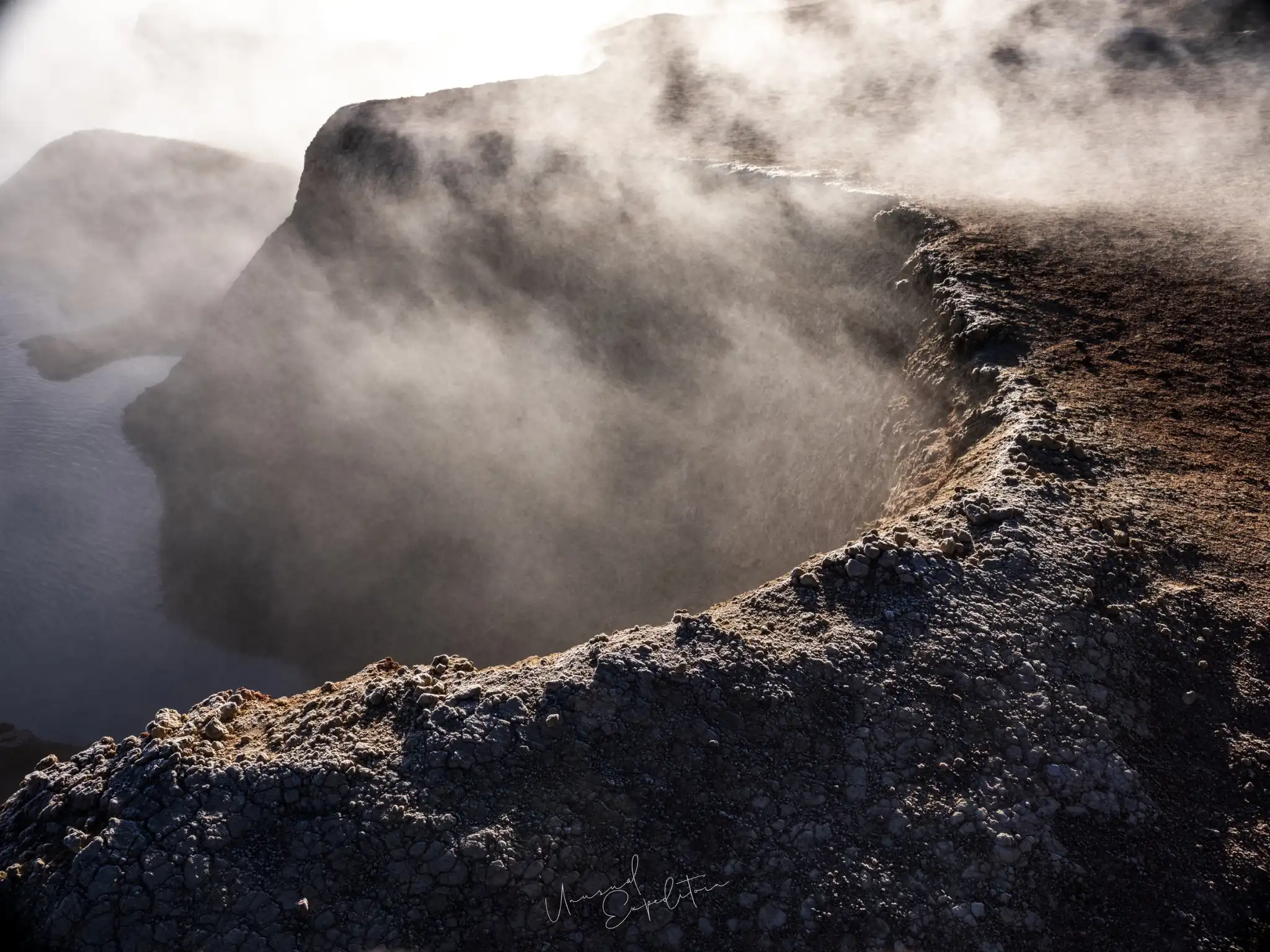
The Sol de Mañana geyser field has no fences in most places, and the ground between the vents can be thin crust over boiling mud. Local guides and drivers know where it is solid, and the simple rule is to follow their path and stay off pale, damp-looking ground near the pools. Keep a respectful distance from the edges of mud pots, which can spit hot mud without warning, and from the stronger vents, where the steam is scalding close to the opening. Do not put tripod legs on soft ground at the edge of a crater. A 24-70mm and a 70-200mm let you frame the pools and vents from a safe distance without walking up to them. Sulphur in the air also coats lenses, so wipe the front element after you leave.
Geysers Bolivia: Sol de Mañana compared
| Subject | Best light | Lens | Notes |
|---|---|---|---|
| Backlit steam columns | Sunrise, sun behind the steam | 16-35mm or 24-70mm | Coldest mornings give the tallest steam |
| Mud pools and crater rims | Soft morning light or cloud | 24-70mm | Shoot from solid ground only |
| Bubbling mud close-ups | Any light | 70-200mm | Fast shutter to freeze the splashes |
| Figures or vehicles in the vapour | Low sun | 70-200mm | Shows the size of the field |
The table is really a list of what to do in the right order: steam first, while the sun is low, and the mud pools after.
What else is near Sol de Mañana
Sol de Mañana sits in the Eduardo Avaroa Andean Fauna National Reserve, so the same morning usually links it with the lagoons. Laguna Colorada, with its red water and flamingos, lies to the north; further south are the hot springs and the green and white lagoons near the Chilean border. On our trip the mornings went to the geysers and the flamingo lagoons, and the nights to the stars over the rock formations of the high desert. Our Laguna Colorada flamingos article covers the birds and Uyuni sunset, sunrise and night sky covers the night photography of the area.
Is Sol de Mañana worth the long road south?
Sol de Mañana is worth the road south if you can arrive at sunrise. Seen at midday, in flat light with the steam reduced to wisps, the field can feel like a stop on the way to somewhere else. In the cold first light, with the vents roaring and the sun breaking through the steam, it is one of the most striking places in Bolivia. That means planning the route so that the morning falls at the field, which shared tours do not always manage. It also means warm clothes for standing still in deep cold at high altitude. If you are deciding between a short trip on the salt and the longer loop, our is Uyuni salt flats worth it article sets out the trade-off.
Photograph Sol de Mañana with us
We plan private Uyuni trips so that the sunrise falls at the geysers and the morning light at the lagoons. A private tour works for individuals, couples, families and photographers at their own pace, and we arrange all of it. Because no tour leader travels, it can cost less than a group tour; a photographer or photography coaching can be added at extra cost. Give us two months' notice where possible. See private tours and our Bolivia photography tours.
Uyuni photography tours
The next Uyuni departure is announced on the Uyuni photography tours page, with previous expeditions and all the planning guides.
Explore Uyuni in depth
- Uyuni Photography Tour: The Salt Flats, Lagoons and GeysersBolivia
- How to Get to Uyuni Salt Flats: Visa, Flights, Altitude and MoneyBolivia
- Is Uyuni Salt Flats Worth It? Isla Incahuasi and How to Get ThereBolivia
- Laguna Colorada Flamingos: Where to See Flamingos in BoliviaBolivia
- Uyuni Sunset, Sunrise and Night Sky: Photographing the Salt Flats After DarkBolivia
- Best Time to Visit Uyuni Salt Flats: Mirror Season or Dry SeasonBolivia
- Uyuni Salt Flats Photos: Photo Ideas and Where to StandBolivia
Upcoming Photo Tours
- Egypt Photo Tour – EgyptEgypt 12 Dec 2026 To 20 Dec 2026
- Inner Mongolia Winter Owl Photo Tour – ChinaChina 01 Jan 2027 To 04 Jan 2027
- Inner Mongolia Winter Photo Tour – ChinaChina 05 Jan 2027 To 11 Jan 2027
- Mekong And Central Highland Vietnam Photo Tour - VietnamVietnam 16 Jan 2027 To 24 Jan 2027