
Uyuni Sunset, Sunrise and Night Sky: Photographing the Salt Flats After Dark
Uyuni sunset and sunrise on the salt, dusk long exposures, the Uyuni night sky and Milky Way, with settings that work.
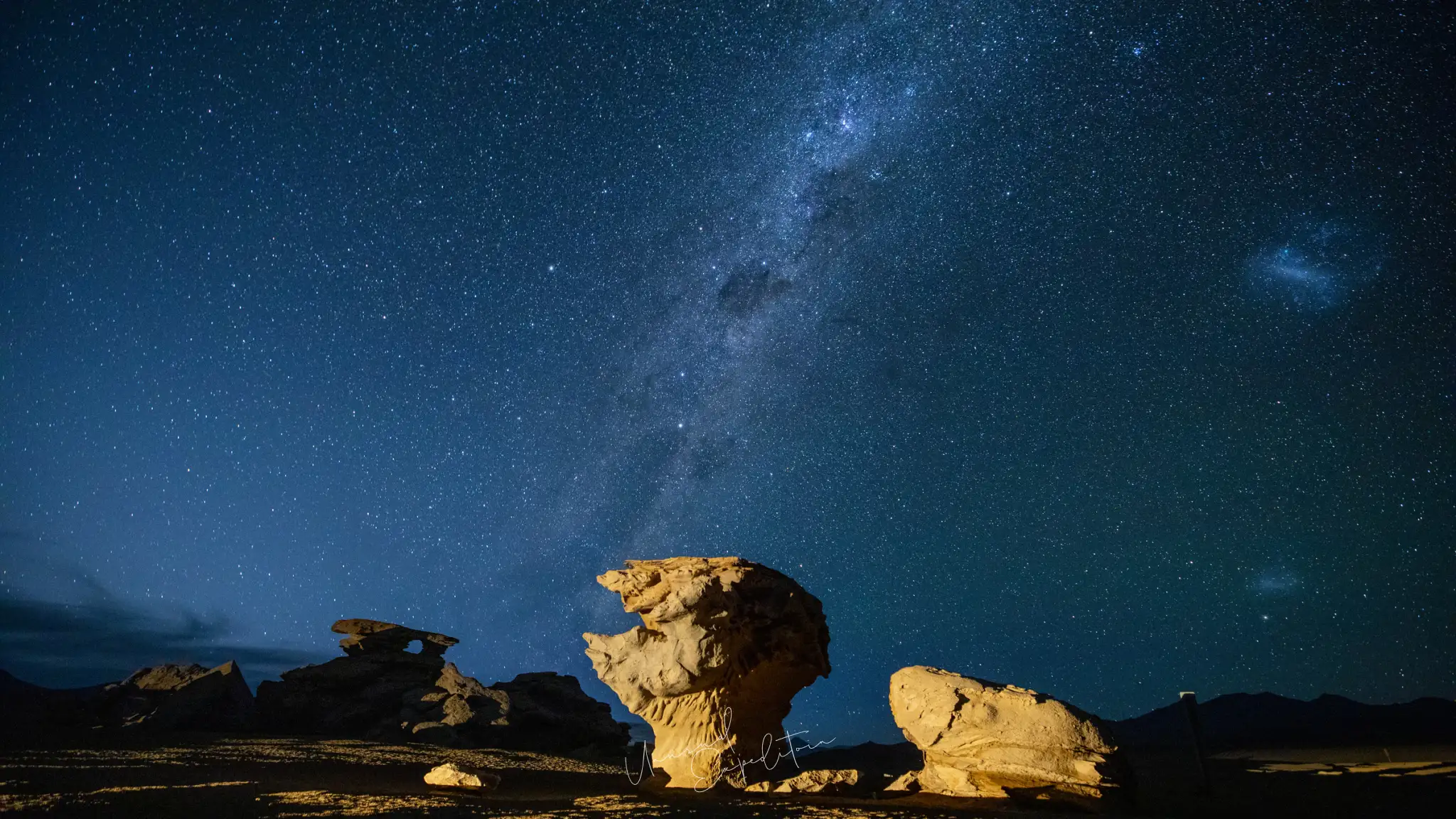
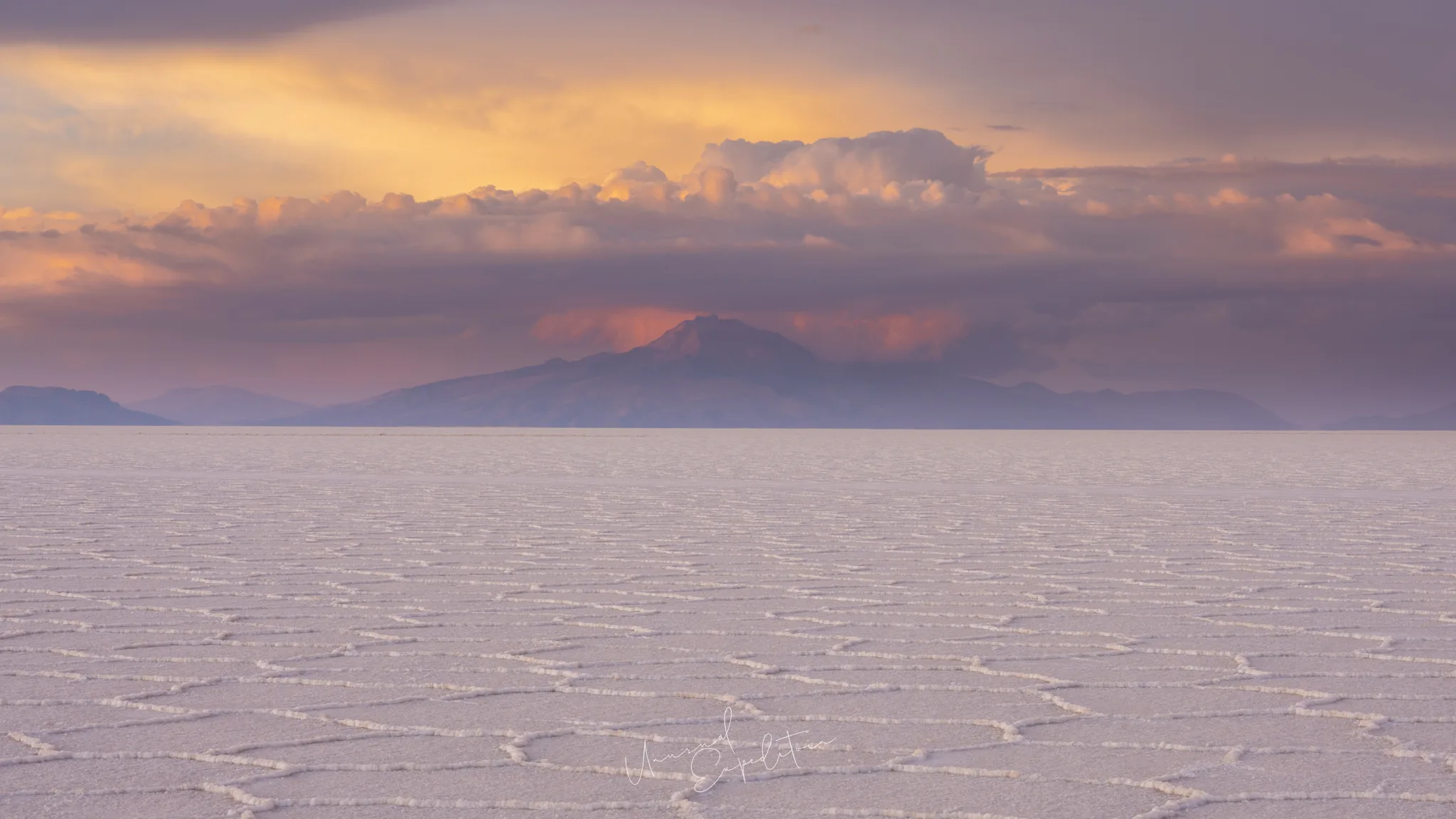
Uyuni sunset is the best hour on the salt for most photographers: the low sun lights the edge of every salt ridge, the sky over the flat holds colour long after the sun has gone, and wet salt doubles it. Uyuni sunrise gives the same light in reverse, with stars fading overhead. The night sky over the salt and the desert to the south is dark enough for the Milky Way. All three need a tripod, warm clothes and a plan for the cold.
For the area as a whole, see our Uyuni photography tour guide. This page is about the hours at either end of the day and the night between them.
Uyuni sunset on the salt flats
A Uyuni sunset starts working about an hour before the sun touches the horizon. As the angle drops, the raised ridges of the salt crust catch light on one side and throw shadow on the other, and the hexagon pattern that was invisible at midday suddenly stands up in lines of gold. That is the moment to get low with a 16-35mm and put a strong polygon in the foreground. When the sun is down, turn round: the sky opposite the sunset often goes pink and violet, and on a clear evening the distant volcanoes on the rim of the Salar de Uyuni pick up the last warm light. Clouds help more than they hurt here. On our evening on the salt a bank of cloud over the horizon caught colour long after the sun had set behind it, and that afterglow, not the sunset itself, gave the strongest frames.
Long exposures at dusk on the Salar de Uyuni
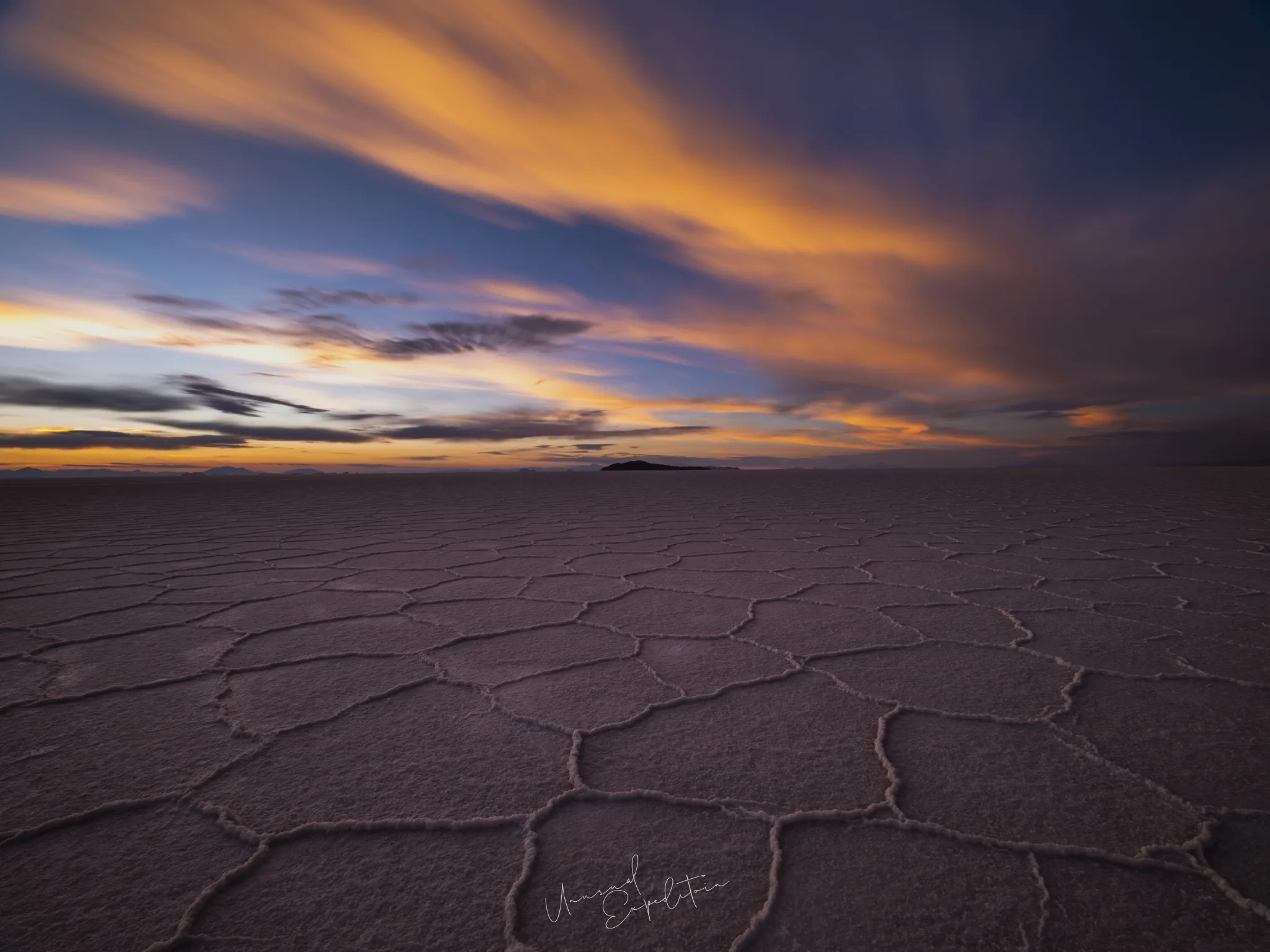
Once the colour starts to fade, the Salar de Uyuni rewards long exposures. With a neutral density filter, or simply the falling light, exposures of a few minutes turn moving cloud into streaks across the sky while the salt crust stays crisp in front of the lens. Our dusk frame of the hexagons under streaked orange cloud was a four-minute exposure at a small aperture and the lowest ISO, on a tripod pressed into the crust. Two habits help. Wipe the salt off the tripod feet and legs afterwards, because it corrodes. And keep checking the horizon line: on a perfectly flat surface any tilt shows immediately. Wind is the main reason these frames fail, so set the tripod low and hang the bag from the centre column.
Uyuni sunrise: is it worth getting up for?
A Uyuni sunrise is worth getting up for, especially in the wet season. Wind on the Altiplano usually drops overnight, so the water on the salt is at its calmest before dawn, which is exactly when the mirror effect is cleanest. The sky goes from star-filled to deep blue to a band of orange on the eastern horizon, and the reflection carries all of it. In the dry season the reward is quieter: the crust in soft blue light and a clear rim of mountains. The cold is the hardest part. The salt sits at about 3,656 metres according to Britannica, and before dawn the temperature is often below freezing. Dress as for a winter night, carry a hot drink and keep spare batteries inside your jacket. On the southwest loop, dawn also belongs to the geysers, covered in our Sol de Mañana geysers article.
Uyuni night sky and the Milky Way
The Uyuni night sky is one of the darkest you can reach easily in South America. The salt and the desert to the south are high, dry and far from city light, so on a moonless night the Milky Way is plain to the eye. Uyuni salt flats Milky Way pictures need a foreground, and the salt itself is a weak one in the dark; a wet patch that reflects the stars, a rock formation or a vehicle with its lights off works better. Our Milky Way frame here was made over wind-carved rocks in the desert south of the salt, a 30-second exposure at ISO 4000 and f/4 on a 16-35mm. The southern sky has its own rewards: the Magellanic Clouds, two small galaxies that NASA describes as satellites of our own Milky Way, are visible from Bolivia but never from Europe or most of North America. Check the moon before you plan: a full moon lights the salt beautifully but washes the stars out.
"The first time you switch off the headlamps out there, people go quiet. There is no glow on any horizon, just stars down to the ground. Give your eyes a few minutes before you touch the camera."
Joseph Mak, tour leader, Unusual Expedition
Salar de Uyuni stars: settings that work
| Subject | Lens | Starting settings | Notes |
|---|---|---|---|
| Sunset hexagons | 16-35mm | f/11, low ISO, tripod | Camera low, side light |
| Dusk cloud streaks | 16-35mm | Several minutes, f/16 to f/20, ISO 50 to 100 | ND filter helps before the light fades |
| Twilight mirror | 16-35mm or 24-70mm | Bracket around 1 to 30 seconds | Needs calm water |
| Milky Way | Wide, fast lens | About 20 to 30 seconds, f/2.8 to f/4, ISO 3200 to 6400 | Moonless night, foreground needed |
| Star reflection | Wide, fast lens | As for the Milky Way | Wet season, no wind |
The numbers are starting points; cold batteries and wind will change them more than the sky does.
Uyuni salt flats sunset tour or your own timing?
Most shared Uyuni salt flats sunset tours leave town in the afternoon, stop for the sunset and return after dark, which gives a taste of the light but little time to choose a spot or wait for the afterglow. The same is true of sunrise and star tours. For photography it pays to control the timing: to arrive early, walk the crust to find a foreground, stay after everyone else has left and come back before dawn if the sky is clear. That is how we plan our own trips, and it is the main difference between photographing the salt and visiting it. Our Uyuni salt flats photos article covers where to stand in daylight, and best time to visit Uyuni salt flats covers which season gives which sky.
Photograph Uyuni after dark with us
We plan private Uyuni trips around the light, with time on the salt at both ends of the day and nights set aside for the stars. You choose the pace and what you want to photograph; we arrange everything else. A private trip can cost less than a group tour because no tour leader travels, and you can add a photographer or photography coaching at extra cost. Ask about two months ahead if you can. More on private tours and our Bolivia photography tours.
Ask us about photographing Uyuni at night
Uyuni photography tours
The next Uyuni departure is announced on the Uyuni photography tours page, with previous expeditions and all the planning guides.
Explore Uyuni in depth
- Uyuni Photography Tour: The Salt Flats, Lagoons and GeysersBolivia
- How to Get to Uyuni Salt Flats: Visa, Flights, Altitude and MoneyBolivia
- Is Uyuni Salt Flats Worth It? Isla Incahuasi and How to Get ThereBolivia
- Sol de Mañana Geysers: Photographing Bolivia's Highest Geothermal FieldBolivia
- Laguna Colorada Flamingos: Where to See Flamingos in BoliviaBolivia
- Best Time to Visit Uyuni Salt Flats: Mirror Season or Dry SeasonBolivia
- Uyuni Salt Flats Photos: Photo Ideas and Where to StandBolivia
Upcoming Photo Tours
- Egypt Photo Tour – EgyptEgypt 12 Dec 2026 To 20 Dec 2026
- Inner Mongolia Winter Owl Photo Tour – ChinaChina 01 Jan 2027 To 04 Jan 2027
- Inner Mongolia Winter Photo Tour – ChinaChina 05 Jan 2027 To 11 Jan 2027
- Mekong And Central Highland Vietnam Photo Tour - VietnamVietnam 16 Jan 2027 To 24 Jan 2027