
Uyuni Salt Flats Photo Spots: Salar de Uyuni Photography Tips by Place
Salar de Uyuni photography tips by place: hexagons, the mirror, Isla Incahuasi, the train cemetery, the lagoons, geysers and stars.
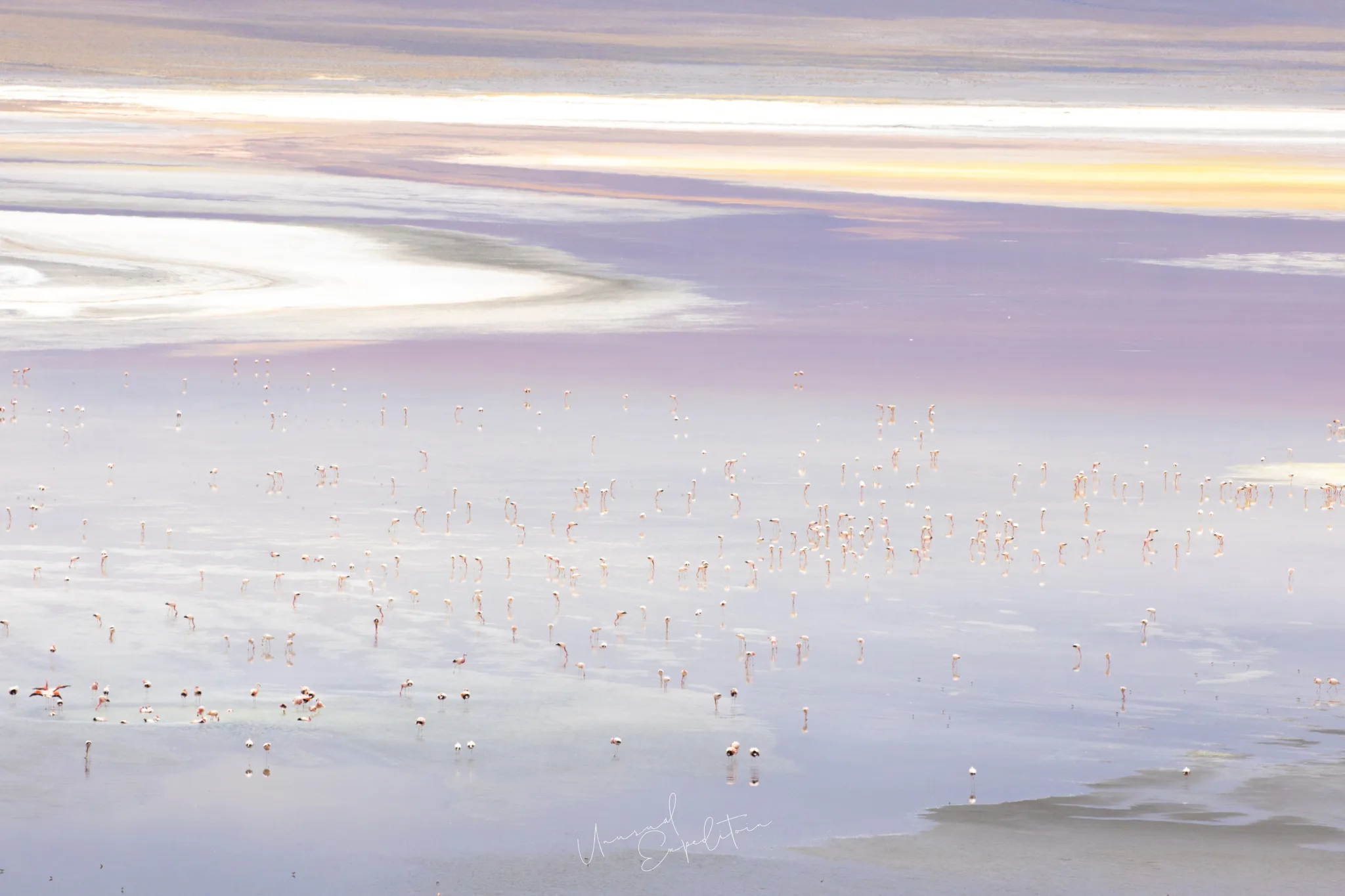
Salar de Uyuni photography tips start with knowing where to stand: the hexagon crust in the dry season, the mirror patches in the wet season, Isla Incahuasi with its giant cacti, the train cemetery outside Uyuni town, the coloured lagoons of the Eduardo Avaroa reserve, the Sol de Mañana geysers and the wind-carved rocks of the high desert. These seven photo spots each have their own light, from the last hour on the salt to sunrise over steaming mud pools.
We photographed the salt flat and the southwest lagoons on one December trip, and the notes below come from those days. For the whole region start with our Uyuni photography tour guide; for what the salt looks like through a lens, see Uyuni salt flats photos.
Uyuni salt flats photo spots at a glance
The Salar de Uyuni lies about 3,656 metres above sea level according to Britannica, and the lagoons and geysers to the southwest climb higher still, up to about 4,900 metres at Sol de Mañana. The air is thin and clear, the sun is fierce at midday and the nights are cold. The table puts each spot next to the light that suits it.
| Spot | Best light | Lens | Season |
|---|---|---|---|
| Hexagon crust | Sunset, low side light | 16-35mm | Dry, roughly May to November |
| Mirror patches | Sunset, twilight, dawn | 16-35mm, 24-70mm | Wet, broadly December to April |
| Isla Incahuasi | Morning and late afternoon | 16-35mm | All year, access depends on water |
| Train cemetery | Late afternoon | 24-70mm | All year |
| Laguna Colorada and the high lagoons | Morning, before the wind | 70-200mm, 100-400mm | All year |
| Sol de Mañana geysers | Sunrise | 16-35mm | All year, very cold |
| Desert rocks under the stars | Night | 16-35mm | Dark, moonless nights |
The salt is at its best at the two ends of the day; the lagoons are best early, before the wind ruffles the water.
Salar de Uyuni photography tips: the hexagon crust
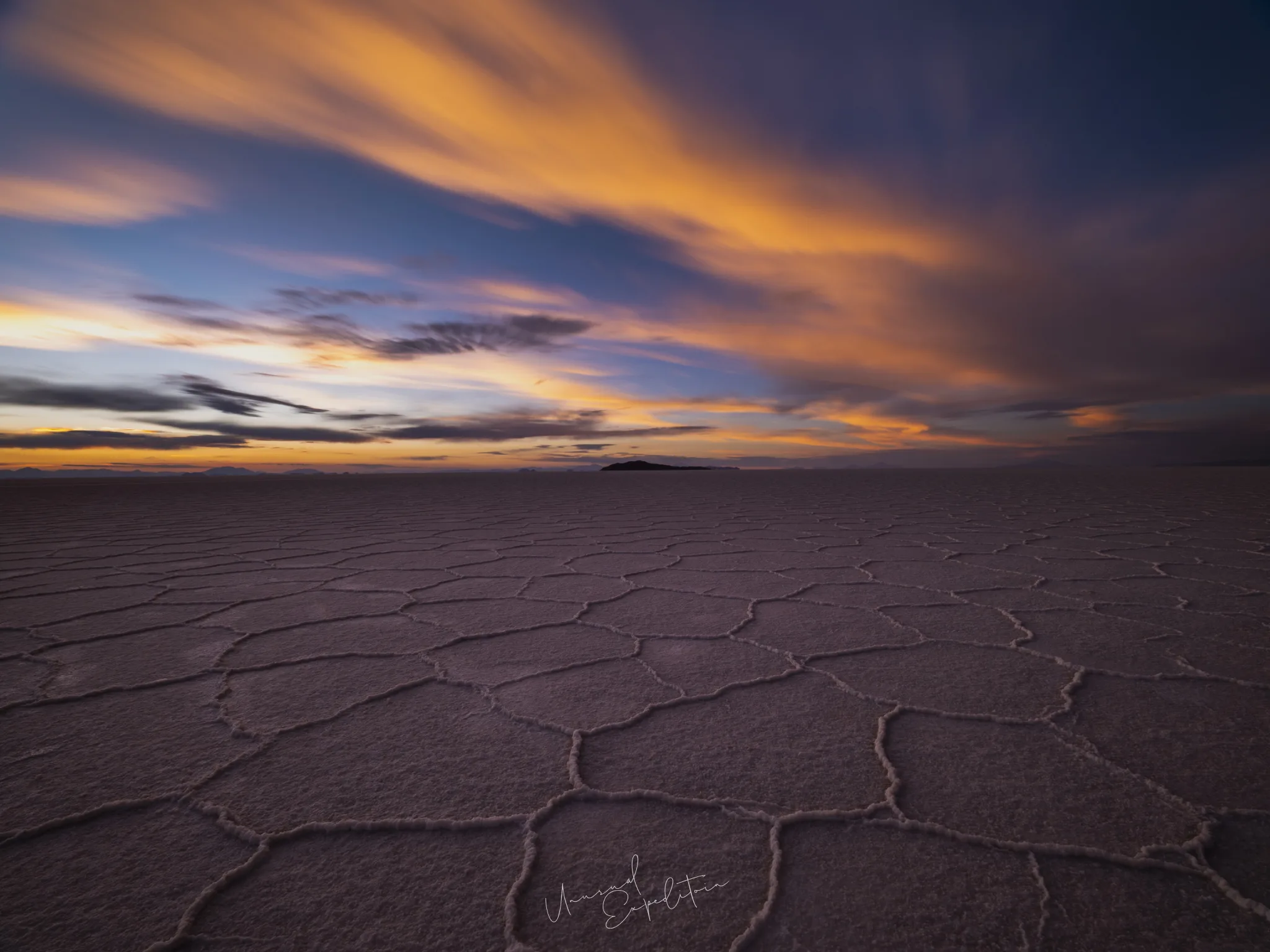
In the dry season the surface of the Salar de Uyuni, the world's largest salt flat at about 10,582 square kilometres, dries into a crust of raised ridges that form hexagons and pentagons to the horizon. At midday they almost disappear in the glare. In the last hour before sunset the low sun rakes across the ridges and every edge throws a shadow, and after sunset the pattern turns blue and cold under the afterglow. Put the camera low, a few centimetres above the crust, with a 16-35mm, and let one hexagon fill the foreground. There is no landmark to stand at: drive out until the crust is clean and unmarked by tyres.
The mirror patches in the wet season
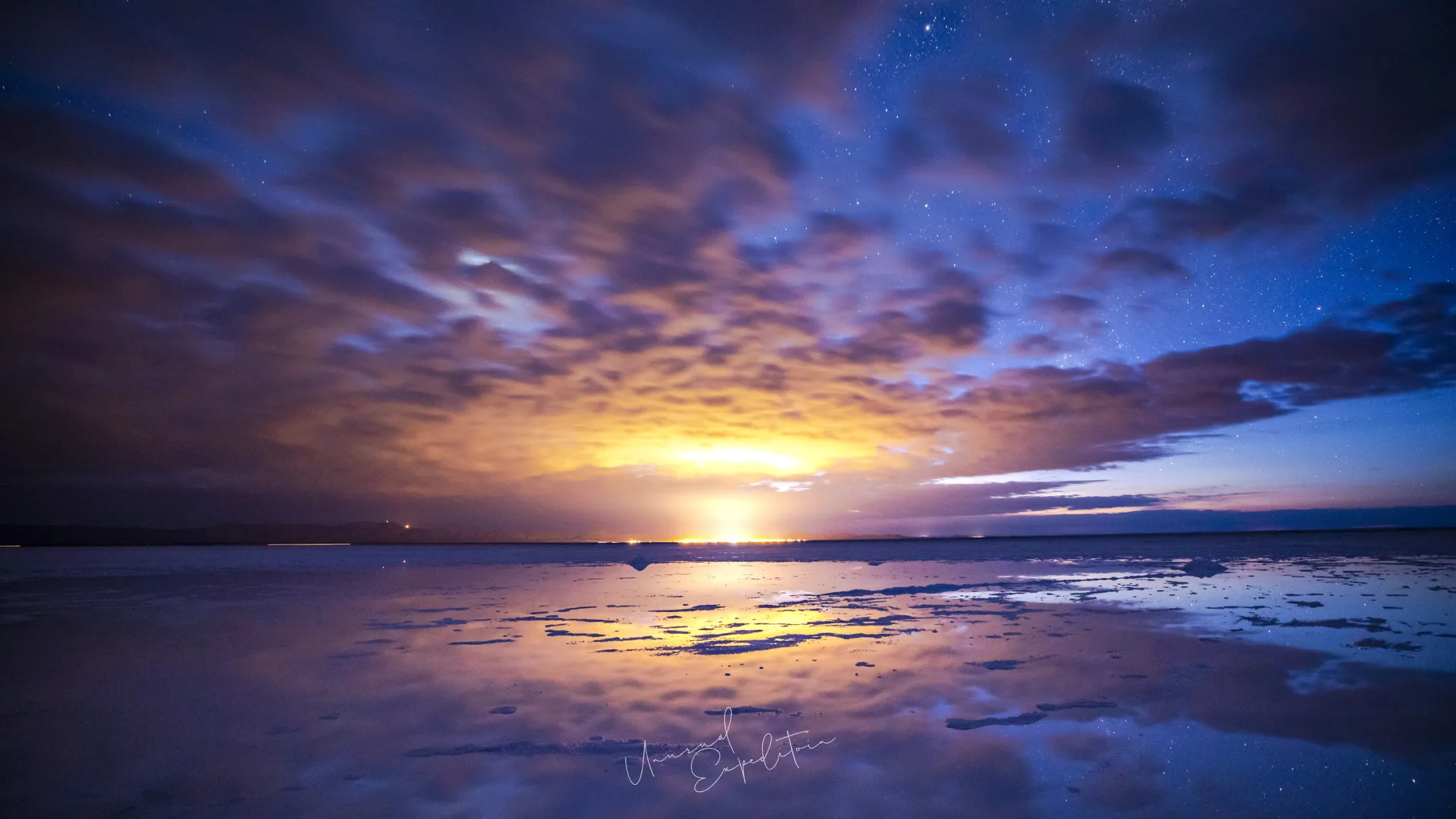
The famous mirror forms when a thin layer of rainwater lies on the salt in the wet season, broadly December to April and most reliably January to March. Where the water is still and shallow the sky and the horizon reflect perfectly, and at sunset and twilight the whole world turns into colour above and below. The drivers know where the water is on the day, so the spot moves. Bring rubber boots, keep the horizon in the middle of the frame for symmetry, and stay after the sun has gone: the best colour comes in the twilight. Heavy rain can close parts of the salt flat and some routes, so plans have to stay flexible.
Isla Incahuasi and its giant cacti
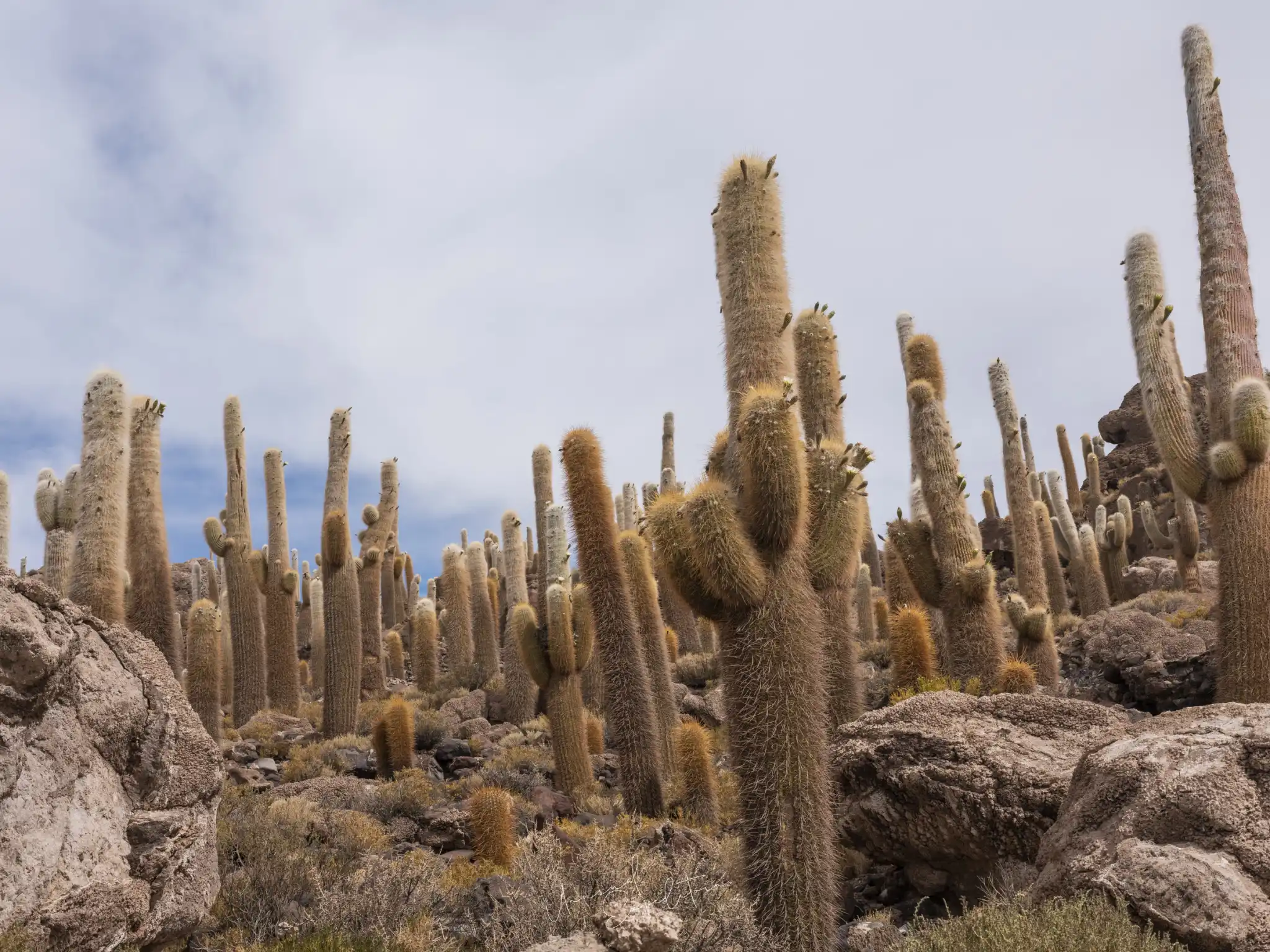
Isla Incahuasi is the top of an old volcano rising out of the middle of the salt, covered in giant columnar cacti that grow extremely slowly. A path climbs between the cacti to the summit, and from the top the white salt runs to the horizon in every direction. The cacti photograph best in side light, in the morning or late afternoon, when their spines catch the light against a blue sky; a 16-35mm close to a trunk makes it tower over the frame. The island charges an entry fee, and in a very wet season the drive to it may not be possible.
The train cemetery outside Uyuni
Just outside the town of Uyuni, rows of rusting steam locomotives and carriages stand abandoned in the desert, painted over with graffiti. It is the stop almost every salt flat tour makes, so it is busy in the middle of the day. Late afternoon gives warm side light on the rust and longer shadows; a 24-70mm lets you isolate wheels, boilers and lettering instead of a frame full of other visitors. Climbing on the engines is common but the metal is sharp and hot.
Laguna Colorada and the high lagoons
South of the salt, the Eduardo Avaroa Andean Fauna National Reserve holds a chain of high lagoons where three species of flamingo feed: Andean, Chilean and James's. Laguna Colorada, a Ramsar wetland at about 4,278 metres, is red from algae and sediments; the smaller lagoons on the way are pale, milky and pastel. Go in the morning, before the afternoon wind ruffles the water and the reflections go. A long lens, 100-400mm or a 70-200mm, picks out birds; a wider view of a whole lagoon, with the flamingos as tiny pink marks across the colour, is often the stronger picture. Our Laguna Colorada flamingos guide has the close-ups.
Sol de Mañana geysers and mud pools
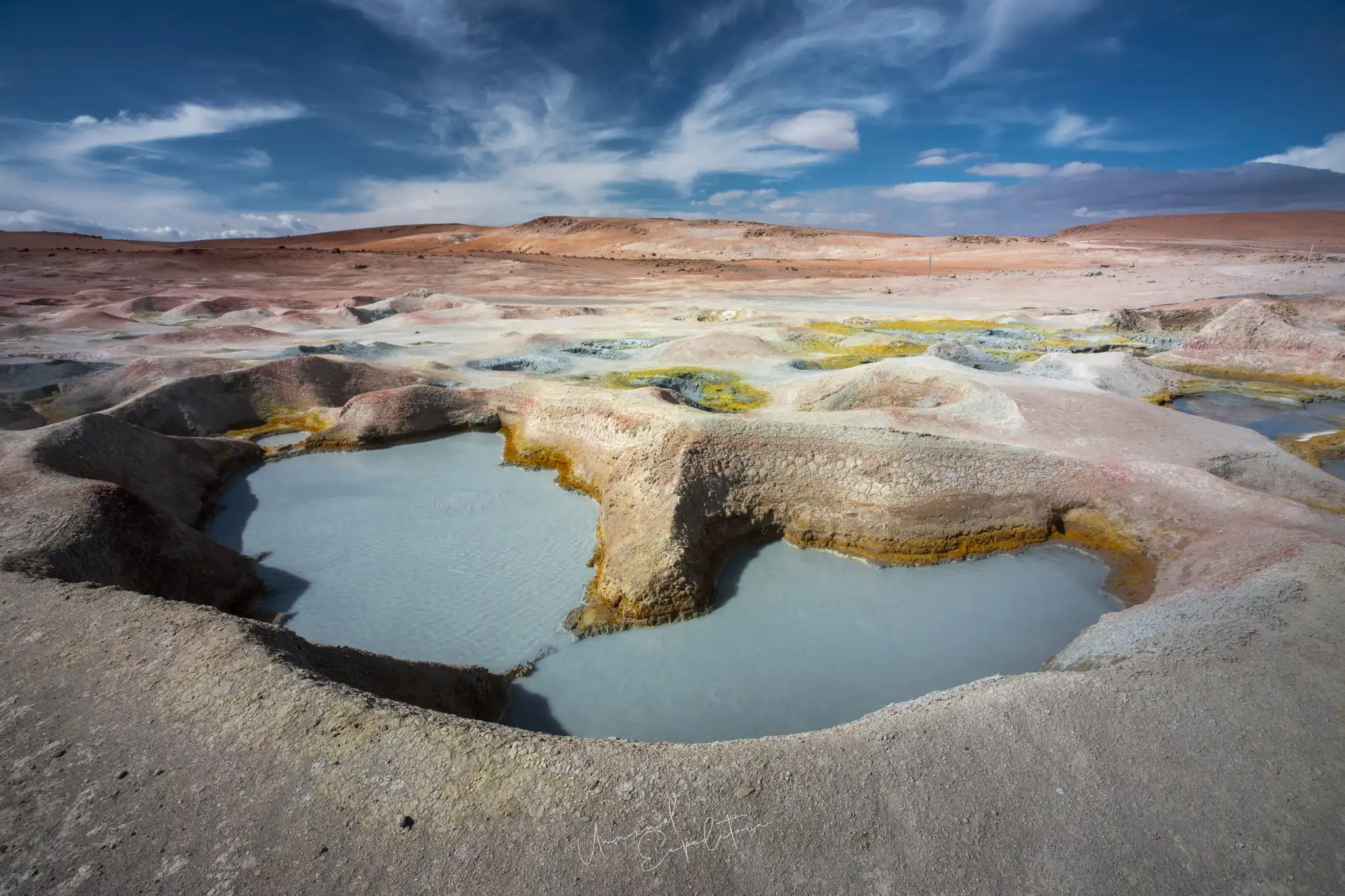
Sol de Mañana is a geothermal field at about 4,900 metres where steam vents roar and grey mud pools bubble in the crust. At sunrise the steam columns are backlit by the low sun and glow against a dark sky, which is the whole reason to get up in the cold. Stay on the marked ground: the crust around the pools is thin and the mud is boiling. A 16-35mm takes in the vents and the sky; the mud pools make good close abstracts later in the morning.
Desert rocks under the stars
Between the lagoons, the high desert is scattered with wind-carved rocks, and on a clear, moonless night the Milky Way stands over them. There is almost no light pollution, so a 16-35mm at a wide aperture is all you need; the cold is the real obstacle, so keep spare batteries in an inside pocket. See Uyuni salt flats sunset and stars for the night work.
"On the salt there is nothing to stand next to, so the light is the subject. Get out there for the last hour, and stay for the colour after the sun has gone."
Joseph Mak, tour leader, Unusual Expedition
Things to do in Uyuni with a camera: altitude and care
Most of these spots are above 3,600 metres and some above 4,500, so take the first days slowly and drink plenty of water. Sunglasses and sunscreen matter on the white salt. Park entry fees apply to the Eduardo Avaroa reserve and to Isla Incahuasi. Singapore passport holders need a visa for Bolivia, and the Singapore MFA advises a high degree of caution because of protests and road blockades, so check the latest advice before you travel.
Photograph the salt flat with us
We build private Uyuni trips around the light on the salt and the southern lagoons; read how they work on our private tours page, and see the Bolivia photography tours page for every Bolivia destination guide.
Uyuni photography tours
The next Uyuni departure is announced on the Uyuni photography tours page, with previous expeditions and all the planning guides.
Explore Uyuni in depth
- Uyuni Photography Tour: The Salt Flats, Lagoons and GeysersBolivia
- How to Get to Uyuni Salt Flats: Visa, Flights, Altitude and MoneyBolivia
- Is Uyuni Salt Flats Worth It? Isla Incahuasi and How to Get ThereBolivia
- Sol de Mañana Geysers: Photographing Bolivia's Highest Geothermal FieldBolivia
- Laguna Colorada Flamingos: Where to See Flamingos in BoliviaBolivia
- Uyuni Sunset, Sunrise and Night Sky: Photographing the Salt Flats After DarkBolivia
- Best Time to Visit Uyuni Salt Flats: Mirror Season or Dry SeasonBolivia
- Uyuni Salt Flats Photos: Photo Ideas and Where to StandBolivia
Upcoming Photo Tours
- Egypt Photo Tour – EgyptEgypt 12 Dec 2026 To 20 Dec 2026
- Inner Mongolia Winter Owl Photo Tour – ChinaChina 01 Jan 2027 To 04 Jan 2027
- Inner Mongolia Winter Photo Tour – ChinaChina 05 Jan 2027 To 11 Jan 2027
- Mekong And Central Highland Vietnam Photo Tour - VietnamVietnam 16 Jan 2027 To 24 Jan 2027