
Antarctica Fly Cruise: How It Works and Who It Suits
What an Antarctica fly cruise is: the two-hour flight to King George Island, one Drake crossing, weather contingency and who it suits.
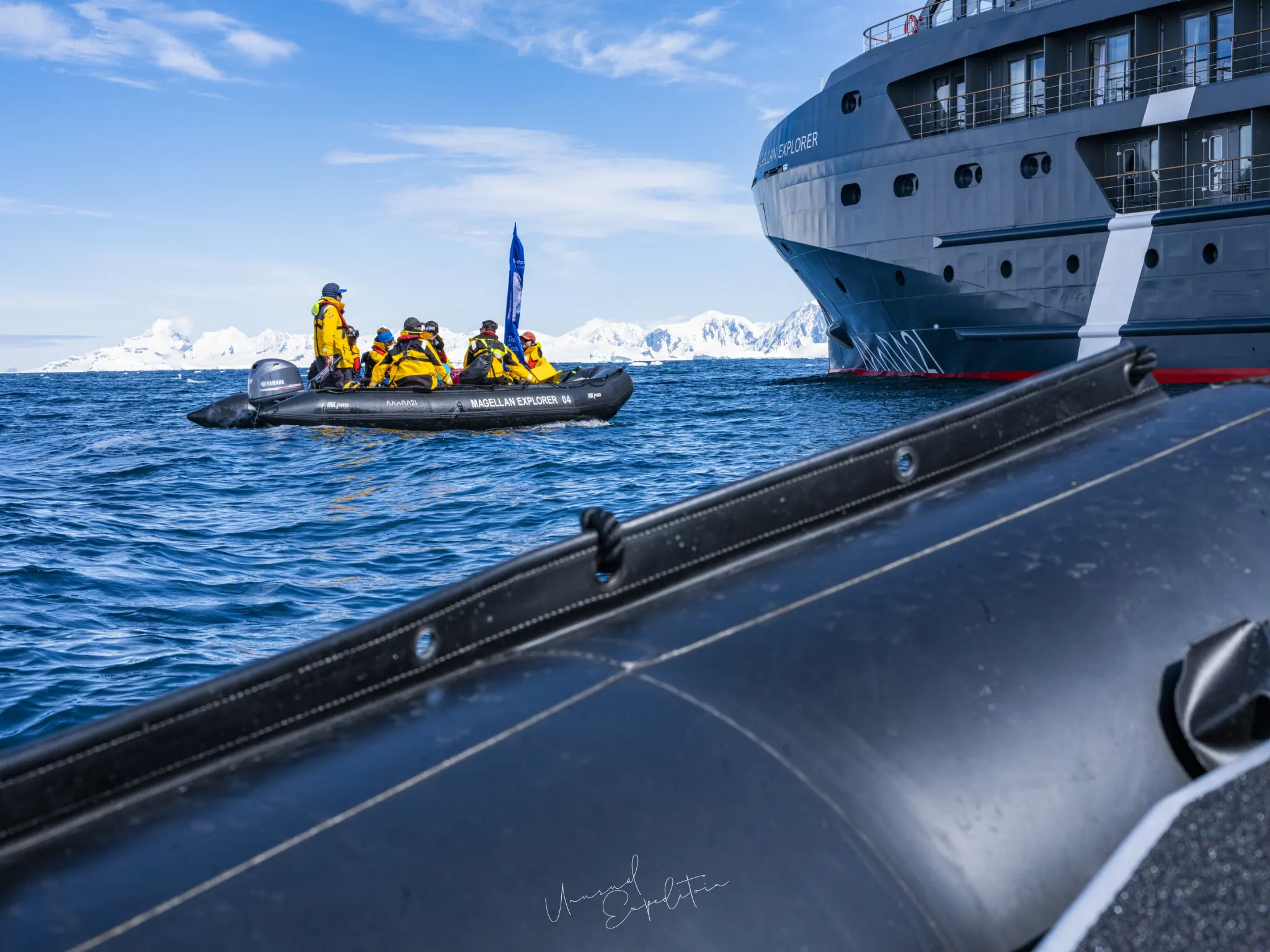
An Antarctica fly cruise replaces the two-day ship crossing of the Drake Passage with a charter flight of about two hours from Punta Arenas, Chile, to King George Island in the South Shetlands, where you board a small expedition ship. The ship then spends its time among the islands and the Antarctic Peninsula instead of in open ocean. It suits people short on days or prone to seasickness, and it carries one real risk: the flight needs clear visibility to land, so it can slip by a day.
The fly-cruise is the shape of our own March departure, and the complete guide to an Antarctica photography tour puts it in the context of the whole trip. What follows is the mechanics.
What is an Antarctica fly cruise?
The Antarctic Peninsula lies across the Drake Passage from South America, about 800 km at the narrowest point and often quoted as up to 1,000 km. The classic expedition cruise sails that water twice, taking 36 to 48 hours each way from Ushuaia. A fly cruise swaps one or both crossings for a flight. Antarctica21, based in Punta Arenas and running these trips since 2003, flies guests to the gravel airstrip on the Fildes Peninsula of King George Island, beside Chile's Presidente Frei base, and has the ship waiting in Fildes Bay a short Zodiac ride away. Ours, the Antarctica Express Air-Cruise, flies south and sails north, so you cross the Drake once by sea and finish in Ushuaia after Cape Horn and the Beagle Channel. The ship portion is six nights.
Fly or cruise to Antarctica: two hours against two days, each way
The arithmetic is the whole argument. A classic voyage spends roughly four of its days crossing the Drake, open water with no landings. A fly-in puts you on King George Island the same day you leave Chile and gives the ship its six nights in the South Shetlands and Peninsula waters, where the penguins, seals, whales and ice are. For a photographer that means more Zodiac hours per day of leave. What you lose is sea time, and sea time is not empty: the Drake is where wandering albatross, giant petrels and cape petrels follow the ship, and the Antarctic Convergence, where water temperature drops and the birdlife changes, is crossed in the middle of it. On this product you still get that once, on the way north, as described in crossing the Drake Passage: what to expect.
| Feature | Classic ship route | Fly south, sail north |
|---|---|---|
| Drake crossings by sea | Two, 36 to 48 hours each | One, northbound |
| Flight across the Drake | None | One, about two hours |
| Gateway towns | Ushuaia both ways | Punta Arenas in, Ushuaia out |
| Seasickness exposure | Both crossings | One crossing |
| Weather risk | Rough seas, late arrival | Flight may move by a day or more |
| Seabirds from the deck | Four days | Two days |
Neither column is free of weather; the fly-in simply moves the risk from the sea to the sky and halves the time you spend exposed to it.
Antarctica cruise without the Drake Passage: does this one skip it?
Not entirely, and I think that is the right design. A trip that flies both ways avoids the Drake completely. Ours flies south and sails north, so you meet the Drake once, at the end, when you have already filled your cards. The crossing runs to the sailors' two nicknames, Drake Lake and Drake Shake. The reward on the far side is Hornos Island, where the ship attempts a Zodiac landing in calm conditions for the Chilean Navy lighthouse and the steel albatross monument to lost sailors, then the Beagle Channel into Ushuaia. That ending is in Cape Horn and the Beagle Channel. If one crossing is one too many, Antarctica21 sells fly-both-ways versions.
What happens if the flight to King George Island cannot leave?
The airstrip has no instrument landing system, so the pilots need line of sight, and low cloud or fog at King George Island grounds the flight even when Punta Arenas is clear. The flight may then move earlier or later by a day or more. While you wait, hotel and meals in Punta Arenas are provided. If the flight cannot operate at all within the window, Antarctica21 refunds the cruise fare less an administrative fee. Operators' published statistics put roughly four in five Punta Arenas to King George flights on their scheduled day, with most of the rest leaving within a day. Build slack into your flights home from Ushuaia, and make sure the comprehensive insurance the operator requires anyway covers delay.
The aircraft and the airstrip
The jets are from the BAe 146 and Avro RJ family, four-engine high-wing aircraft with the short-field performance to use the gravel runway of Teniente Rodolfo Marsh airfield. King George Island sits at about 62 degrees south, about 120 km north of the Peninsula, and holds the densest cluster of research stations in Antarctica, with Chile, Russia, China, Uruguay, Argentina, Brazil, Poland, South Korea and Peru among the countries present. You step off the aircraft onto the gravel in your expedition gear and head for the shore and the Zodiac to the ship. The stations are workplaces and access inside is never guaranteed, but the walk past Bellingshausen and the timber Trinity Church on its rise is usually the first photograph of the trip. The island has its own article: King George Island: the airstrip, the bases and the church.
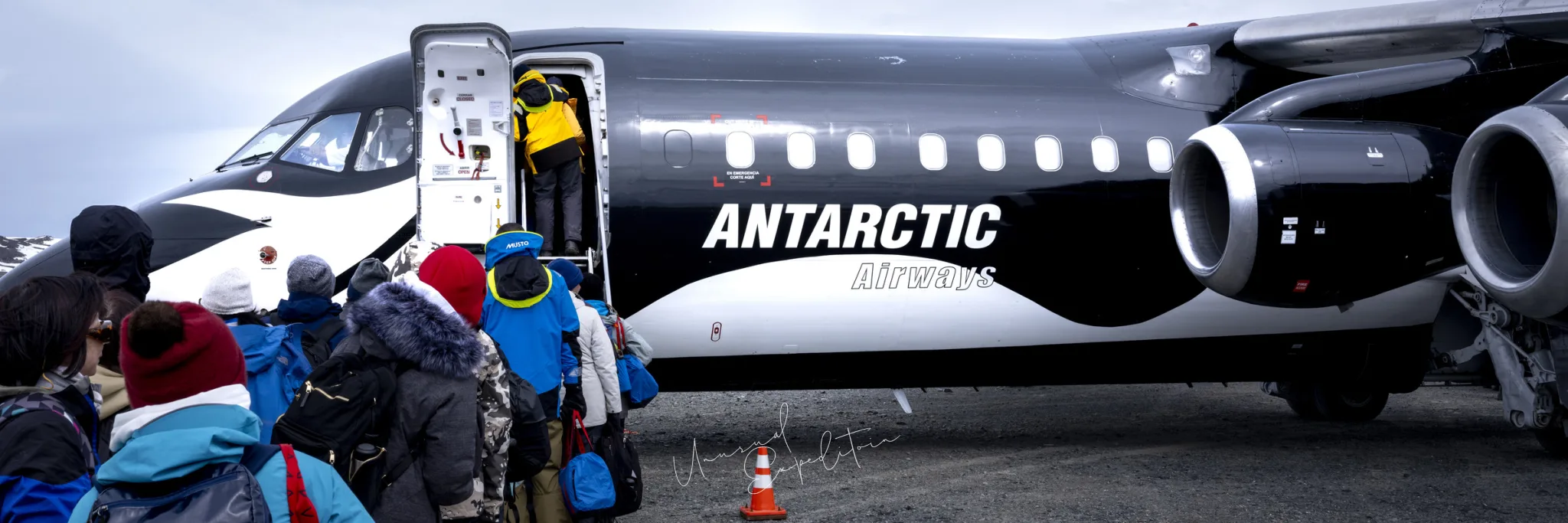
Fly to Antarctica then cruise: what the ship days are like
Once aboard, a fly cruise is an expedition cruise like any other. The ship moves through the South Shetlands and the Peninsula, and the expedition leader decides each morning where ice and weather allow a landing or a Zodiac cruise. The waters in play are the ones every Antarctic photographer knows: the Bransfield and Gerlache Straits, bays such as Neko Harbour and Paradise Harbour, the Lemaire Channel, Deception Island with its black sand. Which of them you reach is not fixed. Under IAATO rules no more than 100 visitors are ashore at a site at a time with a guide for every 20 guests, and a small ship clears everyone ashore quickly. Most cabins have private balconies, which for a photographer means a place to leave a camera on a tripod.
"I have crossed the Drake by ship and I have flown over it with Antarctica21, in December 2019, and I know which one my stomach prefers. The albatross were worth it every time; the second night of a Shake was not. When Antarctica21's fly-south option came up for March, choosing it took me about a minute."
Joseph Mak, tour leader, Unusual Expedition
Who a fly cruise suits
Three kinds of traveller. First, people who are short on leave: from Singapore the fly cruise fits inside about a week on the ground plus travel, where the classic route adds roughly four sea days. Second, people who know they get seasick. One crossing at the end, with the pictures already made, is a very different proposition from two crossings with the second one still ahead of the whole trip. Third, photographers who count Zodiac hours, because every day not spent in open ocean is a day among ice and penguins. Children must be 8 or over on Antarctica21 air-cruises, and everyone must be able to get in and out of a Zodiac unaided and walk on snow and uneven rock. Price is not the reason to choose it; a fly cruise is not a cheaper way south, as how much an Antarctica trip costs from Singapore explains.
Who should still take the classic ship route
If the Southern Ocean itself is the point for you, sail both ways. Seabird photographers want the full four days of albatross and petrels off the stern. People who dislike schedule uncertainty may prefer a ship that leaves Ushuaia on the day it says and accepts a rough sea over a flight that might wait for cloud to lift. Travellers who want to reach much further south need the longer ship itineraries that some operators run. And anyone on a tight budget should look at the whole market; the fly cruise is priced for the charter aircraft and the small ship, not for economy. I have done it both ways; my December 2019 voyage was an Antarctica21 air-cruise. The late-season case for our March date is made in the best time to visit Antarctica for photography.
Cross the Drake once, with a camera in hand
The Antarctica Express Air-Cruise photography tour is our March fly-cruise with Antarctica21: in by air from Punta Arenas, out by sea to Ushuaia, six nights on the ship between. I will be on the deck and in the Zodiac with you, and the tour page has the current fare and the booking form.
Join the Antarctica photography tour
Antarctica Express Air-Cruise 2028 - Antarctica departs 10 Mar 2028 To 16 Mar 2028. Small group, photography first. All Antarctica photography tours.
Explore Antarctica in depth
- The Complete Guide to an Antarctica Photography TourAntarctica
- King George Island: Weather by Month, Daylight Hours and PenguinsAntarctica
- Sunset in Antarctica: Does the Sun Set, and What the Light DoesAntarctica
- Antarctica Photos: What It Really Looks Like from an Expedition ShipAntarctica
- What to Pack for an Antarctica Cruise (and the 25 kg Rule)Antarctica
- Photographing the South Shetland IslandsAntarctica
- King George Island, Antarctica: The Airstrip, the Bases and the ChurchAntarctica
- Is Antarctica Worth Visiting? A Photographer's ViewAntarctica
- Crossing the Drake Passage: What to ExpectAntarctica
- Cape Horn and the Beagle Channel: Photographing the End of the WorldAntarctica
- Camera Gear for Antarctica PhotographyAntarctica
- The Best Time to Visit Antarctica for PhotographyAntarctica
Upcoming Photo Tours
- Egypt Photo Tour – EgyptEgypt 12 Dec 2026 To 20 Dec 2026
- Inner Mongolia Winter Owl Photo Tour – ChinaChina 01 Jan 2027 To 04 Jan 2027
- Inner Mongolia Winter Photo Tour – ChinaChina 05 Jan 2027 To 11 Jan 2027
- Mekong And Central Highland Vietnam Photo Tour - VietnamVietnam 16 Jan 2027 To 24 Jan 2027