
Seals and Seabirds of Antarctica: What You Can Photograph
Weddell, crabeater, leopard, fur and elephant seals, albatross, petrels, skuas and sheathbills: where each appears and how to photograph it.
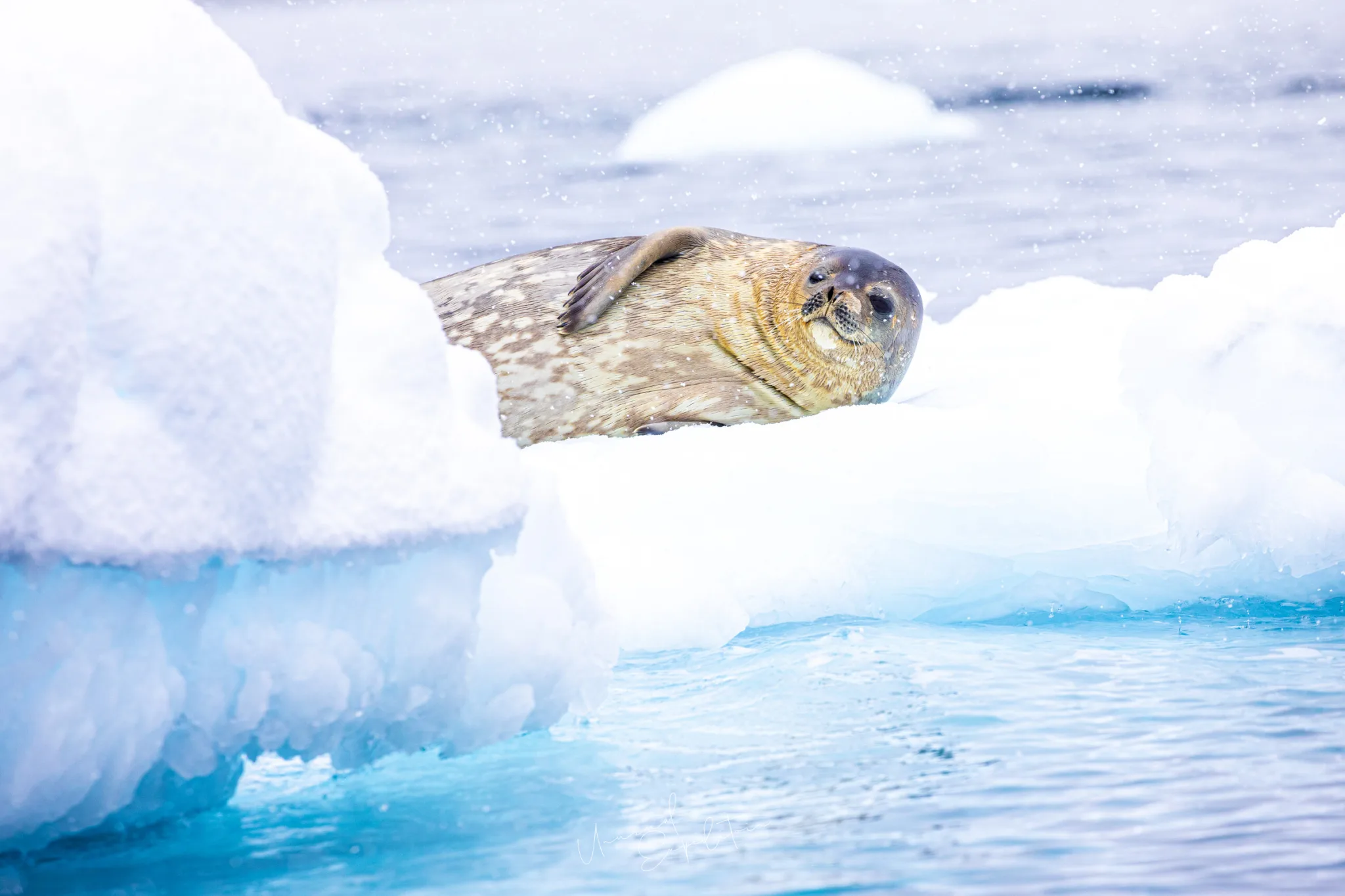
The seals and seabirds of Antarctica that a peninsula voyage can photograph are five seals, Weddell, crabeater, leopard, Antarctic fur and southern elephant, and a seabird list that runs from the wandering albatross over the Drake Passage to the snowy sheathbill picking through a penguin colony. Seals are photographed on shore and on ice floes from a Zodiac; seabirds are photographed from the ship's stern during the Drake crossing, which is the one dedicated seabird session of the trip.
Penguins and whales get most of the attention, and they have their own articles linked from the complete guide to an Antarctica photography tour. Seals and seabirds fill the hours between, and some of my best Antarctic frames are of neither penguin nor whale. Here is where each species appears, shore, ice floe or open sea, and how to photograph it.
Antarctica penguins and seals: what lives alongside the colonies
Antarctica penguins and seals share the same beaches, and once you look past the colony the seals are everywhere. Weddell seals lie on snow and shore ice near the landing sites, heavy, spotted and calm, often with a half-closed eye turned to the camera. Antarctic fur seals haul out on the beaches of the South Shetland Islands in numbers in late season, and unlike the true seals they move fast on land and will hold their ground; keep well beyond the IAATO minimum of 5 metres and give them more if they lift their heads. Southern elephant seals lie in heaps on sheltered beaches, moulting and grunting, and photograph best as a tangle of bodies with one open eye. Leopard seals and crabeater seals are animals of the ice rather than the shore, and they come next. All of these animals ignore people because Antarctica has no land predators; the distance rules exist for them, not for your safety, though a fur seal is the one exception worth respecting.
Seals on the ice floes
Crabeater and leopard seals are photographed from a Zodiac as the driver eases up to a floe with the engine low. Crabeater seals are the most numerous seal on earth and the most often seen on the ice around the peninsula, pale and slim, sometimes several to a floe. The leopard seal is the one everyone wants: long, reptilian in the head, with a wide mouth and a spotted throat, and it lies on a floe looking at the Zodiac with total indifference. It is a predator of penguins and the only Antarctic seal with a reputation for curiosity about boats, so the driver keeps distance and nobody leans over the side. A 70-200mm lens frames a seal and its floe; a 100-400mm lens frames the head and the eye. The exposure trap is the same as for penguins: a dark seal on white ice reads as a dark subject, so expose for the ice at +1 to +2 EV and let the seal sit dark. Shutter speed 1/1000 s from a moving Zodiac is enough for an animal that does not move.
| Species | Shore | Ice floe | Open sea |
|---|---|---|---|
| Weddell seal | Yes, on snow and shore ice near landings | Sometimes | No |
| Crabeater seal | Rarely | Yes, the usual place | Swimming between floes |
| Leopard seal | Rarely | Yes | Hunting off penguin landings |
| Antarctic fur seal | Yes, South Shetland beaches | No | Porpoising near shore |
| Southern elephant seal | Yes, sheltered beaches | No | No |
| Wandering and black-browed albatross | No | No | Yes, Drake Passage |
| Southern giant petrel | Nests on some islands | No | Yes, follows the ship |
| Cape (pintado) petrel | No | No | Yes, Drake and Bransfield |
| Wilson's storm petrel and snow petrel | No | Snow petrel rests on ice | Yes |
| Skua, kelp gull, snowy sheathbill | Yes, around penguin colonies | No | Skuas over the ship |
| Antarctic shag and Antarctic tern | Yes, cliffs and shore | No | Shag fishing close in |
The albatrosses and the oceanic petrels appear nowhere else on the trip, which is why the Drake crossing matters; the seals are a shore and ice-floe subject.
Drake Passage animals: the seabird session
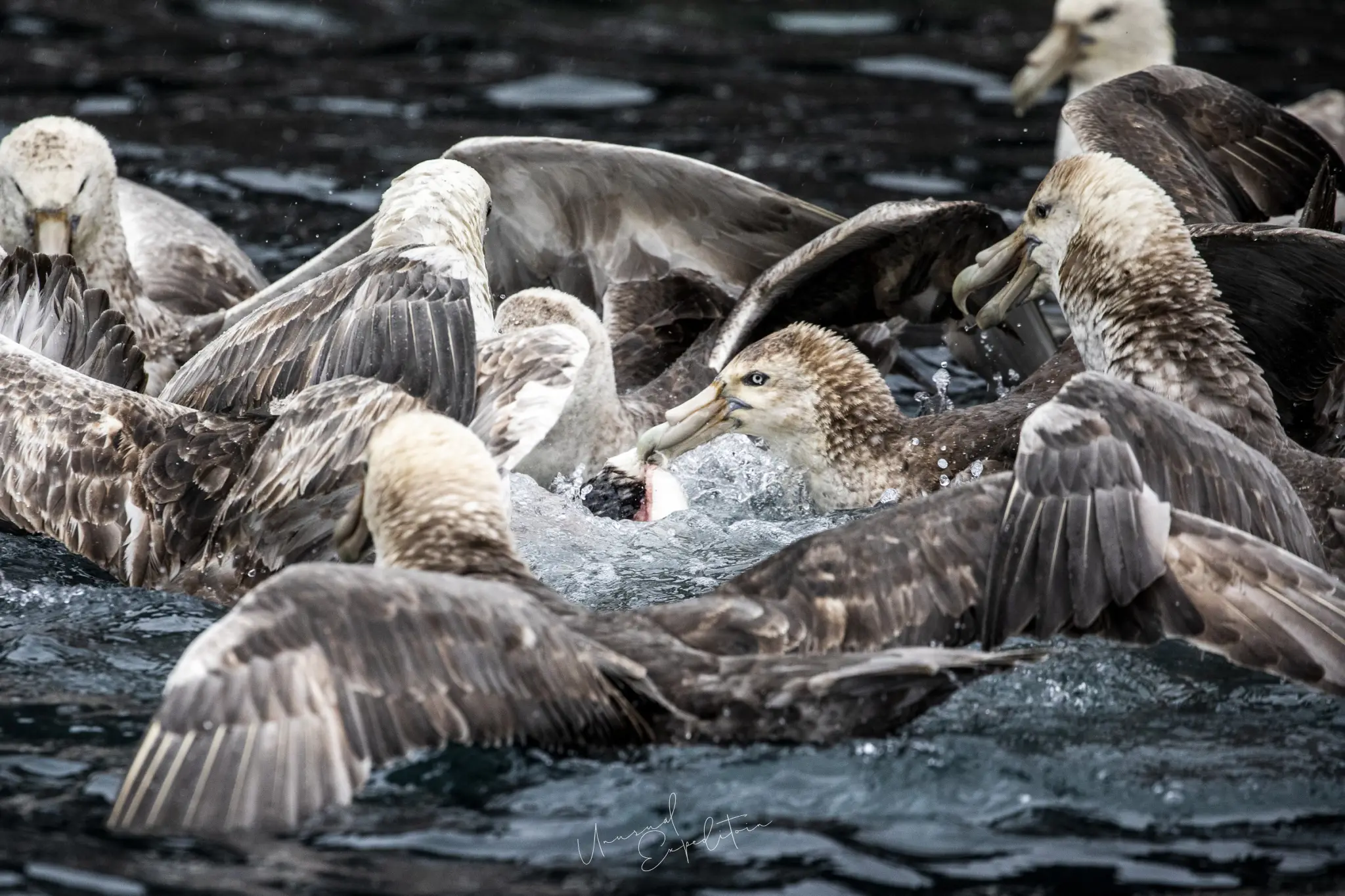
Drake Passage animals are seabirds, and the northbound crossing of 36 to 48 hours at the end of our voyage is where the seabird photography happens. The Drake is where the Southern Ocean flows round the globe without a landmass in the way, and the birds that live on that wind follow ships. Wandering albatross, with the widest wingspan of any bird, glide behind the stern on wings that barely move; black-browed albatross are smaller and more numerous, with a dark brow line that shows at close range. Southern giant petrels, big and grey-brown, patrol the wake. Cape petrels, called pintado for their black-and-white chequered backs, are the most photogenic and the closest, flying in flocks alongside the ship. Wilson's storm petrels flutter at the surface like swallows. Crossing the Antarctic Convergence the water temperature drops and the bird mix changes, which is as good a reason as any to stay on deck. What the crossing feels like is in crossing the Drake Passage.
Photographing seabirds from a moving ship
Seabirds from the stern of a ship in the Drake Passage are the best flight photography practice most people will ever get, because the birds come to you and stay. Stand at the stern rail or on the lee side out of the wind, with a 100-400mm lens or a 70-200mm lens for the cape petrels that come close. Shutter speed 1/2500 s, continuous autofocus with a wide zone, and a burst as the bird banks. Expose a third to two thirds of a stop over the camera's reading so white plumage against dark water does not go grey, and more if the sky is bright. Albatrosses fly in long arcs and come back; pick the one you want and wait for the pass where the wing tip nearly touches the water. The ship's motion is the hard part. Brace against the rail, bend your knees, and shoot when the deck pauses at the top or bottom of a roll. A lens cloth for salt spray lives in your outer pocket on this crossing, and the camera goes into a sealed bag before you step back into the warm.
South Shetland Islands animals around the colonies
South Shetland Islands animals that are neither penguin nor seal are the birds of the colony edge. Skuas, brown and heavy, sit on the slopes above a penguin colony waiting for an unguarded chick or egg, and in March they are picking at the remains of the season. Kelp gulls work the shoreline. The snowy sheathbill, the only Antarctic bird without webbed feet, walks through the colony like a white chicken cleaning up anything dropped, and it will come to within a few metres of a seated photographer. Antarctic shags nest on cliffs and fish close to shore, and Antarctic terns hover over the shallows. None of these are glamorous. All of them give you a bird at eye level without the crowd, and a skua in flight against snow at 1/2000 s is a sharper, cleaner picture than most penguin frames. The geography of the islands and their main colonies is in photographing the South Shetland Islands.
"On my midsummer voyages the leopard seal was the animal that stopped the Zodiac. One lay on a floe in Paradise Harbour with its mouth slightly open and did not move for the whole time we were there. Everyone wanted the head. I shot the head, then turned the lens round and photographed the whole floe with the seal small on it and the glacier behind, and that is the frame I kept."
Joseph Mak, tour leader, Unusual Expedition
Lenses and settings for seals and seabirds
Seals and seabirds want different kit. For seals from the Zodiac and on shore, a 70-200mm lens does most of the work and a 100-400mm lens gives the tight head shot without breaking the 5 metre rule; shutter speed 1/1000 s is enough for a resting animal, exposure +1 to +2 EV for ice and snow backgrounds. For seabirds from the ship, the 100-400mm lens is the main tool, shutter 1/2500 s, continuous autofocus, exposure a third of a stop or more over the reading. In both cases let the ISO rise; the light in March is lower than in midsummer and a sharp high-ISO frame is the one you keep. Carry more batteries than seems sane and warm them in an inside pocket. The full kit list, within the 25 kg flight baggage limit, is in camera gear for Antarctica photography.
Spend the crossing at the stern rail with us
Seals on the ice, albatrosses behind the ship and sheathbills at your feet are the quiet half of an Antarctic voyage, and they reward the people who stay on deck. The Antarctica photography tour page has the current March departure. Dress for the stern rail; that is where you will find me on the crossing.
Join the Antarctica photography tour
Antarctica Express Air-Cruise 2028 - Antarctica departs 10 Mar 2028 To 16 Mar 2028. Small group, photography first. All Antarctica photography tours.
Explore Antarctica in depth
- The Complete Guide to an Antarctica Photography TourAntarctica
- King George Island: Weather by Month, Daylight Hours and PenguinsAntarctica
- Sunset in Antarctica: Does the Sun Set, and What the Light DoesAntarctica
- Antarctica Photos: What It Really Looks Like from an Expedition ShipAntarctica
- What to Pack for an Antarctica Cruise (and the 25 kg Rule)Antarctica
- Photographing the South Shetland IslandsAntarctica
- King George Island, Antarctica: The Airstrip, the Bases and the ChurchAntarctica
- Is Antarctica Worth Visiting? A Photographer's ViewAntarctica
- Crossing the Drake Passage: What to ExpectAntarctica
- Cape Horn and the Beagle Channel: Photographing the End of the WorldAntarctica
- Camera Gear for Antarctica PhotographyAntarctica
- The Best Time to Visit Antarctica for PhotographyAntarctica
Upcoming Photo Tours
- Egypt Photo Tour – EgyptEgypt 12 Dec 2026 To 20 Dec 2026
- Inner Mongolia Winter Owl Photo Tour – ChinaChina 01 Jan 2027 To 04 Jan 2027
- Inner Mongolia Winter Photo Tour – ChinaChina 05 Jan 2027 To 11 Jan 2027
- Mekong And Central Highland Vietnam Photo Tour - VietnamVietnam 16 Jan 2027 To 24 Jan 2027