
Mara River Crossing in the Serengeti: How to Photograph It
Mara River crossing in the Serengeti: where and when herds cross, crocodile attacks, crossing points, lenses and settings.
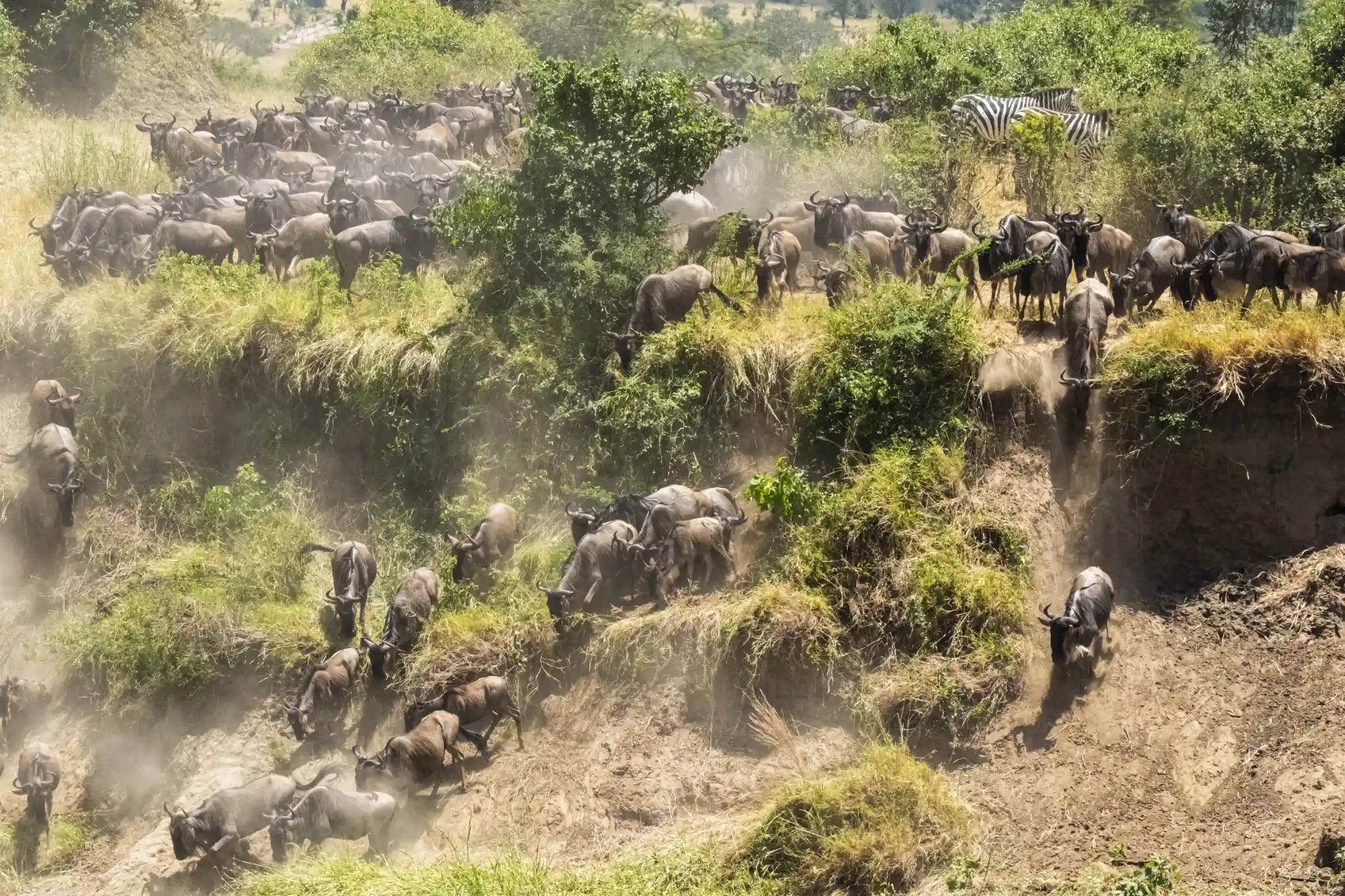
The Mara River crossing in the Serengeti is the moment the migrating wildebeest and zebra throw themselves down the riverbank and swim across the Mara River in the far north of Serengeti National Park, Tanzania, while crocodiles wait in the current. Crossings happen mainly from July to October, most often in August and September, around Kogatende and the Lamai area. They cannot be scheduled: a herd may gather for hours and turn away, or cross twice in a morning.
The river is one part of our Serengeti photography tour guide; this destination guide is about photographing the crossing itself.
Mara river crossing serengeti: where it happens
The Mara River rises in Kenya and loops south across the border into the northern Serengeti before turning west towards Lake Victoria. The migration has to cross it on the way north into Kenya's Masai Mara and again on the way back, and on the Tanzanian side the crossings centre on the Kogatende area, with the Lamai area north of the river. Guides know the stretches where the banks are low enough for the herds to get in and out, and they refer to them by local names or numbers. The northern Serengeti feels different from the rest of the park: wooded hills, rocky outcrops and a steep-banked river valley, where the plains of the centre are open and flat. Discover Africa's HerdTracker notes that the crossings can be watched from the Tanzanian side at Kogatende, which is where we base ourselves.
When the crossings happen
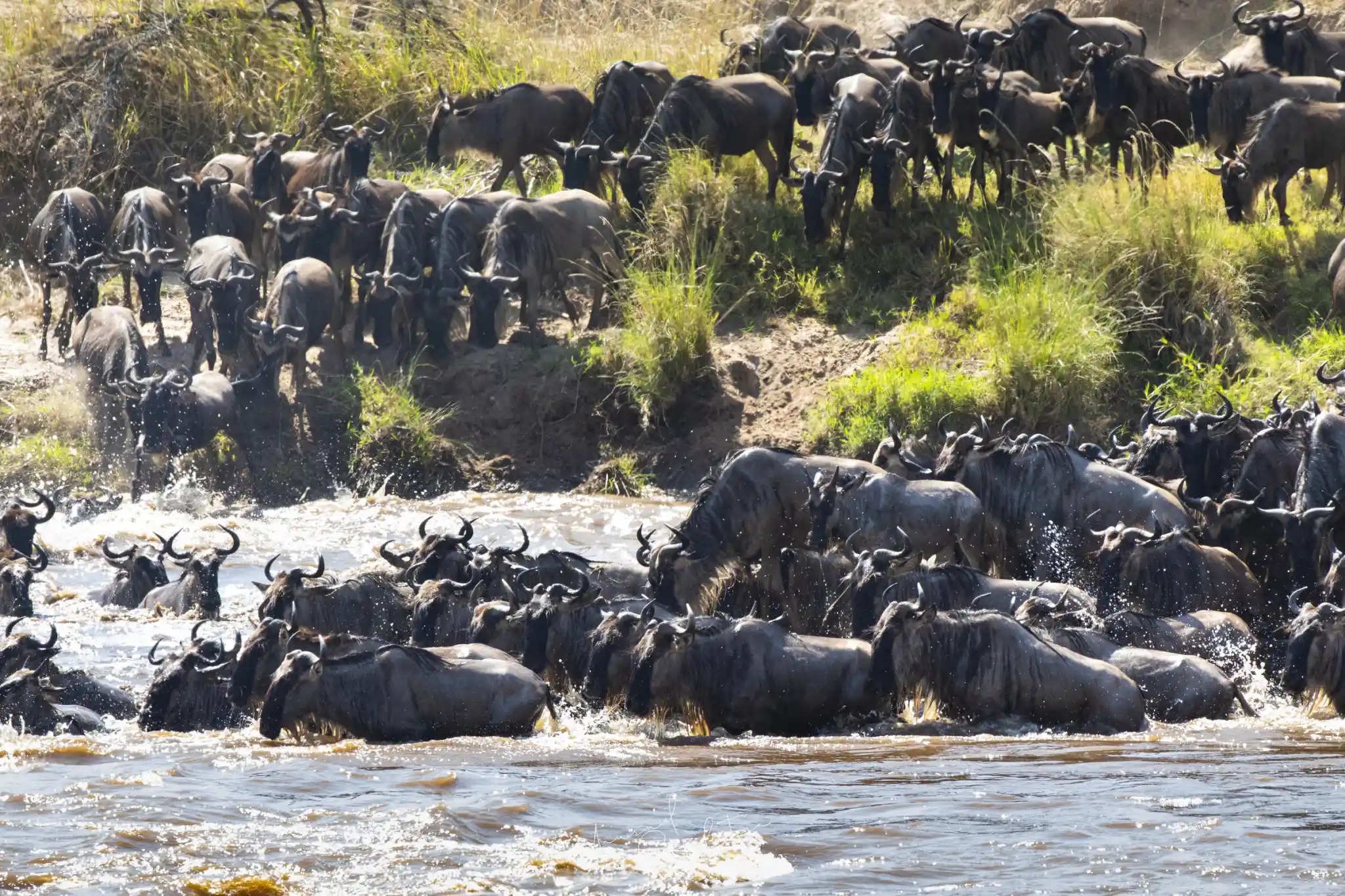
Asilia Africa and Discover Africa's HerdTracker both describe the same broad pattern: the first herds usually reach the Mara River in July, crossings peak in August and September, and they taper off through October as the herds turn south again. The exact timing depends on rain, which moves the grazing and the herds by weeks from one year to the next. That uncertainty is why a crossing trip needs several mornings at the river; a single day is a gamble. Our best time to visit the Serengeti guide shows where the herds usually are in every month.
What a crossing looks like
A crossing begins long before anything happens. Thousands of wildebeest and zebra gather above the bank, move towards the water, stop, mill about and sometimes retreat for no reason you can see. Then one animal goes, and the rest follow in a rush: the bank fills with dust, the first animals leap into the river and the herd becomes a solid line of heads and horns swimming for the far side. Some crossings last a few minutes, others go on and on as more animals arrive from behind. Zebras often wait and cross in their own groups. Calves get separated, animals are swept downstream, and at steep exits they scramble and fall back. On the far bank the herd shakes itself off and walks away as if nothing happened.
Mara river crossing crocodile attack
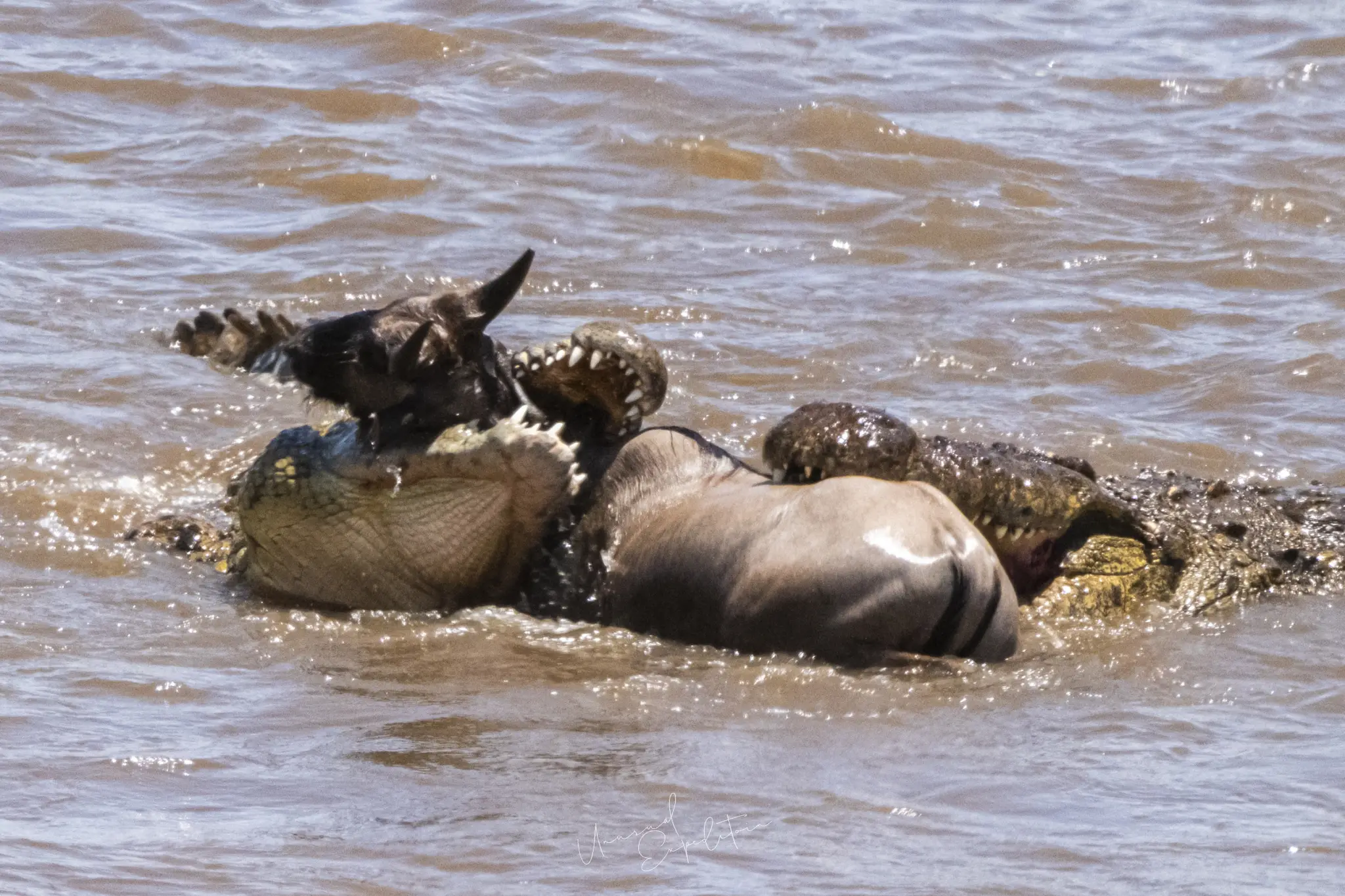
The Mara River crossing crocodile attack is the frame everyone hopes for and many find hard to watch. Large Nile crocodiles live in the Mara River, and during the crossing season they wait at the crossing points, often sinking out of sight until an animal is in the water beside them. When we photographed the crossings on the Mara, we watched a crocodile take a wildebeest in mid-river during one of them, and the struggle in the water went on for some time. Keep a long lens on the water, not only on the bank: the attack happens where the herd is swimming, often away from the leaping animals that draw the eye. A fast shutter, 1/2000s or quicker, is needed for the spray.
How to photograph the crossing
Two cameras help most. Put a 100-400mm or 200-400mm on one body for the leap and the crocodiles, and a 70-200mm or 24-70mm on the other for the whole scene with the river and the herd on the bank. Use continuous autofocus and a high burst rate, and shoot at 1/2000s or faster for animals in the air. Keep the vehicle back while the herd is gathering; guides know that vehicles too close to the bank can turn a herd away, and everyone loses the crossing. When the crossing starts, the guide may move to a better position, so be seated and ready. A slow pan at 1/30s with a running herd on the far bank gives a different kind of picture once the main action has passed.
| Moment | Lens | Settings to start from |
|---|---|---|
| Herd gathering on the bank | 70-200mm | 1/1000s, wide area autofocus |
| Leap into the river | 100-400mm or 200-400mm | 1/2000s or faster, burst |
| Herd swimming, crocodiles | 100-400mm | 1/2000s, tracking autofocus |
| Whole river scene | 24-70mm | 1/1000s, smaller aperture for depth |
| Herd leaving the far bank | 70-200mm | 1/30s pan or 1/1000s |
Set both cameras before the herd moves; there is no time to change anything once it starts.
Mara river crossing points and the waiting
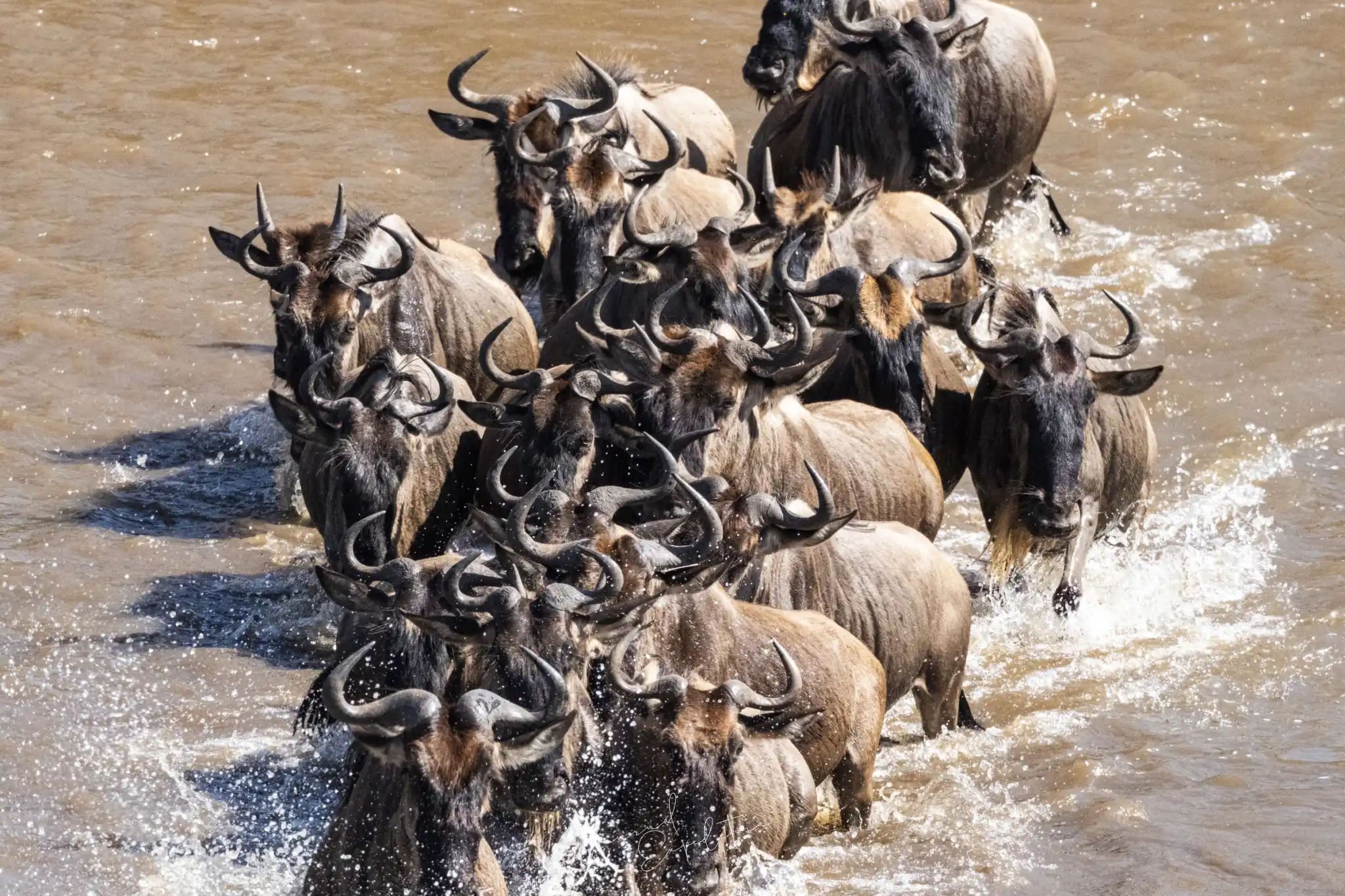
The Mara River crossing points shift with the herds, the water level and the state of the banks, and guides share sightings over the radio as soon as a herd starts gathering. Most of a crossing day is waiting, often in the heat of late morning and early afternoon when herds come down to drink. Bring water, a hat and patience. Light is often hard at that time, so expose for the bright dust and the white water and accept deep shadows. Between crossings the river gives other subjects: hippos in the pools, crocodiles on the sandbanks, elephants coming down to drink and vultures on the carcasses left by earlier crossings.
On the Mara the waiting is the job. You sit with a herd for half a morning and it walks away. Then someone on the radio says another group is coming down a bend upstream, and everything happens at once.
Joseph Mak, tour leader, Unusual Expedition
Tanzania side or Kenya side?
The same herds cross the same river in Kenya's Masai Mara and in the northern Serengeti. On the Kenyan side the crossing points are closer to many camps and can draw large numbers of vehicles. On the Tanzanian side the northern Serengeti is more remote and, in our experience, the sightings can be quieter. UNESCO lists the Serengeti for the scale of its migration, and the Mara River section is where that migration is most visible. For the rest of the park and the big cats that live there all year, read our Serengeti big cats guide and the Serengeti National Park photos set.
Photograph the Mara River with us
Our Serengeti Photo Tour 2027 gives several days to the Mara River so that a slow week still has time to deliver a crossing, then moves on to the central Serengeti. The current dates and the full trip are on the Tanzania photography tours page.
Ask us about the Mara River crossing
Join the Serengeti photography tour
Serengeti Photo Tour – Tanzania 2027 departs 21 Aug 2027 To 01 Sep 2027. Small group, photography first. All Serengeti photography tours.
Explore Serengeti in depth
- Serengeti Photography Tour: The Complete GuideTanzania
- Serengeti National Park Big Five: Where to Find and Photograph Each OneTanzania
- Serengeti National Park Zebra: Photographing the Stripes of the MigrationTanzania
- Serengeti National Park Birds: Bateleurs, Vultures, Hornbills and How to Photograph ThemTanzania
- Serengeti Leopards: Finding and Photographing Them in Seronera and on the KopjesTanzania
- Serengeti Photography FAQ: Fees, Weather, Rules and GearTanzania
- Is the Serengeti Worth Visiting? How to Get There and What to ExpectTanzania
- Serengeti Big Cats: Photographing Leopards, Lions and CheetahsTanzania
- Serengeti Sunrise and Sunset: Photographing the Golden HoursTanzania
- Best Time to Visit the Serengeti for Photography, Month by MonthTanzania
- Serengeti National Park Photos: What the Park Looks LikeTanzania
Upcoming Photo Tours
- Egypt Photo Tour – EgyptEgypt 12 Dec 2026 To 20 Dec 2026
- Inner Mongolia Winter Owl Photo Tour – ChinaChina 01 Jan 2027 To 04 Jan 2027
- Inner Mongolia Winter Photo Tour – ChinaChina 05 Jan 2027 To 11 Jan 2027
- Mekong And Central Highland Vietnam Photo Tour - VietnamVietnam 16 Jan 2027 To 24 Jan 2027